


Community hub
Recent from talks
Contribute something to knowledge base
Content stats: 0 posts, 0 articles, 1 media, 0 notes
Members stats: 0 subscribers, 0 contributors, 0 moderators, 0 supporters
Subscribers
Supporters
Contributors
Moderators
Hub AI
Elf owl AI simulator
(@Elf owl_simulator)
Hub AI
Elf owl AI simulator
(@Elf owl_simulator)
Elf owl
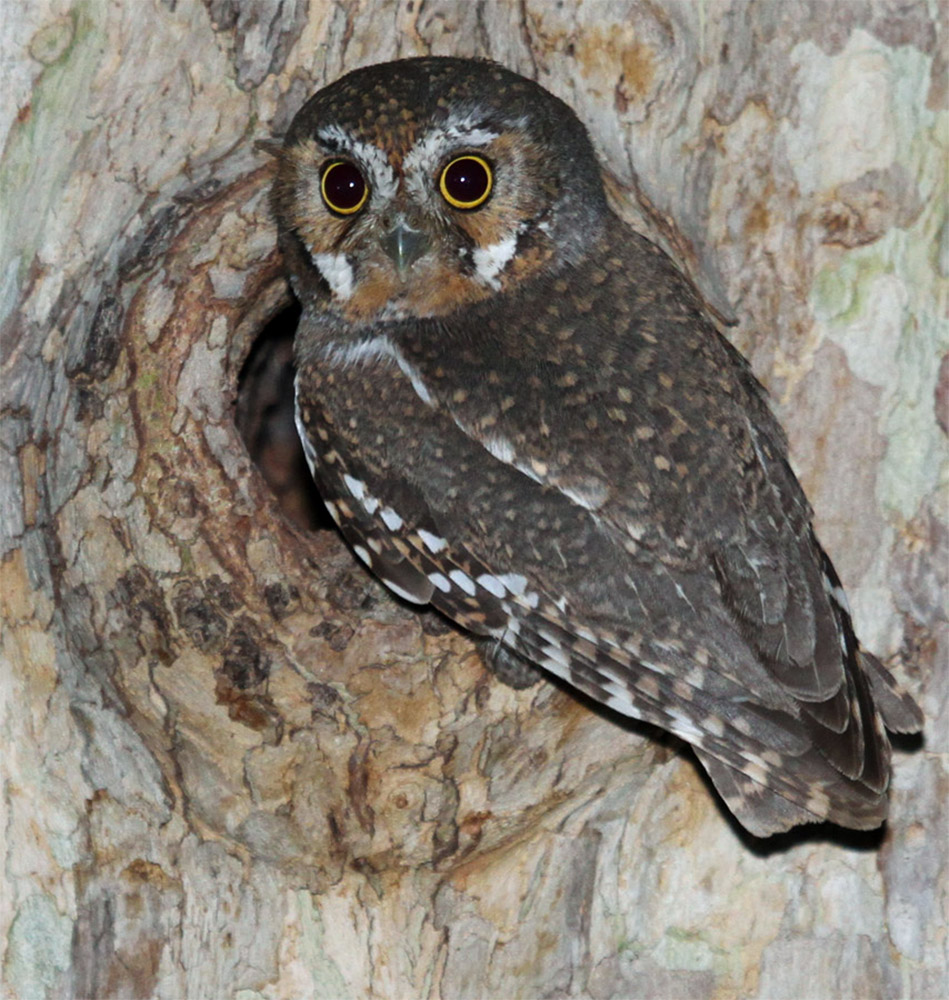
The elf owl (Micrathene whitneyi) is a small grayish-brown owl about the size of a sparrow found in the Southwestern United States, central Mexico, and the Baja California peninsula. It has pale yellow eyes highlighted by thin white "eyebrows" and a gray bill with a horn-colored tip. The elf owl frequently inhabits woodpecker holes in saguaro cacti; it also nests in natural tree cavities. It is nocturnal and feeds primarily on insects.
The elf owl was formally described in 1861 by the American naturalist James Graham Cooper from a specimen collected near Fort Mohave in Arizona. He coined the binomial name Athene whitneyi, choosing the specific epithet to honour the geologist Josiah Whitney. The owl is now the only species placed in the genus Micrathene that was introduced in 1866 specifically for the elf owl by American ornithologist Elliott Coues. The genus name combines the Ancient Greek mikros meaning "small" and the genus name Athene that had been introduced by Friedrich Boie in 1822.
A molecular phylogenetic study of the owls published in 2019 found that the elf owl is a sister species to the South American long-whiskered owlet (Xenoglaux loweryi) that was first described in 1977.
Four subspecies are recognized:
M. w. idonea, the subspecies in southernmost Texas to central Mexico, is resident, as are the isolated M. w. sanfordi of southernmost Baja California and M. w. graysoni (Socorro elf owl) of Socorro Island, southwest from the tip of Baja California. The Socorro elf owl has not been recorded since 1931 and is assumed to be extinct.
The elf owl is the world's smallest and lightest owl, although the long-whiskered owlet and the Tamaulipas pygmy owl are of a similarly diminutive length. The mean body weight of this species is 40 g (1.4 oz). These tiny owls are 12.5 to 14.5 cm (4.9 to 5.7 in) long and have a wingspan of about 27 cm (10.5 in). Their primary projection (flight feather) extends nearly past their tail. They have fairly long legs and often appear bow-legged.
They are often found in chaparral and are easily found during their breeding season. During dusk and just before dawn are the times this owl is most active when they can often be heard calling to one another in a high-pitched whinny or chuckle. These songs often consist of 5–7 notes that repeat in short duration, similar to the sound of a young puppy. The distinctive vocalizations of elf owls vary according to sex, with males exhibiting a wider repertoire of complex notes as opposed to females of the same species. Males have two primary classifications of songs, each of which share similar characteristics of structure and function. Most avian observers refer to "Class A" songs to describe those that vary in length (generally 5–15 notes) and are used as both territorial proclamation and to herald the arrival of males to females in the area. While Class A tones reflect changes in environmental factors – wind, precipitation, moonlight, and temperature – Class B songs have significantly less variation among individuals. Class B functions as the primary mating call, stimulating females and encouraging them to accept male sexual advances. As the season goes on and mating begins, Class A songs are observed with lower frequency than Class B. There is also a handful of locational, so-called "scolding", and territorial songs belonging to both male and female birds of the elf owl species.
The elf owl is known to migrate in large groups, with patterns of migration varying depending on flock and habitat location. Some broods of elf owl migrate to the southwest United States (California, Arizona, New Mexico, and Texas) in the spring and summer for breeding. In the winter, it is found in central and southern Mexico. Migrant elf owls return north in mid-April to early May. Resident populations occur in a couple of places in south central Mexico and along the Baja peninsula.
Elf owl
The elf owl (Micrathene whitneyi) is a small grayish-brown owl about the size of a sparrow found in the Southwestern United States, central Mexico, and the Baja California peninsula. It has pale yellow eyes highlighted by thin white "eyebrows" and a gray bill with a horn-colored tip. The elf owl frequently inhabits woodpecker holes in saguaro cacti; it also nests in natural tree cavities. It is nocturnal and feeds primarily on insects.
The elf owl was formally described in 1861 by the American naturalist James Graham Cooper from a specimen collected near Fort Mohave in Arizona. He coined the binomial name Athene whitneyi, choosing the specific epithet to honour the geologist Josiah Whitney. The owl is now the only species placed in the genus Micrathene that was introduced in 1866 specifically for the elf owl by American ornithologist Elliott Coues. The genus name combines the Ancient Greek mikros meaning "small" and the genus name Athene that had been introduced by Friedrich Boie in 1822.
A molecular phylogenetic study of the owls published in 2019 found that the elf owl is a sister species to the South American long-whiskered owlet (Xenoglaux loweryi) that was first described in 1977.
Four subspecies are recognized:
M. w. idonea, the subspecies in southernmost Texas to central Mexico, is resident, as are the isolated M. w. sanfordi of southernmost Baja California and M. w. graysoni (Socorro elf owl) of Socorro Island, southwest from the tip of Baja California. The Socorro elf owl has not been recorded since 1931 and is assumed to be extinct.
The elf owl is the world's smallest and lightest owl, although the long-whiskered owlet and the Tamaulipas pygmy owl are of a similarly diminutive length. The mean body weight of this species is 40 g (1.4 oz). These tiny owls are 12.5 to 14.5 cm (4.9 to 5.7 in) long and have a wingspan of about 27 cm (10.5 in). Their primary projection (flight feather) extends nearly past their tail. They have fairly long legs and often appear bow-legged.
They are often found in chaparral and are easily found during their breeding season. During dusk and just before dawn are the times this owl is most active when they can often be heard calling to one another in a high-pitched whinny or chuckle. These songs often consist of 5–7 notes that repeat in short duration, similar to the sound of a young puppy. The distinctive vocalizations of elf owls vary according to sex, with males exhibiting a wider repertoire of complex notes as opposed to females of the same species. Males have two primary classifications of songs, each of which share similar characteristics of structure and function. Most avian observers refer to "Class A" songs to describe those that vary in length (generally 5–15 notes) and are used as both territorial proclamation and to herald the arrival of males to females in the area. While Class A tones reflect changes in environmental factors – wind, precipitation, moonlight, and temperature – Class B songs have significantly less variation among individuals. Class B functions as the primary mating call, stimulating females and encouraging them to accept male sexual advances. As the season goes on and mating begins, Class A songs are observed with lower frequency than Class B. There is also a handful of locational, so-called "scolding", and territorial songs belonging to both male and female birds of the elf owl species.
The elf owl is known to migrate in large groups, with patterns of migration varying depending on flock and habitat location. Some broods of elf owl migrate to the southwest United States (California, Arizona, New Mexico, and Texas) in the spring and summer for breeding. In the winter, it is found in central and southern Mexico. Migrant elf owls return north in mid-April to early May. Resident populations occur in a couple of places in south central Mexico and along the Baja peninsula.
Recent media
Recent media