
Recent from talks
Elias Moadab
Knowledge base stats:
Talk channels stats:
Members stats:
Elias Moadab
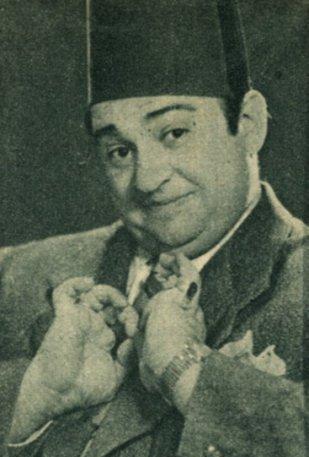
Elias Moadab (6 February 1916 – 28 May 1952) was an Egyptian actor.
Born to a Syrian Jewish father and Egyptian Jewish mother, in the city of Tanta. When he was four years old, the family moved to Cairo and lived in the old Jewish quarter of Cairo. He graduated from the Lycee school in 1932.[citation needed]
At the beginning of his career, he worked in his father's eyewear shop and repaired watches, but he soon moved into the world of entertainment and in 1944 began using the stage name Elias Moadev and began his artistic career as a singer in the famous nightclub «Elborg» where he was introduced to Bishara Wakim and Ismail Yasin, they opened the doors for him to work in the films.
Moadab made his film debut in 1947, including Habib al-Omr (Lifelong Lover) and Sittat Afirit (Women Are Fairies). He quickly became a fixture in Egyptian comedy cinema, performing in approximately 20–25 films over five years, often alongside heavyweights like Ismail Yassin, Leila Mourad, Samia Gamal, Tahiya Karioka, Shadia, and Anwar Wagd.[citation needed]
Moadb often played comic characters who spoke with a Shami accent, to the point that many believed he was Syrian or Lebanese, when in fact he was a native Egyptian who lived on Firah Street (Chicken Street) in the Jewish Quarter (Haret al-Yahud).[citation needed]
In addition to his work in film, he also appeared at several prestigious nightclubs, including "Al-Ariozna" and "Helmiyya Palace." He also made a living by performing at private events such as weddings and bar mitzvahs, for which he received high salaries.
After 1948, despite pressure from Zionist organizations to emigrate to Israel, he insisted: "Egypt is my homeland; here I was born and here I shall be buried." However, he steadfastly practiced Jewish rituals.[citation needed]
Suffered chronic headaches in later years, and tragically died during surgery to remove a brain tumor—just shy of his 36th birthday. Left behind a lasting cinematic legacy and was posthumously commemorated in festivals such as the Luxor Egyptian and European Film Festival as a key figure of Egyptian cinema's golden age.
Hub AI
Elias Moadab AI simulator
(@Elias Moadab_simulator)
Elias Moadab
Elias Moadab (6 February 1916 – 28 May 1952) was an Egyptian actor.
Born to a Syrian Jewish father and Egyptian Jewish mother, in the city of Tanta. When he was four years old, the family moved to Cairo and lived in the old Jewish quarter of Cairo. He graduated from the Lycee school in 1932.[citation needed]
At the beginning of his career, he worked in his father's eyewear shop and repaired watches, but he soon moved into the world of entertainment and in 1944 began using the stage name Elias Moadev and began his artistic career as a singer in the famous nightclub «Elborg» where he was introduced to Bishara Wakim and Ismail Yasin, they opened the doors for him to work in the films.
Moadab made his film debut in 1947, including Habib al-Omr (Lifelong Lover) and Sittat Afirit (Women Are Fairies). He quickly became a fixture in Egyptian comedy cinema, performing in approximately 20–25 films over five years, often alongside heavyweights like Ismail Yassin, Leila Mourad, Samia Gamal, Tahiya Karioka, Shadia, and Anwar Wagd.[citation needed]
Moadb often played comic characters who spoke with a Shami accent, to the point that many believed he was Syrian or Lebanese, when in fact he was a native Egyptian who lived on Firah Street (Chicken Street) in the Jewish Quarter (Haret al-Yahud).[citation needed]
In addition to his work in film, he also appeared at several prestigious nightclubs, including "Al-Ariozna" and "Helmiyya Palace." He also made a living by performing at private events such as weddings and bar mitzvahs, for which he received high salaries.
After 1948, despite pressure from Zionist organizations to emigrate to Israel, he insisted: "Egypt is my homeland; here I was born and here I shall be buried." However, he steadfastly practiced Jewish rituals.[citation needed]
Suffered chronic headaches in later years, and tragically died during surgery to remove a brain tumor—just shy of his 36th birthday. Left behind a lasting cinematic legacy and was posthumously commemorated in festivals such as the Luxor Egyptian and European Film Festival as a key figure of Egyptian cinema's golden age.
Recent media