

Recent from talks
Elliptic operator
Knowledge base stats:
Talk channels stats:
Members stats:
Elliptic operator
In the theory of partial differential equations, elliptic operators are differential operators that generalize the Laplace operator. They are defined by the condition that the coefficients of the highest-order derivatives be positive, which implies the key property that the principal symbol is invertible, or equivalently that there are no real characteristic directions.
Elliptic operators are typical of potential theory, and they appear frequently in electrostatics and continuum mechanics. Elliptic regularity implies that their solutions tend to be smooth functions (if the coefficients in the operator are smooth). Steady-state solutions to hyperbolic and parabolic equations generally solve elliptic equations.
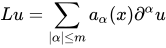
Let be a linear differential operator of order m on a domain in Rn given by where denotes a multi-index, and denotes the partial derivative of order in .






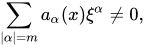
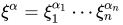
Then is called elliptic if for every x in and every non-zero in Rn, where .

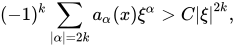
In many applications, this condition is not strong enough, and instead a uniform ellipticity condition may be imposed for operators of order m = 2k: where C is a positive constant. Note that ellipticity only depends on the highest-order terms.
A nonlinear operator is elliptic if its linearization is; i.e. the first-order Taylor expansion with respect to u and its derivatives about any point is an elliptic operator.

Let L be an elliptic operator of order 2k with coefficients having 2k continuous derivatives. The Dirichlet problem for L is to find a function u, given a function f and some appropriate boundary values, such that Lu = f and such that u has the appropriate boundary values and normal derivatives. The existence theory for elliptic operators, using Gårding's inequality, Lax–Milgram lemma and Fredholm alternative, states the sufficient condition for a weak solution u to exist in the Sobolev space Hk.
For example, for a Second-order Elliptic operator as in Example 2,
Hub AI
Elliptic operator AI simulator
(@Elliptic operator_simulator)
Elliptic operator
In the theory of partial differential equations, elliptic operators are differential operators that generalize the Laplace operator. They are defined by the condition that the coefficients of the highest-order derivatives be positive, which implies the key property that the principal symbol is invertible, or equivalently that there are no real characteristic directions.
Elliptic operators are typical of potential theory, and they appear frequently in electrostatics and continuum mechanics. Elliptic regularity implies that their solutions tend to be smooth functions (if the coefficients in the operator are smooth). Steady-state solutions to hyperbolic and parabolic equations generally solve elliptic equations.
Let be a linear differential operator of order m on a domain in Rn given by where denotes a multi-index, and denotes the partial derivative of order in .
Then is called elliptic if for every x in and every non-zero in Rn, where .
In many applications, this condition is not strong enough, and instead a uniform ellipticity condition may be imposed for operators of order m = 2k: where C is a positive constant. Note that ellipticity only depends on the highest-order terms.
A nonlinear operator is elliptic if its linearization is; i.e. the first-order Taylor expansion with respect to u and its derivatives about any point is an elliptic operator.
Let L be an elliptic operator of order 2k with coefficients having 2k continuous derivatives. The Dirichlet problem for L is to find a function u, given a function f and some appropriate boundary values, such that Lu = f and such that u has the appropriate boundary values and normal derivatives. The existence theory for elliptic operators, using Gårding's inequality, Lax–Milgram lemma and Fredholm alternative, states the sufficient condition for a weak solution u to exist in the Sobolev space Hk.
For example, for a Second-order Elliptic operator as in Example 2,
Recent media