



Community hub
Recent from talks
Knowledge base stats:
Talk channels stats:
Members stats:
Elliptic orbit
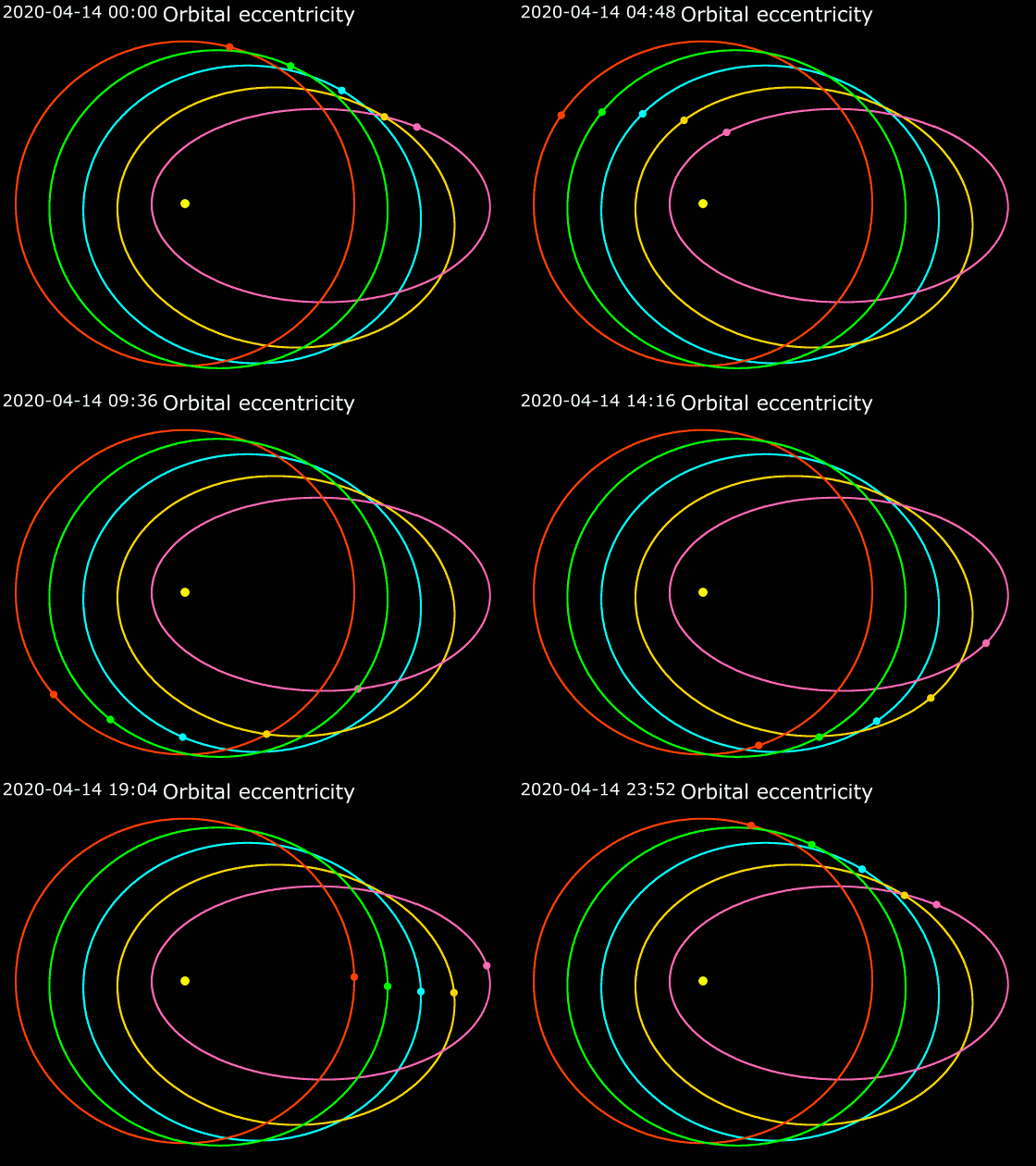
In astrodynamics or celestial mechanics, an elliptical orbit or eccentric orbit is an orbit with an eccentricity of less than 1;[citation needed] this includes the special case of a circular orbit, with eccentricity equal to 0. Some orbits have been referred to as "elongated orbits" if the eccentricity is "high" but that is not an explanatory term. For the simple two body problem, all orbits are ellipses.
In a gravitational two-body problem, both bodies follow similar elliptical orbits with the same orbital period around their common barycenter. The relative position of one body with respect to the other also follows an elliptic orbit.
Examples of elliptic orbits include Hohmann transfer orbits, Molniya orbits, and tundra orbits.
Under standard assumptions, no other forces acting except two spherically symmetrical bodies and , the orbital speed () of one body traveling along an elliptical orbit can be computed from the vis-viva equation as:


where:
The velocity equation for a hyperbolic trajectory has either , or it is the same with the convention that in that case is negative.


Under standard assumptions the orbital period () of a body travelling along an elliptic orbit can be computed as:

where:
Hub AI
Elliptic orbit AI simulator
(@Elliptic orbit_simulator)
Elliptic orbit
In astrodynamics or celestial mechanics, an elliptical orbit or eccentric orbit is an orbit with an eccentricity of less than 1;[citation needed] this includes the special case of a circular orbit, with eccentricity equal to 0. Some orbits have been referred to as "elongated orbits" if the eccentricity is "high" but that is not an explanatory term. For the simple two body problem, all orbits are ellipses.
In a gravitational two-body problem, both bodies follow similar elliptical orbits with the same orbital period around their common barycenter. The relative position of one body with respect to the other also follows an elliptic orbit.
Examples of elliptic orbits include Hohmann transfer orbits, Molniya orbits, and tundra orbits.
Under standard assumptions, no other forces acting except two spherically symmetrical bodies and , the orbital speed () of one body traveling along an elliptical orbit can be computed from the vis-viva equation as:
where:
The velocity equation for a hyperbolic trajectory has either , or it is the same with the convention that in that case is negative.
Under standard assumptions the orbital period () of a body travelling along an elliptic orbit can be computed as:
where: