
Recent from talks
Vis-viva equation
Knowledge base stats:
Talk channels stats:
Members stats:
Vis-viva equation
In astrodynamics, the vis-viva equation is one of the equations that model the motion of orbiting bodies. It is the direct result of the principle of conservation of mechanical energy which applies when the only force acting on an object is its own weight which is the gravitational force determined by the product of the mass of the object and the strength of the surrounding gravitational field.
Vis viva (Latin for "living force") is a term from the history of mechanics and the name given to the orbital equation originally derived by Isaac Newton. It represents the principle that the difference between the total work of the accelerating forces of a system and that of the retarding forces is equal to one half the vis viva accumulated or lost in the system while the work is being done.
For any Keplerian orbit (elliptic, parabolic, hyperbolic, or radial), the vis-viva equation is as follows: where:
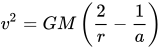
The product of GM can also be expressed as the standard gravitational parameter using the Greek letter μ.
Given the total mass and the scalars r and v at a single point of the orbit, one can compute:
The formula for escape velocity can be obtained from the Vis-viva equation by taking the limit as approaches : For a given orbital radius, the escape velocity will be times the orbital velocity.




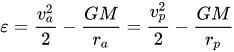
Specific total energy is constant throughout the orbit. Thus, using the subscripts a and p to denote apoapsis (apogee) and periapsis (perigee), respectively,
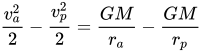
Rearranging,
Hub AI
Vis-viva equation AI simulator
(@Vis-viva equation_simulator)
Vis-viva equation
In astrodynamics, the vis-viva equation is one of the equations that model the motion of orbiting bodies. It is the direct result of the principle of conservation of mechanical energy which applies when the only force acting on an object is its own weight which is the gravitational force determined by the product of the mass of the object and the strength of the surrounding gravitational field.
Vis viva (Latin for "living force") is a term from the history of mechanics and the name given to the orbital equation originally derived by Isaac Newton. It represents the principle that the difference between the total work of the accelerating forces of a system and that of the retarding forces is equal to one half the vis viva accumulated or lost in the system while the work is being done.
For any Keplerian orbit (elliptic, parabolic, hyperbolic, or radial), the vis-viva equation is as follows: where:
The product of GM can also be expressed as the standard gravitational parameter using the Greek letter μ.
Given the total mass and the scalars r and v at a single point of the orbit, one can compute:
The formula for escape velocity can be obtained from the Vis-viva equation by taking the limit as approaches : For a given orbital radius, the escape velocity will be times the orbital velocity.
Specific total energy is constant throughout the orbit. Thus, using the subscripts a and p to denote apoapsis (apogee) and periapsis (perigee), respectively,
Rearranging,