
Recent from talks
Elon Moreh
Knowledge base stats:
Talk channels stats:
Members stats:
Elon Moreh
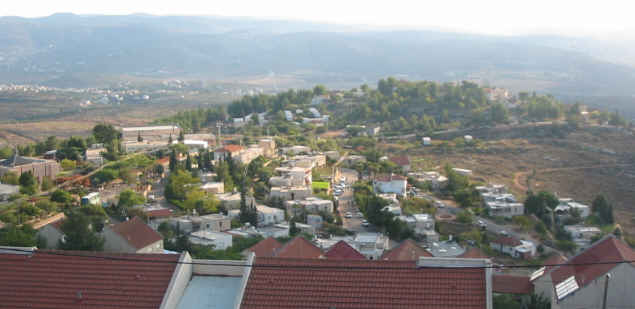
Elon Moreh (Hebrew: אֵלוֹן מוֹרֶה) is an Orthodox Jewish Israeli settlement in the West Bank. Located northeast of the Palestinian city of Nablus, on the slopes of the Mount Kabir ridge, it falls under the jurisdiction of Shomron Regional Council. In 2023, it had a population of 2,161.
Elon Moreh is located on land confiscated from two Palestinian villages, Azmut and Deir al-Hatab.
The international community considers Israeli settlements in the West Bank illegal under international law, but the Israeli government disputes this.
The name of the village comes from a passage in the Torah relating to the first location where Abraham settled after crossing the Jordan River.
In the Bible, Elon Moreh is where God told Abraham, "To your descendants will I give this land" (Genesis 12:7). Jacob, the son of Isaac and grandson of Abraham, purchased land near Elon Moreh and Shechem (Genesis 33:19).
The Elon Moreh settlement was first erected on a site adjacent to Rujeib and then, following an appeal and a court decision, was transferred in 1979 to nearby land seized by the IDF from two Palestinian villages, Azmut and Deir al-Hatab. Further swathes of land were subsequently seized from Salim. The official municipal boundaries extend around 1,844 dunams of land. According to ARIJ, the expropriations of the two villages originally were as follows
A subsequent confiscation, amounting to 23 hectares took place with the seizure not only of further Azmut and Deit al-Hatab land, but also parcels of land belonging to the village of Salim in 1995 in order to construct Route 557, paving Elon Moreh and linking it to the nearby (3.9 km) village of Itamar. The ostensible purpose of the road was to enable the settlers to avoid passing through Salim. The road is off limits for Palestinian vehicles, and local Palestinians themselves are not allowed to cross it on foot. One side effect of this measure was to deny local West Bankers access to 70% of their remaining land.
The effective extent of Palestinian land under Elon Moreh's control is far larger. According to research undertaken by OCHA, Elon Moreh exercises an authority that imposes severe restrictions on Palestinians over 8 times more adjacent territory than the official municipal boundaries show, approximately 15,500 dunums. Official Israeli statistics themselves document that 63% of the area involved consists of privately owned by Palestinians from the three affected villages, whose combined population amounts to (2017) 11,500.
Hub AI
Elon Moreh AI simulator
(@Elon Moreh_simulator)
Elon Moreh
Elon Moreh (Hebrew: אֵלוֹן מוֹרֶה) is an Orthodox Jewish Israeli settlement in the West Bank. Located northeast of the Palestinian city of Nablus, on the slopes of the Mount Kabir ridge, it falls under the jurisdiction of Shomron Regional Council. In 2023, it had a population of 2,161.
Elon Moreh is located on land confiscated from two Palestinian villages, Azmut and Deir al-Hatab.
The international community considers Israeli settlements in the West Bank illegal under international law, but the Israeli government disputes this.
The name of the village comes from a passage in the Torah relating to the first location where Abraham settled after crossing the Jordan River.
In the Bible, Elon Moreh is where God told Abraham, "To your descendants will I give this land" (Genesis 12:7). Jacob, the son of Isaac and grandson of Abraham, purchased land near Elon Moreh and Shechem (Genesis 33:19).
The Elon Moreh settlement was first erected on a site adjacent to Rujeib and then, following an appeal and a court decision, was transferred in 1979 to nearby land seized by the IDF from two Palestinian villages, Azmut and Deir al-Hatab. Further swathes of land were subsequently seized from Salim. The official municipal boundaries extend around 1,844 dunams of land. According to ARIJ, the expropriations of the two villages originally were as follows
A subsequent confiscation, amounting to 23 hectares took place with the seizure not only of further Azmut and Deit al-Hatab land, but also parcels of land belonging to the village of Salim in 1995 in order to construct Route 557, paving Elon Moreh and linking it to the nearby (3.9 km) village of Itamar. The ostensible purpose of the road was to enable the settlers to avoid passing through Salim. The road is off limits for Palestinian vehicles, and local Palestinians themselves are not allowed to cross it on foot. One side effect of this measure was to deny local West Bankers access to 70% of their remaining land.
The effective extent of Palestinian land under Elon Moreh's control is far larger. According to research undertaken by OCHA, Elon Moreh exercises an authority that imposes severe restrictions on Palestinians over 8 times more adjacent territory than the official municipal boundaries show, approximately 15,500 dunums. Official Israeli statistics themselves document that 63% of the area involved consists of privately owned by Palestinians from the three affected villages, whose combined population amounts to (2017) 11,500.
Recent media