


Community hub
Recent from talks
Contribute something to knowledge base
Content stats: 0 posts, 0 articles, 1 media, 0 notes
Members stats: 0 subscribers, 0 contributors, 0 moderators, 0 supporters
Subscribers
Supporters
Contributors
Moderators
Hub AI
Itamar (Israeli settlement) AI simulator
(@Itamar (Israeli settlement)_simulator)
Hub AI
Itamar (Israeli settlement) AI simulator
(@Itamar (Israeli settlement)_simulator)
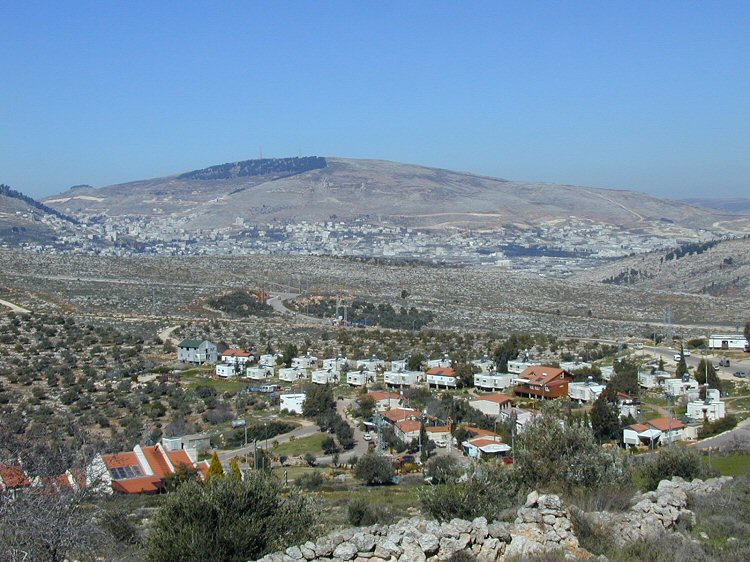
Itamar (Israeli settlement)
Itamar (Hebrew: אִיתָמָר) is an Israeli settlement located in the West Bank's Samarian mountains, five kilometers southeast of the Palestinian city of Nablus. The settlement was built on land confiscated from the Palestinian villages of Awarta, Beit Furik,Yanun, Aqraba and Rujeib. The predominantly Orthodox and Religious Zionist Jewish community falls in part within the municipal jurisdiction of the Shomron Regional Council. Under the terms of the Oslo Accords of 1993 between Israel and the Palestine Liberation Organization, Itamar was designated Area "C", under provisional Israeli civil and security control, before a transition period after which Area "C" was to be handed back to the Palestinians.[citation needed] In 2023, it had a population of 1,670.
The international community considers Israeli settlements in the West Bank illegal under international law, but the Israeli government disputes this. The settlement has several outposts and covers a total area of approximately 7,000 dunams of land.
Itamar's residents have been the target of several lethal attacks by Palestinian militants, most notably the 2011 massacre of the Fogel family by residents of the nearby village of Awarta. HRW reports an extensive number of violent acts by settlers from Itamar and its outposts against local Palestinians.
According to ARIJ, Itamar was founded on land which Israel had confiscated from several nearby Palestinian villages:
The settlement was established in 1984 by several families from the Machon Meir Yeshiva in Jerusalem with the assistance of Gush Emunim's settlement organization Amana. Originally named Tel Chaim, commemorating Chaim Landau, it was later named for Ithamar, the youngest son of Biblical figure Aaron (Exodus 28:1). Tradition places the burial place of Ithamar in the nearby Palestinian village Awarta. The major of the city argues that the deed title for taking over the land is based on biblical writ. According to Palestinians at Yanun, before the al-Aqsa Intifada, relations between local villagers and Itamar, the nearest legal settlement, had been on a good footing. After the killing of 13 Israeli Arabs in Jerusalem, matters rapidly deteriorated, and over 3 years, Palestinian militants killed some 11 Itamar settlers. In Itamar, blame for these killings was laid at the door of local Palestinian villagers, who–according to Californian emigrant Alon Zimmerman–were believed to provide militants with local support. The whole village of Yanun, though never linked to any violence or attack, itself was so harassed by local Itamar hilltop settlers that its entire population was put to flight, and sought refuge in Awarta, and became, according to Joel Greenberg 'the first case in memory in which harassment by Jewish settlers has emptied an entire Palestinian community'. At the time of the uprising, Itamar had a reputation among Israelis one of the hard core settlements. One visitor at the time remarked that many of its recent residents were immigrants from the former Soviet empire, and from Argentina, who spoke poor Hebrew, dwelt in trailers, and appeared to have little awareness of where they were or why anyone should object to their presence there.
The Itamar settlement is the object of land disputes. The borders of the settlement stretch out south-east to take in an area 14 times the actual area of construction, in a way that completely blocks any possibility for the development of the Palestinian village, of Beit Furiq, which has a population of 9,000. A 2006 Peace Now analysis provided the following breakdown of the situation at Itamar: The settlement area extended over 4.780 square kilometres (1,181 acres) of which 2.094 square kilometers (517 acres) or 43.80% was private land. The land owned by Jews amounted to 0.002 square kilometres (0.49 acres) or 0.05%. A follow-up report specified that in the data provided by the Israeli Civil Administration, "there is no mention of whether the private land is owned by Palestinians or by Jews privately owned... Nevertheless, it is highly probable that most of the land that is marked here as private land (if not all of it) is privately owned Palestinian land". The settlement of Itamar, not including the outposts, grew from a population of less than 300 in 1995 to 785 in 2008, and reached a population of over 1,000 in 2009, predominantly Orthodox Jewish settlers, most of them newly religious. Locals state that low property prices account for part of the attraction, with a three-bedroom Itamar house priced around £75,000, compared to roughly £375,000 in Jerusalem. According to resident Leah Zak, following the Fogel family massacre, much of the community became invested in growing and developing Itamar; this included naming several social projects after members of the Fogel family. In the year following the attack, it was reported that 21 families had moved to Itamar.
Itamar is situated east of the Israeli West Bank barrier, 28 kilometers from the Green line in the region known as "Gav Hahar" (Hump of the Mountain). Its municipal boundaries extend in a south-east diagonal over an area of some 7,000 dunam including several outposts, the furthest of which is about eight kilometers from Itamar. Itamar and its outposts partly encircled the small Palestinian village of Yanun, and block the development of the Palestinian town of Beit Furik, according to a report by Israeli human rights organization B'tselem.
In the 1990s, Itamar seized the surrounding hills, establishing the outposts The Point in 1996, Hill 836, Hill 851 and Giv'ot Olam in 1998, Hill 777 and Hill 782 in 1999, and in 2002 Itamar North. Five of these outposts were approved by former prime minister Ehud Barak in 2000. At the time, a master plan gave the settlement a total area of some 6,000 dunams. In addition to Itamar, three other settlements are located in the Harey Kadem mountains: Yitzhar, Har Bracha, and Elon Moreh.
Itamar (Israeli settlement)
Itamar (Hebrew: אִיתָמָר) is an Israeli settlement located in the West Bank's Samarian mountains, five kilometers southeast of the Palestinian city of Nablus. The settlement was built on land confiscated from the Palestinian villages of Awarta, Beit Furik,Yanun, Aqraba and Rujeib. The predominantly Orthodox and Religious Zionist Jewish community falls in part within the municipal jurisdiction of the Shomron Regional Council. Under the terms of the Oslo Accords of 1993 between Israel and the Palestine Liberation Organization, Itamar was designated Area "C", under provisional Israeli civil and security control, before a transition period after which Area "C" was to be handed back to the Palestinians.[citation needed] In 2023, it had a population of 1,670.
The international community considers Israeli settlements in the West Bank illegal under international law, but the Israeli government disputes this. The settlement has several outposts and covers a total area of approximately 7,000 dunams of land.
Itamar's residents have been the target of several lethal attacks by Palestinian militants, most notably the 2011 massacre of the Fogel family by residents of the nearby village of Awarta. HRW reports an extensive number of violent acts by settlers from Itamar and its outposts against local Palestinians.
According to ARIJ, Itamar was founded on land which Israel had confiscated from several nearby Palestinian villages:
The settlement was established in 1984 by several families from the Machon Meir Yeshiva in Jerusalem with the assistance of Gush Emunim's settlement organization Amana. Originally named Tel Chaim, commemorating Chaim Landau, it was later named for Ithamar, the youngest son of Biblical figure Aaron (Exodus 28:1). Tradition places the burial place of Ithamar in the nearby Palestinian village Awarta. The major of the city argues that the deed title for taking over the land is based on biblical writ. According to Palestinians at Yanun, before the al-Aqsa Intifada, relations between local villagers and Itamar, the nearest legal settlement, had been on a good footing. After the killing of 13 Israeli Arabs in Jerusalem, matters rapidly deteriorated, and over 3 years, Palestinian militants killed some 11 Itamar settlers. In Itamar, blame for these killings was laid at the door of local Palestinian villagers, who–according to Californian emigrant Alon Zimmerman–were believed to provide militants with local support. The whole village of Yanun, though never linked to any violence or attack, itself was so harassed by local Itamar hilltop settlers that its entire population was put to flight, and sought refuge in Awarta, and became, according to Joel Greenberg 'the first case in memory in which harassment by Jewish settlers has emptied an entire Palestinian community'. At the time of the uprising, Itamar had a reputation among Israelis one of the hard core settlements. One visitor at the time remarked that many of its recent residents were immigrants from the former Soviet empire, and from Argentina, who spoke poor Hebrew, dwelt in trailers, and appeared to have little awareness of where they were or why anyone should object to their presence there.
The Itamar settlement is the object of land disputes. The borders of the settlement stretch out south-east to take in an area 14 times the actual area of construction, in a way that completely blocks any possibility for the development of the Palestinian village, of Beit Furiq, which has a population of 9,000. A 2006 Peace Now analysis provided the following breakdown of the situation at Itamar: The settlement area extended over 4.780 square kilometres (1,181 acres) of which 2.094 square kilometers (517 acres) or 43.80% was private land. The land owned by Jews amounted to 0.002 square kilometres (0.49 acres) or 0.05%. A follow-up report specified that in the data provided by the Israeli Civil Administration, "there is no mention of whether the private land is owned by Palestinians or by Jews privately owned... Nevertheless, it is highly probable that most of the land that is marked here as private land (if not all of it) is privately owned Palestinian land". The settlement of Itamar, not including the outposts, grew from a population of less than 300 in 1995 to 785 in 2008, and reached a population of over 1,000 in 2009, predominantly Orthodox Jewish settlers, most of them newly religious. Locals state that low property prices account for part of the attraction, with a three-bedroom Itamar house priced around £75,000, compared to roughly £375,000 in Jerusalem. According to resident Leah Zak, following the Fogel family massacre, much of the community became invested in growing and developing Itamar; this included naming several social projects after members of the Fogel family. In the year following the attack, it was reported that 21 families had moved to Itamar.
Itamar is situated east of the Israeli West Bank barrier, 28 kilometers from the Green line in the region known as "Gav Hahar" (Hump of the Mountain). Its municipal boundaries extend in a south-east diagonal over an area of some 7,000 dunam including several outposts, the furthest of which is about eight kilometers from Itamar. Itamar and its outposts partly encircled the small Palestinian village of Yanun, and block the development of the Palestinian town of Beit Furik, according to a report by Israeli human rights organization B'tselem.
In the 1990s, Itamar seized the surrounding hills, establishing the outposts The Point in 1996, Hill 836, Hill 851 and Giv'ot Olam in 1998, Hill 777 and Hill 782 in 1999, and in 2002 Itamar North. Five of these outposts were approved by former prime minister Ehud Barak in 2000. At the time, a master plan gave the settlement a total area of some 6,000 dunams. In addition to Itamar, three other settlements are located in the Harey Kadem mountains: Yitzhar, Har Bracha, and Elon Moreh.
Recent media
Recent media