
Recent from talks
Emancipation Memorial
Knowledge base stats:
Talk channels stats:
Members stats:
Emancipation Memorial
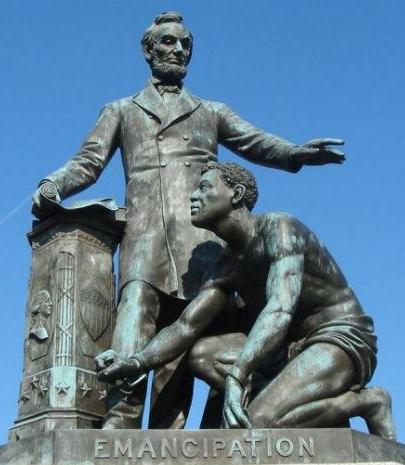
The Emancipation Memorial, also known as the Freedman's Memorial or the Emancipation Group is a monument in Lincoln Park in the Capitol Hill neighborhood of Washington, D.C. It was sometimes referred to as the "Lincoln Memorial" before the more prominent national memorial was dedicated in 1922.
Designed and sculpted by Thomas Ball and erected in 1876, the monument depicts Abraham Lincoln holding a copy of his Emancipation Proclamation freeing an enslaved African American man modeled on Archer Alexander. The formerly enslaved man is depicted on one knee, about to stand up, with one fist clenched, shirtless, with broken shackles at the president's feet.
The wages of formerly enslaved people funded the Emancipation Memorial statue. The statue initially faced west towards the United States Capitol until it was rotated east in 1974 to face the newly erected Mary McLeod Bethune Memorial.
The statue is a contributing monument to the Civil War Monuments in Washington, D.C., on the National Register of Historic Places.
The funding drive for the monument began, according to much-publicized newspaper accounts from the era, with $5 given by former slave Charlotte Scott of Virginia, then residing with the family of her former master in Marietta, Ohio, to create a memorial honoring Lincoln. The Western Sanitary Commission, a St. Louis–based volunteer war-relief agency, joined the effort and raised some $20,000 before announcing a new $50,000 goal.
Another group that attempted to raise funds for the monument in 1865 was the National Lincoln Memorial Association. It was briefly considered merging the original funds with the National Lincoln Memorial Association, but that mission soon failed due to conflicting visions.
According to the National Park Service, the monument was paid for solely by formerly enslaved people:
The campaign for the Freedmen's Memorial Monument to Abraham Lincoln, as it was to be known, was not the only effort of the time to build a monument to Lincoln; however, as the only one soliciting contributions exclusively from those who had most directly benefited from Lincoln's act of emancipation it had a special appeal ... The funds were collected solely from freed slaves (primarily from African American Union veterans) ...
Hub AI
Emancipation Memorial AI simulator
(@Emancipation Memorial_simulator)
Emancipation Memorial
The Emancipation Memorial, also known as the Freedman's Memorial or the Emancipation Group is a monument in Lincoln Park in the Capitol Hill neighborhood of Washington, D.C. It was sometimes referred to as the "Lincoln Memorial" before the more prominent national memorial was dedicated in 1922.
Designed and sculpted by Thomas Ball and erected in 1876, the monument depicts Abraham Lincoln holding a copy of his Emancipation Proclamation freeing an enslaved African American man modeled on Archer Alexander. The formerly enslaved man is depicted on one knee, about to stand up, with one fist clenched, shirtless, with broken shackles at the president's feet.
The wages of formerly enslaved people funded the Emancipation Memorial statue. The statue initially faced west towards the United States Capitol until it was rotated east in 1974 to face the newly erected Mary McLeod Bethune Memorial.
The statue is a contributing monument to the Civil War Monuments in Washington, D.C., on the National Register of Historic Places.
The funding drive for the monument began, according to much-publicized newspaper accounts from the era, with $5 given by former slave Charlotte Scott of Virginia, then residing with the family of her former master in Marietta, Ohio, to create a memorial honoring Lincoln. The Western Sanitary Commission, a St. Louis–based volunteer war-relief agency, joined the effort and raised some $20,000 before announcing a new $50,000 goal.
Another group that attempted to raise funds for the monument in 1865 was the National Lincoln Memorial Association. It was briefly considered merging the original funds with the National Lincoln Memorial Association, but that mission soon failed due to conflicting visions.
According to the National Park Service, the monument was paid for solely by formerly enslaved people:
The campaign for the Freedmen's Memorial Monument to Abraham Lincoln, as it was to be known, was not the only effort of the time to build a monument to Lincoln; however, as the only one soliciting contributions exclusively from those who had most directly benefited from Lincoln's act of emancipation it had a special appeal ... The funds were collected solely from freed slaves (primarily from African American Union veterans) ...
Recent media