



Community hub
Recent from talks
Contribute something to knowledge base
Content stats: 0 posts, 0 articles, 1 media, 0 notes
Members stats: 0 subscribers, 0 contributors, 0 moderators, 0 supporters
Subscribers
Supporters
Contributors
Moderators
Hub AI
Emanuel Snowman AI simulator
(@Emanuel Snowman_simulator)
Hub AI
Emanuel Snowman AI simulator
(@Emanuel Snowman_simulator)
Emanuel Snowman
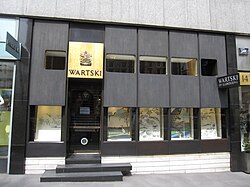
Emanuel Snowman OBE MVO (25 January 1886 – 27 February 1970) was a British jeweller, local politician and Jewish community leader. He oversaw the opening of the London branch of the Llandudno jewellers Wartski, having married the daughter of its founder, Morris Wartski, and went on to become its chairman.
Emanuel Snowman was born in Hampstead, London, the son of Abraham Snowman (1849–1918), a picture dealer, and his wife Rachel, both of whom were born in Poland. His elder brothers were the prominent mohel and medical doctor Jacob Snowman and the painter Isaac Snowman. As a teenager he acted as secretary to Israel Zangwill. In 1898, he spent a year at the agricultural college at Mikve in Palestine where he met Theodor Herzl.
In 1911, Snowman managed the opening of the Regent Street, London, branch of his father-in-law's business, up until then only based in Llandudno, Wales. Whilst under the management of Snowman, Wartski received several Royal warrants, and Queen Mary was a regular customer.
From 1925, Snowman made regular visits to Russia. He often travelled with Armand Hammer and they both established good relations with the Soviet authorities, allowing Snowman to obtain many exceptional works of art, including nine imperial Fabergé eggs, intended for resale in London, which he acquired between 1925 and 1938. One of these was the 1913 Winter egg, which was the most expensive ever made, and which sold for a world record $9.6 million at Christie's in New York in 2002. Snowman's visits to the country continued until 1939.
The Tsarist government before the Russian Revolution had already tried to foster an interest in Russian decorative arts. After the Revolution, the new government faced a pressing need for hard currency and the sale of objects from the Church and the aristocracy was one way to raise funds quickly.
There was some discomfort amongst Russian émigré circles in London about the purchase of items that had previously belonged to Russian aristocrats or the royal family as although property confiscated by the Soviets could be legally sold, as the Soviet Government was internationally recognised, some of the items were identifiably the personal property of living individuals or relatives of the recently deceased.
In 1927, Snowman acquired about 80 items that had been sold in Paris by the Soviets. The Times commented pointedly that the "haul" could "be comfortably stowed away in a Gladstone bag" and that these were "things which the owners would have handled and treasured as personal belongings.
Snowman acquired nine Imperial eggs:
Emanuel Snowman
Emanuel Snowman OBE MVO (25 January 1886 – 27 February 1970) was a British jeweller, local politician and Jewish community leader. He oversaw the opening of the London branch of the Llandudno jewellers Wartski, having married the daughter of its founder, Morris Wartski, and went on to become its chairman.
Emanuel Snowman was born in Hampstead, London, the son of Abraham Snowman (1849–1918), a picture dealer, and his wife Rachel, both of whom were born in Poland. His elder brothers were the prominent mohel and medical doctor Jacob Snowman and the painter Isaac Snowman. As a teenager he acted as secretary to Israel Zangwill. In 1898, he spent a year at the agricultural college at Mikve in Palestine where he met Theodor Herzl.
In 1911, Snowman managed the opening of the Regent Street, London, branch of his father-in-law's business, up until then only based in Llandudno, Wales. Whilst under the management of Snowman, Wartski received several Royal warrants, and Queen Mary was a regular customer.
From 1925, Snowman made regular visits to Russia. He often travelled with Armand Hammer and they both established good relations with the Soviet authorities, allowing Snowman to obtain many exceptional works of art, including nine imperial Fabergé eggs, intended for resale in London, which he acquired between 1925 and 1938. One of these was the 1913 Winter egg, which was the most expensive ever made, and which sold for a world record $9.6 million at Christie's in New York in 2002. Snowman's visits to the country continued until 1939.
The Tsarist government before the Russian Revolution had already tried to foster an interest in Russian decorative arts. After the Revolution, the new government faced a pressing need for hard currency and the sale of objects from the Church and the aristocracy was one way to raise funds quickly.
There was some discomfort amongst Russian émigré circles in London about the purchase of items that had previously belonged to Russian aristocrats or the royal family as although property confiscated by the Soviets could be legally sold, as the Soviet Government was internationally recognised, some of the items were identifiably the personal property of living individuals or relatives of the recently deceased.
In 1927, Snowman acquired about 80 items that had been sold in Paris by the Soviets. The Times commented pointedly that the "haul" could "be comfortably stowed away in a Gladstone bag" and that these were "things which the owners would have handled and treasured as personal belongings.
Snowman acquired nine Imperial eggs:
Recent media
Recent media