



Community hub
Recent from talks
Knowledge base stats:
Talk channels stats:
Members stats:
Enamelled glass
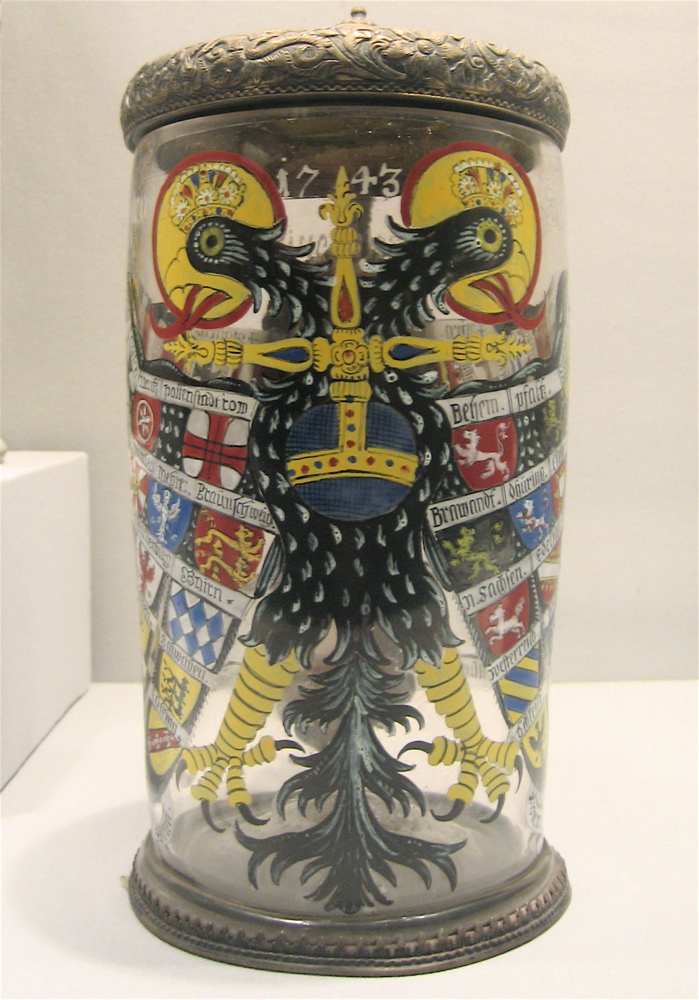
Enamelled glass or painted glass is glass which has been decorated with vitreous enamel (powdered glass, usually mixed with a binder) and then fired to fuse the glasses. It can produce brilliant and long-lasting colours, and be translucent or opaque. Unlike most methods of decorating glass, it allows painting using several colours, and along with glass engraving, has historically been the main technique used to create the full range of image types on glass.
All proper uses of the term "enamel" refer to glass made into some flexible form, put into place on an object in another material, and then melted by heat to fuse them with the object. It is called vitreous enamel or just "enamel" when used on metal surfaces, and "enamelled" overglaze decoration when on pottery, especially on porcelain. Here the supporting surface is glass. All three versions of the technique have been used to make brush-painted images, which on glass and pottery are the normal use of the technique.
Enamelled glass is only one of the techniques used in luxury glass, and at least until the Early Modern period it appears in each of the leading centres of this extravagant branch of the decorative arts, although it has tended to fall from fashion after two centuries or so. After a brief appearance in ancient Egypt, it was first made in any quantity in various Greco-Roman centres under the Roman Empire, then medieval Egypt and Syria, followed by medieval Venice, from where it spread across Europe, but especially to the Holy Roman Empire. After a decline from the mid-18th century, in the late 19th century it was revived in newer styles, led by French glassmakers. Enamel on metal remained a constant in goldsmithing and jewellery, and though enamelled glass seems to virtually disappear at some points, this perhaps helped the technique to revive quickly when a suitable environment arrived.
It has also been a technique used in stained glass windows, in most periods supplementary to other techniques, and has sometimes been used for portrait miniatures and other paintings on flat glass.
Glass is enamelled by mixing powdered glass, either already coloured (more usual) or clear glass mixed with the pigments, with a binder such as gum arabic that gives a thick liquid texture allowing it to be painted with brushes. Generally the desired colours only appear when the piece is fired, adding to the artist's difficulties. As with enamel on metal, gum tragacanth may be used to make sharp boundaries to the painted areas. The paint is applied to the vessel, which has already been fully formed; this is called the "blank" . Once painted, the enamelled glass vessel needs to be fired at a temperature high enough to melt the applied powder, but low enough that the vessel itself is only "softened" sufficiently to fuse the enamel with the glass surface, but not enough to deform or melt the original shape (unless this is desired, as it may be). The binding and demarcating substances burn away.
Until recent centuries the enamel firing was done holding the vessel in a furnace on a pontil (long iron rod), with the glassmaker paying careful attention to any changes in the shape. Many pieces show two pontil marks on the base, where the pontil intruded on the glass, showing it had been on the furnace twice, before and after the enamels were applied. Modern techniques, in use since the 19th century, use enamels with a lower melting point, enabling the second firing to be done more conveniently in a kiln.
In fact some glassmakers allowed for a deforming effect in the second firing, which lowered and widened the shape of the vessel, sometimes very greatly, by making blanks that were taller and more narrow than the shape they actually wanted. The enamels leave a layer of glass projecting very slightly over the original surface, the edges of which can be felt by running a finger over the surface. Enamelled glass is often used in combination with gilding, but lustreware, which often produces a "gold" metallic coating is a different process. Sometimes elements of the "blank", such as handles, may only be added after the enamel paints, during the second firing.
Glass is sometimes "cold painted" with enamel paints that are not fired; often this was done on the underside of a bowl, to minimize wear on the painted surface. This was used for some elaborate Venetian pieces in the early 16th century, but the technique is "famously impermanent", and pieces have usually suffered badly from the paint falling off the glass.
Hub AI
Enamelled glass AI simulator
(@Enamelled glass_simulator)
Enamelled glass
Enamelled glass or painted glass is glass which has been decorated with vitreous enamel (powdered glass, usually mixed with a binder) and then fired to fuse the glasses. It can produce brilliant and long-lasting colours, and be translucent or opaque. Unlike most methods of decorating glass, it allows painting using several colours, and along with glass engraving, has historically been the main technique used to create the full range of image types on glass.
All proper uses of the term "enamel" refer to glass made into some flexible form, put into place on an object in another material, and then melted by heat to fuse them with the object. It is called vitreous enamel or just "enamel" when used on metal surfaces, and "enamelled" overglaze decoration when on pottery, especially on porcelain. Here the supporting surface is glass. All three versions of the technique have been used to make brush-painted images, which on glass and pottery are the normal use of the technique.
Enamelled glass is only one of the techniques used in luxury glass, and at least until the Early Modern period it appears in each of the leading centres of this extravagant branch of the decorative arts, although it has tended to fall from fashion after two centuries or so. After a brief appearance in ancient Egypt, it was first made in any quantity in various Greco-Roman centres under the Roman Empire, then medieval Egypt and Syria, followed by medieval Venice, from where it spread across Europe, but especially to the Holy Roman Empire. After a decline from the mid-18th century, in the late 19th century it was revived in newer styles, led by French glassmakers. Enamel on metal remained a constant in goldsmithing and jewellery, and though enamelled glass seems to virtually disappear at some points, this perhaps helped the technique to revive quickly when a suitable environment arrived.
It has also been a technique used in stained glass windows, in most periods supplementary to other techniques, and has sometimes been used for portrait miniatures and other paintings on flat glass.
Glass is enamelled by mixing powdered glass, either already coloured (more usual) or clear glass mixed with the pigments, with a binder such as gum arabic that gives a thick liquid texture allowing it to be painted with brushes. Generally the desired colours only appear when the piece is fired, adding to the artist's difficulties. As with enamel on metal, gum tragacanth may be used to make sharp boundaries to the painted areas. The paint is applied to the vessel, which has already been fully formed; this is called the "blank" . Once painted, the enamelled glass vessel needs to be fired at a temperature high enough to melt the applied powder, but low enough that the vessel itself is only "softened" sufficiently to fuse the enamel with the glass surface, but not enough to deform or melt the original shape (unless this is desired, as it may be). The binding and demarcating substances burn away.
Until recent centuries the enamel firing was done holding the vessel in a furnace on a pontil (long iron rod), with the glassmaker paying careful attention to any changes in the shape. Many pieces show two pontil marks on the base, where the pontil intruded on the glass, showing it had been on the furnace twice, before and after the enamels were applied. Modern techniques, in use since the 19th century, use enamels with a lower melting point, enabling the second firing to be done more conveniently in a kiln.
In fact some glassmakers allowed for a deforming effect in the second firing, which lowered and widened the shape of the vessel, sometimes very greatly, by making blanks that were taller and more narrow than the shape they actually wanted. The enamels leave a layer of glass projecting very slightly over the original surface, the edges of which can be felt by running a finger over the surface. Enamelled glass is often used in combination with gilding, but lustreware, which often produces a "gold" metallic coating is a different process. Sometimes elements of the "blank", such as handles, may only be added after the enamel paints, during the second firing.
Glass is sometimes "cold painted" with enamel paints that are not fired; often this was done on the underside of a bowl, to minimize wear on the painted surface. This was used for some elaborate Venetian pieces in the early 16th century, but the technique is "famously impermanent", and pieces have usually suffered badly from the paint falling off the glass.