
Recent from talks
Endoreversible thermodynamics
Knowledge base stats:
Talk channels stats:
Members stats:
Endoreversible thermodynamics
Endoreversible thermodynamics is a subset of irreversible thermodynamics aimed at making more realistic assumptions about heat transfer than are typically made in reversible thermodynamics. It gives an upper bound on the power that can be derived from a real process that is lower than that predicted by Carnot for a Carnot cycle, and accommodates the exergy destruction occurring as heat is transferred irreversibly.
It is also called finite-time thermodynamics, entropy generation minimization, or thermodynamic optimization.
Endoreversible thermodynamics was discovered multiple times, with Reitlinger (1929), Novikov (1957) and Chambadal (1957), although it is most often attributed to Curzon & Ahlborn (1975).
Reitlinger derived it by considering a heat exchanger receiving heat from a finite hot stream fed by a combustion process.
A brief review of the history of rediscoveries is in.
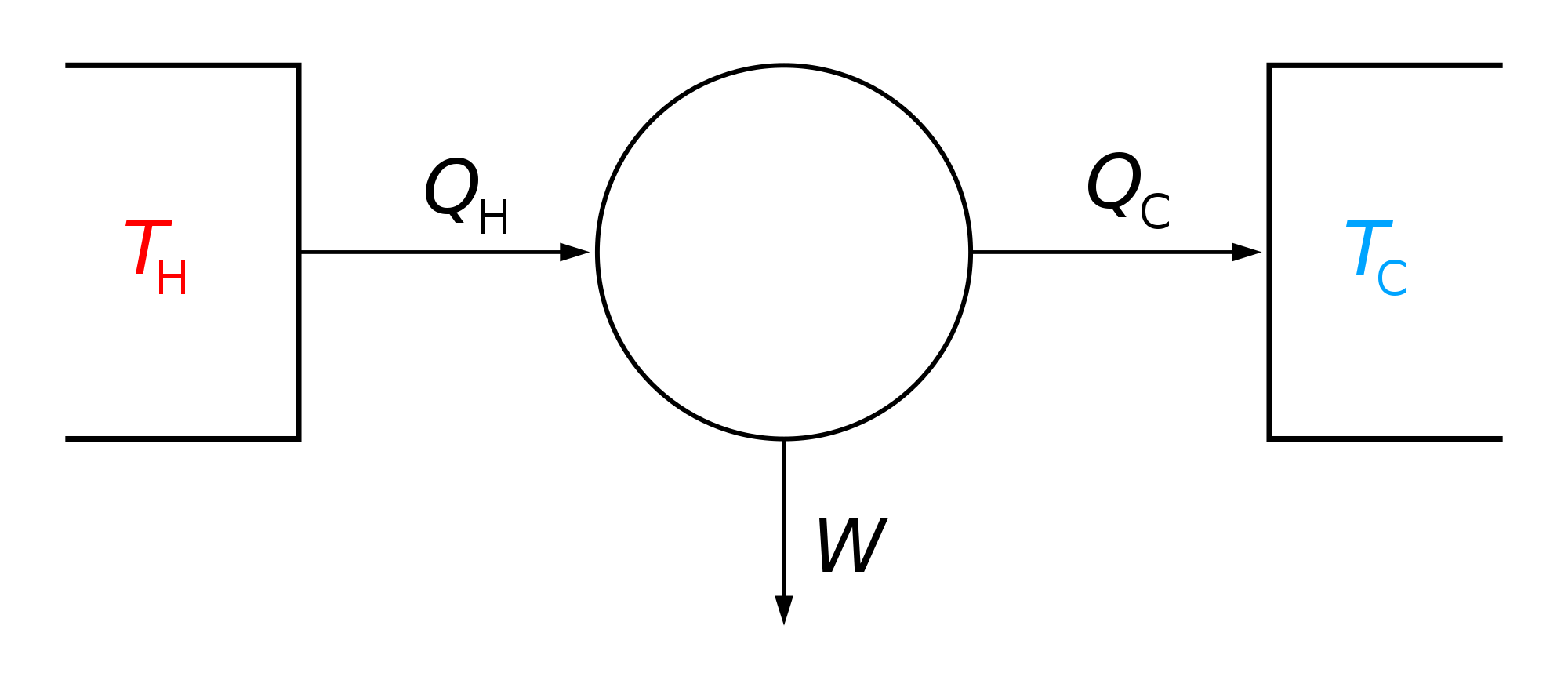
Consider a semi-ideal heat engine, in which heat transfer takes time, according to Fourier's law of heat conduction: , but other operations happen instantly.

Its maximal efficiency is the standard Carnot result, but it requires heat transfer to be reversible (quasistatic), thus taking infinite time. At maximum power output, its efficiency is the Chambadal–Novikov efficiency:
Due to occasional confusion about the origins of the above equation, it is sometimes named the Chambadal–Novikov–Curzon–Ahlborn efficiency.
Hub AI
Endoreversible thermodynamics AI simulator
(@Endoreversible thermodynamics_simulator)
Endoreversible thermodynamics
Endoreversible thermodynamics is a subset of irreversible thermodynamics aimed at making more realistic assumptions about heat transfer than are typically made in reversible thermodynamics. It gives an upper bound on the power that can be derived from a real process that is lower than that predicted by Carnot for a Carnot cycle, and accommodates the exergy destruction occurring as heat is transferred irreversibly.
It is also called finite-time thermodynamics, entropy generation minimization, or thermodynamic optimization.
Endoreversible thermodynamics was discovered multiple times, with Reitlinger (1929), Novikov (1957) and Chambadal (1957), although it is most often attributed to Curzon & Ahlborn (1975).
Reitlinger derived it by considering a heat exchanger receiving heat from a finite hot stream fed by a combustion process.
A brief review of the history of rediscoveries is in.
Consider a semi-ideal heat engine, in which heat transfer takes time, according to Fourier's law of heat conduction: , but other operations happen instantly.
Its maximal efficiency is the standard Carnot result, but it requires heat transfer to be reversible (quasistatic), thus taking infinite time. At maximum power output, its efficiency is the Chambadal–Novikov efficiency:
Due to occasional confusion about the origins of the above equation, it is sometimes named the Chambadal–Novikov–Curzon–Ahlborn efficiency.
Recent media