
Recent from talks
Endowment House
Knowledge base stats:
Talk channels stats:
Members stats:
Endowment House
40°46′16″N 111°53′37″W / 40.77111°N 111.89361°W
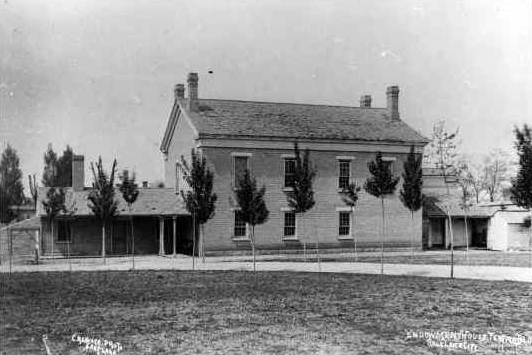
The Endowment House was an early building used by the Church of Jesus Christ of Latter-day Saints (LDS Church) to administer temple ordinances in Salt Lake City, Utah Territory. From the construction of the Council House in 1852, Salt Lake City's first public building, until the construction of the Endowment House, the members of the LDS Church used the top floor of the Council House for administering temple ordinances. When this arrangement proved impractical, Brigham Young directed Truman O. Angell, architect of the Salt Lake Temple, to design a temporary temple. Completed in 1855, the building was dedicated by Heber C. Kimball and came to be called the Endowment House after the endowment ceremonies that were conducted inside it.
The Endowment House stood on the northwest corner of Temple Square. Initially, it was a two-story adobe building, 44 by 34 feet (13 by 10 m), with a single-story 20-foot (6.1 m) extension on its north side. In 1856, another extension was added on its south side and a baptistry on its west side.
Inside, the Endowment House was the first building designed specifically for administering temple ordinances. Earlier buildings used for such purposes—such as Joseph Smith’s Red Brick Store in Nauvoo; the Nauvoo Temple; and the Council House—only had temporary canvas partitions. The Endowment House had the typical ordinance rooms found in some later temples: a creation room; a garden room; a world room; a celestial room; and sealing rooms. In 1856, William Ward painted the walls of the creation room to represent the Garden of Eden, the first such temple mural. It was one of the first buildings in Utah to have indoor bathrooms.
The Endowment House was used primarily for performing temple ordinances. From 1857 to 1876 the baptismal font was used to perform 134,053 baptisms for the dead. Between 1855 and 1884 54,170 persons received their washings and anointings and endowments. Between 1855 and 1889 68,767 couples were sealed in marriage—31,052 for the living and 37,715 for the dead.
Members of the LDS Church did not consider the Endowment House a temple, so they did not perform all temple ordinances in it. Brigham Young explained, "We can, at the present time [1873], go into the Endowment House and be baptized for our dead, receive our washings and anointings, etc. ... We also have the privilege of sealing women to men without a Temple ... but when we come to other sealing ordinances, ordinances pertaining to the holy Priesthood, to connect the chain of the Priesthood from father Adam until now, by sealing children to their parents, being sealed for our forefathers, etc., they cannot be done without a temple". Hence, there were no sealing of children nor endowments for the dead performed in the Endowment House. These ordinances were first administered in Utah's first temple, in St. George, in 1877.
The Endowment House was also used for other purposes, including prayer circles, settings apart, and instructing missionaries before their departure, as well as meetings of the various church leaders, such as the First Presidency and Quorum of the Twelve Apostles.
The Endowment House was demolished in November 1889 as a part of a plan to employ hundreds of Mormon migrant workers so that they could register to vote in Salt Lake City elections. Church authorities, led by Brigham Young Jr., ordered the building razed on October 18, and the Salt Lake Tribune reported that the building was "being demolished" on November 17. By the end of the month all trace of the Endowment House was gone.
Hub AI
Endowment House AI simulator
(@Endowment House_simulator)
Endowment House
40°46′16″N 111°53′37″W / 40.77111°N 111.89361°W
The Endowment House was an early building used by the Church of Jesus Christ of Latter-day Saints (LDS Church) to administer temple ordinances in Salt Lake City, Utah Territory. From the construction of the Council House in 1852, Salt Lake City's first public building, until the construction of the Endowment House, the members of the LDS Church used the top floor of the Council House for administering temple ordinances. When this arrangement proved impractical, Brigham Young directed Truman O. Angell, architect of the Salt Lake Temple, to design a temporary temple. Completed in 1855, the building was dedicated by Heber C. Kimball and came to be called the Endowment House after the endowment ceremonies that were conducted inside it.
The Endowment House stood on the northwest corner of Temple Square. Initially, it was a two-story adobe building, 44 by 34 feet (13 by 10 m), with a single-story 20-foot (6.1 m) extension on its north side. In 1856, another extension was added on its south side and a baptistry on its west side.
Inside, the Endowment House was the first building designed specifically for administering temple ordinances. Earlier buildings used for such purposes—such as Joseph Smith’s Red Brick Store in Nauvoo; the Nauvoo Temple; and the Council House—only had temporary canvas partitions. The Endowment House had the typical ordinance rooms found in some later temples: a creation room; a garden room; a world room; a celestial room; and sealing rooms. In 1856, William Ward painted the walls of the creation room to represent the Garden of Eden, the first such temple mural. It was one of the first buildings in Utah to have indoor bathrooms.
The Endowment House was used primarily for performing temple ordinances. From 1857 to 1876 the baptismal font was used to perform 134,053 baptisms for the dead. Between 1855 and 1884 54,170 persons received their washings and anointings and endowments. Between 1855 and 1889 68,767 couples were sealed in marriage—31,052 for the living and 37,715 for the dead.
Members of the LDS Church did not consider the Endowment House a temple, so they did not perform all temple ordinances in it. Brigham Young explained, "We can, at the present time [1873], go into the Endowment House and be baptized for our dead, receive our washings and anointings, etc. ... We also have the privilege of sealing women to men without a Temple ... but when we come to other sealing ordinances, ordinances pertaining to the holy Priesthood, to connect the chain of the Priesthood from father Adam until now, by sealing children to their parents, being sealed for our forefathers, etc., they cannot be done without a temple". Hence, there were no sealing of children nor endowments for the dead performed in the Endowment House. These ordinances were first administered in Utah's first temple, in St. George, in 1877.
The Endowment House was also used for other purposes, including prayer circles, settings apart, and instructing missionaries before their departure, as well as meetings of the various church leaders, such as the First Presidency and Quorum of the Twelve Apostles.
The Endowment House was demolished in November 1889 as a part of a plan to employ hundreds of Mormon migrant workers so that they could register to vote in Salt Lake City elections. Church authorities, led by Brigham Young Jr., ordered the building razed on October 18, and the Salt Lake Tribune reported that the building was "being demolished" on November 17. By the end of the month all trace of the Endowment House was gone.
Recent media