
Recent from talks
Baptistery
Knowledge base stats:
Talk channels stats:
Members stats:
Baptistery
In Christian architecture the baptistery or baptistry (Old French baptisterie; Latin baptisterium; Greek βαπτιστήριον, 'bathing-place, baptistery', from βαπτίζειν, baptízein, 'to baptize') is the separate centrally planned structure surrounding the baptismal font. The baptistery may be incorporated within the body of a church or cathedral, and provided with an altar as a chapel. In the early Church, the catechumens were instructed and the sacrament of baptism was administered in the baptistery.
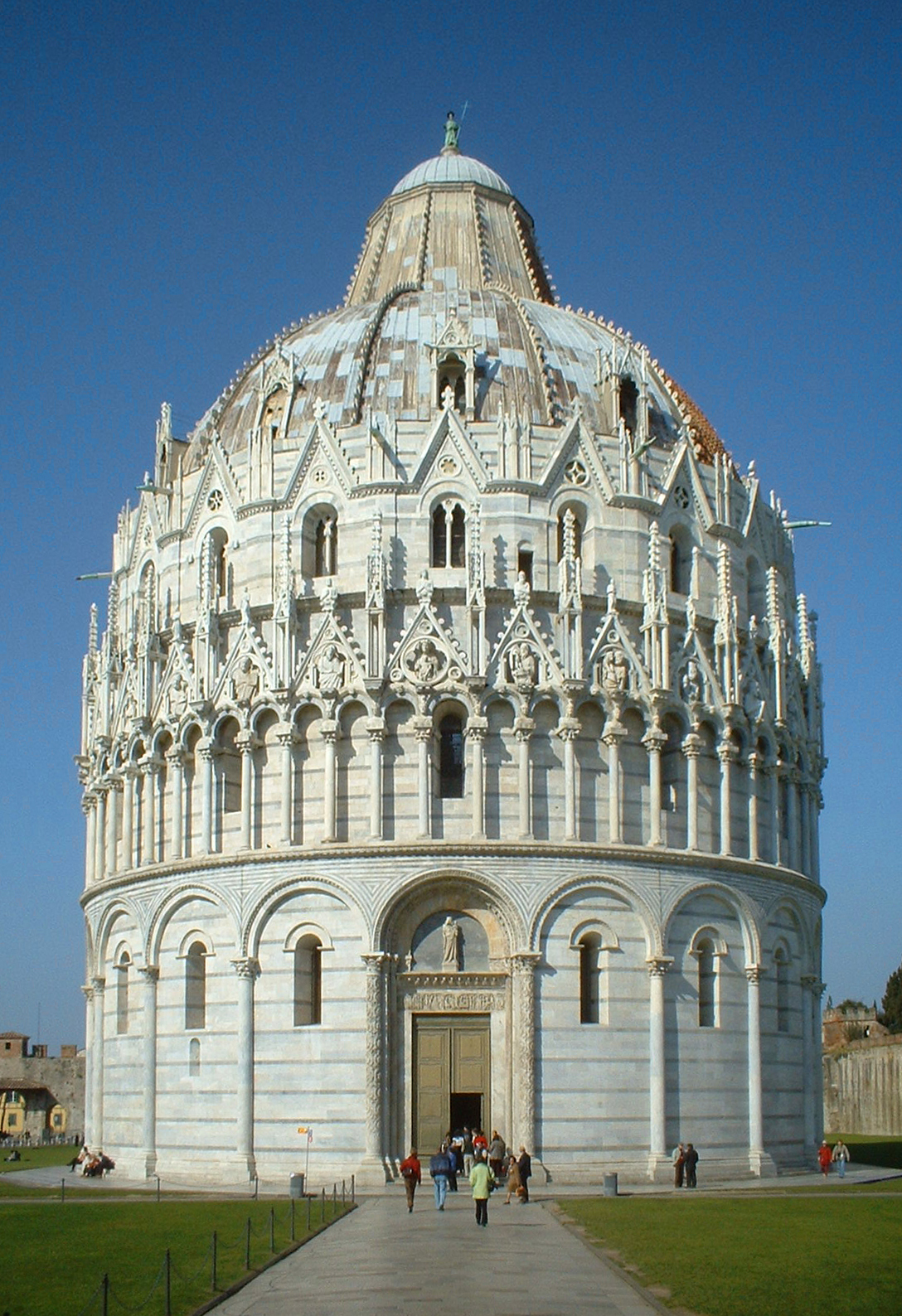
The sacramental importance and sometimes architectural splendour of the baptistery reflect the historical importance of baptism to Christians. Beginning in the fourth century, baptisteries in Italy were often designed with an octagonal plan. The octagonal plan of the Lateran Baptistery, the first structure expressly built as a baptistery, provided a widely followed model. The baptistery might be twelve-sided, or even circular as at Pisa.
In a narthex or anteroom, the catechumens were instructed and made their confession of faith before baptism. The main interior space centered upon the baptismal font (piscina), in which those to be baptized were thrice immersed. Three steps led down to the floor of the font, and over it might be suspended a gold or silver dove. The iconography of frescos or mosaics on the walls were commonly of the scenes in the life of Saint John the Baptist. The font was at first always of stone, but latterly metals were often used.
The Lateran baptistery's font was fed by a natural spring. When the site had been the palatial dwelling of the Laterani, before Constantine presented it to Bishop Miltiades, the spring formed the water source for the numerous occupants of the domus. As the requirements for Christian baptisteries expanded, Christianization of sacred pagan springs presented natural opportunities. Cassiodorus, in a letter written in AD 527, described a fair held at a former pagan shrine of Leucothea, in the still culturally Greek region of southern Italy. This shrine had been Christianized by converting it to a baptistery (Variae 8.33). There are also examples of the transition from miraculous springs to baptisteries from Gregory of Tours (died c. 594) and Maximus, bishop of Turin (died c. 466).
Baptisteries belong to a period of the church when great numbers of adult catechumens were baptized and immersion was the rule. They did not seem to be common before the emperors Gratian, Valentinian, and Theodosius made Christianity the state religion in the Edict of Thessalonica (i.e. before the 4th century). As early as the 6th century, the baptismal font was commonly built in the porch of the church, before it was moved into the church itself. After the 9th century, with infant baptism increasingly the rule, few baptisteries were built. Some of the older baptisteries were so large that there are accounts of councils and synods being held in them. They had to be large because a bishop in the early church would customarily baptize all the catechumens in his diocese and the rite was performed only three times a year, on certain holy days. Baptisteries were thus attached to the cathedral and not to the parish churches. In the Italian countryside a pieve was a church with a baptistery on which other churches without baptisteries depended.
During the months when no baptisms occurred, the baptistery doors were sealed with the bishop's seal, a method of controlling the orthodoxy of all baptism in the diocese. Some baptisteries were divided into two parts to separate the sexes; or sometimes the church had two baptisteries, one for each sex. A fireplace was often provided to warm the neophytes after immersion.
Though baptisteries were forbidden to be used as burial-places by the Council of Auxerre (578), they were sometimes used as such. The Florentine Antipope John XXIII (d. 1419) was buried in the Florence Baptistery, facing Florence Cathedral, with great ceremony, and a large and sculpturally important tomb by Donatello and his partner. Many of the early archbishops of Canterbury in England were buried in the baptistery at Canterbury.
According to the records of early church councils, baptisteries were first built and used to correct what were considered the evils arising from the practice of private baptism. As soon as Christianity had expanded so that baptism became the rule, and as immersion of adults gave place to sprinkling of infants, the ancient baptisteries were no longer necessary. They are still in general use, however, in Florence and Pisa.
Hub AI
Baptistery AI simulator
(@Baptistery_simulator)
Baptistery
In Christian architecture the baptistery or baptistry (Old French baptisterie; Latin baptisterium; Greek βαπτιστήριον, 'bathing-place, baptistery', from βαπτίζειν, baptízein, 'to baptize') is the separate centrally planned structure surrounding the baptismal font. The baptistery may be incorporated within the body of a church or cathedral, and provided with an altar as a chapel. In the early Church, the catechumens were instructed and the sacrament of baptism was administered in the baptistery.
The sacramental importance and sometimes architectural splendour of the baptistery reflect the historical importance of baptism to Christians. Beginning in the fourth century, baptisteries in Italy were often designed with an octagonal plan. The octagonal plan of the Lateran Baptistery, the first structure expressly built as a baptistery, provided a widely followed model. The baptistery might be twelve-sided, or even circular as at Pisa.
In a narthex or anteroom, the catechumens were instructed and made their confession of faith before baptism. The main interior space centered upon the baptismal font (piscina), in which those to be baptized were thrice immersed. Three steps led down to the floor of the font, and over it might be suspended a gold or silver dove. The iconography of frescos or mosaics on the walls were commonly of the scenes in the life of Saint John the Baptist. The font was at first always of stone, but latterly metals were often used.
The Lateran baptistery's font was fed by a natural spring. When the site had been the palatial dwelling of the Laterani, before Constantine presented it to Bishop Miltiades, the spring formed the water source for the numerous occupants of the domus. As the requirements for Christian baptisteries expanded, Christianization of sacred pagan springs presented natural opportunities. Cassiodorus, in a letter written in AD 527, described a fair held at a former pagan shrine of Leucothea, in the still culturally Greek region of southern Italy. This shrine had been Christianized by converting it to a baptistery (Variae 8.33). There are also examples of the transition from miraculous springs to baptisteries from Gregory of Tours (died c. 594) and Maximus, bishop of Turin (died c. 466).
Baptisteries belong to a period of the church when great numbers of adult catechumens were baptized and immersion was the rule. They did not seem to be common before the emperors Gratian, Valentinian, and Theodosius made Christianity the state religion in the Edict of Thessalonica (i.e. before the 4th century). As early as the 6th century, the baptismal font was commonly built in the porch of the church, before it was moved into the church itself. After the 9th century, with infant baptism increasingly the rule, few baptisteries were built. Some of the older baptisteries were so large that there are accounts of councils and synods being held in them. They had to be large because a bishop in the early church would customarily baptize all the catechumens in his diocese and the rite was performed only three times a year, on certain holy days. Baptisteries were thus attached to the cathedral and not to the parish churches. In the Italian countryside a pieve was a church with a baptistery on which other churches without baptisteries depended.
During the months when no baptisms occurred, the baptistery doors were sealed with the bishop's seal, a method of controlling the orthodoxy of all baptism in the diocese. Some baptisteries were divided into two parts to separate the sexes; or sometimes the church had two baptisteries, one for each sex. A fireplace was often provided to warm the neophytes after immersion.
Though baptisteries were forbidden to be used as burial-places by the Council of Auxerre (578), they were sometimes used as such. The Florentine Antipope John XXIII (d. 1419) was buried in the Florence Baptistery, facing Florence Cathedral, with great ceremony, and a large and sculpturally important tomb by Donatello and his partner. Many of the early archbishops of Canterbury in England were buried in the baptistery at Canterbury.
According to the records of early church councils, baptisteries were first built and used to correct what were considered the evils arising from the practice of private baptism. As soon as Christianity had expanded so that baptism became the rule, and as immersion of adults gave place to sprinkling of infants, the ancient baptisteries were no longer necessary. They are still in general use, however, in Florence and Pisa.
Recent media