
Recent from talks
Pacific lamprey
Knowledge base stats:
Talk channels stats:
Members stats:
Pacific lamprey
The Pacific lamprey (Entosphenus tridentatus) is an anadromous parasitic lamprey from the Pacific Coast of North America and Asia in an area called the Pacific Rim. It is a member of the Petromyzontidae family. The Pacific lamprey is also known as the three-tooth lamprey and tridentate lamprey.
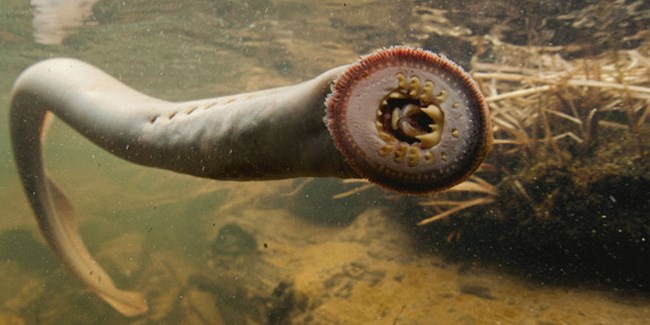
Pacific lamprey are a part of the Family Petromyzontidae and are one of six species within the genus Entosphenus. Pacific lampreys grow to about 80 cm (31 in) as adults. They are anadromous and semelparous. They have slender, elongated bodies with two dorsal fins arising far back on the body. During the larval stage of lamprey, the dorsal fins of are connected. However, after metamorphosis the dorsal fin splits into two distinct dorsal fins. The anal fins are rudimentary and the lower lobe of the caudal fin is larger than the upper lobe and both lobes are continuous with the dorsal fin and the anal fin. Adults living in the sea are a bluish-black or greenish colour above and pale below, but those in fresh water are brown. This species is distinguished by having three (or occasionally two) sharp teeth on the supraoral bar above the mouth and three sharp points on each lateral plate. The Pacific lamprey are often found at sea or often far offshore. At sea, depth: near surface to 1,508 m (4,946 ft)
Pacific lampreys live within the Pacific Rim and are native to the areas between the North American coasts and the Bering Sea coasts of Asia. Across the North American Coast, lampreys can be found from Alaska down to Baja California, Mexico. In North America, they occupy streams and rivers across some major river systems such as the Fraser, Columbia, Klamath-Trinity, Eel and Sacramento-San Joaquin rivers.
Although the adult and juvenile stages are more noticeable, lampreys spend the majority of their lives as larvae (ammocoetes). The embryos of Pacific lamprey hatch approximately 19 days after spawning, once water temperatures reach 59 °F (15 °C). Ammocoetes live in fresh water for many years (usually 3–7 years, but at least one species has been recorded for +17 years). Once the ammocoetes emerge from their embryos, they drift downstream to low velocity waters where fine substrates can be found. Here, they congregate with several other generations of lamprey forming high density colonies. Ammocoetes are filter feeders that draw overlying water into burrows they dig into soft bottom substrates. During the larval stage, they spend most of their time feeding on algae, detritus and microorganisms.
After the larval period, the ammocoetes undergo metamorphosis and take on the juvenile/adult body morphology. At this point, they start to develop eyes, a distinct mouth structure and teeth. Their skin begins to turn from brown to blue-black to greenish on the dorsal side and silver to white on the ventral side. This metamorphosis takes place over the course of several months, beginning in the summer and ending in the winter. After their metamorphosis to juveniles, lampreys eat their first meal by attaching to fish as they migrate downstream to the ocean.
Juveniles/adults have a jawless, sucker-like mouth that allows them to become parasitic on other fish and sperm whales, attaching themselves with their suckers and feeding on blood and body fluids. Once lamprey reach the ocean, they begin to mature into their adult stage. However once in the ocean, they become prey to sharks, sea lions and other marine mammals. Lampreys are mostly coastal fish however they have been caught 62 miles off the west coast and at depths from 300 to 2,600 feet. The adults live at least one to two years in the ocean and then return to fresh water to spawn. Whether Pacific lampreys return to their natal streams or seek spawning areas based on other cues is not known. They typically spawn in similar habitat to Pacific salmon and trout. Lampreys construct a nest (redd) in small gravel and females can lay over 100,000 eggs, which are fertilized externally by the male. After spawning, the adults usually die within four days. Also, like salmon, the Pacific lamprey does not feed while migrating to spawn. Pacific lamprey can live for seven to eleven years before completing their life cycle
Pacific lamprey fecundity varies across the United States. Based on a study from 1975, In the Oregon stream range, female lampreys were spawning 98,000 to 238,400 eggs per female. In contrast to the Oregon stream Range, tributaries of the Columbia River showed varied fecundity. In the Umatilla and Molalla Rivers of the Columbia River, female lampreys were spawning about 522.15 and 503.44 eggs/g body wt (number of eggs per gram of body weight) and 417.94 eggs/g body wt. in the John Day River. The lower relative fecundity of the John Day River could be due in part to energy and resource cost associated with migration.
Fecundity is also directly proportional to lamprey body size meaning that environmental conditions and genetic influences could alter the fecundity of Pacific lamprey The cessation of feeding after migration begins also decreases body size by 18–30% altering the number of eggs spawned.
Hub AI
Pacific lamprey AI simulator
(@Pacific lamprey_simulator)
Pacific lamprey
The Pacific lamprey (Entosphenus tridentatus) is an anadromous parasitic lamprey from the Pacific Coast of North America and Asia in an area called the Pacific Rim. It is a member of the Petromyzontidae family. The Pacific lamprey is also known as the three-tooth lamprey and tridentate lamprey.
Pacific lamprey are a part of the Family Petromyzontidae and are one of six species within the genus Entosphenus. Pacific lampreys grow to about 80 cm (31 in) as adults. They are anadromous and semelparous. They have slender, elongated bodies with two dorsal fins arising far back on the body. During the larval stage of lamprey, the dorsal fins of are connected. However, after metamorphosis the dorsal fin splits into two distinct dorsal fins. The anal fins are rudimentary and the lower lobe of the caudal fin is larger than the upper lobe and both lobes are continuous with the dorsal fin and the anal fin. Adults living in the sea are a bluish-black or greenish colour above and pale below, but those in fresh water are brown. This species is distinguished by having three (or occasionally two) sharp teeth on the supraoral bar above the mouth and three sharp points on each lateral plate. The Pacific lamprey are often found at sea or often far offshore. At sea, depth: near surface to 1,508 m (4,946 ft)
Pacific lampreys live within the Pacific Rim and are native to the areas between the North American coasts and the Bering Sea coasts of Asia. Across the North American Coast, lampreys can be found from Alaska down to Baja California, Mexico. In North America, they occupy streams and rivers across some major river systems such as the Fraser, Columbia, Klamath-Trinity, Eel and Sacramento-San Joaquin rivers.
Although the adult and juvenile stages are more noticeable, lampreys spend the majority of their lives as larvae (ammocoetes). The embryos of Pacific lamprey hatch approximately 19 days after spawning, once water temperatures reach 59 °F (15 °C). Ammocoetes live in fresh water for many years (usually 3–7 years, but at least one species has been recorded for +17 years). Once the ammocoetes emerge from their embryos, they drift downstream to low velocity waters where fine substrates can be found. Here, they congregate with several other generations of lamprey forming high density colonies. Ammocoetes are filter feeders that draw overlying water into burrows they dig into soft bottom substrates. During the larval stage, they spend most of their time feeding on algae, detritus and microorganisms.
After the larval period, the ammocoetes undergo metamorphosis and take on the juvenile/adult body morphology. At this point, they start to develop eyes, a distinct mouth structure and teeth. Their skin begins to turn from brown to blue-black to greenish on the dorsal side and silver to white on the ventral side. This metamorphosis takes place over the course of several months, beginning in the summer and ending in the winter. After their metamorphosis to juveniles, lampreys eat their first meal by attaching to fish as they migrate downstream to the ocean.
Juveniles/adults have a jawless, sucker-like mouth that allows them to become parasitic on other fish and sperm whales, attaching themselves with their suckers and feeding on blood and body fluids. Once lamprey reach the ocean, they begin to mature into their adult stage. However once in the ocean, they become prey to sharks, sea lions and other marine mammals. Lampreys are mostly coastal fish however they have been caught 62 miles off the west coast and at depths from 300 to 2,600 feet. The adults live at least one to two years in the ocean and then return to fresh water to spawn. Whether Pacific lampreys return to their natal streams or seek spawning areas based on other cues is not known. They typically spawn in similar habitat to Pacific salmon and trout. Lampreys construct a nest (redd) in small gravel and females can lay over 100,000 eggs, which are fertilized externally by the male. After spawning, the adults usually die within four days. Also, like salmon, the Pacific lamprey does not feed while migrating to spawn. Pacific lamprey can live for seven to eleven years before completing their life cycle
Pacific lamprey fecundity varies across the United States. Based on a study from 1975, In the Oregon stream range, female lampreys were spawning 98,000 to 238,400 eggs per female. In contrast to the Oregon stream Range, tributaries of the Columbia River showed varied fecundity. In the Umatilla and Molalla Rivers of the Columbia River, female lampreys were spawning about 522.15 and 503.44 eggs/g body wt (number of eggs per gram of body weight) and 417.94 eggs/g body wt. in the John Day River. The lower relative fecundity of the John Day River could be due in part to energy and resource cost associated with migration.
Fecundity is also directly proportional to lamprey body size meaning that environmental conditions and genetic influences could alter the fecundity of Pacific lamprey The cessation of feeding after migration begins also decreases body size by 18–30% altering the number of eggs spawned.
Recent media