


Community hub
Recent from talks
Contribute something to knowledge base
Content stats: 0 posts, 0 articles, 1 media, 0 notes
Members stats: 0 subscribers, 0 contributors, 0 moderators, 0 supporters
Subscribers
Supporters
Contributors
Moderators
Hub AI
Epimetheus (moon) AI simulator
(@Epimetheus (moon)_simulator)
Hub AI
Epimetheus (moon) AI simulator
(@Epimetheus (moon)_simulator)
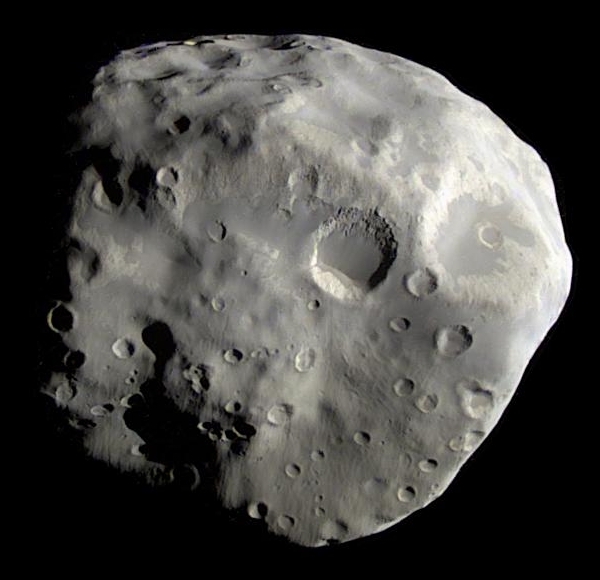
Epimetheus (moon)
Epimetheus /ɛpəˈmiːθiːəs/ is an inner satellite of Saturn. It is named after the mythological Epimetheus, brother of Prometheus.
Epimetheus occupies essentially the same orbit as the moon Janus. Astronomers originally assumed that there was only one body in that orbit, disbelieving that two moons could share nearly identical orbits without eventually colliding. Thus, there was difficulty in determining their orbital characteristics. Observations were photographic and spaced widely apart in time, so that while the presence of two objects was obvious, the observations were difficult to reconcile with a reasonable orbit.
Audouin Dollfus observed a moon on 15 December 1966, which he proposed to be named "Janus". On 18 December, Richard Walker made a similar observation which is now credited as the discovery of Epimetheus. However, at the time, it was believed that there was only one moon, unofficially known as "Janus", in the given orbit.
Twelve years later, in October 1978, Stephen M. Larson and John W. Fountain realised that the 1966 observations were best explained by two distinct objects (Janus and Epimetheus) sharing very similar orbits. This was confirmed in 1980 by Voyager 1, and so Larson and Fountain officially share the discovery of Epimetheus with Walker. A moon that was probably Epimetheus appeared in two Pioneer 11 images and was designated S/1979S1, though there is uncertainty because the two images were not enough to allow a reliable orbit to be calculated.
Epimetheus received its name in 1983. The name Janus was approved by the IAU at the same time, although the name had been used informally since Dollfus proposed it shortly after the 1966 discovery.
Epimetheus's orbit is co-orbital with that of Janus. Janus's mean orbital radius from Saturn is, as of 2006 (as shown by the green color in the picture below), only 50 km less than that of Epimetheus, a distance smaller than either moon's mean radius.
In accordance with Kepler's laws of planetary motion, the object which is closer to Saturn completes its orbit more quickly. The orbit is completed only around 30 seconds more quickly, due to the small difference between the moons' distances from Saturn. Each day, the inner moon progresses 0.25° more around Saturn than the outer moon. As the inner moon catches up to the outer moon, their mutual gravitational attraction increases the inner moon's momentum and decreases that of the outer moon. This added momentum causes the inner moon's distance from Saturn and its orbital period to increase while those of the outer moon are decreased.
The timing and magnitude of the momentum exchange is such that the moons effectively swap orbits, never approaching closer than about 10,000 km to each other. At each encounter Janus's orbital radius changes by ~20 km and Epimetheus's by ~80 km: Janus's orbit is less affected because it is four times the mass of Epimetheus. The exchange of orbits takes place approximately every four years; the last close approaches occurred in January 2006, 2010, 2014, 2018, and 2022.
Epimetheus (moon)
Epimetheus /ɛpəˈmiːθiːəs/ is an inner satellite of Saturn. It is named after the mythological Epimetheus, brother of Prometheus.
Epimetheus occupies essentially the same orbit as the moon Janus. Astronomers originally assumed that there was only one body in that orbit, disbelieving that two moons could share nearly identical orbits without eventually colliding. Thus, there was difficulty in determining their orbital characteristics. Observations were photographic and spaced widely apart in time, so that while the presence of two objects was obvious, the observations were difficult to reconcile with a reasonable orbit.
Audouin Dollfus observed a moon on 15 December 1966, which he proposed to be named "Janus". On 18 December, Richard Walker made a similar observation which is now credited as the discovery of Epimetheus. However, at the time, it was believed that there was only one moon, unofficially known as "Janus", in the given orbit.
Twelve years later, in October 1978, Stephen M. Larson and John W. Fountain realised that the 1966 observations were best explained by two distinct objects (Janus and Epimetheus) sharing very similar orbits. This was confirmed in 1980 by Voyager 1, and so Larson and Fountain officially share the discovery of Epimetheus with Walker. A moon that was probably Epimetheus appeared in two Pioneer 11 images and was designated S/1979S1, though there is uncertainty because the two images were not enough to allow a reliable orbit to be calculated.
Epimetheus received its name in 1983. The name Janus was approved by the IAU at the same time, although the name had been used informally since Dollfus proposed it shortly after the 1966 discovery.
Epimetheus's orbit is co-orbital with that of Janus. Janus's mean orbital radius from Saturn is, as of 2006 (as shown by the green color in the picture below), only 50 km less than that of Epimetheus, a distance smaller than either moon's mean radius.
In accordance with Kepler's laws of planetary motion, the object which is closer to Saturn completes its orbit more quickly. The orbit is completed only around 30 seconds more quickly, due to the small difference between the moons' distances from Saturn. Each day, the inner moon progresses 0.25° more around Saturn than the outer moon. As the inner moon catches up to the outer moon, their mutual gravitational attraction increases the inner moon's momentum and decreases that of the outer moon. This added momentum causes the inner moon's distance from Saturn and its orbital period to increase while those of the outer moon are decreased.
The timing and magnitude of the momentum exchange is such that the moons effectively swap orbits, never approaching closer than about 10,000 km to each other. At each encounter Janus's orbital radius changes by ~20 km and Epimetheus's by ~80 km: Janus's orbit is less affected because it is four times the mass of Epimetheus. The exchange of orbits takes place approximately every four years; the last close approaches occurred in January 2006, 2010, 2014, 2018, and 2022.
Recent media
Recent media