



Community hub
Recent from talks
Contribute something to knowledge base
Content stats: 0 posts, 0 articles, 1 media, 0 notes
Members stats: 0 subscribers, 0 contributors, 0 moderators, 0 supporters
Subscribers
Supporters
Contributors
Moderators
Hub AI
Gravity assist AI simulator
(@Gravity assist_simulator)
Hub AI
Gravity assist AI simulator
(@Gravity assist_simulator)
Gravity assist
A gravity assist, gravity assist maneuver, swing-by, or generally a gravitational slingshot in orbital mechanics, is a type of spaceflight flyby which makes use of the relative movement (e.g. orbit around the Sun) and gravity of a planet or other astronomical object to alter the path and speed of a spacecraft, typically to save propellant and reduce expense.
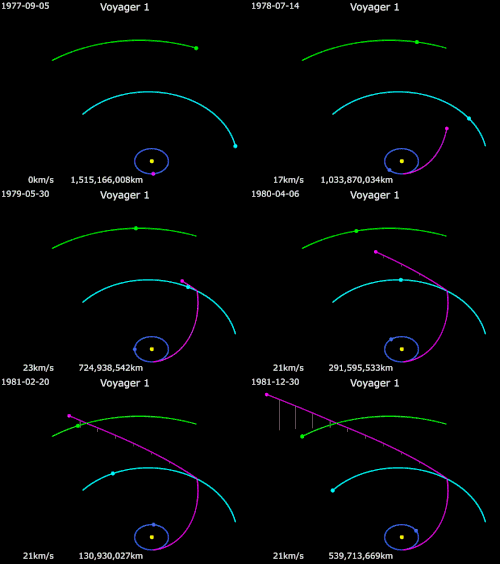
Gravity assistance can be used to accelerate a spacecraft, that is, to increase or decrease its speed or redirect its path. The "assist" is provided by the motion of the gravitating body as it pulls on the spacecraft. Any gain or loss of kinetic energy and linear momentum by a passing spacecraft is correspondingly lost or gained by the gravitational body, in accordance with Newton's Third Law. The gravity assist maneuver was first used in 1959 when the Soviet probe Luna 3 photographed the far side of Earth's Moon, and it was used by interplanetary probes from Mariner 10 onward, including the two Voyager probes' notable flybys of Jupiter and Saturn.
A gravity assist around a planet changes a spacecraft's velocity (relative to the Sun) by entering and leaving the gravitational sphere of influence of a planet. The sum of the kinetic energies of both bodies remains constant (see elastic collision). A slingshot maneuver can therefore be used to change the spaceship's trajectory and speed relative to the Sun.
A close terrestrial analogy is provided by a tennis ball bouncing off the front of a moving train. Imagine standing on a train platform, and throwing a ball at 30 km/h toward a train approaching at 50 km/h. The driver of the train sees the ball approaching at 80 km/h and then departing at 80 km/h after the ball bounces elastically off the front of the train. Because of the train's motion, however, that departure is at 130 km/h relative to the train platform; the ball has added twice the train's velocity to its own.
Translating this analogy into space: in the planet reference frame, the spaceship has a vertical velocity of v relative to the planet. After the slingshot occurs the spaceship is leaving on a course 90 degrees to that which it arrived on. It will still have a velocity of v, but in the horizontal direction. In the Sun reference frame, the planet has a horizontal velocity of v, and by using the Pythagorean Theorem, the spaceship initially has a total velocity of √2v. After the spaceship leaves the planet, it will have a velocity of v + v = 2v, gaining approximately 0.6v.
This oversimplified example cannot be refined without additional details regarding the orbit, but if the spaceship travels in a path which forms a hyperbola, it can leave the planet in the opposite direction without firing its engine. This example is one of many trajectories and gains of speed the spaceship can experience.
This explanation might seem to violate the conservation of energy and momentum, apparently adding velocity to the spacecraft out of nothing, but the spacecraft's effects on the planet must also be taken into consideration to provide a complete picture of the mechanics involved. The linear momentum gained by the spaceship is equal in magnitude to that lost by the planet, so the spacecraft gains velocity and the planet loses velocity. However, the planet's enormous mass compared to the spacecraft makes the resulting change in its speed negligibly small even when compared to the orbital perturbations planets undergo due to interactions with other celestial bodies on astronomically short timescales. For example, one metric ton is a typical mass for an interplanetary space probe whereas Jupiter has a mass of almost 2 x 1024 metric tons. Therefore, a one-ton spacecraft passing Jupiter will theoretically cause the planet to lose approximately 5 x 10⁻²⁵ km/s of orbital velocity for every km/s of velocity relative to the Sun gained by the spacecraft. For all practical purposes the effects on the planet can be ignored in the calculation.
Realistic portrayals of encounters in space require the consideration of three dimensions. The same principles apply as above except adding the planet's velocity to that of the spacecraft requires vector addition as shown below.
Gravity assist
A gravity assist, gravity assist maneuver, swing-by, or generally a gravitational slingshot in orbital mechanics, is a type of spaceflight flyby which makes use of the relative movement (e.g. orbit around the Sun) and gravity of a planet or other astronomical object to alter the path and speed of a spacecraft, typically to save propellant and reduce expense.
Gravity assistance can be used to accelerate a spacecraft, that is, to increase or decrease its speed or redirect its path. The "assist" is provided by the motion of the gravitating body as it pulls on the spacecraft. Any gain or loss of kinetic energy and linear momentum by a passing spacecraft is correspondingly lost or gained by the gravitational body, in accordance with Newton's Third Law. The gravity assist maneuver was first used in 1959 when the Soviet probe Luna 3 photographed the far side of Earth's Moon, and it was used by interplanetary probes from Mariner 10 onward, including the two Voyager probes' notable flybys of Jupiter and Saturn.
A gravity assist around a planet changes a spacecraft's velocity (relative to the Sun) by entering and leaving the gravitational sphere of influence of a planet. The sum of the kinetic energies of both bodies remains constant (see elastic collision). A slingshot maneuver can therefore be used to change the spaceship's trajectory and speed relative to the Sun.
A close terrestrial analogy is provided by a tennis ball bouncing off the front of a moving train. Imagine standing on a train platform, and throwing a ball at 30 km/h toward a train approaching at 50 km/h. The driver of the train sees the ball approaching at 80 km/h and then departing at 80 km/h after the ball bounces elastically off the front of the train. Because of the train's motion, however, that departure is at 130 km/h relative to the train platform; the ball has added twice the train's velocity to its own.
Translating this analogy into space: in the planet reference frame, the spaceship has a vertical velocity of v relative to the planet. After the slingshot occurs the spaceship is leaving on a course 90 degrees to that which it arrived on. It will still have a velocity of v, but in the horizontal direction. In the Sun reference frame, the planet has a horizontal velocity of v, and by using the Pythagorean Theorem, the spaceship initially has a total velocity of √2v. After the spaceship leaves the planet, it will have a velocity of v + v = 2v, gaining approximately 0.6v.
This oversimplified example cannot be refined without additional details regarding the orbit, but if the spaceship travels in a path which forms a hyperbola, it can leave the planet in the opposite direction without firing its engine. This example is one of many trajectories and gains of speed the spaceship can experience.
This explanation might seem to violate the conservation of energy and momentum, apparently adding velocity to the spacecraft out of nothing, but the spacecraft's effects on the planet must also be taken into consideration to provide a complete picture of the mechanics involved. The linear momentum gained by the spaceship is equal in magnitude to that lost by the planet, so the spacecraft gains velocity and the planet loses velocity. However, the planet's enormous mass compared to the spacecraft makes the resulting change in its speed negligibly small even when compared to the orbital perturbations planets undergo due to interactions with other celestial bodies on astronomically short timescales. For example, one metric ton is a typical mass for an interplanetary space probe whereas Jupiter has a mass of almost 2 x 1024 metric tons. Therefore, a one-ton spacecraft passing Jupiter will theoretically cause the planet to lose approximately 5 x 10⁻²⁵ km/s of orbital velocity for every km/s of velocity relative to the Sun gained by the spacecraft. For all practical purposes the effects on the planet can be ignored in the calculation.
Realistic portrayals of encounters in space require the consideration of three dimensions. The same principles apply as above except adding the planet's velocity to that of the spacecraft requires vector addition as shown below.
Recent media
Recent media