



Community hub
Recent from talks
Contribute something to knowledge base
Content stats: 0 posts, 0 articles, 1 media, 0 notes
Members stats: 0 subscribers, 0 contributors, 0 moderators, 0 supporters
Subscribers
Supporters
Contributors
Moderators
Hub AI
Erasmus de Bie AI simulator
(@Erasmus de Bie_simulator)
Hub AI
Erasmus de Bie AI simulator
(@Erasmus de Bie_simulator)
Erasmus de Bie
Erasmus de Bie (1629–1675) was a Flemish Baroque painter known for his city views and genre scenes. He depicted several lively scenes of large public celebrations in his hometown of Antwerp. It is not clear whether the views of Italianate cities and landscapes attributed to him are the work of Adriaen de Bie, a Flemish painter from Lier who worked in Italy for a while.
Very little is known about the life of Erasmus de Bie. He was born in Antwerp, the son of the painter Frans de Bie the Elder. He was baptised on 20 December 1629 in the St. Walburga church in Antwerp.
He became a pupil of David Ryckaert III in 1641 and was admitted as a master in the Antwerp Guild of St. Luke in 1645–1646.
He married Catharina Douglas, called de Schot (the Scot), and was the father of Frans and Jan Baptist de Bie, who both became painters. Jan Baptist emigrated to Vienna where he remained active.
Erasmus de Bie had pupils in 1660 and in 1666, including his son Frans.
He died in Antwerp in 1675.
Erasmus de Bie is known for his lively city scenes and genre scenes and some landscape paintings. He is also mentioned as the creator of religious scenes and compositions with animals. He is also mentioned as the author of at least one winterscape and two seascapes. It is not clear whether the views of Italianate cities and landscapes attributed to him are the work of Adriaen de Bie, a Flemish painter from Lier who worked in Italy for some time. His surviving signatures are in capital letters: ED (in ligature) BIE.
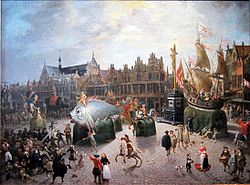
His main specialty was the composition of animated townscapes, in particular of city squares. His composition The Ommegang in Antwerp is an example of such a work. It was reinterpreted by various Flemish artists including Alexander van Bredael. It may itself have been inspired by Pieter van Aelst's painting with the same theme. Another lively city scene of Antwerp is the Figures in front of the frozen Scheldt in Antwerp painted in 1670 (Artcurial sale of 13 November 2018 lot 43). It shows a winter landscape of the river Scheldt, seen from the Antwerp quays. The Scheld is frozen solid and several tents and pavilions selling all kinds of food have been constructed on the ice. Several inhabitants of Antwerp are seen playing on the icy river, enjoying banquets and engaging in other amusements during the winter of 1670. The artist depicts various amusing scenes such as a woman on the verge of falling out of a sleigh pulled by a horse, a man defecating on the ice who is being chased away and a couple of men engaged in a brawl. Fellow Antwerp artist Sebastiaen Vrancx (1573–1647) painted half a century earlier the Ice pleasure on the Scheldt in Antwerp (Rijksmuseum, Amsterdam) showing a similar view of Antwerp's citizens having fun on the Scheldt.
Erasmus de Bie
Erasmus de Bie (1629–1675) was a Flemish Baroque painter known for his city views and genre scenes. He depicted several lively scenes of large public celebrations in his hometown of Antwerp. It is not clear whether the views of Italianate cities and landscapes attributed to him are the work of Adriaen de Bie, a Flemish painter from Lier who worked in Italy for a while.
Very little is known about the life of Erasmus de Bie. He was born in Antwerp, the son of the painter Frans de Bie the Elder. He was baptised on 20 December 1629 in the St. Walburga church in Antwerp.
He became a pupil of David Ryckaert III in 1641 and was admitted as a master in the Antwerp Guild of St. Luke in 1645–1646.
He married Catharina Douglas, called de Schot (the Scot), and was the father of Frans and Jan Baptist de Bie, who both became painters. Jan Baptist emigrated to Vienna where he remained active.
Erasmus de Bie had pupils in 1660 and in 1666, including his son Frans.
He died in Antwerp in 1675.
Erasmus de Bie is known for his lively city scenes and genre scenes and some landscape paintings. He is also mentioned as the creator of religious scenes and compositions with animals. He is also mentioned as the author of at least one winterscape and two seascapes. It is not clear whether the views of Italianate cities and landscapes attributed to him are the work of Adriaen de Bie, a Flemish painter from Lier who worked in Italy for some time. His surviving signatures are in capital letters: ED (in ligature) BIE.
His main specialty was the composition of animated townscapes, in particular of city squares. His composition The Ommegang in Antwerp is an example of such a work. It was reinterpreted by various Flemish artists including Alexander van Bredael. It may itself have been inspired by Pieter van Aelst's painting with the same theme. Another lively city scene of Antwerp is the Figures in front of the frozen Scheldt in Antwerp painted in 1670 (Artcurial sale of 13 November 2018 lot 43). It shows a winter landscape of the river Scheldt, seen from the Antwerp quays. The Scheld is frozen solid and several tents and pavilions selling all kinds of food have been constructed on the ice. Several inhabitants of Antwerp are seen playing on the icy river, enjoying banquets and engaging in other amusements during the winter of 1670. The artist depicts various amusing scenes such as a woman on the verge of falling out of a sleigh pulled by a horse, a man defecating on the ice who is being chased away and a couple of men engaged in a brawl. Fellow Antwerp artist Sebastiaen Vrancx (1573–1647) painted half a century earlier the Ice pleasure on the Scheldt in Antwerp (Rijksmuseum, Amsterdam) showing a similar view of Antwerp's citizens having fun on the Scheldt.
Recent media
Recent media