Hubbry Logo
ErbarErbarMain
Open search
Erbar
Community hub
Erbar
logo
7 pages, 0 posts
0 subscribers
Be the first to start a discussion here.
Erbar
Erbar
from Wikipedia
Erbar
CategorySans-serif
ClassificationGeometric
DesignerJakob Erbar
FoundryLudwig & Mayer
Date released1922-30
Re-issuing foundriesLinotype, Continental Type Founders Association

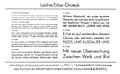
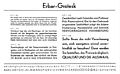
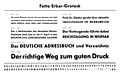
Erbar or Erbar-Grotesk is a sans-serif typeface in the geometric style, one of the first designs of this kind released as type.[1] Designer Jakob Erbar's aim was to design a printing type which would be free of all individual characteristics, possess thoroughly legible letter forms, and be a purely typographic creation. He concluded that this could only work if the type form was developed from a fundamental element, the circle.[2] Erbar-Grotesk was developed in stages; Erbar wrote that he had originally sketched out the design in 1914 but had been prevented from working on it due to the war. The original version of Erbar was released in 1926, following Erbar's "Phosphor" titling capitals of 1922 which are very similar in design.[3][4]

The typeface first explored Bauhaus geometric letterforms with centered text and compact layouts.[5] Under Jakob Erbar's influence, it then evolved to look similar to Bauhaus principles and asymmetrical design of New Typography.[5]

Font

[edit]

Erbar was originally cast by the Ludwig & Mayer foundry of Frankfurt, Germany, with machine composition matrices later being offered by German and then American Linotype.[6][7] Erbar was later exported to the United States and sold by the Continental Type Founders Association.[8] A digital version is sold today by Linotype.

Erbar was cast in four weights with italic and condensed faces. Other variants were offered:

  • Lumina, an open face version.
  • Lux, a version with contrasting outlines.
  • Phosphor, an ultra-bold/inline display version similar to Neuland, released slightly before Erbar itself.[6]
[edit]

Influence on other typefaces

[edit]

The success of Erbar inspired the creation of many new geometric sans-serif faces by competing foundries, including Futura, Metro, Vogue, Spartan and Twentieth Century among others. Of those, Futura proved to be the most successful. That, Jakob Erbar's early death, the small size of Erbar's Ludwig & Mayer Foundry and the international reach of Futura's Bauer Type Foundry led to Erbar becoming less well known than Futura.

Phosphor, an ultra-bold and inline display that was design similar to Erbar but was released first, was particularly popular, and several imitations and revivals were created.

Zhurnalnaya roublennaya (Журнальная рубленая), or Journal Grotesque, was a Russian sans-serif that was created in the Soviet Union by Anatoly Schukin and others and released from 1947 onwards, was quite loosely inspired by Erbar and with Cyrillic and later Latin characters.[9][10][11]

Digitisations

[edit]
Erbar Condensed and Phosphor, as well as some other typefaces designed by Jakob Erbar.

A leading unofficial Erbar digitisation is Dunbar, released by CJ Dunn in late 2016 as an unofficial digitisation in a choice of x-heights named Dunbar Low, Dunbar Text and Dunbar Tall.[12] It is also offered as a variable font, in which the x-height and the weight can be varied smoothly, and as such is the first variable font on sale.

As of 2016, several Erbar digitisations exist under this name. URW++ has released a revival of seven weights (of the normal width only), and a "Neo Mini" digitisation optimised for small sizes, with an enlarged x-height and solid weight.[13][14] Linotype has digitised light and bold weights of the condensed style.[15]

Stephen Coles, an expert on digital fonts, has been critical of the Erbar digitisations on the market, writing that "there is no recommendable digital version...existing revivals neither capture the spirit or breadth of the original family. Still, if you really have a Erbar hankering, URW’s version is the most complete."[16]

Because of Phosphor's popularity, several revivals exist independently of the latter Erbar rereleases (none of which include it), by Monotype and others.[17] Phosphate, an unofficial revival created by Red Rooster Fonts, is bundled with OS X.[18] Zamenhof, by CastleType, is a large revival inspired by Russian adaptations of the style.[19]

Zhurnalnaya roublennaya has itself been digitised by Grilli Type as GT Eesti and (much more loosely) for ParaType as Journal Sans by Olexa Volochay, Maria Selezeneva and Alexandra Korolkova.[9][10][11]

See also

[edit]

References

[edit]
[edit]
Revisions and contributorsEdit on WikipediaRead on Wikipedia
from Grokipedia
Erbar, also known as Erbar-Grotesk, is a pioneering geometric typeface designed by German typographer Jakob Erbar and first released in 1926 by the Ludwig & Mayer in . This typeface is characterized by its strict use of basic geometric forms, such as circles, squares, and straight lines, reflecting the modernist aesthetic of the early and marking it as one of the earliest fully realized examples of a geometric design. Its development spanned from around 1922 to 1930, with initial weights including Kräftig (bold) and Halbfett (medium), which gained popularity for their clean, functional appearance suitable for and use. Jakob Erbar (1878–1935), born in and later based in , was a prominent figure in German typography as a teacher at the Köner Werkschule (Cologne School of Arts and Crafts). Erbar's approach to type design emphasized rationality and simplicity, influenced by the broader movement and the push toward functional modernism in post-World War I Europe, though he worked independently of the Bauhaus itself. His creation of Erbar represented a deliberate shift from traditional serifs and asymmetrical forms toward pure geometry, aligning with the era's industrial and architectural trends. Erbar's significance lies in its role as a precursor to other landmark geometric sans-serifs, predating Paul Renner's Futura (1927) and inspiring subsequent designs that defined 20th-century graphic design. Despite its initial success in Europe—particularly in Germany for posters, packaging, and book covers—the typeface waned in prominence during the mid-20th century as more versatile families like Helvetica gained favor, though it experienced revivals in digital formats by foundries such as Linotype and URW in the late 20th and early 21st centuries. Today, Erbar endures as a testament to the innovative spirit of 1920s typography, embodying the era's quest for universal, machine-age legibility.

History and Development

Origins and Influences

Jakob Erbar (1878–1935) was a German type designer, calligrapher, and educator whose career began with training as a typesetter in during the , followed by studies in under notable figures such as F.H. Ehmcke and Anna Simons. By the early 1900s, he had transitioned into printing and graphic design, teaching at the School of Arts and Crafts from 1908 onward, where he emphasized practical skills in and . Erbar's background in these disciplines laid the foundation for his innovative approach to creation, blending traditional craftsmanship with emerging modernist ideals. The conceptual origins of Erbar trace back to initial sketches begun around 1914, when Erbar explored forms as a means to express contemporary design principles. These early efforts were interrupted by the outbreak of , which halted development amid the broader disruptions in . Resuming in the early 1920s, Erbar refined his ideas in the post-war period, aligning them with the era's push for renewal and efficiency in . Erbar's work was profoundly shaped by the movement, founded in , which championed geometric simplicity and functionalism in and . He drew inspiration from its emphasis on reducing forms to elemental shapes—such as circles, straight lines, and squares—to evoke industrial modernity and universality. In the context of post-World War I Germany, where economic recovery and cultural reconstruction were paramount, sans-serif typefaces like Erbar emerged as symbols of progress, rejecting ornate historical styles in favor of clean, forward-looking aesthetics that mirrored the nation's aspirations for a rational, machine-age future. This typeface was ultimately produced by the Ludwig & Mayer foundry.

Design Process and Release

The development of the Erbar typeface, also known as Erbar-Grotesk, took place from 1922 to 1930 at the Ludwig & Mayer foundry in Frankfurt, Germany, under the direction of designer Jakob Erbar. The project began with the creation of titling capitals, reflecting Erbar's focus on modular, geometric forms suitable for display purposes. In 1922, Ludwig & Mayer released these initial capitals as the typeface Phosphor, a bold, uppercase-only design intended for headlines and signage. This marked the starting point for what would become a complete family, with Phosphor serving as a precursor that emphasized the typeface's innovative geometric structure. The full Erbar family, including lowercase letters and multiple weights, followed in 1926, establishing it as a comprehensive option for both text and display use. Erbar's design positioned it as one of the earliest geometric sans-serifs, predating Paul Renner's Futura by a year and influencing the shift toward modernist in the . For broader distribution, Ludwig & Mayer partnered with Linotype for international machine composition, offering two weights of the standard Erbar and four weights of the condensed variant. In the United States, the was handled by the Continental Type Founders Association starting in the mid-1920s, facilitating its adoption in American printing.

Design Characteristics

Geometric Principles

Erbar's design philosophy centers on a strict application of circular and linear to create letterforms that embody modernist simplicity and universality. Jakob Erbar constructed the typeface using basic geometric primitives, such as perfect circles for the foundation of rounded letters, ensuring a harmonious and mechanically precise appearance suited to the . This approach derives letters like 'o', 'c', and 'e' directly from ideal circular forms, with the 'o' as a pure , the 'c' as a , and the 'e' as a truncated by horizontal strokes, promoting a sense of elemental purity over organic variation. The adopts a reductionist style by eliminating serifs, flourishes, and any decorative elements, reducing forms to their essential linear and curved components for an aesthetic aligned with industrial functionality. Uniform stroke widths across letters reinforce this , where components like verticals, horizontals, and arcs are interchangeable and derived from a consistent grid, distinguishing Erbar from earlier sans-serifs. In contrast to contemporary grotesques, which often retained subtle asymmetries and variable weights from 19th-century models, Erbar enforces stricter geometric purity through its modular construction, prioritizing rational, compass-and-ruler precision over humanistic nuances. For instance, the lowercase 'a' is formed as a halved circle for the bowl, intersected by a straight crossbar and a vertical stem meeting at an acute , creating a double-story structure that maintains along the horizontal axis. Similarly, the 'g' features a simplified and spur derived from circular segments, avoiding elaborate loops to uphold the typeface's geometric rigor.

Typographic Features and Readability

Erbar's typographic features contribute to its reputation for clarity and functionality, particularly in the of early 20th-century German design traditions. The employs monolinear strokes with minimal variation in thickness, creating a uniform appearance that aligns with its geometric foundations based on circular constructions. This monolinearity, combined with open counters in letters such as 'o' and 'a', enhances by allowing for better distinction between forms, especially at smaller sizes. Additionally, subtle diagonal stress in curved elements, like the tails of 'y' and '', introduces a slight dynamism without compromising the overall neutrality, making Erbar suitable for both display and body text applications. The standard set of Erbar features an even x-height that supports consistent readability across lines of text, promoting an even color on the page when set in paragraphs. This balance is particularly effective in German typesetting practices, where the typeface's versatility allows it to perform well from headlines down to 8-point body text, reflecting Jakob Erbar's intent to create a legible form free of ornate distractions. Condensed variants further emphasize economy of space, ideal for compact layouts like signage or advertisements, while maintaining sufficient openness to avoid crowding. In practice, these attributes made Erbar a staple in industrial and functional printing, contributing to its widespread adoption in Europe during the interwar period. Despite these strengths, Erbar has faced criticism for occasional stiffness in its lowercase letters, particularly when compared to more humanist sans-serifs like , which offer greater organic flow. The strict adherence to geometric proportions can result in an awkward visual rhythm in extended reading, especially in the low-x-height variant (Set II), limiting its appeal for prolonged text blocks in some contexts. Nonetheless, its pioneering approach to neutrality and clarity influenced subsequent designs, underscoring its role in advancing practical .

Weights, Styles, and Expansions

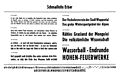
The Erbar family, released by the Ludwig & Mayer foundry starting in 1926, originally comprised four weights: Mager (light), Halbfett (medium or semi-bold), Fett (bold), and Kräftig (heavy). Each weight included matching italic styles to provide slanted alternatives for emphasis and layout flexibility. To support applications requiring narrower letterforms, such as headlines and tight columns, condensed variants under the name Schmale Erbar-Grotesk were introduced in the late . These included at least Mager and Halbfett weights, maintaining the geometric proportions of the regular family while reducing width for space-efficient . By 1930, the Erbar family had grown through ongoing expansions, incorporating specialized outline versions like Lumina (an open, outlined form) and inline variants such as (a bold inline design) for eye-catching display work. These additions enhanced the typeface's utility across , , and print media. Initially limited to uppercase letters in its 1922 prototype, Erbar evolved into a complete by the 1926 full release, incorporating lowercase, numerals, and to overcome early constraints and broaden its adoption in modern .

Phosphor and Other Derivatives

, designed by Jakob Erbar and released by the Ludwig & Mayer foundry in 1922, served as an early precursor to the full Erbar family. This all-caps titling face was produced in a bold weight with an inline structure, creating a heavier and more condensed form optimized for headline use in and display settings. Initially lacking lowercase letters, it emphasized geometric precision and legibility at large sizes, resembling a glowing effect due to its outlined design. By the mid-1920s, elements of were integrated into the Erbar series as the basis for Erbar Bold, bridging its specialized role to the broader family. In 1929, Erbar expanded the lineage with , a medium-weight derivative tailored for applications. Lux featured inline and shadow variants, presenting a thin-thick, two-line display style without lowercase characters, which distinguished it from the standard Erbar weights by prioritizing decorative contrast and visual impact in promotional materials. Its engraved inline aesthetic complemented the geometric purity of the parent design while adapting it for bolder, more ornamental contexts. Ludwig & Mayer further extended Erbar's derivatives through experimental variations by Jakob Erbar, including open faces like Lumina and Lucina. Lumina, an outline version from around 1928, introduced an open, transparent structure ideal for overlay effects in posters and signage. Lucina, released around 1926, was a reverse (inverted outline) version of Erbar, providing additional display options. Meanwhile, (1923) was a separate fat, extrabold design by Erbar serving as a heavyweight companion to the foundry's earlier Feder-Grotesk, with robust proportions for emphatic titling. These designs highlighted the foundry's innovation in adapting geometric principles to niche, high-contrast roles, though was not part of the Erbar family.

Legacy and Influence

Impact on Geometric Sans-Serifs

Erbar-Grotesk, released in 1926 by the Ludwig & Mayer foundry, served as a crucial precursor to Paul Renner's Futura of , establishing foundational principles of geometric construction based on circles and other basic forms that Renner refined for greater commercial appeal. While Futura achieved widespread success through its balanced proportions and marketing, Erbar's earlier emphasis on pure geometric shapes—such as circular 'o' and 'c'—directly informed the modernist trend, positioning it as the inaugural example of the genre. This influence extended to American designs, notably Linotype's Metro No. 1 (1929), designed by William A. Dwiggins, which adopted geometric modularity inspired by the European wave including Erbar and Futura, though with adjustments for in settings. Similarly, in the , Anatoliy Shchukin's Zhurnalnaya Roublennaya (1947), developed at Polygraphmash, drew directly from Erbar-Grotesk's forms alongside Metro, adapting them for Cyrillic use in a constrained typographic environment to evoke and functionality. These borrowings highlight Erbar's role in disseminating geometric sans-serif aesthetics across continents and political contexts. Erbar contributed significantly to the formal classification of "geometric" sans-serifs, distinguishing them from earlier grotesques like through stricter adherence to elemental shapes, while bridging to later Swiss styles by emphasizing neutrality and legibility. This transitional quality—rejecting ornate traditions in favor of Bauhaus-inspired simplicity—helped evolve sans-serifs from 19th-century grotesques toward the modular precision seen in mid-20th-century designs. By the post-1950s era, Erbar's popularity waned as neo-grotesques like (1957) dominated, offering refined proportions and broader availability that overshadowed earlier geometrics in corporate and international applications. Despite this, Erbar has seen renewed interest in modernist retrospectives, with digital revivals and reinterpretations—such as Typotheque's Uni Grotesk (2016)—celebrating its pioneering status in exhibitions and typeface libraries dedicated to 20th-century design history.

Recognition in Typography History

In the 1920s, Erbar gained acclaim across Europe as a modernist icon, representing one of the earliest commercial realizations of geometric sans-serif design principles that aligned closely with the functional aesthetics of the Bauhaus movement. Designed by Jakob Erbar with development starting around 1922 and first released by the Ludwig & Mayer foundry in 1926, the typeface was celebrated for its pure, elemental forms derived from basic geometric shapes, capturing the era's emphasis on rationality and machine-age efficiency in typography. Its debut marked a shift toward sans-serifs that prioritized legibility and universality, influencing the broader New Typography movement and earning recognition in contemporary design discourse as a harbinger of modernist type. During the mid-20th century, Erbar receded into obscurity, eclipsed by the ascendance of neo-grotesque sans-serifs like (1957) and (1957), which offered greater versatility and neutral adaptability for postwar commercial printing. These newer faces, with their refined proportions and extensive families, dominated the market and marginalized earlier geometric designs like Erbar, reducing its presence in catalogs and everyday use. This diminished status is acknowledged in key typographic histories, such as Robert Bringhurst's (first published 1992), where Erbar is referenced as part of the lineage of sans-serif evolution. The has seen a resurgence of interest in Erbar, driven by typographic scholarship that reevaluates its role as a foundational geometric . It features prominently in dedicated studies, including those by Stephen Coles, which underscore the incompleteness of the original Ludwig & Mayer releases—lacking full weights and alternates—and position Erbar as an underappreciated precursor to more famous designs like Futura. Revivals and analyses in outlets like Typographica and Print Magazine have highlighted its cultural significance, framing Erbar as a symbol of early modernist experimentation amid renewed appreciation for interwar European type design. Recent examples include the typeface (2025), which incorporates elements of Erbar-Grotesk in experimental condensed and expanded forms, further underscoring its enduring influence as of 2025. Despite this revival, scholarly coverage of Erbar remains constrained by gaps in archival resources, particularly the scarcity of Jakob Erbar's personal design notes or preparatory sketches, which limits deeper insights into his iterative process. Post-2015 digitizations of historical specimens have begun to address these voids, enabling fresh examinations of the typeface's and variations, though comprehensive personal documentation from Erbar himself (who died in 1935) continues to elude researchers.

Digitizations and Modern Use

Digital Revivals

Linotype released a digital revival of Erbar AT in 2017, featuring two condensed weights without italics, aiming for fidelity to the original geometric forms. This version, known as Erbar AT, supports basic Latin character sets but has been critiqued for limited coverage, lacking comprehensive support for extended languages and advanced typographic features compared to modern standards. URW++ introduced Erbar in as an expanded revival, offering seven weights from Thin to Black in the normal width, plus a condensed variant, with enhanced features including ligatures and fractions for improved digital performance. This adaptation builds on the original's proportions while incorporating contemporary spacing and adjustments suitable for screen and print applications. In 2016, type designer CJ Dunn launched through CJ Type, a interpretation of Erbar that interpolates across multiple weights and optical sizes, including Low and Tall variants for display and a Text subfamily for body use. adds , stylistic alternates for letters like 'a' and 'g' that echo Erbar's experimental originals, and features such as case-sensitive , addressing gaps in earlier digitizations. Red Rooster Collection developed in the 1990s as a revival of the subfamily, an inline display face originally designed by Erbar around , with Pro versions released around 2010 featuring solid and outline styles in for headline and decorative applications. This version emphasizes the bold, geometric inline structure for large-scale visual impact, maintaining the historical flair while optimizing for digital rendering.

Contemporary Availability and Applications

Digitized versions of Erbar are widely available through established font distribution platforms, including MyFonts, Linotype, and , offering licenses for both desktop and web applications. The URW Erbar family on MyFonts comprises nine styles, with individual styles priced at $44.49 and the complete family pack at $88.99, enabling use in software and online embedding via webfont kits. Linotype's Erbar AT edition provides two styles, available for $29.99 per style or $88.99 for the full family, supporting similar licensing options for professional workflows. In modern design projects, Erbar finds application in branding for retro-modern logos that evoke early 20th-century , editorial design for clean headlines and body text in print publications, and web where its clarity enhances readability across devices. implementations in certain revivals facilitate responsive scaling, allowing weight and width adjustments to adapt seamlessly to varying screen sizes and layouts without multiple file downloads. Updates to Erbar revivals since 2015 have focused on expanding character support for non-Latin scripts, such as Cyrillic, to overcome historical limitations in glyph coverage and broaden global usability. For instance, the Journal Sans family, a direct descendant of Erbar-Grotesk adaptations, now accommodates 83 languages including Russian, Ukrainian, and Polish, making it suitable for multilingual editorial and branding contexts. As of 2025, these remain the primary digital versions with no major new revivals reported. Contemporary challenges include the prevalence of font piracy, which erodes licensing integrity across the industry, and the persistent demand for enhanced sets in revivals to fully support diverse scripts and symbols in international projects.

References

Add your contribution
Related Hubs
User Avatar
No comments yet.