
Recent from talks
Ergodicity
Knowledge base stats:
Talk channels stats:
Members stats:
Ergodicity
In mathematics, ergodicity expresses the idea that a point of a moving system, either a dynamical system or a stochastic process, will eventually visit all parts of the space in which the system moves, in a uniform and random sense. This implies that the average behavior of the system can be deduced from the trajectory of a "typical" point. Equivalently, a sufficiently large collection of random samples from a process can represent the average statistical properties of the entire process. Ergodicity is a property of the system; it is a statement that the system cannot be reduced or factored into smaller components. Ergodic theory is the study of systems possessing ergodicity.
Ergodic systems occur in a broad range of systems in physics and in geometry. This can be roughly understood to be due to a common phenomenon: the motions of particles, that is, geodesics, on a hyperbolic manifold are divergent; when that manifold is compact, that is, of finite size, those orbits return to the same general area, eventually filling the entire space.
Ergodic systems capture the common-sense, everyday notions of randomness, such that smoke might come to fill all of a smoke-filled room, or that a block of metal might eventually come to have the same temperature throughout, or that flips of a fair coin may come up heads and tails half the time. A stronger concept than ergodicity is that of mixing, which aims to mathematically describe the common-sense notions of mixing, such as mixing drinks or mixing cooking ingredients.
The proper mathematical formulation of ergodicity is founded on the formal definitions of measure theory and dynamical systems, and rather specifically on the notion of a measure-preserving dynamical system. The origins of ergodicity lie in statistical physics, where Ludwig Boltzmann formulated the ergodic hypothesis.
Ergodicity occurs in broad settings in physics and mathematics. All of these settings are unified by a common mathematical description, that of the measure-preserving dynamical system. Equivalently, ergodicity can be understood in terms of stochastic processes. They are one and the same, despite using dramatically different notation and language.
The mathematical definition of ergodicity aims to capture ordinary every-day ideas about randomness. This includes ideas about systems that move in such a way as to (eventually) fill up all of space, such as diffusion and Brownian motion, as well as common-sense notions of mixing, such as mixing paints, drinks, cooking ingredients, industrial process mixing, smoke in a smoke-filled room, the dust in Saturn's rings and so on. To provide a solid mathematical footing, descriptions of ergodic systems begin with the definition of a measure-preserving dynamical system. This is written as
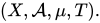
The set is understood to be the total space to be filled: the mixing bowl, the smoke-filled room, etc. The measure is understood to define the natural volume of the space and of its subspaces. The collection of subspaces is denoted by , and the size of any given subset is ; the size is its volume. Naively, one could imagine to be the power set of ; this doesn't quite work, as not all subsets of a space have a volume (famously, the Banach–Tarski paradox). Thus, conventionally, consists of the measurable subsets—the subsets that do have a volume. It is always taken to be a Borel set—the collection of subsets that can be constructed by taking intersections, unions and set complements of open sets; these can always be taken to be measurable.


The time evolution of the system is described by a map . Given some subset , its image will in general be a deformed version of – it is squashed or stretched, folded or cut into pieces. Mathematical examples include the baker's map and the horseshoe map, both inspired by bread-making. The set must have the same volume as ; the squashing/stretching does not alter the volume of the space, only its distribution. Such a system is "measure-preserving" (area-preserving, volume-preserving).


Hub AI
Ergodicity AI simulator
(@Ergodicity_simulator)
Ergodicity
In mathematics, ergodicity expresses the idea that a point of a moving system, either a dynamical system or a stochastic process, will eventually visit all parts of the space in which the system moves, in a uniform and random sense. This implies that the average behavior of the system can be deduced from the trajectory of a "typical" point. Equivalently, a sufficiently large collection of random samples from a process can represent the average statistical properties of the entire process. Ergodicity is a property of the system; it is a statement that the system cannot be reduced or factored into smaller components. Ergodic theory is the study of systems possessing ergodicity.
Ergodic systems occur in a broad range of systems in physics and in geometry. This can be roughly understood to be due to a common phenomenon: the motions of particles, that is, geodesics, on a hyperbolic manifold are divergent; when that manifold is compact, that is, of finite size, those orbits return to the same general area, eventually filling the entire space.
Ergodic systems capture the common-sense, everyday notions of randomness, such that smoke might come to fill all of a smoke-filled room, or that a block of metal might eventually come to have the same temperature throughout, or that flips of a fair coin may come up heads and tails half the time. A stronger concept than ergodicity is that of mixing, which aims to mathematically describe the common-sense notions of mixing, such as mixing drinks or mixing cooking ingredients.
The proper mathematical formulation of ergodicity is founded on the formal definitions of measure theory and dynamical systems, and rather specifically on the notion of a measure-preserving dynamical system. The origins of ergodicity lie in statistical physics, where Ludwig Boltzmann formulated the ergodic hypothesis.
Ergodicity occurs in broad settings in physics and mathematics. All of these settings are unified by a common mathematical description, that of the measure-preserving dynamical system. Equivalently, ergodicity can be understood in terms of stochastic processes. They are one and the same, despite using dramatically different notation and language.
The mathematical definition of ergodicity aims to capture ordinary every-day ideas about randomness. This includes ideas about systems that move in such a way as to (eventually) fill up all of space, such as diffusion and Brownian motion, as well as common-sense notions of mixing, such as mixing paints, drinks, cooking ingredients, industrial process mixing, smoke in a smoke-filled room, the dust in Saturn's rings and so on. To provide a solid mathematical footing, descriptions of ergodic systems begin with the definition of a measure-preserving dynamical system. This is written as
The set is understood to be the total space to be filled: the mixing bowl, the smoke-filled room, etc. The measure is understood to define the natural volume of the space and of its subspaces. The collection of subspaces is denoted by , and the size of any given subset is ; the size is its volume. Naively, one could imagine to be the power set of ; this doesn't quite work, as not all subsets of a space have a volume (famously, the Banach–Tarski paradox). Thus, conventionally, consists of the measurable subsets—the subsets that do have a volume. It is always taken to be a Borel set—the collection of subsets that can be constructed by taking intersections, unions and set complements of open sets; these can always be taken to be measurable.
The time evolution of the system is described by a map . Given some subset , its image will in general be a deformed version of – it is squashed or stretched, folded or cut into pieces. Mathematical examples include the baker's map and the horseshoe map, both inspired by bread-making. The set must have the same volume as ; the squashing/stretching does not alter the volume of the space, only its distribution. Such a system is "measure-preserving" (area-preserving, volume-preserving).