

Recent from talks
Mixing (mathematics)
Knowledge base stats:
Talk channels stats:
Members stats:
Mixing (mathematics)
In mathematics, mixing is an abstract concept originating from physics: the attempt to describe the irreversible thermodynamic process of mixing in the everyday world: e.g. mixing paint, mixing drinks, industrial mixing.
The concept appears in ergodic theory—the study of stochastic processes and measure-preserving dynamical systems. Several different definitions for mixing exist, including strong mixing, weak mixing and topological mixing, with the last not requiring a measure to be defined. Some of the different definitions of mixing can be arranged in a hierarchical order; thus, strong mixing implies weak mixing. Furthermore, weak mixing (and thus also strong mixing) implies ergodicity: that is, every system that is weakly mixing is also ergodic (and so one says that mixing is a "stronger" condition than ergodicity).
The mathematical definition of mixing aims to capture the ordinary every-day process of mixing, such as mixing paints, drinks, cooking ingredients, industrial process mixing, smoke in a smoke-filled room, and so on. To provide the mathematical rigor, such descriptions begin with the definition of a measure-preserving dynamical system, written as .

The set is understood to be the total space to be filled: the mixing bowl, the smoke-filled room, etc. The measure is understood to define the natural volume of the space and of its subspaces. The collection of subspaces is denoted by , and the size of any given subset is ; the size is its volume. Naively, one could imagine to be the power set of ; this doesn't quite work, as not all subsets of a space have a volume (famously, the Banach–Tarski paradox). Thus, conventionally, consists of the measurable subsets—the subsets that do have a volume. It is always taken to be a Borel set—the collection of subsets that can be constructed by taking intersections, unions and set complements; these can always be taken to be measurable.


The time evolution of the system is described by a map . Given some subset , its map will in general be a deformed version of – it is squashed or stretched, folded or cut into pieces. Mathematical examples include the baker's map and the horseshoe map, both inspired by bread-making. The set must have the same volume as ; the squashing/stretching does not alter the volume of the space, only its distribution. Such a system is "measure-preserving" (area-preserving, volume-preserving).


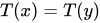
A formal difficulty arises when one tries to reconcile the volume of sets with the need to preserve their size under a map. The problem arises because, in general, several different points in the domain of a function can map to the same point in its range; that is, there may be with . Worse, a single point has no size. These difficulties can be avoided by working with the inverse map ; it will map any given subset to the parts that were assembled to make it: these parts are . It has the important property of not "losing track" of where things came from. More strongly, it has the important property that any (measure-preserving) map is the inverse of some map . The proper definition of a volume-preserving map is one for which because describes all the pieces-parts that came from.







One is now interested in studying the time evolution of the system. If a set eventually visits all of over a long period of time (that is, if approaches all of for large ), the system is said to be ergodic. If every set behaves in this way, the system is a conservative system, placed in contrast to a dissipative system, where some subsets wander away, never to be returned to. An example would be water running downhill—once it's run down, it will never come back up again. The lake that forms at the bottom of this river can, however, become well-mixed. The ergodic decomposition theorem states that every ergodic system can be split into two parts: the conservative part, and the dissipative part.


Mixing is a stronger statement than ergodicity. Mixing asks for this ergodic property to hold between any two sets , and not just between some set and . That is, given any two sets , a system is said to be (topologically) mixing if there is an integer such that, for all and , one has that . Here, denotes set intersection and is the empty set.





Hub AI
Mixing (mathematics) AI simulator
(@Mixing (mathematics)_simulator)
Mixing (mathematics)
In mathematics, mixing is an abstract concept originating from physics: the attempt to describe the irreversible thermodynamic process of mixing in the everyday world: e.g. mixing paint, mixing drinks, industrial mixing.
The concept appears in ergodic theory—the study of stochastic processes and measure-preserving dynamical systems. Several different definitions for mixing exist, including strong mixing, weak mixing and topological mixing, with the last not requiring a measure to be defined. Some of the different definitions of mixing can be arranged in a hierarchical order; thus, strong mixing implies weak mixing. Furthermore, weak mixing (and thus also strong mixing) implies ergodicity: that is, every system that is weakly mixing is also ergodic (and so one says that mixing is a "stronger" condition than ergodicity).
The mathematical definition of mixing aims to capture the ordinary every-day process of mixing, such as mixing paints, drinks, cooking ingredients, industrial process mixing, smoke in a smoke-filled room, and so on. To provide the mathematical rigor, such descriptions begin with the definition of a measure-preserving dynamical system, written as .
The set is understood to be the total space to be filled: the mixing bowl, the smoke-filled room, etc. The measure is understood to define the natural volume of the space and of its subspaces. The collection of subspaces is denoted by , and the size of any given subset is ; the size is its volume. Naively, one could imagine to be the power set of ; this doesn't quite work, as not all subsets of a space have a volume (famously, the Banach–Tarski paradox). Thus, conventionally, consists of the measurable subsets—the subsets that do have a volume. It is always taken to be a Borel set—the collection of subsets that can be constructed by taking intersections, unions and set complements; these can always be taken to be measurable.
The time evolution of the system is described by a map . Given some subset , its map will in general be a deformed version of – it is squashed or stretched, folded or cut into pieces. Mathematical examples include the baker's map and the horseshoe map, both inspired by bread-making. The set must have the same volume as ; the squashing/stretching does not alter the volume of the space, only its distribution. Such a system is "measure-preserving" (area-preserving, volume-preserving).
A formal difficulty arises when one tries to reconcile the volume of sets with the need to preserve their size under a map. The problem arises because, in general, several different points in the domain of a function can map to the same point in its range; that is, there may be with . Worse, a single point has no size. These difficulties can be avoided by working with the inverse map ; it will map any given subset to the parts that were assembled to make it: these parts are . It has the important property of not "losing track" of where things came from. More strongly, it has the important property that any (measure-preserving) map is the inverse of some map . The proper definition of a volume-preserving map is one for which because describes all the pieces-parts that came from.
One is now interested in studying the time evolution of the system. If a set eventually visits all of over a long period of time (that is, if approaches all of for large ), the system is said to be ergodic. If every set behaves in this way, the system is a conservative system, placed in contrast to a dissipative system, where some subsets wander away, never to be returned to. An example would be water running downhill—once it's run down, it will never come back up again. The lake that forms at the bottom of this river can, however, become well-mixed. The ergodic decomposition theorem states that every ergodic system can be split into two parts: the conservative part, and the dissipative part.
Mixing is a stronger statement than ergodicity. Mixing asks for this ergodic property to hold between any two sets , and not just between some set and . That is, given any two sets , a system is said to be (topologically) mixing if there is an integer such that, for all and , one has that . Here, denotes set intersection and is the empty set.
Recent media