


Community hub
Recent from talks
Contribute something
Nothing was collected or created yet.
Eric Maynor
View on Wikipedia
Eric Demarqua Maynor (born June 11, 1987) is an American former professional basketball player and current assistant coach for the Oklahoma City Thunder of the National Basketball Association. He played college basketball for Virginia Commonwealth University. As a senior, he averaged 22.4 points, 6.2 assists, 3.6 rebounds and 1.7 steals per game in the 2008–09 season.
Key Information


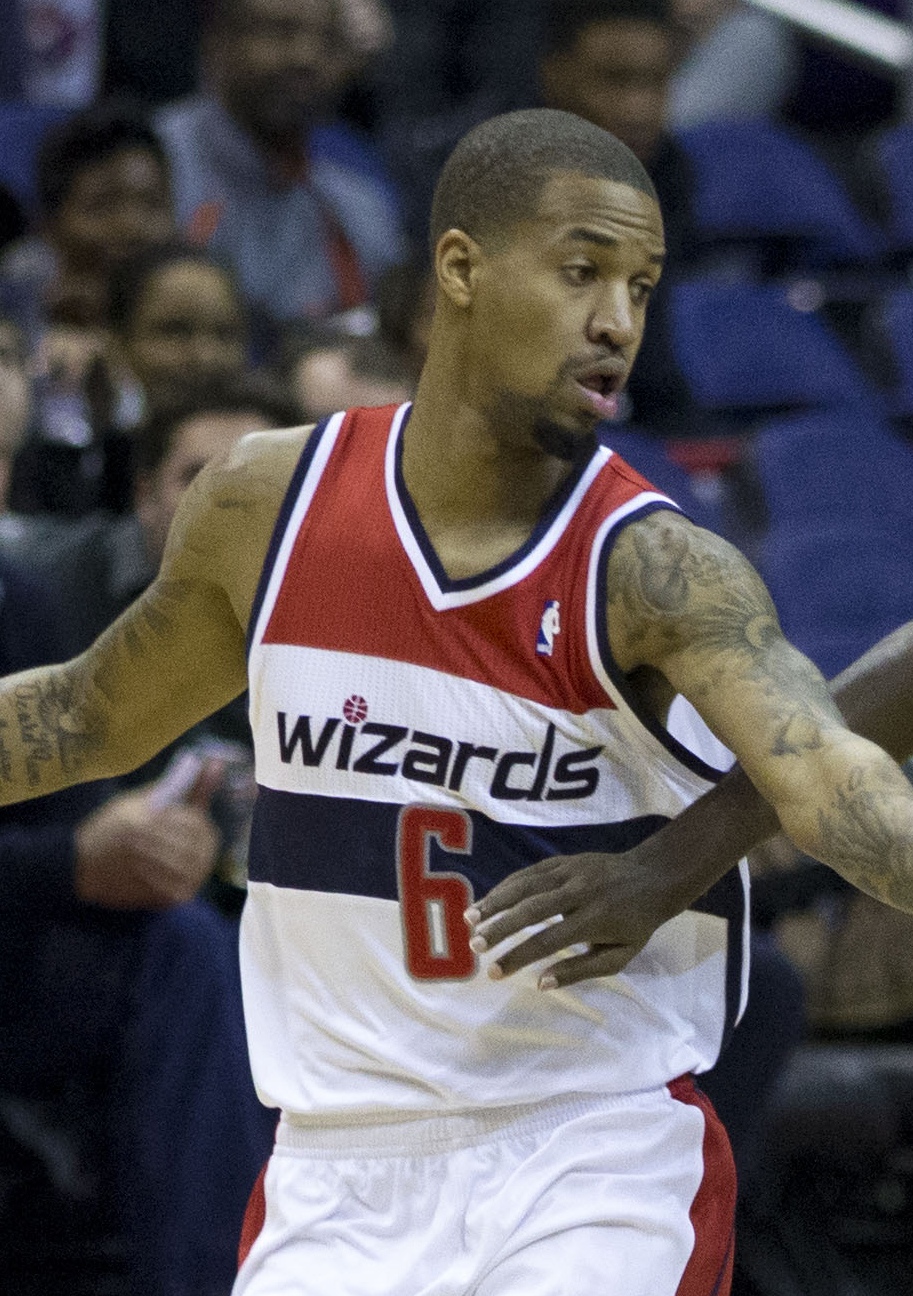
Maynor was drafted by the Utah Jazz of the NBA in 2009. He has also played for the Oklahoma City Thunder, Portland Trail Blazers, Washington Wizards and Philadelphia 76ers.
Early years
[edit]Eric Demarqua Maynor was born June 11, 1987, in Raeford, North Carolina, the third of four children of George Maynor and Barbara Robinson.[1] Maynor's father was a former collegiate basketball player at East Carolina University and was a fourth-round selection of the Chicago Bulls in the 1979 NBA draft.[1]
High school career
[edit]Maynor began at Hoke County High School in Raeford, then transferred to Westover High School in neighboring Fayetteville for his senior year to play alongside his friend and AAU teammate De'shaune Griffin.[2] Maynor led the team to the North Carolina state championship game, scoring 25 points in a loss to North Mecklenburg High School on March 14, 2005.[3] For his outstanding performance during the season Maynor was named to the 2004/05 North Carolina All State Basketball team by the sports website NCPreps.com.[4]
College career
[edit]Eric Maynor was a four-year player in the men's basketball program at Virginia Commonwealth University (VCU). He graduated from VCU with a degree in Sports Management.[1]
Freshman season (2005–06)
[edit]Maynor played in 29 games as a freshman at VCU, cracking the team's starting lineup by the end of the season.[1] Maynor averaged 4.7 points and 2.2 assists in an average of 15.7 minutes per game during this first collegiate campaign.[1]
Sophomore season (2006–07)
[edit]On March 15, 2007, Maynor scored 22 points, including the game-winning shot, in VCU's victory over Duke in the first round of the 2007 NCAA Division I men's basketball tournament. Maynor's last-minute heroics are also what helped VCU to overcome George Mason in the 2007 Colonial Athletic Association (CAA) championship game.
Over the summer of 2007, Maynor was selected to represent the United States in the Pan American Games, alongside D. J. White and Michael Beasley.[1] Maynor was only able to play two games for the American Pan-Am team, however, before he was forced from further action by a hip injury.[1] Maynor was also named one of the 50 pre-season candidates for the men's 2007–08 John R. Wooden Award, the nation's most prestigious college basketball honor.[1]
Junior season (2007–08)
[edit]Maynor helped VCU win the CAA regular-season title, though the team fell in the semi-finals of the conference tournament to William & Mary. He was selected as the CAA Player of the Year and selected to the All-CAA first team.[5] The Rams failed to reach the NCAA Tournament and went on to play in the NIT, where they lost in the first round against the University of Alabama at Birmingham.
Senior season (2008–09)
[edit]During the 2008–09 season, Eric Maynor became VCU's all-time leader in assists[6] and in made free throws.[6] On February 28, 2009, Maynor became the leading scorer in VCU history with a floater against Georgia State. As of March 10, 2009, he had scored a school record 1,929 points. Maynor also led VCU to a second CAA title during his career, scoring 25 points in a 71–50 victory over George Mason on March 9, 2009, at the Richmond Coliseum. The Rams went on to the 2009 NCAA Tournament but lost to UCLA when Maynor missed a buzzer-beater to win the game.
Professional career
[edit]NBA
[edit]Utah Jazz (2009)
[edit]Maynor was drafted 20th overall by the Utah Jazz in the 2009 NBA draft.[7] He became the first VCU player ever selected in the first round of the NBA draft.[1]
Maynor signed a two-year contract with the Jazz on July 1, 2009, and made $1.3 million in his rookie season.[8] Although he was to back up Deron Williams, Maynor had a positive outlook on the situation. When asked in an interview with RealCollegeBasketball.com what he thought about coming off the bench in Utah, Maynor replied, "Feel real good about it... I'm getting a chance to learn from some of the best".[9]
Oklahoma City Thunder (2009–2013)
[edit]On December 22, 2009, Maynor, along with Matt Harpring, was traded to the Oklahoma City Thunder for the rights to Peter Fehse.[10] According to a statement made by Jazz general manager Kevin O'Connor at the time of the deal, the trade of Maynor along with the $6.5 million contract of the injured power forward Harpring was made for financial reasons, in an effort to reduce the team's liability under the NBA's punitive "luxury tax" on teams with excessive salaries.[11]
"Trading Eric was a difficult decision," O'Connor acknowledged, while noting that the team remained strong at the point guard position with star Deron Williams and Ronnie Price as a capable and proven reserve player.[11]
Maynor wound up as the backup point guard on the young Thunder team behind the emerging superstar Russell Westbrook, drafted by the franchise as the #4 overall pick one year prior to Maynor coming into the NBA.
On January 7, 2012, the Thunder reported that Maynor had torn his right anterior cruciate ligament (ACL) in the fourth quarter of Oklahoma City's 98–95 win over the Houston Rockets and would miss the remainder of the season. Without Maynor the Thunder reached the 2012 NBA Finals, but lost in five games to the Miami Heat.
Portland Trail Blazers (2013)
[edit]In a deal concluded just 30 minutes before the noon trade deadline on February 21, 2013, Maynor was traded to the Portland Trail Blazers for the NBA rights to Georgios Printezis.[12] Maynor was averaging just 2.8 points and 2.0 assists in an average of about 10.6 minutes per game playing for the Thunder and had fallen to number three on the team's depth chart for point guards, with second-year player Reggie Jackson emerging to capture most of the team's backup PG minutes.[13] The Blazers were forced to waive reserve point guard Ronnie Price to make room on the team's 15-man roster for Maynor.[13]
Portland general manager Neil Olshey was effusive about Maynor's style of play and his fit for the club, calling Maynor "a great guy to run our second unit while being able to play with our starters."[12] Olshey noted that Maynor was known for making excellent decisions with the basketball while playing at a steady and reliable pace and offered the possibility that Maynor might potentially share time in the backcourt with Blazer rookie star Damian Lillard.[12]
Olshey expressed hope that Maynor would mesh well with the team and make a solid long-term addition to the roster, declaring:
"You don't make moves just for 28 games, but clearly there's going to be an evaluation curve for us where we're going to have to evaluate Eric, see how he fits in with our team, our style of play, our culture.... We'll see what kind of opportunities present themselves."[12]
Washington Wizards (2013–2014)
[edit]On July 10, 2013, Maynor signed with the Washington Wizards.[14]
Philadelphia 76ers (2014)
[edit]On February 20, 2014, Maynor was traded to the Philadelphia 76ers in a three-team trade involving the Nuggets and the Wizards.[15] On March 17, 2014, he was waived by the 76ers.[16]
Europe
[edit]On January 14, 2015, Maynor signed a contract with Pallacanestro Varese of Italy for the rest of the 2014–15 Lega Basket Serie A season.[17]
On July 23, 2015, he signed a one-year contract with the Russian club Nizhny Novgorod.[18]
On July 27, 2016, Maynor returned to Pallacanestro Varese, signing a contract for the 2016–17 season.[19]
On November 20, 2017, Maynor signed with Italian club Orlandina Basket for the rest of the 2017–18 season.[20]
The Basketball Tournament
[edit]In 2017, Maynor participated in The Basketball Tournament for Ram Nation, a team of VCU alumni. Maynor averaged 13.5 PPG, 7.3 APG, and 5.5 RPG to help Ram Nation reach the Elite 8. In the Elite 8, Ram Nation lost a close game to the eventual tournament champs, Overseas Elite. The Basketball Tournament is an annual $2 million winner-take-all tournament broadcast on ESPN.[21]
Coaching career
[edit]In September 2019, Maynor was named assistant coach of the Oklahoma City Blue.[22]
In August 2021, Maynor was moved from the Blue staff to the Thunder as a player development coach.[23]
NBA career statistics
[edit]| GP | Games played | GS | Games started | MPG | Minutes per game |
| FG% | Field goal percentage | 3P% | 3-point field goal percentage | FT% | Free throw percentage |
| RPG | Rebounds per game | APG | Assists per game | SPG | Steals per game |
| BPG | Blocks per game | PPG | Points per game | Bold | Career high |
Regular season
[edit]| Year | Team | GP | GS | MPG | FG% | 3P% | FT% | RPG | APG | SPG | BPG | PPG |
|---|---|---|---|---|---|---|---|---|---|---|---|---|
| 2009–10 | Utah | 26 | 2 | 14.0 | .391 | .208 | .758 | 1.5 | 3.1 | .5 | .1 | 5.2 |
| 2009–10 | Oklahoma City | 55 | 0 | 16.5 | .434 | .362 | .692 | 1.7 | 3.4 | .5 | .1 | 4.5 |
| 2010–11 | Oklahoma City | 82 | 0 | 14.6 | .402 | .385 | .729 | 1.5 | 2.9 | .4 | .1 | 4.2 |
| 2011–12 | Oklahoma City | 9 | 0 | 15.2 | .359 | .353 | 1.000 | 1.4 | 2.4 | .6 | .0 | 4.2 |
| 2012–13 | Oklahoma City | 37 | 0 | 10.6 | .313 | .326 | .810 | .5 | 2.0 | .3 | .0 | 2.8 |
| 2012–13 | Portland | 27 | 0 | 21.2 | .422 | .380 | .683 | 1.0 | 4.0 | .4 | .0 | 6.9 |
| 2013–14 | Washington | 23 | 0 | 9.3 | .292 | .320 | .667 | 1.0 | 1.7 | .2 | .0 | 2.3 |
| 2013–14 | Philadelphia | 8 | 0 | 14.0 | .379 | .333 | .500 | 1.9 | 1.5 | .5 | .3 | 3.8 |
| Career | 267 | 2 | 14.6 | .392 | .350 | .721 | 1.3 | 2.8 | .4 | .1 | 4.3 | |
Playoffs
[edit]| Year | Team | GP | GS | MPG | FG% | 3P% | FT% | RPG | APG | SPG | BPG | PPG |
|---|---|---|---|---|---|---|---|---|---|---|---|---|
| 2010 | Oklahoma City | 6 | 0 | 12.7 | .300 | .167 | .818 | 1.5 | 1.5 | .2 | .2 | 3.7 |
| 2011 | Oklahoma City | 17 | 0 | 12.9 | .377 | .360 | .789 | 1.3 | 2.2 | .5 | .0 | 4.8 |
| Career | 23 | 0 | 12.9 | .361 | .323 | .800 | 1.3 | 2.0 | .4 | .0 | 4.5 | |
References
[edit]- ^ a b c d e f g h i "Eric Maynor," NBA.com, Retrieved Feb. 22, 2013.
- ^ This assertion as to the reason for the change of schools is unsourced but appears to be accurate, as De'shaune Griffin's father was an assistant boys' basketball coach at Westover High. See: "#3 De'shaune Griffin," Iona College Gaels, www.icgaels.com
- ^ Bob Gibbons, "State Champions Crowned in North Carolina," Rivals.com, www.collegebasketball.rivals.com/ March 14, 2005.
- ^ Don Hines, "The NCPreps.com 2004-05 North Carolina All State Basketball Team," NCPreps.com/ April 27, 2005.
- ^ VCU’S Maynor Headlines 2007-08: All-CAA Men's Basketball Team," CAA Hoop Scoop, www.caasports.com/ March 6, 2008.
- ^ a b "Regular Season Crown, Scoring Title on the Line Saturday at 4 pm," Archived 2011-09-01 at the Wayback Machine VCU Rams Basketball, www.vcuathletics.tv/ Feb. 28, 2009.
- ^ "Eric Demarqua Maynor". Basketball-Reference.Com. Retrieved December 10, 2012.
- ^ "Rookie Maynor signs two-year deal with Jazz". NBA.com. Archived from the original on November 8, 2012. Retrieved July 1, 2009.
- ^ "RealCollegeBasketball.com's Interview With Eric Maynor". Archived from the original on August 25, 2011. Retrieved August 13, 2009.
- ^ "Thunder Acquires Maynor From Utah Jazz," NBA.com, Dec. 22, 2009.
- ^ a b Associated Press, "Maynor Headed to Thunder," via ESPN.com Dec. 23, 2009.
- ^ a b c d Mike Tokito, "Late Trade Lands Backup Point Guard: Eric Maynor Moves from Thunder Bench to Playing time with Blazers," The Oregonian, Feb. 22, 2013; pp. D1, 5.
- ^ a b Ben Golliver, "Blazers Trade For Thunder G Eric Maynor; Waive Ronnie Price," Blazers Edge, Feb. 21, 2013.
- ^ "Wizards Sign Eric Maynor". NBA.com. Retrieved July 10, 2013.
- ^ Sixers Acquire Two Future Second-Round Picks as Part of Three Team Trade
- ^ Sixers Sign Forward James Nunnally to 10-day Contract
- ^ "La Pallacanestro OpenJobMetis Varese ingaggia Eric Maynor". pallacanestrovarese.it (in Italian). Pallacanestro Varese. Archived from the original on January 19, 2015. Retrieved January 14, 2015.
- ^ "Nizhny Novgorod signs playmaker Maynor". Eurocupbasketball.com. July 23, 2015. Archived from the original on July 23, 2015. Retrieved July 23, 2015.
- ^ "IL RITORNO DI ERIC MAYNOR". pallacanestrovarese.it (in Italian). July 27, 2016. Archived from the original on January 12, 2017. Retrieved July 27, 2016.
- ^ "Eric Maynor signs with Orlandina Basket". Sportando.com. November 20, 2017. Retrieved November 20, 2017.
- ^ "Eric Maynor | The Basketball Tournament". www.thetournament.com. Archived from the original on May 27, 2017.
- ^ "Thunder hires former OKC guard Eric Maynor as Blue assistant". THE OKLAHOMAN. September 26, 2019.
- ^ "Anthony Morrow and Eric Maynor Join Thunder Staff". Sports Illustrated. August 10, 2021.
External links
[edit]- Career statistics from NBA.com · Basketball Reference
- ESPN.com Profile
- FIBA.com Profile
Eric Maynor
View on GrokipediaEarly life
Childhood and family background
Eric Demarqua Maynor was born on June 11, 1987, in Raeford, North Carolina, a small town in Hoke County with a population under 5,000, known primarily for its turkey farming industry.[1][10] He grew up one of five children to George Maynor and Barbara Johnson Maynor, in a modest environment near the North Raeford Trailer Park.[10] His father, George, had pursued a basketball career himself, playing point guard at Hoke County High School before attending East Carolina University, where he earned a spot in the 1979 NBA Draft as the 72nd overall pick by the Chicago Bulls; however, he was released after just two weeks in training camp and returned to Raeford to work as a corrections officer.[10][11] Maynor's early interest in basketball was profoundly shaped by his family's athletic legacy and the local North Carolina environment, where the sport held a strong cultural presence. Starting at age six, he tagged along with older siblings, including brothers Tony and Rodney, to play on a makeshift dirt court fashioned from power line poles on Upchurch Street, honing his skills under streetlights until dark.[10][12] His mother, Barbara, who juggled multiple jobs, played a pivotal role by driving him to practices and fostering his dedication, often recalling his assurances that "it’s going to pay off one day. Just believe. Just trust me."[10] George Maynor instilled fundamentals and resilience in his children, drawing from his own experiences of being cut from the NBA, emphasizing education alongside basketball and positioning Eric as a natural point guard from a young age.[10][13] This family-driven foundation continued through Maynor's formative years, as he participated in junior high pickup games with his father and brother, developing signature moves like a high-arching teardrop shot while working summer jobs for Raeford's parks department to stay immersed in sports.[13] By 2005, he graduated from Westover Senior High School in nearby Fayetteville, North Carolina, setting the stage for his recruitment to college basketball programs.[1]High school career
Maynor began his high school basketball career at Hoke County High School in Raeford, North Carolina, where he played for three years before transferring to Westover High School in Fayetteville for his senior season.[1] Following in the footsteps of his father, George Maynor, a point guard at East Carolina University in the 1970s, Eric developed his skills as a quick and crafty guard.[12] During his junior year at Hoke County, Maynor demonstrated shooting prowess, connecting on 39% of his three-point attempts while emerging as a key contributor for the team.[14] In his senior year at Westover, he elevated his game significantly, averaging 28.3 points per game, 1.7 steals per game, and shooting 36% from beyond the arc.[15][14] His standout performances included a 40-point outburst (with 8 rebounds, 5 assists, 5 steals, and 3 blocks) in the 2005 East Regional Finals, helping propel Westover to the North Carolina 4A state championship game, where he scored a team-high 25 points despite a narrow loss.[15] For his efforts, Maynor earned all-state honors as one of North Carolina's top performers.[15] Maynor's high school exploits drew interest from mid-major programs, including most teams in the Colonial Athletic Association and others outside the conference.[16] He committed to Virginia Commonwealth University on February 2, 2005, choosing the Rams for their fit with his playing style.[17]College career
Freshman season (2005–06)
Following a standout high school career at Westover Senior High School in Fayetteville, North Carolina, where he earned all-state honors, Eric Maynor committed to Virginia Commonwealth University (VCU) in February 2005.[17] He transitioned to college basketball as a freshman under head coach Jeff Capel, adapting to the Division I level as a reserve point guard on a team featuring experienced upperclassmen.[18] Maynor focused on learning the system's nuances, providing energy off the bench while developing his playmaking skills in limited minutes.[19] In the 2005–06 season, Maynor appeared in 29 games for the VCU Rams, starting just four, and averaged 4.7 points, 2.2 assists, and 1.3 rebounds per game while playing 15.7 minutes.[20] His shooting efficiency included a 43.0% field goal percentage, 20.0% from three-point range, and an impressive 82.9% from the free-throw line.[20] These contributions marked a solid adjustment for a true freshman, emphasizing ball-handling and perimeter defense in a reserve role that supported the team's up-tempo style.[19] VCU concluded the year with a 19–10 overall record and an 11–7 mark in Colonial Athletic Association (CAA) play, finishing sixth in the conference standings.[18] Maynor's notable performances included his debut on November 26, 2005, against Houston, where he scored 2 points in 8 minutes off the bench.[21] In an early conference game versus UNC Wilmington on December 4, 2005, he tallied 5 assists in 15 minutes despite scoring zero points.[21] His season highlight came in the CAA Tournament against Hofstra on March 4, 2006, recording a career-high 16 points and 5 assists in 35 minutes.[21]Sophomore season (2006–07)
Following his freshman season as a reserve guard, where he averaged 4.7 points and 2.2 assists per game off the bench, Eric Maynor emerged as a full-time starter during the 2006–07 campaign under new head coach Anthony Grant, who had taken over after Jeff Capel's departure.[20][22] Maynor's promotion to starting point guard marked a significant step in his development, as he anchored the VCU Rams' backcourt and contributed to a dominant regular season in the Colonial Athletic Association (CAA).[22] Maynor's statistical output improved markedly, with season averages of 13.9 points, 6.4 assists, and 1.4 steals per game across 35 appearances, starting 34.[20] His playmaking prowess stood out, as he led the CAA in assists and ranked fifth nationally with 6.4 per game, while also bolstering the team's defense with his steals.[20] These contributions helped propel VCU to a 26–5 regular-season record and a first-place finish in the CAA standings at 16–2.[22] Maynor earned first-team All-CAA honors for his leadership and performance, becoming the only sophomore on the squad to receive such recognition that year.[23] The Rams, seeded first in the CAA Tournament, advanced to the championship game, where Maynor's efforts secured the title and an automatic bid to the NCAA Tournament.[22] A highlight came in the NCAA first round on March 15, 2007, when Maynor scored 22 points and hit a game-winning 17-foot jumper with 1.8 seconds left to upset No. 6 seed Duke 79–77, advancing VCU to the second round for the first time since 1985.[24][25]Junior season (2007–08)
In his junior season, Eric Maynor emerged as the primary leader for the VCU Rams, building on his starting experience from the previous year to anchor the team's offense. He averaged 17.9 points, 4.2 rebounds, and a league-high 5.5 assists per game over 32 appearances, all as starts, while shooting 45.9% from the field and 39.4% from three-point range.[20] These figures solidified his reputation as the Colonial Athletic Association's (CAA) premier point guard, where he ranked second in scoring at 17.8 points per game and first in assists.[26] Maynor's individual excellence earned him the CAA Player of the Year award, along with first-team All-CAA honors, recognizing his role as the conference's top performer.[26] He scored in double figures in 26 of VCU's 29 regular-season games, including the final 13 consecutively, and surpassed 20 points on 12 occasions, demonstrating consistent offensive reliability.[26] Under Maynor's guidance, VCU achieved a 24-8 overall record and a dominant 15-3 mark in CAA play, securing the regular-season conference championship for the second straight year.[27] The Rams earned a berth in the National Invitation Tournament (NIT) as the automatic qualifier but fell in the first round to UAB, 80-77.[28] Maynor delivered several signature performances, particularly against conference rivals. He tallied 26 points and 10 assists in a 78-68 win over Old Dominion on January 19, 2008, and followed with 25 points and eight assists in a narrow 67-66 loss to the same opponent on February 16.[29] Earlier, he erupted for 25 points in a 65-45 rout of in-state rival Richmond on December 8, 2007, helping VCU assert early dominance.[29] His season-high 30 points came against Bradley on December 22, 2007, in a 79-64 non-conference victory.[29]Senior season (2008–09)
In his senior season at Virginia Commonwealth University during 2008–09, Eric Maynor achieved career-high averages of 22.4 points, 6.2 assists, 3.6 rebounds, and 1.7 steals per game while leading the Rams to a 24–10 overall record and a 14–4 mark in Colonial Athletic Association (CAA) play.[30] The Rams shared the CAA regular-season championship. They won the CAA Tournament, defeating George Mason 71–50 in the championship game, to earn a berth in the NCAA Tournament, where they lost to UCLA 65–64 in the first round.[31][32] He became only the second player in CAA history to lead the conference in both scoring and assists in the same season, showcasing his versatility as a point guard who orchestrated the offense and provided elite scoring.[33] Maynor earned his second consecutive CAA Player of the Year award, capping a college career that included three first-team All-CAA selections.[33][34] Building on his prior accolades as a junior, these honors underscored his dominance within the conference.[34] During the season, Maynor set VCU all-time records for career assists (651) and free throws made (511), while also becoming the program's leading scorer with 1,953 points.[33][35] He graduated from VCU with a degree in sports management that spring.[36] In recognition of his contributions, VCU retired his No. 3 jersey, honoring him among the program's elite.[37]Professional playing career
NBA career
Eric Maynor was selected by the Utah Jazz with the 20th overall pick in the first round of the 2009 NBA Draft. During his brief rookie stint with the Jazz, he appeared in 26 games, averaging 5.5 points and 3.2 assists per game in 14.2 minutes off the bench as a backup point guard.[1] On December 22, 2009, the Jazz traded Maynor and forward Matt Harpring to the Oklahoma City Thunder in exchange for point guard Brevin Knight, allowing Maynor to join a rebuilding Thunder team needing backcourt depth. With the Thunder, Maynor solidified his role as a reliable backup to starter Russell Westbrook. In the 2009–10 season after the trade, he played 55 games for Oklahoma City, contributing 4.7 points and 3.3 assists per game in 16.5 minutes, and appeared in six playoff games during the first round against the Los Angeles Lakers, averaging 3.7 points and 1.5 assists.[1] His performance peaked in the 2010–11 season, where he appeared in 82 games (0 starts) with 4.2 points and 2.9 assists per game in 14.6 minutes, helping the Thunder reach the Western Conference Finals; he played 17 playoff games that year, averaging 4.8 points and 2.2 assists.[38] However, his 2011–12 season was derailed by a torn anterior cruciate ligament (ACL) in his right knee, suffered on January 7, 2012, against the Houston Rockets, limiting him to just nine games (4.2 points, 2.4 assists per game) and sidelining him for the remainder of the year and into recovery.[39] The injury significantly impacted his mobility and role, as the Thunder advanced to the NBA Finals without him that postseason.[40] Following the ACL tear, Maynor's production declined amid ongoing recovery. In the lockout-shortened 2011–12 season's remainder and into 2012–13, he averaged 3.4 points and 2.1 assists in 37 games for Oklahoma City before being traded to the Portland Trail Blazers on February 21, 2013, for the draft rights to Georgios Printezis; in 27 games with Portland, he provided bench scoring with 6.6 points and 3.9 assists per game in 20.8 minutes, though limited by lingering knee issues.[1][41] As a free agent, he signed a two-year contract with the Washington Wizards in July 2013, appearing in 22 games with modest output of 2.5 points and 1.7 assists per game in 9.4 minutes.[42] On February 20, 2014, the Wizards traded him to the Philadelphia 76ers for Ish Smith, where he played nine games (3.3 points, 1.3 assists per game) before being waived at season's end, marking the conclusion of his NBA playing career.[1] Over five NBA seasons, Maynor appeared in 267 regular-season games across five teams, averaging 4.2 points, 1.2 rebounds, and 2.8 assists per game in 14.4 minutes, with career totals of 1,141 points and 740 assists.[1] He also played 23 playoff games, averaging 4.7 points and 2.0 assists. The ACL injury in 2012 proved pivotal, shortening his peak years and contributing to reduced minutes and eventual departure from the league, as it hampered his quickness and decision-making on the court.[43]European career
Following his NBA career, which was hampered by multiple knee injuries including a torn right ACL in 2012, Eric Maynor transitioned to professional basketball in Europe during the 2014–15 season seeking a fresh start.[1] Maynor signed with Pallacanestro Varese of the Italian Lega Basket Serie A in October 2014, where he quickly established himself as the starting point guard. In 15 regular-season games, he averaged 13.5 points, 7.4 assists, and 4.1 rebounds per game while playing 33.3 minutes, leading the league in both minutes played and assists per game.[44] His playmaking ability helped Varese reach the playoffs, though the team was eliminated in the quarterfinals.[45] In July 2015, Maynor joined BC Nizhny Novgorod of the Russian VTB United League and EuroCup. However, he suffered a torn left ACL in the season opener, limiting him to just one appearance in the VTB League (2 points, 1 assist in 6 minutes) and two games in the EuroCup (averaging 0.5 points in 3 minutes per game). The injury sidelined him for the entire 2015–16 season, marking another significant setback in his career.[45][46][47] Maynor returned to Varese for the 2016–17 season, contributing to both the Serie A and the Basketball Champions League (BCL). In 29 Serie A games, he posted averages of 12.9 points and 5.5 assists in 29.9 minutes, ranking second in the league in total assists with 159. In the BCL, across 16 games, he averaged 8.9 points and 3.9 assists in 23.6 minutes, providing steady leadership as a veteran guard.[44][45] For his final professional season in 2017–18, Maynor signed with Orlandina Basket (also known as Betaland Capo d'Orlando) in the Serie A. Appearing in 13 games, he averaged 8.5 points and 5.3 assists in 29.4 minutes, serving as a key facilitator despite the team's struggles near the bottom of the standings. Maynor retired from playing basketball following the 2017–18 campaign at age 30, concluding a European tenure where he adapted to faster-paced international play and emphasized his assist-oriented style across 57 total Serie A games (averaging 12.0 points and 6.0 assists).[44][45]Coaching career
Oklahoma City Blue (2019–2021)
In September 2019, Eric Maynor was hired as an assistant coach for the Oklahoma City Blue, the NBA G League affiliate of the Oklahoma City Thunder, under head coach Grant Gibbs.[48][49] The hiring, announced by Thunder general manager Sam Presti, came through the organization's former player coaching internship program, leveraging Maynor's prior experience as a point guard with the Thunder from 2009 to 2013.[48] Maynor's responsibilities focused on player development, particularly skill enhancement for young prospects, where he drew on his background as an NBA point guard to emphasize fundamentals like ball-handling, decision-making, and offensive orchestration.[48][50] In this role, he supported the growth of G League talent aligned with the Thunder's rebuilding efforts, contributing to on-court training and strategic preparation for potential NBA transitions. During the 2019–20 season, the Blue finished with a 20–22 record, placing eighth in the Western Conference amid a competitive league schedule.[51] In the shortened 2020–21 bubble season due to the COVID-19 pandemic, they posted an 8–7 mark, again securing eighth in the Disney World conference.[52] Maynor's work aided in developing players who earned NBA opportunities, including forward Kevin Hervey's call-up to the Thunder in December 2019.[53] Maynor served two seasons with the Blue before transitioning in June 2021 to a player development role on the Thunder's NBA staff, marking his promotion within the organization.[50][49]Oklahoma City Thunder (2021–present)
In August 2021, Eric Maynor transitioned from the Oklahoma City Blue to the Thunder's staff as a player development coach, leveraging his prior G League experience as a foundation for his NBA-level role.[54] By the 2023–24 season, he advanced to a full assistant coach position, marking his third consecutive year contributing directly to the Thunder's NBA roster development.[49] This progression allowed Maynor to apply his background as a former point guard to high-level coaching responsibilities within the organization.[55] Maynor's key contributions have centered on guard development, the refinement of offensive schemes, and targeted mentorship of star players such as Shai Gilgeous-Alexander. He has emphasized enhancing guards' versatility in offensive systems, helping players like Gilgeous-Alexander improve their scoring efficiency and playmaking under pressure.[55] These efforts have bolstered the Thunder's backcourt dynamics, contributing to the team's overall offensive fluidity and adaptability during games.[55] During the 2024–25 playoffs, Maynor played a pivotal role in the Thunder's championship run as an assistant coach, implementing strategies that highlighted guard-driven offensive versatility to navigate defensive challenges in key series. His work on player preparation and scheme adjustments supported the team's path to the NBA Finals victory over the Indiana Pacers in seven games, securing the franchise's first title since relocation.[54][55][56] The coaching staff, including Maynor, received recognition for fostering a cohesive unit that executed high-impact plays, with Gilgeous-Alexander earning Finals MVP honors amid Maynor's developmental influence.[55] As of November 2025, Maynor remains an assistant coach, continuing to shape the Thunder's team culture through mentorship and innovative training approaches that prioritize long-term player growth and competitive edge. His tenure has positioned the organization for sustained success, with ongoing emphasis on building a dynasty around emerging talent.[49]Career statistics and records
NBA regular season
Eric Maynor's NBA regular season career spanned from 2009 to 2014, during which he served primarily as a backup point guard for five teams, contributing steady playmaking and scoring in limited minutes. His per-game averages highlight his role as a facilitator, with career marks of 4.3 points, 2.8 assists, and 1.3 rebounds across 267 games.[1] The following table summarizes Maynor's regular season per-game averages by season and team:| Season | Team | G | MP | PTS | AST | TRB | STL |
|---|---|---|---|---|---|---|---|
| 2009-10 | UTA | 26 | 14.0 | 5.2 | 3.1 | 1.5 | 0.5 |
| 2009-10 | OKC | 55 | 16.5 | 4.5 | 3.4 | 1.7 | 0.5 |
| 2010-11 | OKC | 82 | 14.6 | 4.2 | 2.9 | 1.5 | 0.4 |
| 2011-12 | OKC | 9 | 15.2 | 4.2 | 2.4 | 1.4 | 0.6 |
| 2012-13 | OKC | 37 | 10.6 | 2.8 | 2.0 | 0.5 | 0.3 |
| 2012-13 | POR | 27 | 21.2 | 6.9 | 4.0 | 1.0 | 0.4 |
| 2013-14 | WAS | 23 | 9.3 | 2.3 | 1.7 | 1.0 | 0.2 |
| 2013-14 | PHI | 8 | 14.0 | 3.8 | 1.5 | 1.9 | 0.5 |
| Career | 267 | 14.6 | 4.3 | 2.8 | 1.3 | 0.4 |
NBA playoffs
Maynor's NBA playoff career was marked by his role as a backup point guard for the Oklahoma City Thunder, providing depth during their early postseason runs in 2010 and 2011, though limited by injuries in subsequent years.[1] He appeared in 23 total playoff games across two seasons, averaging 4.5 points, 2.0 assists, and 1.3 rebounds in 12.8 minutes per game, often contributing steady ball-handling and occasional scoring bursts off the bench.[59]Playoff Appearances
Maynor's postseason opportunities were confined to the Thunder's 2010 and 2011 playoffs, as he suffered a torn ACL on January 8, 2012, during the regular season, sidelining him for the remainder of the 2011-12 campaign (after 9 games) during which OKC advanced to the NBA Finals, and he was traded to the Portland Trail Blazers in February 2013 before the Thunder's 2013 playoffs. In 2009–10, he played six games in the first-round loss to the Los Angeles Lakers, averaging 3.7 points and 1.5 assists in limited minutes. The following year, during OKC's run to the Western Conference Finals, Maynor featured in all 17 games against the Denver Nuggets, Memphis Grizzlies, and Dallas Mavericks, posting season-best averages of 4.8 points and 2.2 assists per game.[38]| Season | Team | Series Result | GP | MPG | PPG | APG | RPG |
|---|---|---|---|---|---|---|---|
| 2009–10 | OKC | Lost First Round (Lakers, 2–4) | 6 | 12.7 | 3.7 | 1.5 | 1.5 |
| 2010–11 | OKC | Lost Conf. Finals (Mavericks, 1–4) | 17 | 12.9 | 4.8 | 2.2 | 1.3 |
| 2011–12 | OKC | Did Not Play (Injured) | 0 | — | — | — | — |
| 2012–13 | OKC | Did Not Play (Traded Pre-Playoffs) | 0 | — | — | — | — |