


Community hub
Recent from talks
Contribute something
Nothing was collected or created yet.
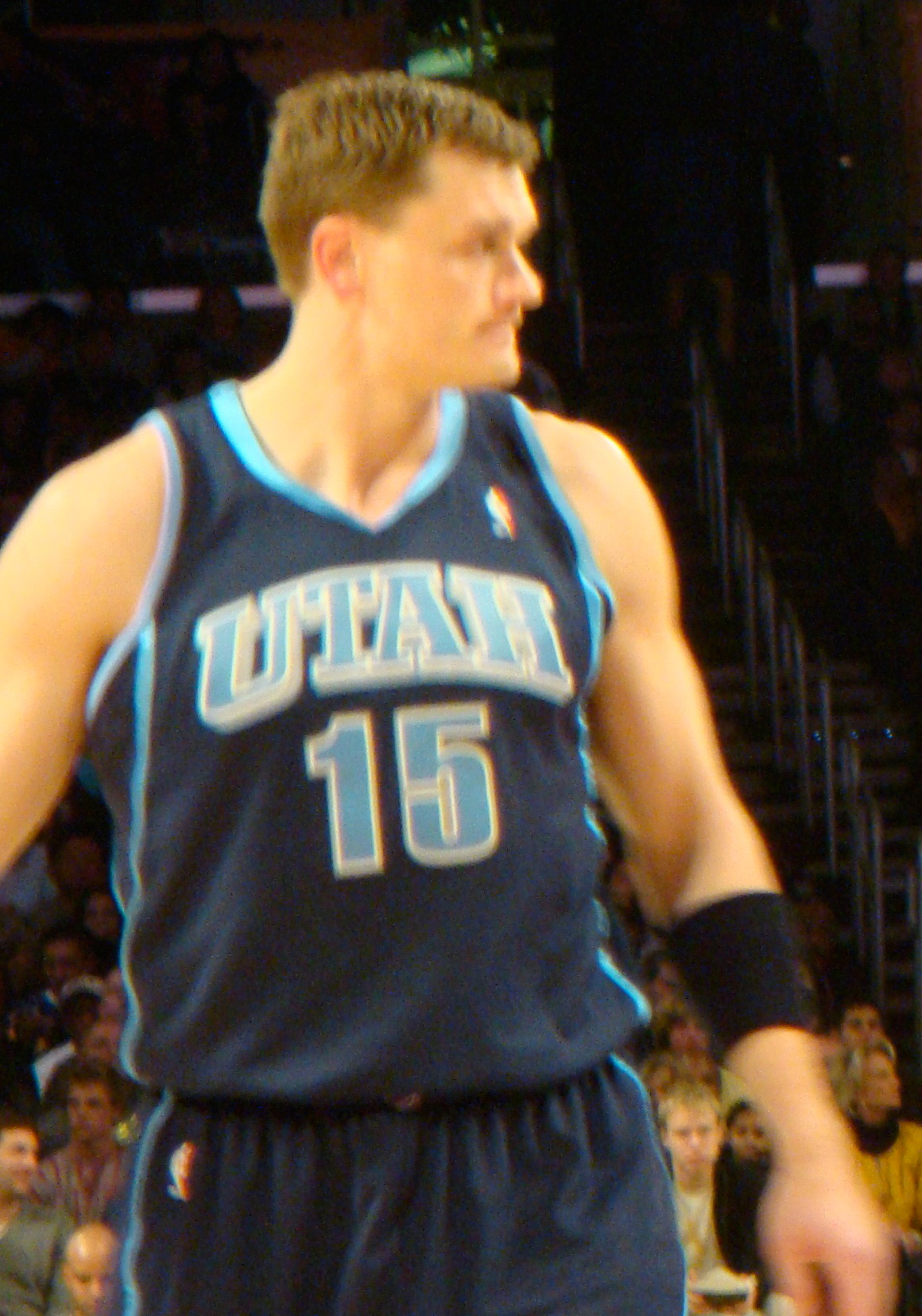
Matt Harpring
View on Wikipedia
Matthew Joseph Harpring (born May 31, 1976) is an American former professional basketball player who played 11 seasons in the National Basketball Association (NBA) and was formerly paired with play-by-play broadcaster Craig Bolerjack as the color analyst in broadcasting games for the Utah Jazz.
Key Information


College career
[edit]After attending Marist School near Atlanta, Harpring played college basketball at Georgia Tech, where he was a four-year starter. He was named First Team All-ACC three times (the only other Yellow Jacket player to accomplish this feat was Mark Price from 1984 to 1986). In his senior season (1997–98), Harpring set career-highs by averaging 21.6 points and 9.4 rebounds per game, ranking second in the ACC in both categories. For his efforts, he was named Third Team All-American.
He finished his collegiate career as Georgia Tech's second all-time leader in points (2,225) and rebounds (997). He is the institute's all-time leader in free throws attempted (675) and made (508). Prior to his final regular season home game, Georgia Tech retired Harpring's jersey number 15. In 2002, Harpring was selected to the ACC 50th Anniversary men's basketball team as one of the fifty greatest players in Atlantic Coast Conference history.
While he excelled on the court, he was equally impressive in the classroom. Harpring earned a bachelor's degree in business management from Georgia Tech, and was named GTE Academic All-District III three times. As a senior, he was an Academic All-American.[citation needed]
Early professional career
[edit]The Orlando Magic selected Harpring with the 15th pick in the first round of the 1998 NBA draft. In his rookie season, he averaged 8.2 points and 4.3 rebounds per game. He started 22 of 50 games, averaging 10.5 points and 5.5 rebounds as a starter. He was named to the 1998–99 NBA All-Rookie First Team.
In his second year with the Magic, Harpring played in just four games. An injury to his left ankle sidelined him for most of the season. In August 2000, he was traded to the Cleveland Cavaliers for center Andrew DeClercq. He played just one season with the Cavs, averaging 11.1 points and 4.3 rebounds in 56 games. He scored a career-high 28 points against Charlotte on March 16, 2001.
In August 2001, the Cavs traded Harpring to the Philadelphia 76ers along with Cedric Henderson and Robert Traylor in exchange for Tyrone Hill and Jumaine Jones.[1] Harpring played in 81 games for the Sixers during the 2001–02 season. He set career highs in points, rebounds, assists, steals, and blocks. For the year, he averaged 11.8 points and 7.1 rebounds per game. He scored 20 or more points in five different games.
Utah Jazz
[edit]Harpring signed a free agent contract with the Utah Jazz in August 2002. Known as a smart, hard-working player, he fit well in Utah's offensive system, playing alongside superstars Karl Malone and John Stockton. Harpring played the best basketball of his career, averaging 17.6 points per game while shooting 51.1 percent from the floor and 41.3 percent on three-pointers. He set a new career high with 30 points against the Los Angeles Clippers on November 26, 2002. Three nights later, he set another career high with 33 points against the Minnesota Timberwolves (on November 29, 2002). He finished second in voting for the NBA's Most Improved Player in 2002–03 (behind Golden State's Gilbert Arenas).
Prior to the 2003–04 season, Stockton announced his retirement and Malone left Utah to play for the Los Angeles Lakers. Harpring was named team captain by coach Jerry Sloan. Harpring provided leadership for the young team, which played surprisingly well despite the departures of Malone and Stockton. Harpring's season ended suddenly with a knee injury that required surgery to repair. In 31 games, he averaged 16.2 points and 8.0 rebounds per game. At the time of his injury, he was Utah's leading scorer.
Harpring returned from his injury the following season, but saw his role on the team reduced as Andrei Kirilenko emerged as an All-Star at small forward, and the Jazz added power forwards Carlos Boozer and Mehmet Okur to the roster.
In 2009, after suffering various injuries and a post-surgery infection in his ankle, Harpring announced that he would probably not be able to continue playing in the NBA, though he did not formally retire.[2] He joined the Jazz television broadcast team for a few games to add color commentary.
Since 2010, Harpring has successfully transitioned to his current role as color commentary voice for the games broadcast on AT&T SportsNet Rocky Mountain,[3] adding a dry sense of humor which he admits he suppressed while a player to the widely recognized play-by-play skills of Craig Bolerjack.[4]
Oklahoma City Thunder
[edit]On December 22, 2009, Harpring's contract was included in a trade between the Jazz and Oklahoma City Thunder, sending Harpring and point guard Eric Maynor to the Thunder in exchange for the rights to 2002 draft pick Peter Fehse. Harpring did not report to Oklahoma City,[5][6] who waived him on February 22, 2010.
Awards and honors
[edit]Harpring was inducted into the Georgia Sports Hall of Fame, in Macon, Georgia, as a member of the 2017 class.[8]
NBA career statistics
[edit]| GP | Games played | GS | Games started | MPG | Minutes per game |
| FG% | Field goal percentage | 3P% | 3-point field goal percentage | FT% | Free throw percentage |
| RPG | Rebounds per game | APG | Assists per game | SPG | Steals per game |
| BPG | Blocks per game | PPG | Points per game | Bold | Career high |
| * | Led the league |
Regular season
[edit]| Year | Team | GP | GS | MPG | FG% | 3P% | FT% | RPG | APG | SPG | BPG | PPG |
|---|---|---|---|---|---|---|---|---|---|---|---|---|
| 1998–99 | Orlando | 50* | 22 | 22.3 | .463 | .400 | .713 | 4.3 | .9 | .6 | .1 | 8.2 |
| 1999–00 | Orlando | 4 | 0 | 15.8 | .235 | 1.000 | .857 | 3.0 | 2.0 | 1.3 | .3 | 4.0 |
| 2000–01 | Cleveland | 56 | 55 | 28.8 | .454 | .250 | .812 | 4.3 | 1.8 | .8 | .3 | 11.1 |
| 2001–02 | Philadelphia | 81 | 81 | 31.4 | .461 | .304 | .743 | 7.1 | 1.3 | .9 | .1 | 11.8 |
| 2002–03 | Utah | 78 | 69 | 32.8 | .511 | .413 | .792 | 6.6 | 1.7 | .9 | .2 | 17.6 |
| 2003–04 | Utah | 31 | 31 | 36.6 | .471 | .242 | .688 | 8.0 | 2.0 | .7 | .1 | 16.2 |
| 2004–05 | Utah | 78 | 55 | 33.1 | .489 | .209 | .778 | 6.2 | 1.8 | .9 | .2 | 14.0 |
| 2005–06 | Utah | 71 | 32 | 27.4 | .475 | .359 | .725 | 5.2 | 1.4 | .8 | .2 | 12.5 |
| 2006–07 | Utah | 77 | 2 | 25.5 | .491 | .333 | .767 | 4.6 | 1.3 | .7 | .1 | 11.6 |
| 2007–08 | Utah | 76 | 0 | 18.1 | .500 | .200 | .712 | 3.2 | 1.1 | .6 | .2 | 8.2 |
| 2008–09 | Utah | 63 | 2 | 11.0 | .461 | .000 | .764 | 2.0 | .4 | .5 | .1 | 4.4 |
| Career | 665 | 349 | 26.4 | .481 | .333 | .753 | 5.1 | 1.4 | .7 | .2 | 11.5 | |
Playoffs
[edit]| Year | Team | GP | GS | MPG | FG% | 3P% | FT% | RPG | APG | SPG | BPG | PPG |
|---|---|---|---|---|---|---|---|---|---|---|---|---|
| 1999 | Orlando | 4 | 0 | 20.5 | .462 | .200 | .727 | 5.0 | 1.8 | .3 | .0 | 8.3 |
| 2002 | Philadelphia | 5 | 5 | 23.8 | .500 | .000 | .778 | 5.2 | 1.4 | 1.0 | .0 | 10.2 |
| 2003 | Utah | 5 | 5 | 31.2 | .484 | .143 | .813 | 5.4 | 1.0 | 1.0 | .2 | 14.8 |
| 2007 | Utah | 17 | 0 | 25.5 | .456 | .000 | .723 | 4.8 | 1.4 | .4 | .2 | 9.3 |
| 2008 | Utah | 12 | 0 | 17.4 | .397 | .333 | .800 | 2.8 | .7 | .6 | .3 | 6.6 |
| 2009 | Utah | 5 | 0 | 9.8 | .500 | .000 | 1.000 | 1.8 | .8 | .4 | .2 | 4.8 |
| Career | 48 | 10 | 21.8 | .459 | .150 | .767 | 4.1 | 1.1 | .6 | .2 | 8.7 | |
Career highs
[edit]- Points – 33 vs. Minnesota Timberwolves, November 29, 2002
- Rebounds – 19 vs. Orlando Magic, November 17, 2003
- Assists – 7 vs. Charlotte Hornets, March 16, 2001
- Steals – 4 on 6 occasions
- Blocks – 3 on 2 occasions
- Minutes – 49 vs. Sacramento Kings, November 1, 2000
Personal life
[edit]Harpring and his wife Amanda, who is a physician, have five children: the first son Luke Matthew and second daughter Kate Eileen, Robert, and Matthew. His eldest son Luke currently plays football at his alma mater Georgia Tech. Harpring mentioned on the Utah Jazz broadcast that he enjoys The Office. (Utah vs. Dallas, October 28, 2018).[9]
References
[edit]- ^ Tyrone Hill Returns To the Cavs
- ^ Harpring: Season, maybe career over
- ^ Jazz announce broadcast crews, schedule for 2015-16 season
- ^ From Player to Broadcaster, Harpring Enjoying Role as Jazz TV Analyst
- ^ "NBA Notebook: Harpring Still Injured but Not Ready to Retire -- NBA FanHouse". nba.fanhouse.com. Archived from the original on December 7, 2009.
- ^ Maynor headed to Thunder
- ^ Thunder Sign Anderson, Waive Harpring Archived February 25, 2010, at the Wayback Machine
- ^ "Class of 2017".
- ^ ATT Sportsnet, Utah vs. Dallas, October 28, 2018
External links
[edit]- Career statistics from NBA.com · Basketball Reference
- Matt Harpring – Official Site
- [1] In Depth Interview of Matt Harpring
Matt Harpring
View on GrokipediaEarly life
High school career
Matthew Joseph Harpring was born on May 31, 1976, in Cincinnati, Ohio. His family relocated to Atlanta, Georgia, when he was young, and he grew up in the area while attending Marist School, a private Catholic preparatory institution renowned for its strong academic and athletic programs.[6][7] At Marist, Harpring distinguished himself as a multisport athlete, particularly in basketball and football. As a senior in 1994, he captained the War Eagles to an undefeated 32–0 season and the Georgia Class AAAA state championship. For his leadership and performance, he was honored as Georgia's Mr. Basketball.[3] Harpring's imposing 6-foot-7 frame initially drew significant football recruitment interest, with scholarship offers from Northwestern and Wisconsin to play quarterback. Ultimately, he opted for basketball, securing a scholarship to Georgia Tech after late interest from coach Bobby Cremins, marking his transition to college hoops.[7][3]College career
Harpring committed to Georgia Tech in 1994 after a standout high school career at Marist School, where he attracted late attention from Yellow Jackets coach Bobby Cremins despite being lightly recruited nationally.[7] He played four seasons for the Yellow Jackets from 1994 to 1998, starting 119 of 124 games and logging 4,472 minutes, third-most in program history. Over his career, Harpring scored 2,225 points (second in school history), grabbed 997 rebounds (third all-time), and dished 289 assists while shooting .462 from the field and .357 from three-point range; he also set the Georgia Tech record for free throws made with 508.[8][3] As a freshman in 1994–95, Harpring averaged 12.1 points and 6.2 rebounds per game, earning ACC All-Freshman honors and finishing as the conference Rookie of the Year runner-up.[8][3] In his sophomore season of 1995–96, he boosted his production to 18.6 points and 8.1 rebounds per game, helping lead Georgia Tech to the ACC regular-season title and an NCAA Tournament Sweet 16 appearance alongside teammates Stephon Marbury and Drew Barry; he was named to the All-ACC first team and the ACC All-Tournament first team.[8][3] His junior year in 1996–97 saw averages of 19.0 points and 8.2 rebounds amid a challenging 9–18 team record, earning another All-ACC first-team selection.[8][7] Harpring's senior campaign in 1997–98 marked his peak, as he averaged 21.6 points and 9.4 rebounds per game while shooting 81.0% from the free-throw line, guiding the Yellow Jackets to a 19–14 record and an NIT quarterfinals appearance, where they defeated Coppin State and Minnesota before losing to Penn State.[8] He repeated as All-ACC first-team honoree—joining Mark Price as the only Georgia Tech players with three such selections—and was a finalist for the Naismith and Wooden Awards, earning All-America recognition.[3][9] Known for his gritty, physical play and relentless rebounding despite standing 6-foot-7 as a forward, Harpring's tenacity and mid-range scoring made him a cornerstone of the program.[7][3] After graduating with a degree in June 1998, he declared for the NBA Draft.[7]Professional career
Orlando Magic
Harpring was selected by the Orlando Magic with the 15th overall pick in the first round of the 1998 NBA Draft, coming off a strong college career at Georgia Tech where he earned All-ACC honors.[6] In his rookie season during the 1998–99 lockout-shortened campaign, Harpring appeared in all 50 games for the Magic, starting 22 of them while averaging 8.2 points, 4.3 rebounds, and 0.9 assists per game, shooting 46.3% from the field.[6] His energetic play and ability to contribute on both ends helped the Magic finish with a 33–17 record, securing the No. 2 seed in the Eastern Conference playoffs, where Harpring averaged 8.3 points and 5.0 rebounds across four games before Orlando's first-round exit.[10] For his performance, he earned a spot on the NBA All-Rookie First Team, recognizing his impact as one of the league's top newcomers.[11] Harpring's sophomore season in 1999–2000 was severely limited by an ankle injury, restricting him to just four games where he averaged 4.0 points and 3.0 rebounds.[6] Despite his absence, the Magic posted a 41–41 record under coach Doc Rivers but missed the playoffs.[12] Throughout his time in Orlando, Harpring established himself as a versatile forward known for his hustle, defensive effort, and reliable mid-range shooting, often providing energy off the bench in a tough-nosed role.[13] On August 3, 2000, Harpring was traded to the Cleveland Cavaliers in exchange for center Andrew DeClercq, ending his two-year stint with Orlando after appearing in 54 regular-season games.[14]Cleveland Cavaliers
On August 3, 2000, the Cleveland Cavaliers acquired Matt Harpring from the Orlando Magic in exchange for center Andrew DeClercq, adding a versatile forward to their roster during the team's rebuilding phase.[15][14] During the 2000–01 season, Harpring emerged as a key starter for the young Cavaliers, appearing in 56 games with 55 starts while averaging 28.8 minutes per contest. He contributed 11.1 points, 4.3 rebounds, and 1.8 assists per game, shooting 45.4% from the field as a reliable scoring option in the frontcourt.[6] On a developing team that finished with a 30–52 record and missed the playoffs, Harpring provided consistent energy and toughness, highlighted by a season-high 28 points against the Charlotte Hornets on March 16, 2001.[16][17] Despite dealing with minor injuries, including a strained left Achilles' tendon that caused him to miss just one game in December 2000, he solidified his role as a dependable contributor amid Cleveland's roster of emerging talent.[18] Following the season, Harpring's tenure with the Cavaliers ended when he was traded to the Philadelphia 76ers on August 3, 2001, along with Cedric Henderson and Robert Traylor, in exchange for Tyrone Hill and Jumaine Jones.[19][20]Philadelphia 76ers
On August 3, 2001, the Cleveland Cavaliers traded Matt Harpring, along with Cedric Henderson and Robert Traylor, to the Philadelphia 76ers in exchange for Tyrone Hill and Jumaine Jones.[19] This move positioned Harpring as a starting small forward in head coach Larry Brown's defensive-minded system, where he complemented star guard Allen Iverson by providing consistent scoring and rebounding from the forward spot.[21] During the 2001–02 regular season, Harpring appeared in all 81 games for the 76ers, starting every contest and averaging 11.8 points, 7.1 rebounds, and 1.3 assists per game while shooting 46.1% from the field.[6] His contributions helped the team secure a 43–39 record and the fourth seed in the Eastern Conference playoffs, marking a solid but transitional year following their 2001 NBA Finals run. Harpring's physical play and efficiency inside the arc added balance to the roster, particularly in supporting Iverson's high-usage offense amid frontcourt adjustments after the trade.[21] In the playoffs, the 76ers faced the Boston Celtics in the first round and were eliminated in five games (3–2 series loss). Harpring started all five contests, averaging 10.2 points and 5.2 rebounds in 23.8 minutes per game, with a field goal percentage of 50.0%.[6] His efforts provided forward depth, though the team struggled against Boston's balanced attack. Following the season, the 76ers rescinded their qualifying offer to Harpring on July 25, 2002, making him an unrestricted free agent; he subsequently signed a four-year, $18.5 million contract with the Utah Jazz on August 15, 2002.[22]Utah Jazz
Harpring signed a four-year, $18.5 million contract with the Utah Jazz as a free agent on August 15, 2002.[22] He spent seven seasons with the Jazz from 2002–03 to 2008–09, appearing in 474 regular-season games while averaging 12.7 points and 5.3 rebounds per game.[6] As a key sixth man under head coach Jerry Sloan, Harpring provided scoring and rebounding off the bench, leveraging his physical style and prior experiences with multiple teams to enhance his versatility as a small forward.[6] Harpring reached his peak performance during the 2005–06 season, averaging 14.6 points and 6.0 rebounds per game while shooting 47.5 percent from the field in 71 games.[6] In 2006–07, he maintained strong production with 14.3 points per game across 77 contests, finishing tied for eighth in Sixth Man of the Year voting that season.[23] The Jazz made six playoff appearances during Harpring's tenure, from 2003 to 2005 and 2007 to 2009, including a run to the Western Conference Finals in 2007 against the San Antonio Spurs.[24][25] He played in 39 postseason games for Utah, averaging 8.8 points and 3.9 rebounds per game.[6] Knee and ankle injuries plagued Harpring in the 2008–09 season, limiting him to 63 games with averages of 5.5 points and 2.8 rebounds per game.[6][26] On December 22, 2009, the Jazz traded Harpring to the Oklahoma City Thunder as part of a deal involving rookie Eric Maynor, though he did not report to the team and retired shortly thereafter.[27] Harpring became a fan favorite in Utah for his toughness and relentless play, earning the nickname "The Bulldog" among supporters, and he wore jersey number 15 throughout his time with the franchise.[28][29]Oklahoma City Thunder
On December 22, 2009, the Utah Jazz traded forward Matt Harpring and rookie guard Eric Maynor to the Oklahoma City Thunder in exchange for the draft rights to Peter Fehse, a 2002 second-round pick.[27][30] At the time of the trade, Harpring was sidelined by a chronic knee injury sustained during his tenure with the Jazz, which prevented him from playing any games in the 2009-10 season and from reporting to or practicing with the Thunder.[31][32] Harpring never appeared in a game for Oklahoma City, remaining on the roster for two months while continuing his rehabilitation.[33] The Thunder waived him on February 22, 2010, to sign guard Antonio Anderson from the NBA Development League.[34] Following his release, Harpring announced his retirement from the NBA on March 5, 2010, concluding an 11-year professional career marked by persistent injuries; over that span, he appeared in 665 regular-season games across five teams.[35][6]Awards and honors
Professional awards
During his rookie season with the Orlando Magic in 1998–99, Harpring earned a spot on the NBA All-Rookie First Team, an accolade that honors the top performers among first-year players for their immediate contributions to the league. He amassed 35 voting points, including 10 first-place votes out of a possible 56, reflecting his averages of 8.2 points and 4.3 rebounds per game across 50 appearances despite a shortened season due to injury.[36] Later in his career with the Utah Jazz, Harpring received votes for the NBA Sixth Man of the Year award, which recognizes the most valuable reserve player. In the 2005–06 season, he finished 16th in the voting with 3 points, underscoring his reliable scoring and rebounding off the bench during a campaign where he averaged 12.5 points and 5.2 rebounds in 71 games. The following year, 2006–07, Harpring finished 8th in the voting with 4 points, as he contributed 11.6 points and 4.6 rebounds per game in 77 outings while providing defensive tenacity and perimeter shooting for the playoff-bound Jazz.[37][23] Harpring never earned an NBA All-Star selection or received votes for league MVP, yet his sustained impact as a versatile role player—blending scoring, rebounding, and hustle—was evident in these specialized recognitions that highlighted his value beyond starting lineups.[38]Post-career honors
Following his retirement from the NBA in 2009, Matt Harpring continued to receive recognitions for his athletic achievements, particularly those rooted in his college career at Georgia Tech. In 2017, he was inducted into the Georgia Sports Hall of Fame as part of the Class of 2017, honoring his overall contributions to Georgia athletics, including his standout performances in high school, college, and professional basketball.[39][40] In 2017, Harpring was named to the ACC Basketball Legends class.[9] Earlier retrospective honors further solidified Harpring's legacy in Atlantic Coast Conference (ACC) basketball. In 2002, he was selected to the ACC 50th Anniversary Men's Basketball Team, recognizing him among the 50 greatest players in conference history for his scoring prowess and leadership during his Georgia Tech tenure from 1995 to 1998.[41] Harpring's impact on Georgia Tech athletics was formally acknowledged in 2008 when he was inducted into the Georgia Tech Athletics Hall of Fame, where his profile highlights his records as the program's second-leading scorer with 2,225 points and his role in elevating the Yellow Jackets' competitiveness in the ACC.[3][42] A permanent tribute to his college contributions came with the retirement of his No. 15 jersey by Georgia Tech, which occurred prior to his final home game in 1998 but stands as an enduring post-college honor symbolizing his indelible mark on the program.[3]NBA career statistics and records
Regular season
Harpring played 665 regular-season games over 11 NBA seasons, averaging 11.5 points, 5.1 rebounds, and 1.4 assists per game while shooting 48.1% from the field, 33.3% from three-point range, and 75.3% from the free-throw line.[43] His career totals include 7,645 points, 3,366 rebounds, and 907 assists.[43] These figures reflect his role as a versatile forward who contributed scoring and rebounding across multiple teams, with his most productive stretch occurring from 2001–02 to 2004–05.[6] The following table summarizes Harpring's regular-season per-game statistics by year:| Season | Team(s) | GP | GS | MP | PTS | TRB | AST | FG% | 3P% | FT% |
|---|---|---|---|---|---|---|---|---|---|---|
| 1998–99 | Orlando Magic | 50 | 22 | 22.3 | 8.2 | 4.3 | 0.9 | .463 | .400 | .713 |
| 1999–00 | Orlando Magic | 4 | 0 | 15.8 | 4.0 | 3.0 | 2.0 | .235 | 1.000 | .857 |
| 2000–01 | Cleveland Cavaliers | 56 | 55 | 28.8 | 11.1 | 4.3 | 1.8 | .454 | .250 | .812 |
| 2001–02 | Philadelphia 76ers | 81 | 81 | 31.4 | 11.8 | 7.1 | 1.3 | .461 | .304 | .743 |
| 2002–03 | Utah Jazz | 78 | 69 | 32.8 | 17.6 | 6.6 | 1.7 | .511 | .413 | .792 |
| 2003–04 | Utah Jazz | 31 | 31 | 36.6 | 16.2 | 8.0 | 2.0 | .471 | .242 | .688 |
| 2004–05 | Utah Jazz | 78 | 55 | 33.1 | 14.0 | 6.2 | 1.8 | .489 | .209 | .778 |
| 2005–06 | Utah Jazz | 71 | 32 | 27.4 | 12.5 | 5.2 | 1.4 | .475 | .359 | .725 |
| 2006–07 | Utah Jazz | 77 | 2 | 25.5 | 11.6 | 4.6 | 1.3 | .491 | .333 | .767 |
| 2007–08 | Utah Jazz | 76 | 0 | 18.1 | 8.2 | 3.2 | 1.1 | .500 | .200 | .712 |
| 2008–09 | Utah Jazz | 63 | 2 | 11.0 | 4.4 | 2.0 | 0.4 | .461 | .000 | .764 |
| 2009–10 | Oklahoma City Thunder | 0 | 0 |
Playoffs
Harpring appeared in six NBA postseasons from 1999 to 2009, accumulating 48 games primarily as a role player off the bench for the Orlando Magic, Philadelphia 76ers, and Utah Jazz.[6] His postseason role often emphasized hustle plays, rebounding, and efficient scoring in limited minutes, contributing to team efforts in first-round series and deeper runs.[6] Over his playoff career, Harpring averaged 8.8 points, 4.0 rebounds, and 1.2 assists per game, while shooting 45.8 percent from the field.[6] These figures reflect his value as a gritty forward who provided energy and secondary scoring, particularly in the 2007 playoffs when the Jazz reached the Western Conference Finals.[6] One of Harpring's standout playoff performances came in 2003 with the Utah Jazz, where he averaged 14.8 points and 5.4 rebounds across five starts in a first-round loss to the Sacramento Kings. In the 2007 postseason, he logged 17 games for the Jazz, averaging 9.3 points and 4.8 rebounds, including 10.0 points per game in their Western Conference Semifinals victory over the Golden State Warriors.[44] Earlier, during his 2002 stint with the Philadelphia 76ers, Harpring started all five first-round games against the Boston Celtics, posting 10.2 points and 5.2 rebounds per contest in a series defeat.| Year | Team | GP | GS | MPG | FG% | 3P% | FT% | RPG | APG | PPG |
|---|---|---|---|---|---|---|---|---|---|---|
| 1999 | ORL | 4 | 0 | 20.5 | .462 | .200 | .727 | 5.0 | 1.8 | 8.3 |
| 2002 | PHI | 5 | 5 | 23.8 | .500 | .778 | 5.2 | 1.4 | 10.2 | |
| 2003 | UTA | 5 | 5 | 31.2 | .484 | .143 | .813 | 5.4 | 1.0 | 14.8 |
| 2007 | UTA | 17 | 0 | 25.5 | .456 | .000 | .723 | 4.8 | 1.4 | 9.3 |
| 2008 | UTA | 12 | 0 | 17.4 | .397 | .333 | .800 | 2.8 | 0.7 | 6.6 |
| 2009 | UTA | 5 | 0 | 9.8 | .500 | .000 | 1.000 | 1.8 | 0.8 | 4.8 |