


Community hub
Recent from talks
Contribute something to knowledge base
Content stats: 0 posts, 0 articles, 1 media, 0 notes
Members stats: 0 subscribers, 0 contributors, 0 moderators, 0 supporters
Subscribers
Supporters
Contributors
Moderators
Hub AI
Ernest Everett Just AI simulator
(@Ernest Everett Just_simulator)
Hub AI
Ernest Everett Just AI simulator
(@Ernest Everett Just_simulator)
Ernest Everett Just
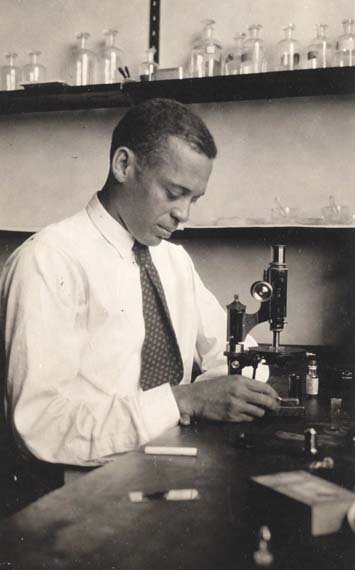
Ernest Everett Just (August 14, 1883 – October 27, 1941) was a pioneering biologist, academic and science writer. Just's primary legacy is his recognition of the fundamental role of the cell surface in the development of organisms. In his work within marine biology, cytology and parthenogenesis, he advocated the study of whole cells under normal conditions, rather than simply breaking them apart in a laboratory setting.
Born to Charles Just Jr. and Mary (Matthews) Just on August 14, 1883, Just was one of five children. His father and grandfather, Charles Sr., were builders. When Just was four years old, both his father and grandfather died (the former of alcoholism). Just's mother became the sole supporter of Just, his younger brother, and his younger sister. Mary Matthews Just taught at an African-American school in Charleston to support her family. During the summer, she worked in the phosphate mines on James Island. Noticing that there was much vacant land near the island, Mary persuaded several black families to move there to farm. The town they founded, now incorporated in the West Ashley area of Charleston, was eventually named Maryville in her honor.
When Just was young, he became severely sick for six weeks with typhoid. Once the fever passed, he had a hard time recuperating, and his memory had been greatly affected. He had previously learned to read and write, but now had to relearn. His mother had been very sympathetic in teaching him, but after a while she gave up.
Hoping Just would become a teacher, at the age of 13 his mother sent him to the "Colored Normal Industrial Agricultural and Mechanical College of South Carolina", the only 1890 land grant school for the education of Negroes in South Carolina, later known as South Carolina State University in Orangeburg, South Carolina. Believing that schools for blacks in the south were inferior, Just and his mother thought it better for him to go north. At the age of 16, Just enrolled at the Meriden, New Hampshire, college-preparatory high school Kimball Union Academy. During Just's second year at Kimball, he returned home for a visit only to learn that his mother had been buried an hour before he arrived. Despite this hardship, Just completed the four-year program in only three years and graduated in 1903 with the highest grades in his class.
Just went on to graduate magna cum laude from Dartmouth College in Hanover, New Hampshire, class of 1907. There, Just developed an interest in biology after learning about fertilization and egg development. Just won special honors in zoology, and distinguished himself in botany, history, and sociology as well. He was also honored as a Rufus Choate scholar for two years and was elected to Phi Beta Kappa.
Just was a candidate to deliver a commencement speech, but was not chosen because the faculty "decided it would be a faux pas to allow the only black in the graduating class to address the crowd of parents, alumni, and benefactors. It would have made too glaring the fact, that Just had won just about every prize imaginable," including honors in botany, sociology, and history. While teaching at Howard University, Just earned a PhD in 1916 from the University of Chicago, becoming one of the first African Americans to do so.
On November 17, 1911, Ernest Just and three Howard University students (Edgar Amos Love, Oscar James Cooper, and Frank Coleman), established the Omega Psi Phi fraternity on the campus of Howard. Love, Cooper, and Coleman had approached Just about establishing the first black fraternity on campus. Howard's faculty and administration initially opposed the idea of establishing the fraternity, fearing that it could pose a political threat to Howard's white administration. However, Just worked to mediate the controversy and, despite the initial doubts, Omega Psi Phi, Alpha chapter, was chartered on Howard's campus on December 15, 1911. Omega Psi Phi was incorporated under the laws of the District of Columbia on October 28, 1914.
When he graduated from Dartmouth, Just faced the same problems all black college graduates of his time did: no matter how brilliant they were or how high their grades were, it was almost impossible for black people to become faculty members at white colleges or universities. Just took what seemed to be the best choice available to him and accepted a teaching position at historically black Howard University in Washington, D.C. In 1907, Just first began teaching rhetoric and English, fields somewhat removed from his specialty. By 1909, however, he was teaching not only English but also Biology. In 1910, he was put in charge of a newly formed biology department by Howard's president, Wilbur P. Thirkield and, in 1912, he became head of the new Department of Zoology, a position he held until his death in 1941.
Ernest Everett Just
Ernest Everett Just (August 14, 1883 – October 27, 1941) was a pioneering biologist, academic and science writer. Just's primary legacy is his recognition of the fundamental role of the cell surface in the development of organisms. In his work within marine biology, cytology and parthenogenesis, he advocated the study of whole cells under normal conditions, rather than simply breaking them apart in a laboratory setting.
Born to Charles Just Jr. and Mary (Matthews) Just on August 14, 1883, Just was one of five children. His father and grandfather, Charles Sr., were builders. When Just was four years old, both his father and grandfather died (the former of alcoholism). Just's mother became the sole supporter of Just, his younger brother, and his younger sister. Mary Matthews Just taught at an African-American school in Charleston to support her family. During the summer, she worked in the phosphate mines on James Island. Noticing that there was much vacant land near the island, Mary persuaded several black families to move there to farm. The town they founded, now incorporated in the West Ashley area of Charleston, was eventually named Maryville in her honor.
When Just was young, he became severely sick for six weeks with typhoid. Once the fever passed, he had a hard time recuperating, and his memory had been greatly affected. He had previously learned to read and write, but now had to relearn. His mother had been very sympathetic in teaching him, but after a while she gave up.
Hoping Just would become a teacher, at the age of 13 his mother sent him to the "Colored Normal Industrial Agricultural and Mechanical College of South Carolina", the only 1890 land grant school for the education of Negroes in South Carolina, later known as South Carolina State University in Orangeburg, South Carolina. Believing that schools for blacks in the south were inferior, Just and his mother thought it better for him to go north. At the age of 16, Just enrolled at the Meriden, New Hampshire, college-preparatory high school Kimball Union Academy. During Just's second year at Kimball, he returned home for a visit only to learn that his mother had been buried an hour before he arrived. Despite this hardship, Just completed the four-year program in only three years and graduated in 1903 with the highest grades in his class.
Just went on to graduate magna cum laude from Dartmouth College in Hanover, New Hampshire, class of 1907. There, Just developed an interest in biology after learning about fertilization and egg development. Just won special honors in zoology, and distinguished himself in botany, history, and sociology as well. He was also honored as a Rufus Choate scholar for two years and was elected to Phi Beta Kappa.
Just was a candidate to deliver a commencement speech, but was not chosen because the faculty "decided it would be a faux pas to allow the only black in the graduating class to address the crowd of parents, alumni, and benefactors. It would have made too glaring the fact, that Just had won just about every prize imaginable," including honors in botany, sociology, and history. While teaching at Howard University, Just earned a PhD in 1916 from the University of Chicago, becoming one of the first African Americans to do so.
On November 17, 1911, Ernest Just and three Howard University students (Edgar Amos Love, Oscar James Cooper, and Frank Coleman), established the Omega Psi Phi fraternity on the campus of Howard. Love, Cooper, and Coleman had approached Just about establishing the first black fraternity on campus. Howard's faculty and administration initially opposed the idea of establishing the fraternity, fearing that it could pose a political threat to Howard's white administration. However, Just worked to mediate the controversy and, despite the initial doubts, Omega Psi Phi, Alpha chapter, was chartered on Howard's campus on December 15, 1911. Omega Psi Phi was incorporated under the laws of the District of Columbia on October 28, 1914.
When he graduated from Dartmouth, Just faced the same problems all black college graduates of his time did: no matter how brilliant they were or how high their grades were, it was almost impossible for black people to become faculty members at white colleges or universities. Just took what seemed to be the best choice available to him and accepted a teaching position at historically black Howard University in Washington, D.C. In 1907, Just first began teaching rhetoric and English, fields somewhat removed from his specialty. By 1909, however, he was teaching not only English but also Biology. In 1910, he was put in charge of a newly formed biology department by Howard's president, Wilbur P. Thirkield and, in 1912, he became head of the new Department of Zoology, a position he held until his death in 1941.
Recent media
Recent media