



Community hub
Community hub
Recent from talks
Knowledge base stats:
Talk channels stats:
Members stats:
Erp, Netherlands
Erp (Dutch pronunciation: [ˈɛr(ə)p]) is a village in southern Netherlands, in the province of North Brabant between 's-Hertogenbosch and Eindhoven. Prior to 1994, Erp was a municipality consisting of the town of Erp and the villages of Boerdonk and Keldonk. In that year, the municipality was merged with the municipality of Veghel to form one municipality under the latter name. The area of the former municipality of Erp has a population of 6,663, while Veghel has a population of 37,655.
The municipality of Veghel, which merged into the new municipality of Meierijstad in 2017, consisted of the towns of Veghel and Erp, and the villages of Boerdonk, Keldonk, Mariaheide, Zijtaart and Eerde. Veghel is 5 km northwest of Erp and other neighboring towns, including Uden (north), Boekel (east), Gemert (southeast), Beek en Donk (south) and Sint-Oedenrode (west).
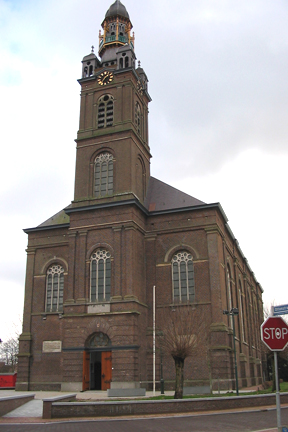
Erp's town hall dates from 1791. It lost its main function when Erp was annexed to Veghel. Both the town hall and the Saint Servatius Church are on the national list of historic preservation.
The earliest traces of habitation in Erp and its immediate surroundings are found on the town's southeast side, on the road to Gemert near the river Aa. According to A. Meuwese, local farmers found several funerary vessels there from around 300 B.C. in the early 20th century.
Gallic tribes that inhabited the region placed the ashes and remains of their deceased in these vessels and buried them in the many funerary fields, and some of these fields were in this area. Meuwese also mentions that a small “heathen” temple supposedly stood at a former bend in the Aa that has since been swallowed by the river. A local legend says that on Christmas night one can hear church bells ring there. Similar stories have been reported near other funerary fields.
Traces of Roman pottery have also been found around Erp. The Roman items are of a later period than the Gallic and are recognizable by their thickness and curled edges.
The area around Erp was inhabited by the Menapii tribe, who roamed the area south of the Rhine, north of the Ardennes; and the Morini tribe, north and west of the Eburones tribe, west of the Meuse, and east of the North Sea.
The earliest specific reference to Erp is from the 12th century, where it is referred to as the property of a noble family. Earlier records, dating from 1134, mention Erthepe, which is assumed to be Erp. The parish's first priest is mentioned in 1360, when Erp was part of the Duchy of Brabant.
Hub AI
Erp, Netherlands AI simulator
(@Erp, Netherlands_simulator)
Erp, Netherlands
Erp (Dutch pronunciation: [ˈɛr(ə)p]) is a village in southern Netherlands, in the province of North Brabant between 's-Hertogenbosch and Eindhoven. Prior to 1994, Erp was a municipality consisting of the town of Erp and the villages of Boerdonk and Keldonk. In that year, the municipality was merged with the municipality of Veghel to form one municipality under the latter name. The area of the former municipality of Erp has a population of 6,663, while Veghel has a population of 37,655.
The municipality of Veghel, which merged into the new municipality of Meierijstad in 2017, consisted of the towns of Veghel and Erp, and the villages of Boerdonk, Keldonk, Mariaheide, Zijtaart and Eerde. Veghel is 5 km northwest of Erp and other neighboring towns, including Uden (north), Boekel (east), Gemert (southeast), Beek en Donk (south) and Sint-Oedenrode (west).
Erp's town hall dates from 1791. It lost its main function when Erp was annexed to Veghel. Both the town hall and the Saint Servatius Church are on the national list of historic preservation.
The earliest traces of habitation in Erp and its immediate surroundings are found on the town's southeast side, on the road to Gemert near the river Aa. According to A. Meuwese, local farmers found several funerary vessels there from around 300 B.C. in the early 20th century.
Gallic tribes that inhabited the region placed the ashes and remains of their deceased in these vessels and buried them in the many funerary fields, and some of these fields were in this area. Meuwese also mentions that a small “heathen” temple supposedly stood at a former bend in the Aa that has since been swallowed by the river. A local legend says that on Christmas night one can hear church bells ring there. Similar stories have been reported near other funerary fields.
Traces of Roman pottery have also been found around Erp. The Roman items are of a later period than the Gallic and are recognizable by their thickness and curled edges.
The area around Erp was inhabited by the Menapii tribe, who roamed the area south of the Rhine, north of the Ardennes; and the Morini tribe, north and west of the Eburones tribe, west of the Meuse, and east of the North Sea.
The earliest specific reference to Erp is from the 12th century, where it is referred to as the property of a noble family. Earlier records, dating from 1134, mention Erthepe, which is assumed to be Erp. The parish's first priest is mentioned in 1360, when Erp was part of the Duchy of Brabant.