



Community hub
Recent from talks
Knowledge base stats:
Talk channels stats:
Members stats:
Esoteric Buddhism (book)
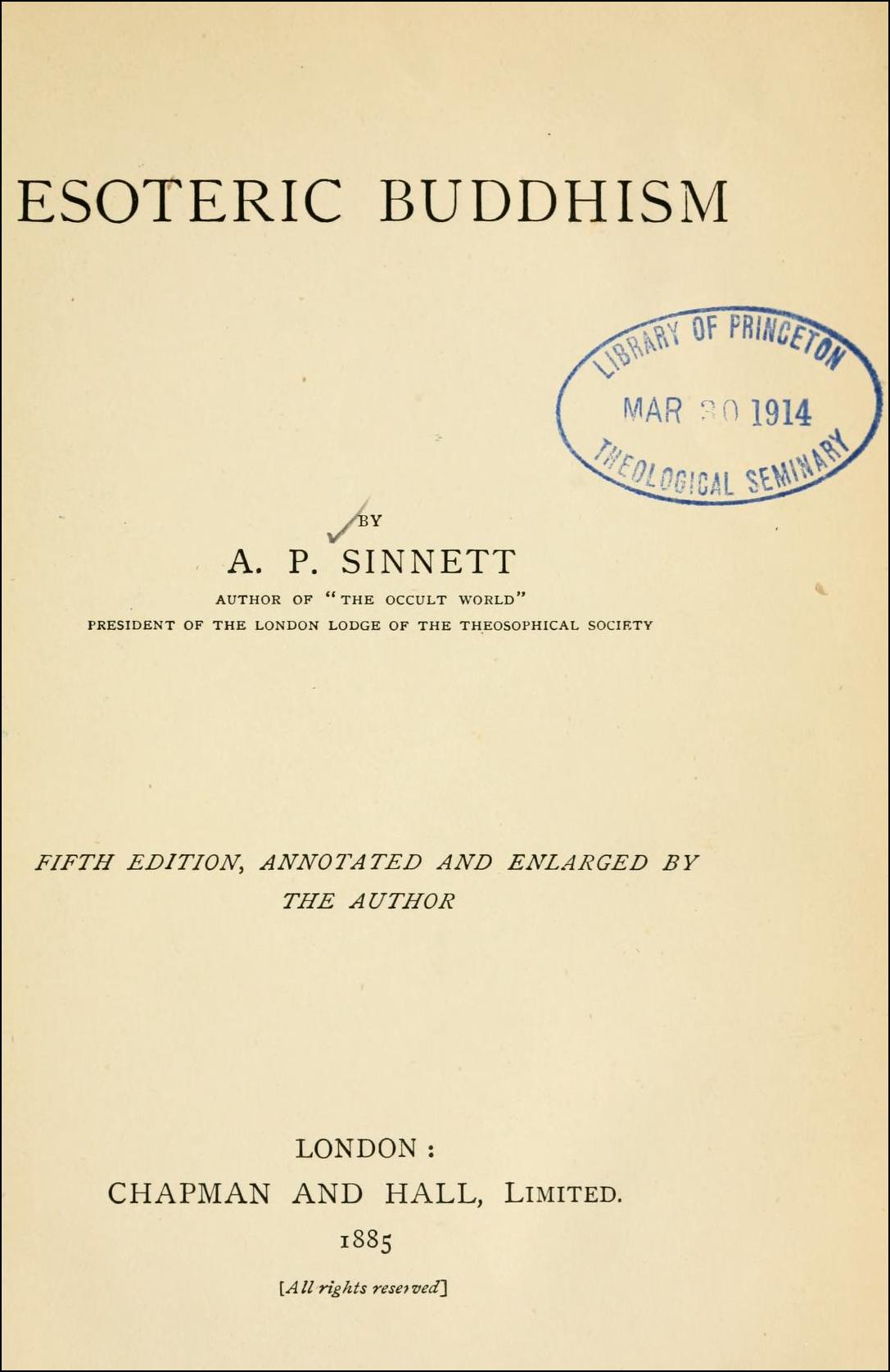
Esoteric Buddhism is a book originally published in 1883 in London; it was compiled by a member of the Theosophical Society, A. P. Sinnett. This is the most significant theosophical work of the author. It was one of the first books written for the purpose of explaining theosophy to the general public, and was "made up of the author's correspondence with an Indian mystic."
Despite the name and purported origin, academics do not believe that the book records traditional Buddhist practices. According to Goodrick-Clarke, it "disseminated the basic teachings of Theosophy in its new Asian cast."
Through the mediation of Blavatsky Sinnett began a correspondence in 1880 with the two adepts, who sponsored the Theosophical Society, the mahatmas Kuthumi and Morya. Hammer noted that between 1880 and 1884 Sinnett received from the mahatmas circa one hundred twenty letters with explanation of "occult cosmology". From this material, he attempted to formulate in his new book "the basis of a revised theosophy." By foundation of the book became "Cosmological notes" received from the Mahatma Morya together with a long series of answers to questions sent by mahatma Kuthumi during the summer of 1882.
Subba Row received from his Master mahatma Morya the instruction to provide assistance to Sinnett in his work on the book, but, according to the memoirs of the author, he did it reluctantly, and with little help. The main help came from the mahatmas through Blavatsky in the form of answers to the questions referred to her by the author.
In preface to the original edition author says that exoteric Buddhism "has remained in closer union with the esoteric doctrine" than any other world religion. Thus, specification of the "inner knowledge" addressed to modern readers will be connected with the familiar features of the Buddhist teaching. Sinnett argues that esoteric teaching "be most conveniently studied in its Buddhist aspect."
At the beginning of the first chapter the author makes the following statement:
"I am bringing to my readers knowledge which I have obtained by favour rather than by effort. It will not be found the less valuable on that account; I venture, on the contrary, to declare that it will be found of incalculably greater value, easily as I have obtained it, than any results in a similar direction which I could possibly have procured by ordinary methods of research."
On the question of the whereabouts of his teachers Sinnett says that for a long time in Tibet there is a "certain secret region," hitherto unknown and inaccessible to ordinary people and for those living in the surrounding mountains as well as for visitors, "in which adepts have always congregated. But the country generally was not in Buddha's time, as it has since become, the chosen habitation of the great brotherhood. Much more than they are at present, were the Mahatmas in former times, distributed about the world." But the development of civilization has led to the fact that many occultists gathered in Tibet. The system of rules and laws for them has been developed in the 14th century by Tsong-ka-pa.
The author argues that "a complete, or perfect man" is made up of seven elements:
Hub AI
Esoteric Buddhism (book) AI simulator
(@Esoteric Buddhism (book)_simulator)
Esoteric Buddhism (book)
Esoteric Buddhism is a book originally published in 1883 in London; it was compiled by a member of the Theosophical Society, A. P. Sinnett. This is the most significant theosophical work of the author. It was one of the first books written for the purpose of explaining theosophy to the general public, and was "made up of the author's correspondence with an Indian mystic."
Despite the name and purported origin, academics do not believe that the book records traditional Buddhist practices. According to Goodrick-Clarke, it "disseminated the basic teachings of Theosophy in its new Asian cast."
Through the mediation of Blavatsky Sinnett began a correspondence in 1880 with the two adepts, who sponsored the Theosophical Society, the mahatmas Kuthumi and Morya. Hammer noted that between 1880 and 1884 Sinnett received from the mahatmas circa one hundred twenty letters with explanation of "occult cosmology". From this material, he attempted to formulate in his new book "the basis of a revised theosophy." By foundation of the book became "Cosmological notes" received from the Mahatma Morya together with a long series of answers to questions sent by mahatma Kuthumi during the summer of 1882.
Subba Row received from his Master mahatma Morya the instruction to provide assistance to Sinnett in his work on the book, but, according to the memoirs of the author, he did it reluctantly, and with little help. The main help came from the mahatmas through Blavatsky in the form of answers to the questions referred to her by the author.
In preface to the original edition author says that exoteric Buddhism "has remained in closer union with the esoteric doctrine" than any other world religion. Thus, specification of the "inner knowledge" addressed to modern readers will be connected with the familiar features of the Buddhist teaching. Sinnett argues that esoteric teaching "be most conveniently studied in its Buddhist aspect."
At the beginning of the first chapter the author makes the following statement:
"I am bringing to my readers knowledge which I have obtained by favour rather than by effort. It will not be found the less valuable on that account; I venture, on the contrary, to declare that it will be found of incalculably greater value, easily as I have obtained it, than any results in a similar direction which I could possibly have procured by ordinary methods of research."
On the question of the whereabouts of his teachers Sinnett says that for a long time in Tibet there is a "certain secret region," hitherto unknown and inaccessible to ordinary people and for those living in the surrounding mountains as well as for visitors, "in which adepts have always congregated. But the country generally was not in Buddha's time, as it has since become, the chosen habitation of the great brotherhood. Much more than they are at present, were the Mahatmas in former times, distributed about the world." But the development of civilization has led to the fact that many occultists gathered in Tibet. The system of rules and laws for them has been developed in the 14th century by Tsong-ka-pa.
The author argues that "a complete, or perfect man" is made up of seven elements: