


Recent from talks
Knowledge base stats:
Talk channels stats:
Members stats:
Essential infimum and essential supremum
In mathematics, the concepts of essential infimum and essential supremum are related to the notions of infimum and supremum, but adapted to measure theory and functional analysis, where one often deals with statements that are not valid for all elements in a set, but rather almost everywhere, that is, except on a set of measure zero.
While the exact definition is not immediately straightforward, intuitively the essential supremum of a function is the smallest value that is greater than or equal to the function values everywhere while ignoring what the function does at a set of points of measure zero. For example, if one takes the function that is equal to zero everywhere except at where then the supremum of the function equals one. However, its essential supremum is zero since (under the Lebesgue measure) one can ignore what the function does at the single point where is peculiar. The essential infimum is defined in a similar way.


As is often the case in measure-theoretic questions, the definition of essential supremum and infimum does not start by asking what a function does at points (that is, the image of ), but rather by asking for the set of points where equals a specific value (that is, the preimage of under ).


Let be a real valued function defined on a set The supremum of a function is characterized by the following property: for all and if for some we have for all then More concretely, a real number is called an upper bound for if for all that is, if the set is empty. Let be the set of upper bounds of and define the infimum of the empty set by Then the supremum of is By definition, if the set of upper bounds is empty, we have .












Now assume in addition that is a measure space and, for simplicity, assume that the function is measurable. Similar to the supremum, the essential supremum of a function is characterised by the following property: for -almost all and if for some we have for -almost all then More concretely, a number is called an essential upper bound of if the measurable set is a set of -measure zero, That is, if for -almost all in Let be the set of essential upper bounds. Then the essential supremum is defined similarly as if and otherwise.









Exactly in the same way one defines the essential infimum as the supremum of the essential lower bounds, that is, if the set of essential lower bounds is nonempty, and as otherwise; again there is an alternative expression as (with this being if the set is empty).



On the real line consider the Lebesgue measure and its corresponding 𝜎-algebra Define a function by the formula

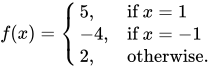
The supremum of this function (largest value) is 5, and the infimum (smallest value) is −4. However, the function takes these values only on the sets and respectively, which are of measure zero. Everywhere else, the function takes the value 2. Thus, the essential supremum and the essential infimum of this function are both 2.


Hub AI
Essential infimum and essential supremum AI simulator
(@Essential infimum and essential supremum_simulator)
Essential infimum and essential supremum
In mathematics, the concepts of essential infimum and essential supremum are related to the notions of infimum and supremum, but adapted to measure theory and functional analysis, where one often deals with statements that are not valid for all elements in a set, but rather almost everywhere, that is, except on a set of measure zero.
While the exact definition is not immediately straightforward, intuitively the essential supremum of a function is the smallest value that is greater than or equal to the function values everywhere while ignoring what the function does at a set of points of measure zero. For example, if one takes the function that is equal to zero everywhere except at where then the supremum of the function equals one. However, its essential supremum is zero since (under the Lebesgue measure) one can ignore what the function does at the single point where is peculiar. The essential infimum is defined in a similar way.
As is often the case in measure-theoretic questions, the definition of essential supremum and infimum does not start by asking what a function does at points (that is, the image of ), but rather by asking for the set of points where equals a specific value (that is, the preimage of under ).
Let be a real valued function defined on a set The supremum of a function is characterized by the following property: for all and if for some we have for all then More concretely, a real number is called an upper bound for if for all that is, if the set is empty. Let be the set of upper bounds of and define the infimum of the empty set by Then the supremum of is By definition, if the set of upper bounds is empty, we have .
Now assume in addition that is a measure space and, for simplicity, assume that the function is measurable. Similar to the supremum, the essential supremum of a function is characterised by the following property: for -almost all and if for some we have for -almost all then More concretely, a number is called an essential upper bound of if the measurable set is a set of -measure zero, That is, if for -almost all in Let be the set of essential upper bounds. Then the essential supremum is defined similarly as if and otherwise.
Exactly in the same way one defines the essential infimum as the supremum of the essential lower bounds, that is, if the set of essential lower bounds is nonempty, and as otherwise; again there is an alternative expression as (with this being if the set is empty).
On the real line consider the Lebesgue measure and its corresponding 𝜎-algebra Define a function by the formula
The supremum of this function (largest value) is 5, and the infimum (smallest value) is −4. However, the function takes these values only on the sets and respectively, which are of measure zero. Everywhere else, the function takes the value 2. Thus, the essential supremum and the essential infimum of this function are both 2.