


Community hub
Recent from talks
Contribute something
Nothing was collected or created yet.
Image (mathematics)
View on Wikipedia
In mathematics, for a function , the image of an input value is the single output value produced by when passed . The preimage of an output value is the set of input values that produce .


More generally, evaluating at each element of a given subset of its domain produces a set, called the "image of under (or through) ". Similarly, the inverse image (or preimage) of a given subset of the codomain is the set of all elements of that map to a member of


The image of the function is the set of all output values it may produce, that is, the image of . The preimage of is the preimage of the codomain . Because it always equals (the domain of ), it is rarely used.
Image and inverse image may also be defined for general binary relations, not just functions.
Definition
[edit]| Algebraic structure → Group theory Group theory |
|---|
 |
|
|


The word "image" is used in three related ways. In these definitions, is a function from the set to the set
Image of an element
[edit]If is a member of then the image of under denoted is the value of when applied to is alternatively known as the output of for argument


Given the function is said to take the value or take as a value if there exists some in the function's domain such that Similarly, given a set is said to take a value in if there exists some in the function's domain such that However, takes [all] values in and is valued in means that for every point in the domain of .


Image of a subset
[edit]Throughout, let be a function. The image under of a subset of is the set of all for It is denoted by or by when there is no risk of confusion. Using set-builder notation, this definition can be written as[1][2]


![{\displaystyle f[A],}](https://wikimedia.org/api/rest_v1/media/math/render/svg/40c7a5932d5a29a5b20593c82ad6f21c2216d138)

![{\displaystyle f[A]=\{f(a):a\in A\}.}](https://wikimedia.org/api/rest_v1/media/math/render/svg/bc01f7f90bd43f9de004147ea4064a23a484e7bf)
This induces a function where denotes the power set of a set that is the set of all subsets of See § Notation below for more.
![{\displaystyle f[\,\cdot \,]:{\mathcal {P}}(X)\to {\mathcal {P}}(Y),}](https://wikimedia.org/api/rest_v1/media/math/render/svg/abffc1c466ae46c2a94661dbcc88cf2e5b93d01b)


Image of a function
[edit]The image of a function is the image of its entire domain, also known as the range of the function.[3] This last usage should be avoided because the word "range" is also commonly used to mean the codomain of

Generalization to binary relations
[edit]If is an arbitrary binary relation on then the set is called the image, or the range, of Dually, the set is called the domain of





Inverse image
[edit]Let be a function from to The preimage or inverse image of a set under denoted by is the subset of defined by

![{\displaystyle f^{-1}[B],}](https://wikimedia.org/api/rest_v1/media/math/render/svg/f6dbf84017bfac544e2b90326d745c352343f1a1)
![{\displaystyle f^{-1}[B]=\{x\in X\,:\,f(x)\in B\}.}](https://wikimedia.org/api/rest_v1/media/math/render/svg/e050cb119eb86cfaeefe36aad4c569dc8bb9ccbf)
Other notations include and [4] The inverse image of a singleton set, denoted by or by is also called the fiber or fiber over or the level set of The set of all the fibers over the elements of is a family of sets indexed by


![{\displaystyle f^{-1}[\{y\}]}](https://wikimedia.org/api/rest_v1/media/math/render/svg/08e16042ec23362592815cff817c8b2760d62671)


For example, for the function the inverse image of would be Again, if there is no risk of confusion, can be denoted by and can also be thought of as a function from the power set of to the power set of The notation should not be confused with that for inverse function, although it coincides with the usual one for bijections in that the inverse image of under is the image of under


![{\displaystyle f^{-1}[B]}](https://wikimedia.org/api/rest_v1/media/math/render/svg/6089e39c5def7b9907ba317bbb0593f74e5550aa)


Notation for image and inverse image
[edit]The traditional notations used in the previous section do not distinguish the original function from the image-of-sets function ; likewise they do not distinguish the inverse function (assuming one exists) from the inverse image function (which again relates the powersets). Given the right context, this keeps the notation light and usually does not cause confusion. But if needed, an alternative[5] is to give explicit names for the image and preimage as functions between power sets:

Arrow notation
[edit]- with
- with




Star notation
[edit]- instead of
- instead of



Other terminology
[edit]- An alternative notation for used in mathematical logic and set theory is [6][7]
- Some texts refer to the image of as the range of [8] but this usage should be avoided because the word "range" is also commonly used to mean the codomain of
![{\displaystyle f[A]}](https://wikimedia.org/api/rest_v1/media/math/render/svg/35ed71bdb47bfe4c79812b2740415da6f8914c21)

Examples
[edit]- defined by The image of the set under is The image of the function is The preimage of is The preimage of is also The preimage of under is the empty set
- defined by The image of under is and the image of is (the set of all positive real numbers and zero). The preimage of under is The preimage of set under is the empty set, because the negative numbers do not have square roots in the set of reals.
- defined by The fibers are concentric circles about the origin, the origin itself, and the empty set (respectively), depending on whether (respectively). (If then the fiber is the set of all satisfying the equation that is, the origin-centered circle with radius )
- If is a manifold and is the canonical projection from the tangent bundle to then the fibers of are the tangent spaces This is also an example of a fiber bundle.
- A quotient group is a homomorphic image.


























Properties
[edit]| Counter-examples based on the real numbers defined by showing that equality generally need not hold for some laws: |
|---|
 |
 |
 |



![{\displaystyle A=[-4,2]}](https://wikimedia.org/api/rest_v1/media/math/render/svg/43003748ab0ca4b4a821c4b5accad858d6155679)
![{\displaystyle B=[-2,4]}](https://wikimedia.org/api/rest_v1/media/math/render/svg/64442023d6e9792651d8b4088dbddffce2f96a23)
![{\displaystyle A_{3}=[-2,2]}](https://wikimedia.org/api/rest_v1/media/math/render/svg/e9d73ae1daa856a3eb86573c3510c9fcdd8f23fb)


General
[edit]For every function and all subsets and the following properties hold:


| Image | Preimage |
|---|---|
(equal if for instance, if is surjective)[9][10] |
(equal if is injective)[9][10] |
| [9] | |
| [11] | [11] |
| [11] | [11] |



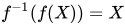
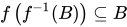

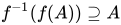
















Also:

Multiple functions
[edit]For functions and with subsets and the following properties hold:




Multiple subsets of domain or codomain
[edit]For function and subsets and the following properties hold:


| Image | Preimage |
|---|---|
| [11][12] | |
| [11][12] (equal if is injective[13]) |
|
| [11] (equal if is injective[13]) |
[11] |
(equal if is injective) |










The results relating images and preimages to the (Boolean) algebra of intersection and union work for any collection of subsets, not just for pairs of subsets:
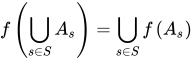
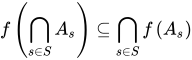
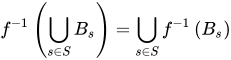
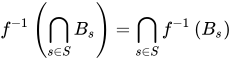
(Here, can be infinite, even uncountably infinite.)
With respect to the algebra of subsets described above, the inverse image function is a lattice homomorphism, while the image function is only a semilattice homomorphism (that is, it does not always preserve intersections).
See also
[edit]- Bijection, injection and surjection – Properties of mathematical functions
- Fiber (mathematics) – Set of all points in a function's domain that all map to some single given point
- Image (category theory)
- Kernel of a function – Equivalence relation expressing that two elements have the same image under a function
- Set inversion – Mathematical problem of finding the set mapped by a specified function to a certain range
Notes
[edit]- ^ "5.4: Onto Functions and Images/Preimages of Sets". Mathematics LibreTexts. 2019-11-05. Retrieved 2020-08-28.
- ^ Paul R. Halmos (1968). Naive Set Theory. Princeton: Nostrand. Here: Sect.8
- ^ Weisstein, Eric W. "Image". mathworld.wolfram.com. Retrieved 2020-08-28.
- ^ Dolecki & Mynard 2016, pp. 4–5.
- ^ Blyth 2005, p. 5.
- ^ Jean E. Rubin (1967). Set Theory for the Mathematician. Holden-Day. p. xix. ASIN B0006BQH7S.
- ^ M. Randall Holmes: Inhomogeneity of the urelements in the usual models of NFU, December 29, 2005, on: Semantic Scholar, p. 2
- ^ Hoffman, Kenneth (1971). Linear Algebra (2nd ed.). Prentice-Hall. p. 388.
- ^ a b c See Halmos 1960, p. 31
- ^ a b See Munkres 2000, p. 19
- ^ a b c d e f g h See p.388 of Lee, John M. (2010). Introduction to Topological Manifolds, 2nd Ed.
- ^ a b Kelley 1985, p. 85
- ^ a b See Munkres 2000, p. 21
References
[edit]- Artin, Michael (1991). Algebra. Prentice Hall. ISBN 81-203-0871-9.
- Blyth, T.S. (2005). Lattices and Ordered Algebraic Structures. Springer. ISBN 1-85233-905-5..
- Dolecki, Szymon; Mynard, Frédéric (2016). Convergence Foundations Of Topology. New Jersey: World Scientific Publishing Company. ISBN 978-981-4571-52-4. OCLC 945169917.
- Halmos, Paul R. (1960). Naive set theory. The University Series in Undergraduate Mathematics. van Nostrand Company. ISBN 9780442030643. Zbl 0087.04403.
{{cite book}}: ISBN / Date incompatibility (help) - Kelley, John L. (1985). General Topology. Graduate Texts in Mathematics. Vol. 27 (2 ed.). Birkhäuser. ISBN 978-0-387-90125-1.
- Munkres, James R. (2000). Topology (2nd ed.). Upper Saddle River, NJ: Prentice Hall, Inc. ISBN 978-0-13-181629-9. OCLC 42683260. (accessible to patrons with print disabilities)
This article incorporates material from Fibre on PlanetMath, which is licensed under the Creative Commons Attribution/Share-Alike License.
Image (mathematics)
View on GrokipediaCore Definitions
Image of an Element
In mathematics, the image of an element under a function is defined as follows: for a function and an element , the image is the unique element such that .[9] This notation directly represents the output assigned to the input , encapsulating the core operation of the function as a rule that pairs each domain element with exactly one codomain element.[10] This concept underscores the mapping aspect of functions, where systematically associates elements of the domain to elements of the codomain . Functions are required to be total, meaning every has a defined image , and single-valued, ensuring that no input maps to more than one output, which distinguishes them from general relations.[11] Without these properties, the image would not be uniquely determined for each element.[12] The understanding of the image of an element presupposes a basic grasp of functions as mappings between sets, where the domain and codomain are specified sets, and the function provides a consistent assignment for all inputs. The collection of such images for elements in a subset forms the image of that subset.[13]Image of a Subset
In the context of a function , the image of a subset is formally defined as the set This construction collects all elements of the codomain that are outputs of elements from under .[14] The fact that is a subset of follows directly from the definition of a function, as each for lies in by construction; the set comprehension ensures no elements outside are included.[14] To see this, suppose ; then there exists such that , and since maps to , .[15] This generalizes the image of a single element , which is merely an individual point in , by aggregating such points into a set that may vary in cardinality and is typically a proper subset of the codomain unless is surjective onto from .[14] For the empty subset, the image is , since the set comprehension yields no elements when there are none in to map.[14]Image of a Function
The image of a function is defined as the set , consisting of all elements in the codomain that are outputs of for some input in the domain .[15] This set represents the actual outputs produced by the function, distinguishing it from the potentially larger codomain.[16] The image is also referred to as the range of the function, emphasizing the subset of that effectively reaches.[15] In general, , and equality holds if and only if is surjective onto .[13] The notation is a standard way to denote this set in mathematical literature.[15] A key property is that if the domain is non-empty, then the image is also non-empty, as the function assigns at least one element in to each element in .[13] This follows directly from the definition of a function in set theory, where every element of the domain is mapped.[17] The image of the full function is thus a specific instance of the image of a subset under , taken over the entire domain .[16]Generalizations
Binary Relations
In the context of binary relations, the image concept generalizes the notion from functions to more flexible associations between sets. A binary relation defines, for each element , the image , which is a subset of that may be empty, a singleton, or contain multiple elements depending on the pairs involving .[18] This contrasts with the image under a function, where each is at most a singleton since functions are single-valued binary relations satisfying for all .[18] For a subset , the image under is defined as , collecting all elements of related to at least one element of .[19] This direct image operation preserves the multi-valued nature of relations, allowing to encompass diverse outputs without the injectivity or surjectivity constraints typical of functions. The full image of the relation, , represents the projection of onto , specifically , which is the range of and may be a proper subset of if is not surjective.[20] This construction highlights how binary relations extend the image to capture broader relational structures in set theory.Other Mathematical Contexts
In linear algebra, the image of a linear map between vector spaces over the same field is defined as the subspace of .[7] This subspace captures the directions in that can be reached from under , and it forms a key component in theorems like the rank-nullity theorem, where the dimension of the image equals the rank of .[21] In topology, the image of a continuous function between topological spaces is simply , equipped with the subspace topology.[22] Continuous maps preserve certain topological properties in their images; for instance, the continuous image of a connected space is connected, and the continuous image of a compact space is compact.[23] These inheritance properties highlight how the image reflects structural features of the domain under continuity. In category theory, the image of a morphism in a category with images is defined via the canonical factorization , where is an epimorphism and is a monomorphism, with being universal among such monomorphisms factoring .[24] This construction generalizes the set-theoretic image and exists in categories like abelian categories or regular categories, where it can be computed as the kernel of the cokernel of .[25] In homomorphisms between algebraic structures, such as group homomorphisms, the image preserves the operation, forming a substructure isomorphic to the quotient by the kernel.[26]Inverse Images
Definition
In mathematics, the inverse image, also known as the preimage, of a subset under a function provides a way to pull back sets from the codomain to the domain, serving as a dual operation to the forward image of a subset.[1] For a function and a subset , the inverse image is defined as the set .[1] When considering single elements, for , the inverse image is the set , which is referred to as the fiber of over or the level set at .[1] A key aspect of the inverse image is that it is always defined for any subset , regardless of whether intersects the image of ; in particular, .[1] Special cases include the inverse image of the empty set, where , and the inverse image of the entire codomain, where .[1]Basic Properties
The inverse image operation preserves unions, intersections, and complements of subsets of the codomain. Specifically, for a function and subsets for , it holds that and .[27][28][29] Additionally, for any , .[30] These preservation properties can be verified through element-chasing arguments establishing set equality via double inclusion. For unions, suppose ; then , so for some , implying . Conversely, if , then for some , so , hence .[30][31] The proofs for intersections and complements follow analogously: for complements, if , then , so and thus , yielding ; the reverse inclusion uses the contrapositive.[30] The inverse image is monotonic with respect to subset inclusion: if , then . To see this, take ; then , so .[30][27][29] Inverse images also relate to direct images in precise ways that highlight their duality. For any and , , where denotes the image of ; equality to holds if is surjective.[28][29] Similarly, , with equality if is injective.[27][28][29] These relations follow from the definitions: for , any satisfies for some with , so and ; the reverse inclusion holds since for , there exists with , so and .[28]Notations
Arrow and Star Notations
In mathematics, the image of a subset under a function is most commonly denoted by , representing the set . For the full image of the function itself—that is, the image of the entire domain —the notations or are standard, with often preferred to emphasize the range as a key property of .[15] In some texts, to avoid ambiguity with the image of individual elements, the direct image is denoted by or the arrow notation .[32] The arrow notation , which extends to a map on power sets . For instance, T.S. Blyth employs in this context to clearly denote the induced mapping on subsets.[32] For the inverse image of a subset under , the standard notation is , defined as regardless of whether is invertible.[33] In more advanced settings, such as category theory, the star notation is sometimes used for the inverse image, particularly in discussions of adjoint functors like geometric morphisms.[34] The choice of notation depends on context: suits general subset images in introductory treatments, while highlights the function's range in analyses of surjectivity or codomain properties.[32]Alternative Terminology
In mathematical literature, the image of a subset under a function , denoted , is sometimes referred to as the direct image, particularly in contexts involving sheaf theory and category theory where it corresponds to the pushforward operation .[35] This terminology distinguishes it from the inverse image and emphasizes the forward mapping action. Additionally, when considering the image of the entire domain, , the term "range" is often used as a synonym, though "image" is preferred in more formal and advanced writing to avoid ambiguity with the codomain.[15] For the inverse image , common alternative terms include "preimage," "inverse image," and "counterimage," with the latter appearing in some topology texts to highlight its role without implying the existence of a function inverse.[36] In category-theoretic settings, it is frequently called the "pullback," reflecting its adjoint relationship to the direct image in structures like geometric morphisms.[37] Context-specific usages further diversify the terminology. In topology, "image" typically presupposes continuous maps, where the direct image of an open set need not be open, a nuance emphasized in foundational texts.[38] In algebra, the kernel of a homomorphism is a special case of the preimage under the zero element, underscoring the inverse image's role in preserving structures like ideals or subgroups./10:_Group_and_Subgroup_Structures/10.01:_Defining_a_Group_Homomorphism) Regional variations are notable in French mathematical traditions, where Bourbaki and associated works by Dieudonné employ "image directe" for the direct image and "image réciproque" for the inverse image, influencing much of modern algebraic geometry.[39] These terms align with the arrow notations and , but prioritize descriptive phrasing in expository writing. Caution is advised to distinguish these concepts from the image of an inverse function, which applies only to bijective cases and does not generalize to arbitrary subsets.[40]Properties
General Properties
The image of a subset under a function preserves inclusions: if for a function , then . This follows directly from the definition of the image, as every element in is also in , so its image under lies in both and .[41] Additionally, the image of the entire domain satisfies always, where is the codomain, though equality holds if and only if is surjective.[4] For finite sets, the cardinality of the image provides bounds related to injectivity: in general, for , with equality if and only if restricted to is injective. A key structural property is that the image operation commutes with unions: for a family of subsets , . This holds because any element in the image of the union arises from some , and conversely, elements in the union of images come from the respective subsets.[41]Properties Involving Compositions and Multiple Sets
In the context of function composition, consider functions and . The image of the composite function satisfies , since every element in is of the form for some , and , so it lies in the image of under . Equality holds if is injective when restricted to , ensuring that distinct elements in map to distinct elements without collapsing. For multiple subsets, the image operator preserves unions: if , then , as every element in the union is the image of some element in or , and conversely.[42] For intersections, , since any image from the intersection must appear in both individual images, but the reverse inclusion may fail unless is injective, in which case distinct preimages preserve the overlap exactly.[42] Under iterated compositions, images form a nonincreasing sequence: for a function , for each , as the property for two functions extends inductively, leading to eventual stabilization in finite settings or contraction in broader analyses.Examples
Elementary Examples
Consider the squaring function defined by . The image of this function, denoted , consists of all non-negative real numbers, so .[41] A constant function provides another basic case. Let be defined by for some fixed real number . The image of is the singleton set .[43] For any non-empty subset , the image , matching . This shows how the image remains unchanged regardless of the input set's size, as long as it is non-empty. Relations generalize functions, and their images follow a similar definition. Consider the equality relation on the natural numbers , where . For a fixed , the section , a singleton set.[44] The overall image , as every natural number appears as a second coordinate. In all cases, the image of a subset satisfies for a function , or analogously for relations, since elements of are outputs produced by inputs in , hence in the full image. This inclusion holds by the definition of the image as the set of all possible outputs.[41]Advanced Examples
In linear algebra, the image of a linear transformation between finite-dimensional vector spaces is the subspace spanned by the columns of the matrix representing , known as the column space. By the rank-nullity theorem, the dimension of the image equals the rank of the matrix, providing a measure of the transformation's "reach" within the codomain.[45] In abstract algebra, the image of a group homomorphism is a subgroup of , specifically the smallest subgroup containing all elements for . A classic example is the evaluation homomorphism sending a polynomial to ; its image is , the even integers, which is a proper subgroup of .[46] This illustrates the first isomorphism theorem, where , linking the image to quotient structures.[46] In topology, the image of a continuous map preserves key properties like connectedness: if is connected and is continuous, then is connected in .[47] Similarly, the image of a compact set under a continuous map is compact.[47] In category theory, the image of a morphism is defined as the universal monomorphism such that there exists with , generalizing set-theoretic images to arbitrary categories. In the category of sets, this coincides with the usual image; in the category of abelian groups, it is the subgroup generated by the elements in the image of . For instance, in the category of abelian groups, the image of the inclusion is itself, as it is already a monomorphism.[48] This construction ensures the image is the "least" subobject through which factors.[48]References
- https://proofwiki.org/wiki/Definition:Image_of_Subset_under_Mapping/Notation