



Community hub
Recent from talks
Contribute something to knowledge base
Content stats: 0 posts, 0 articles, 1 media, 0 notes
Members stats: 0 subscribers, 0 contributors, 0 moderators, 0 supporters
Subscribers
Supporters
Contributors
Moderators
Hub AI
Estradiol enantate AI simulator
(@Estradiol enantate_simulator)
Hub AI
Estradiol enantate AI simulator
(@Estradiol enantate_simulator)
Estradiol enantate
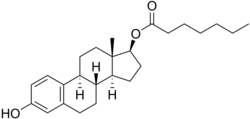
Estradiol enantate (EEn or E2-EN), also spelled estradiol enanthate and sold under the brand names Perlutal and Topasel among others, is an estrogen medication which is used in hormonal birth control for women. It is formulated in combination with dihydroxyprogesterone acetophenide (DHPA; algestone acetophenide), a progestin, and is used specifically as a combined injectable contraceptive. Estradiol enantate is not available for medical use alone. The medication, in combination with DHPA, is given by injection into muscle once a month.
Side effects of estradiol enantate include breast tenderness, breast enlargement, nausea, headache, and fluid retention. Estradiol enantate is an estrogen and hence is an agonist of the estrogen receptor, the biological target of estrogens like estradiol. It is an estrogen ester and a long-lasting prodrug of estradiol in the body. Because of this, it is considered to be a natural and bioidentical form of estrogen.
Estradiol enantate was first described by 1954, and was first studied in combination with DHPA as a combined injectable contraceptive in 1964. The combination was introduced for clinical use by the mid-1970s. Estradiol enantate is not available as a standalone medication (i.e., by itself without DHPA). The combination is available in Latin America and Hong Kong, and was also previously marketed in Spain and Portugal.
Estradiol enantate is used in combination with the progestin DHPA as a once-monthly combined injectable contraceptive for women in Latin America and Hong Kong. Estradiol enantate has been studied in feminizing hormone therapy for transgender women as well. The combination of estradiol enantate and DHPA has likewise been used by transgender women for such purposes. Since at least the 2020s, it has grown in popularity among the transfeminine community as a means of DIY hormone therapy (without DHPA).
The following forms of estradiol enantate are or have been available for use:
A 6 mg estradiol enantate and 90 mg DHPA formulation was also studied, but was never marketed. The combination of estradiol enantate and DHPA has also been studied at other doses ranging from 5 to 50 mg estradiol enantate and 75 to 200 mg DHPA.
The combination of estradiol enantate and DHPA is provided in ampoules at estradiol enantate concentrations of 5 mg/mL and 10 mg/mL.
Contraindications of estrogens include coagulation problems, cardiovascular diseases, liver disease, and certain hormone-sensitive cancers such as breast cancer and endometrial cancer, among others.
Estradiol enantate
Estradiol enantate (EEn or E2-EN), also spelled estradiol enanthate and sold under the brand names Perlutal and Topasel among others, is an estrogen medication which is used in hormonal birth control for women. It is formulated in combination with dihydroxyprogesterone acetophenide (DHPA; algestone acetophenide), a progestin, and is used specifically as a combined injectable contraceptive. Estradiol enantate is not available for medical use alone. The medication, in combination with DHPA, is given by injection into muscle once a month.
Side effects of estradiol enantate include breast tenderness, breast enlargement, nausea, headache, and fluid retention. Estradiol enantate is an estrogen and hence is an agonist of the estrogen receptor, the biological target of estrogens like estradiol. It is an estrogen ester and a long-lasting prodrug of estradiol in the body. Because of this, it is considered to be a natural and bioidentical form of estrogen.
Estradiol enantate was first described by 1954, and was first studied in combination with DHPA as a combined injectable contraceptive in 1964. The combination was introduced for clinical use by the mid-1970s. Estradiol enantate is not available as a standalone medication (i.e., by itself without DHPA). The combination is available in Latin America and Hong Kong, and was also previously marketed in Spain and Portugal.
Estradiol enantate is used in combination with the progestin DHPA as a once-monthly combined injectable contraceptive for women in Latin America and Hong Kong. Estradiol enantate has been studied in feminizing hormone therapy for transgender women as well. The combination of estradiol enantate and DHPA has likewise been used by transgender women for such purposes. Since at least the 2020s, it has grown in popularity among the transfeminine community as a means of DIY hormone therapy (without DHPA).
The following forms of estradiol enantate are or have been available for use:
A 6 mg estradiol enantate and 90 mg DHPA formulation was also studied, but was never marketed. The combination of estradiol enantate and DHPA has also been studied at other doses ranging from 5 to 50 mg estradiol enantate and 75 to 200 mg DHPA.
The combination of estradiol enantate and DHPA is provided in ampoules at estradiol enantate concentrations of 5 mg/mL and 10 mg/mL.
Contraindications of estrogens include coagulation problems, cardiovascular diseases, liver disease, and certain hormone-sensitive cancers such as breast cancer and endometrial cancer, among others.
Recent media
Recent media