
Recent from talks
Etest
Knowledge base stats:
Talk channels stats:
Members stats:
Etest
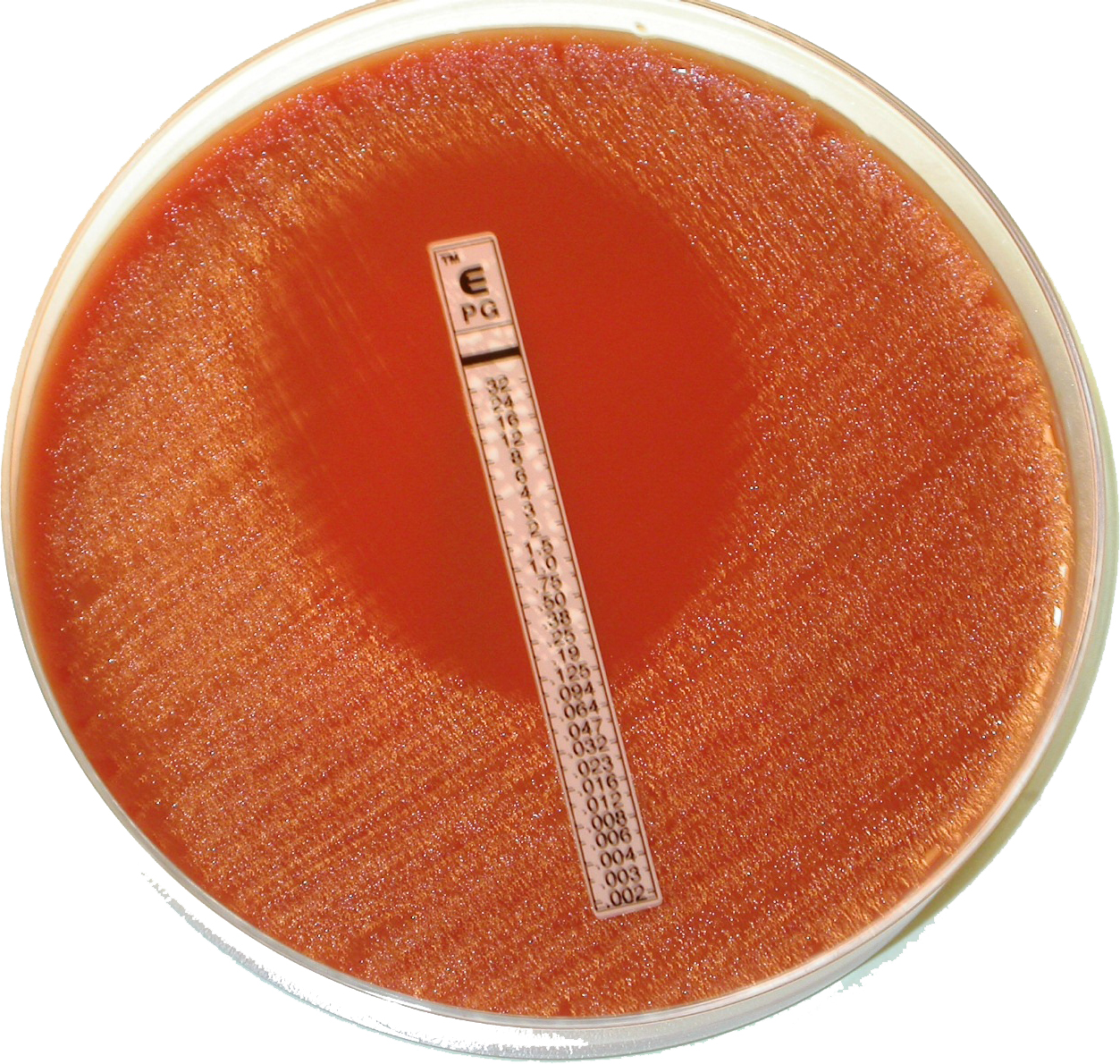
Etest (previously known as the Epsilometer test) is a way of determining antimicrobial sensitivity by placing a strip impregnated with antimicrobials onto an agar plate. A strain of bacterium or fungus will not grow near a concentration of antibiotic or antifungal if it is sensitive. For some microbial and antimicrobial combinations, the results can be used to determine a minimum inhibitory concentration (MIC). Etest is a proprietary system manufactured by bioMérieux. It is a laboratory test used in healthcare settings to help guide physicians by indicating what concentration of antimicrobial could successfully be used to treat patients' infections.
Etest is a quantitative technique for determining the MIC of microorganisms. It is used for a range of Gram-negative and Gram-positive bacteria such as Pseudomonas, Staphylococcus, and Enterococcus species, as well as fastidious bacteria, such as Neisseria and Streptococcus pneumoniae. It can also be used to determine MICs against certain fungi.
Etest is a pre-prepared non-porous plastic reagent strip with a predefined gradient of antibiotic, covering a continuous concentration range. It is applied to the surface of an agar plate inoculated with the test strain, where there is release of the antimicrobial gradient from the plastic carrier to the agar to form a stable and continuous gradient beneath and in nearby to the strip.
The time taken for a plate to be ready depends on the m that is being tested, and the conditions of the agar plate.[citation needed] The predefined Etest gradient remains stable for at least 18 to 24 hours; that is, a period that covers the critical times of many species of fastidious and non-fastidious organisms.
After the test, the bacterial growth becomes visible after incubation and a symmetrical inhibition ellipse centered along the strip is seen. The MIC value is read from the scale in terms of μg/mL where the ellipse edge intersects the strip. After the required incubation period, the minimum inhibitory value is read where the edge of the inhibition ellipse intersects the side of the strip. The plate should not be read if the culture appears mixed or if the lawn of growth is too light or too heavy.[citation needed]
Etest MIC endpoints are usually clear-cut although different growth/inhibition patterns may be seen depending on the antifungal or antibiotic used.
Etest can be used with many different kinds of AST agar medium as long as the medium supports good growth of the test organism and does not interfere with the activity of the antimicrobial agent. However, to maximise reproducibility, the medium chosen should fulfil the basic requirements for a susceptibility test medium. The following AST media are recommended for use with Etest:[citation needed]
These media may require supplemental nutrients to obtain enhanced growth of nutritionally fastidious organisms such as pneumococci, streptococci, Abiotrophia, Haemophilus, gonococci, meningococci and Campylobacter. In general, media recommendations from the Clinical and Laboratory Standards Institute (CLSI) and European Committee on Antimicrobial Susceptibility Testing (EUCAST) are considered appropriate for Etest.
Hub AI
Etest AI simulator
(@Etest_simulator)
Etest
Etest (previously known as the Epsilometer test) is a way of determining antimicrobial sensitivity by placing a strip impregnated with antimicrobials onto an agar plate. A strain of bacterium or fungus will not grow near a concentration of antibiotic or antifungal if it is sensitive. For some microbial and antimicrobial combinations, the results can be used to determine a minimum inhibitory concentration (MIC). Etest is a proprietary system manufactured by bioMérieux. It is a laboratory test used in healthcare settings to help guide physicians by indicating what concentration of antimicrobial could successfully be used to treat patients' infections.
Etest is a quantitative technique for determining the MIC of microorganisms. It is used for a range of Gram-negative and Gram-positive bacteria such as Pseudomonas, Staphylococcus, and Enterococcus species, as well as fastidious bacteria, such as Neisseria and Streptococcus pneumoniae. It can also be used to determine MICs against certain fungi.
Etest is a pre-prepared non-porous plastic reagent strip with a predefined gradient of antibiotic, covering a continuous concentration range. It is applied to the surface of an agar plate inoculated with the test strain, where there is release of the antimicrobial gradient from the plastic carrier to the agar to form a stable and continuous gradient beneath and in nearby to the strip.
The time taken for a plate to be ready depends on the m that is being tested, and the conditions of the agar plate.[citation needed] The predefined Etest gradient remains stable for at least 18 to 24 hours; that is, a period that covers the critical times of many species of fastidious and non-fastidious organisms.
After the test, the bacterial growth becomes visible after incubation and a symmetrical inhibition ellipse centered along the strip is seen. The MIC value is read from the scale in terms of μg/mL where the ellipse edge intersects the strip. After the required incubation period, the minimum inhibitory value is read where the edge of the inhibition ellipse intersects the side of the strip. The plate should not be read if the culture appears mixed or if the lawn of growth is too light or too heavy.[citation needed]
Etest MIC endpoints are usually clear-cut although different growth/inhibition patterns may be seen depending on the antifungal or antibiotic used.
Etest can be used with many different kinds of AST agar medium as long as the medium supports good growth of the test organism and does not interfere with the activity of the antimicrobial agent. However, to maximise reproducibility, the medium chosen should fulfil the basic requirements for a susceptibility test medium. The following AST media are recommended for use with Etest:[citation needed]
These media may require supplemental nutrients to obtain enhanced growth of nutritionally fastidious organisms such as pneumococci, streptococci, Abiotrophia, Haemophilus, gonococci, meningococci and Campylobacter. In general, media recommendations from the Clinical and Laboratory Standards Institute (CLSI) and European Committee on Antimicrobial Susceptibility Testing (EUCAST) are considered appropriate for Etest.
Recent media