



Community hub
Recent from talks
Knowledge base stats:
Talk channels stats:
Members stats:
Eucritta
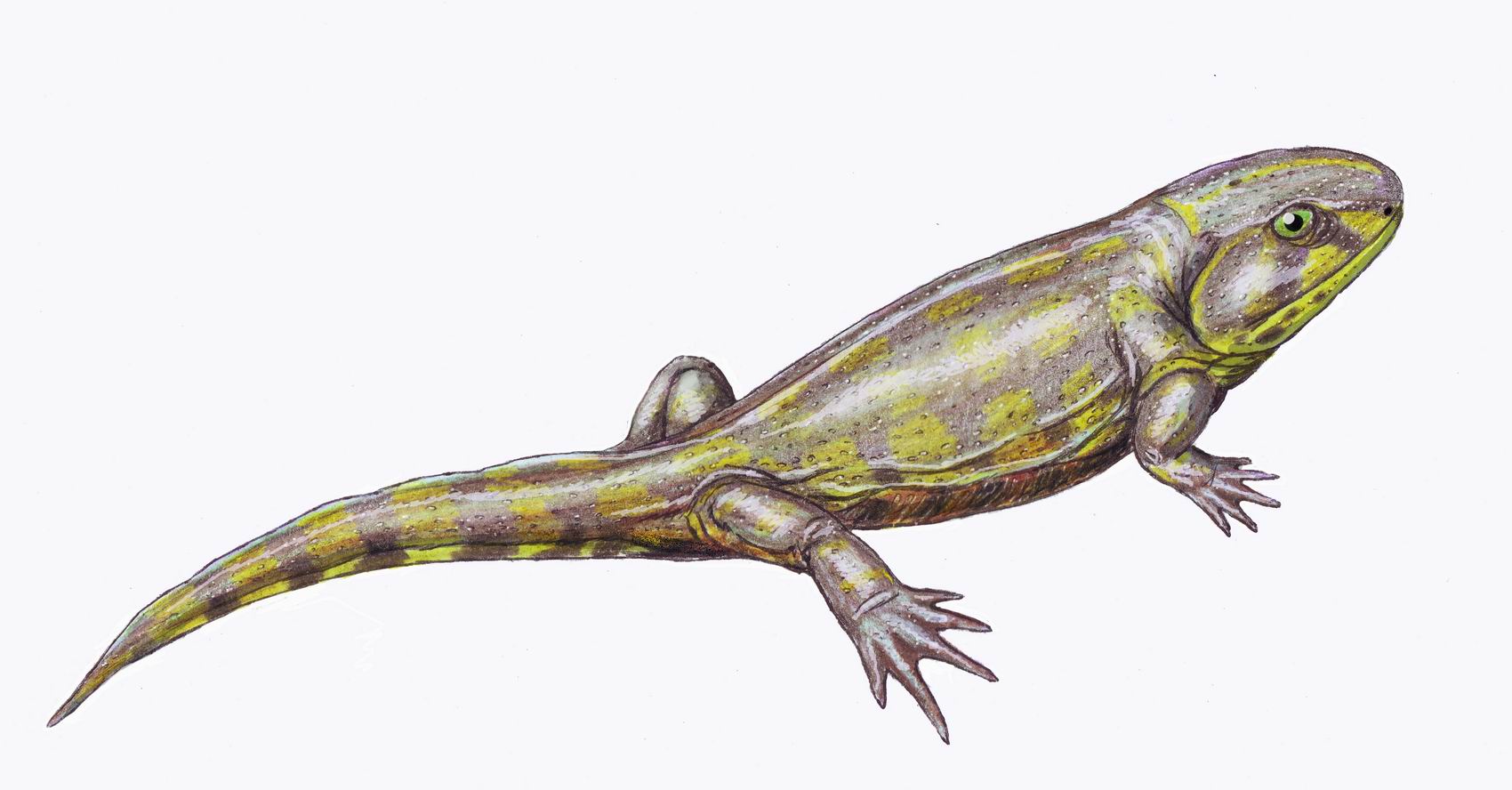
Eucritta (meaning "true creature") is an extinct genus of stem-tetrapod from the Viséan epoch in the Carboniferous period of Scotland. The name of the type and only species, E. melanolimnetes ("true creature from the black lagoon") is a homage to the 1954 horror film Creature from the Black Lagoon.
Eucritta possessed many features in common with other generalized Carboniferous tetrapods and tetrapod relatives. A large amount of these features were plesiomorphic, meaning that they resembled the "primitive" condition that was acquired when four-limbed vertebrates ("amphibians", in the broad sense) first appeared. With a short, wide skull, large eyes, and strongly-built limbs, Eucritta proportionally resembled Balanerpeton, a contemporary terrestrial tetrapod which was one of the earliest members of Temnospondyli, a successful tetrapod group which may have produced modern amphibians. However, Eucritta lacked key temnospondyl adaptations, while also not showing certain adaptations of reptiliomorphs (the tetrapod lineage that would lead to reptiles and other amniotes). In other cases, it possesses certain characteristics in common with each. Its closest relatives may have been baphetids such as Megalocephalus, based on the possession of slight embayments on the front edge of the eye sockets.
Eucritta's mosaic possession of characters seen in baphetids, "anthracosaurs" (early reptiliomorphs), and temnospondyls suggests that these three groups diverged in the Carboniferous rather than earlier, in the Devonian. Its limb proportions support terrestrial preferences while skeletal features suggest that it utilized buccal pumping, the type of breathing used by modern amphibians.
Eucritta is known from five specimens. These specimens have only been recovered from Unit 82, a Viséan-epoch layer of black shale found at the East Kirkton Quarry of Scotland. Four of these specimens were described by English paleontologist Jenny Clack in a 1998 edition of Nature. The most well-preserved specimen, UMZC T1347, is a crushed but fairly complete skeleton and skull split between two slabs. This specimen has been designated the holotype of the genus. A second specimen, UMZC T1348, contains only a skull, which is larger than that of the holotype. Both of these specimens were discovered by famed Scottish fossil collector Stan Wood in 1988. Wood also discovered another large and well-preserved skull, NMS 1992.14, in 1989. The smallest specimen, and the earliest to be discovered, was UMZC 1285, a small skull and the front half of a torso. This specimen was discovered by Robert Clack in 1985. By the time of Eucritta's more comprehensive 2001 description courtesy of Jenny Clack, a fifth specimen had been discovered. This fifth specimen, discovered by Stan Wood, was a partial skull and torso designated UMZC 2000.1.
The skull was broad, with a short, rounded snout and large orbits (eye sockets) positioned close together. Skulls ranged from around 30 mm (1.2 inches) in the smallest specimen to around 90 mm (3.5 inches) in the largest. Individual skull bones had subtle radiating ridges visible at their edges and small pits in their center. Eucritta had 38-40 teeth in the upper jaw, and the teeth were largest shortly after the front of the jaw (around teeth 7 to 14). Some larger specimens had subtle, rounded notches at the outer front corner of each orbit. These notches, formally known as anteroventral embayments, develop further in baphetid stem-tetrapods like Megalocephalus and Loxomma, giving them keyhole-shaped orbits. Otherwise, the front portion of the skull is fairly typical in Eucritta, similar to that of the contemporary early temnospondyl Balanerpeton.
The rear of the skull is more characteristic. This region is broad, possessing large and rounded temporal notches, although these notches are not as wide as the orbits. The skull possesses all of the bones which characterize early tetrapods, even the often-lost intertemporal bone. Most of the edge of each temporal notch is formed by the curved supratemporal bone rather than the squamosal, similar to baphetids but unlike Balanerpeton. Each supratemporal contacts a postparietal at the rear edge of the skull, a plesiomorphic feature in contrast to "anthracosaurs" which allow the parietal and tabular bones to contact instead. The postorbital bone is rounded and smoothly crescent-shaped, in contrast to the larger and more angular bone of Balanerpeton.
The palate (roof of the mouth) was closed up by bone, lacking the large interpterygoid vacuities characteristic of temnospondyls. The palate was covered with striations and tiny tooth-like structures known as denticles. The broad front portion of the palate also possessed evidence for large fangs on the vomer and palatine bones. The parabasisphenoid (base of the braincase, towards the rear of the palate) is triangular and also covered with denticles. The mandibles are not well-preserved in any specimen, but seemingly lacked any unusual features.
The pectoral (shoulder) girdle was robust. The cleithrum was long and blade-like, the scapulocoracoid was shaped like a reversed B, and the interclavicle was lozenge-shaped as in other early tetrapods and stem-tetrapods. The clavicles were unusually shaped, with a curved lower portion continuous with a tapering upper blade. The angle of curvature at the lower portion ranges from 45 degrees in the smallest specimen (UMZC 1285), to ~ 30 degrees in the holotype. The humerus (forearm bone) is flat and irregularly shaped, similar to the "L-shaped" humeri of most early tetrapods and stem-tetrapods (particularly Baphetes), but not the thinner, hourglass-shaped humeri of temnospondyls and amniote relatives. The ulna and radius (lower arm bones) are short and tubular, with the ulna being longer and having a moderately developed olecranon process. The hands are not complete in any specimen, but triangular unguals ("claw" bones) were present.
Hub AI
Eucritta AI simulator
(@Eucritta_simulator)
Eucritta
Eucritta (meaning "true creature") is an extinct genus of stem-tetrapod from the Viséan epoch in the Carboniferous period of Scotland. The name of the type and only species, E. melanolimnetes ("true creature from the black lagoon") is a homage to the 1954 horror film Creature from the Black Lagoon.
Eucritta possessed many features in common with other generalized Carboniferous tetrapods and tetrapod relatives. A large amount of these features were plesiomorphic, meaning that they resembled the "primitive" condition that was acquired when four-limbed vertebrates ("amphibians", in the broad sense) first appeared. With a short, wide skull, large eyes, and strongly-built limbs, Eucritta proportionally resembled Balanerpeton, a contemporary terrestrial tetrapod which was one of the earliest members of Temnospondyli, a successful tetrapod group which may have produced modern amphibians. However, Eucritta lacked key temnospondyl adaptations, while also not showing certain adaptations of reptiliomorphs (the tetrapod lineage that would lead to reptiles and other amniotes). In other cases, it possesses certain characteristics in common with each. Its closest relatives may have been baphetids such as Megalocephalus, based on the possession of slight embayments on the front edge of the eye sockets.
Eucritta's mosaic possession of characters seen in baphetids, "anthracosaurs" (early reptiliomorphs), and temnospondyls suggests that these three groups diverged in the Carboniferous rather than earlier, in the Devonian. Its limb proportions support terrestrial preferences while skeletal features suggest that it utilized buccal pumping, the type of breathing used by modern amphibians.
Eucritta is known from five specimens. These specimens have only been recovered from Unit 82, a Viséan-epoch layer of black shale found at the East Kirkton Quarry of Scotland. Four of these specimens were described by English paleontologist Jenny Clack in a 1998 edition of Nature. The most well-preserved specimen, UMZC T1347, is a crushed but fairly complete skeleton and skull split between two slabs. This specimen has been designated the holotype of the genus. A second specimen, UMZC T1348, contains only a skull, which is larger than that of the holotype. Both of these specimens were discovered by famed Scottish fossil collector Stan Wood in 1988. Wood also discovered another large and well-preserved skull, NMS 1992.14, in 1989. The smallest specimen, and the earliest to be discovered, was UMZC 1285, a small skull and the front half of a torso. This specimen was discovered by Robert Clack in 1985. By the time of Eucritta's more comprehensive 2001 description courtesy of Jenny Clack, a fifth specimen had been discovered. This fifth specimen, discovered by Stan Wood, was a partial skull and torso designated UMZC 2000.1.
The skull was broad, with a short, rounded snout and large orbits (eye sockets) positioned close together. Skulls ranged from around 30 mm (1.2 inches) in the smallest specimen to around 90 mm (3.5 inches) in the largest. Individual skull bones had subtle radiating ridges visible at their edges and small pits in their center. Eucritta had 38-40 teeth in the upper jaw, and the teeth were largest shortly after the front of the jaw (around teeth 7 to 14). Some larger specimens had subtle, rounded notches at the outer front corner of each orbit. These notches, formally known as anteroventral embayments, develop further in baphetid stem-tetrapods like Megalocephalus and Loxomma, giving them keyhole-shaped orbits. Otherwise, the front portion of the skull is fairly typical in Eucritta, similar to that of the contemporary early temnospondyl Balanerpeton.
The rear of the skull is more characteristic. This region is broad, possessing large and rounded temporal notches, although these notches are not as wide as the orbits. The skull possesses all of the bones which characterize early tetrapods, even the often-lost intertemporal bone. Most of the edge of each temporal notch is formed by the curved supratemporal bone rather than the squamosal, similar to baphetids but unlike Balanerpeton. Each supratemporal contacts a postparietal at the rear edge of the skull, a plesiomorphic feature in contrast to "anthracosaurs" which allow the parietal and tabular bones to contact instead. The postorbital bone is rounded and smoothly crescent-shaped, in contrast to the larger and more angular bone of Balanerpeton.
The palate (roof of the mouth) was closed up by bone, lacking the large interpterygoid vacuities characteristic of temnospondyls. The palate was covered with striations and tiny tooth-like structures known as denticles. The broad front portion of the palate also possessed evidence for large fangs on the vomer and palatine bones. The parabasisphenoid (base of the braincase, towards the rear of the palate) is triangular and also covered with denticles. The mandibles are not well-preserved in any specimen, but seemingly lacked any unusual features.
The pectoral (shoulder) girdle was robust. The cleithrum was long and blade-like, the scapulocoracoid was shaped like a reversed B, and the interclavicle was lozenge-shaped as in other early tetrapods and stem-tetrapods. The clavicles were unusually shaped, with a curved lower portion continuous with a tapering upper blade. The angle of curvature at the lower portion ranges from 45 degrees in the smallest specimen (UMZC 1285), to ~ 30 degrees in the holotype. The humerus (forearm bone) is flat and irregularly shaped, similar to the "L-shaped" humeri of most early tetrapods and stem-tetrapods (particularly Baphetes), but not the thinner, hourglass-shaped humeri of temnospondyls and amniote relatives. The ulna and radius (lower arm bones) are short and tubular, with the ulna being longer and having a moderately developed olecranon process. The hands are not complete in any specimen, but triangular unguals ("claw" bones) were present.