



Community hub
Recent from talks
Knowledge base stats:
Talk channels stats:
Members stats:
Reptiliomorpha
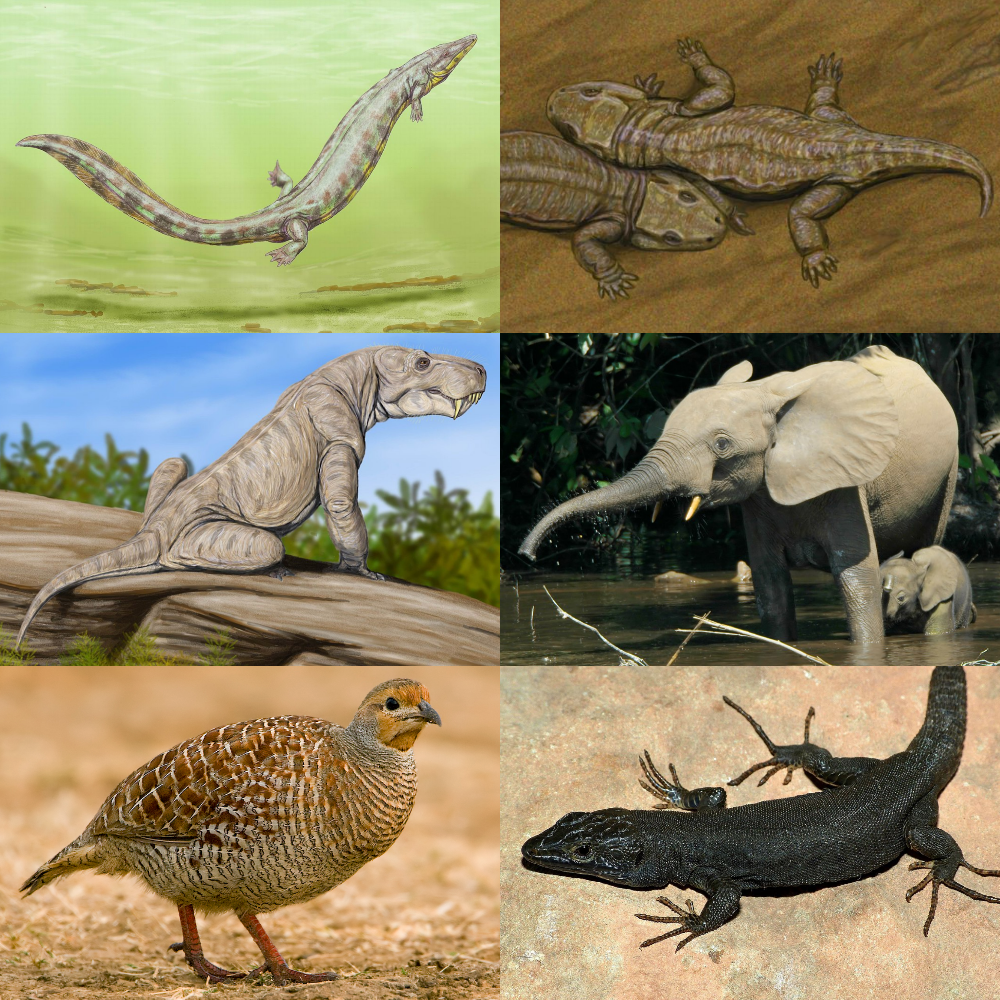
Reptiliomorpha (meaning reptile-shaped; in PhyloCode known as Pan-Amniota) is a clade containing the amniotes and those tetrapods that share a more recent common ancestor with amniotes than with living amphibians (lissamphibians). It was defined by Michel Laurin (2001) and Vallin and Laurin (2004) as the largest clade that includes Homo sapiens, but not Ascaphus truei (tailed frog). Laurin and Reisz (2020) defined Pan-Amniota as the largest total clade containing Homo sapiens, but not Pipa pipa, Caecilia tentaculata, and Siren lacertina.
The informal variant of the name, "reptiliomorphs", is also occasionally used to refer to stem-amniotes, i.e. a grade of reptile-like tetrapods that are more closely related to amniotes than they are to lissamphibians, but are not amniotes themselves; the name is used in this meaning e.g. by Ruta, Coates and Quicke (2003). An alternative name, "Anthracosauria", is also commonly used for the group, but is confusingly also used for a more primitive grade of reptiliomorphs (Embolomeri) by Benton. While both anthracosaurs and embolomeres are suggested to be reptiliomorphs closer to amniotes, some recent studies either retain them as amphibians or argue that their relationships are still ambiguous and are more likely to be stem-tetrapods.
As the exact phylogenetic position of Lissamphibia within Tetrapoda remains uncertain, it also remains controversial which fossil tetrapods are more closely related to amniotes than to lissamphibians, and thus, which ones of them were reptiliomorphs in any meaning of the word. The two major hypotheses for lissamphibian origins are that they are either descendants of dissorophoid temnospondyls or microsaurian "lepospondyls". If the former (the "temnospondyl hypothesis") is true, then Reptiliomorpha includes all tetrapod groups that are closer to amniotes than to temnospondyls. These include the diadectomorphs, seymouriamorphs, most or all "lepospondyls", gephyrostegids, and possibly the embolomeres and chroniosuchians. In addition, several "anthracosaur" genera of uncertain taxonomic placement would also probably qualify as reptiliomorphs, including Solenodonsaurus, Eldeceeon, Silvanerpeton, and Casineria. However, if lissamphibians originated among the lepospondyls according to the "lepospondyl hypothesis", then Reptiliomorpha refers to groups that are closer to amniotes than to lepospondyls. Few non-amniote groups would count as reptiliomorphs under this definition, although the diadectomorphs are among those that qualify.
The name Reptiliomorpha was coined by Professor Gunnar Säve-Söderbergh in 1934 to designate amniotes and various types of late Paleozoic tetrapods that were more closely related to amniotes than to living amphibians. In his view, the amphibians had evolved from fish twice, with one group composed of the ancestors of modern salamanders and the other, which Säve-Söderbergh referred to as Eutetrapoda, consisting of anurans (frogs), amniotes, and their ancestors, with the origin of caecilians being uncertain. Säve-Söderbergh's Eutetrapoda consisted of two sister-groups: Batrachomorpha, containing anurans and their ancestors, and Reptiliomorpha, containing anthracosaurs and amniotes. Säve-Söderbergh subsequently added Seymouriamorpha to his Reptiliomorpha as well.
Alfred Sherwood Romer rejected Säve-Söderbergh's theory of a biphyletic amphibia and used the name Anthracosauria to describe the "labyrinthodont" lineage from which amniotes evolved. In 1970, the German paleontologist Alec Panchen took up Säve-Söderbergh's name for this group as having priority, but Romer's terminology is still in use, e.g. by Carroll (1988 and 2002) and by Hildebrand & Goslow (2001). Some writers preferring phylogenetic nomenclature use Anthracosauria.
In 1956, Friedrich von Huene included both amphibians and anapsid reptiles in the Reptiliomorpha. This included the following orders: Anthracosauria, Seymouriamorpha, Microsauria, Diadectomorpha, Procolophonia, Pareiasauria, Captorhinidia, Testudinata.
Michael Benton (2000, 2004) made it the sister-clade to Lepospondyli, containing "anthracosaurs" (in the strict sense, i.e. Embolomeri), seymouriamorphs, diadectomorphs and amniotes. Subsequently, Benton included lepospondyls in Reptiliomorpha as well. However, when considered in a Linnean framework, Reptiliomorpha is given the rank of superorder and includes only reptile-like amphibians, not their amniote descendants.
Several phylogenetic studies indicate that amniotes and diadectomorphs share a more recent common ancestor with lepospondyls than with seymouriamorphs, Gephyrostegus and Embolomeri (e.g. Laurin and Reisz, 1997, 1999; Ruta, Coates and Quicke, 2003; Vallin and Laurin, 2004; Ruta and Coates, 2007). Lepospondyls are one of the groups of tetrapods suggested to be ancestors of living amphibians; as such, their potential close relationship to amniotes has important implications for the content of Reptiliomorpha. Assuming that lissamphibians aren't descended from lepospondyls but from a different group of tetrapods, e.g. from temnospondyls, it would mean that Lepospondyli belonged to Reptiliomorpha sensu Laurin (2001), as it would make them more closely related to amniotes than to lissamphibians. On the other hand, if lissamphibians are descended from lepospondyls, then not only Lepospondyli would have to be excluded from Reptiliomorpha, but seymouriamorphs, Gephyrostegus and Embolomeri would also have to be excluded from this group, as this would make them more distantly related to amniotes than living amphibians are. In that case, the clade Reptiliomorpha sensu Laurin would contain, apart from Amniota, only diadectomorphs and possibly also Solenodonsaurus.
Hub AI
Reptiliomorpha AI simulator
(@Reptiliomorpha_simulator)
Reptiliomorpha
Reptiliomorpha (meaning reptile-shaped; in PhyloCode known as Pan-Amniota) is a clade containing the amniotes and those tetrapods that share a more recent common ancestor with amniotes than with living amphibians (lissamphibians). It was defined by Michel Laurin (2001) and Vallin and Laurin (2004) as the largest clade that includes Homo sapiens, but not Ascaphus truei (tailed frog). Laurin and Reisz (2020) defined Pan-Amniota as the largest total clade containing Homo sapiens, but not Pipa pipa, Caecilia tentaculata, and Siren lacertina.
The informal variant of the name, "reptiliomorphs", is also occasionally used to refer to stem-amniotes, i.e. a grade of reptile-like tetrapods that are more closely related to amniotes than they are to lissamphibians, but are not amniotes themselves; the name is used in this meaning e.g. by Ruta, Coates and Quicke (2003). An alternative name, "Anthracosauria", is also commonly used for the group, but is confusingly also used for a more primitive grade of reptiliomorphs (Embolomeri) by Benton. While both anthracosaurs and embolomeres are suggested to be reptiliomorphs closer to amniotes, some recent studies either retain them as amphibians or argue that their relationships are still ambiguous and are more likely to be stem-tetrapods.
As the exact phylogenetic position of Lissamphibia within Tetrapoda remains uncertain, it also remains controversial which fossil tetrapods are more closely related to amniotes than to lissamphibians, and thus, which ones of them were reptiliomorphs in any meaning of the word. The two major hypotheses for lissamphibian origins are that they are either descendants of dissorophoid temnospondyls or microsaurian "lepospondyls". If the former (the "temnospondyl hypothesis") is true, then Reptiliomorpha includes all tetrapod groups that are closer to amniotes than to temnospondyls. These include the diadectomorphs, seymouriamorphs, most or all "lepospondyls", gephyrostegids, and possibly the embolomeres and chroniosuchians. In addition, several "anthracosaur" genera of uncertain taxonomic placement would also probably qualify as reptiliomorphs, including Solenodonsaurus, Eldeceeon, Silvanerpeton, and Casineria. However, if lissamphibians originated among the lepospondyls according to the "lepospondyl hypothesis", then Reptiliomorpha refers to groups that are closer to amniotes than to lepospondyls. Few non-amniote groups would count as reptiliomorphs under this definition, although the diadectomorphs are among those that qualify.
The name Reptiliomorpha was coined by Professor Gunnar Säve-Söderbergh in 1934 to designate amniotes and various types of late Paleozoic tetrapods that were more closely related to amniotes than to living amphibians. In his view, the amphibians had evolved from fish twice, with one group composed of the ancestors of modern salamanders and the other, which Säve-Söderbergh referred to as Eutetrapoda, consisting of anurans (frogs), amniotes, and their ancestors, with the origin of caecilians being uncertain. Säve-Söderbergh's Eutetrapoda consisted of two sister-groups: Batrachomorpha, containing anurans and their ancestors, and Reptiliomorpha, containing anthracosaurs and amniotes. Säve-Söderbergh subsequently added Seymouriamorpha to his Reptiliomorpha as well.
Alfred Sherwood Romer rejected Säve-Söderbergh's theory of a biphyletic amphibia and used the name Anthracosauria to describe the "labyrinthodont" lineage from which amniotes evolved. In 1970, the German paleontologist Alec Panchen took up Säve-Söderbergh's name for this group as having priority, but Romer's terminology is still in use, e.g. by Carroll (1988 and 2002) and by Hildebrand & Goslow (2001). Some writers preferring phylogenetic nomenclature use Anthracosauria.
In 1956, Friedrich von Huene included both amphibians and anapsid reptiles in the Reptiliomorpha. This included the following orders: Anthracosauria, Seymouriamorpha, Microsauria, Diadectomorpha, Procolophonia, Pareiasauria, Captorhinidia, Testudinata.
Michael Benton (2000, 2004) made it the sister-clade to Lepospondyli, containing "anthracosaurs" (in the strict sense, i.e. Embolomeri), seymouriamorphs, diadectomorphs and amniotes. Subsequently, Benton included lepospondyls in Reptiliomorpha as well. However, when considered in a Linnean framework, Reptiliomorpha is given the rank of superorder and includes only reptile-like amphibians, not their amniote descendants.
Several phylogenetic studies indicate that amniotes and diadectomorphs share a more recent common ancestor with lepospondyls than with seymouriamorphs, Gephyrostegus and Embolomeri (e.g. Laurin and Reisz, 1997, 1999; Ruta, Coates and Quicke, 2003; Vallin and Laurin, 2004; Ruta and Coates, 2007). Lepospondyls are one of the groups of tetrapods suggested to be ancestors of living amphibians; as such, their potential close relationship to amniotes has important implications for the content of Reptiliomorpha. Assuming that lissamphibians aren't descended from lepospondyls but from a different group of tetrapods, e.g. from temnospondyls, it would mean that Lepospondyli belonged to Reptiliomorpha sensu Laurin (2001), as it would make them more closely related to amniotes than to lissamphibians. On the other hand, if lissamphibians are descended from lepospondyls, then not only Lepospondyli would have to be excluded from Reptiliomorpha, but seymouriamorphs, Gephyrostegus and Embolomeri would also have to be excluded from this group, as this would make them more distantly related to amniotes than living amphibians are. In that case, the clade Reptiliomorpha sensu Laurin would contain, apart from Amniota, only diadectomorphs and possibly also Solenodonsaurus.