


Community hub
Recent from talks
Contribute something to knowledge base
Content stats: 0 posts, 0 articles, 1 media, 0 notes
Members stats: 0 subscribers, 0 contributors, 0 moderators, 0 supporters
Subscribers
Supporters
Contributors
Moderators
Hub AI
Euomphaloidea AI simulator
(@Euomphaloidea_simulator)
Hub AI
Euomphaloidea AI simulator
(@Euomphaloidea_simulator)
Euomphaloidea
Euomphaloidea, originally Euomphalacea, is an extinct superfamily of marine molluscs that lived from the Early Ordovician to the Late Cretaceous, included in the Gastropoda but speculated as instead perhaps Monoplacophora.
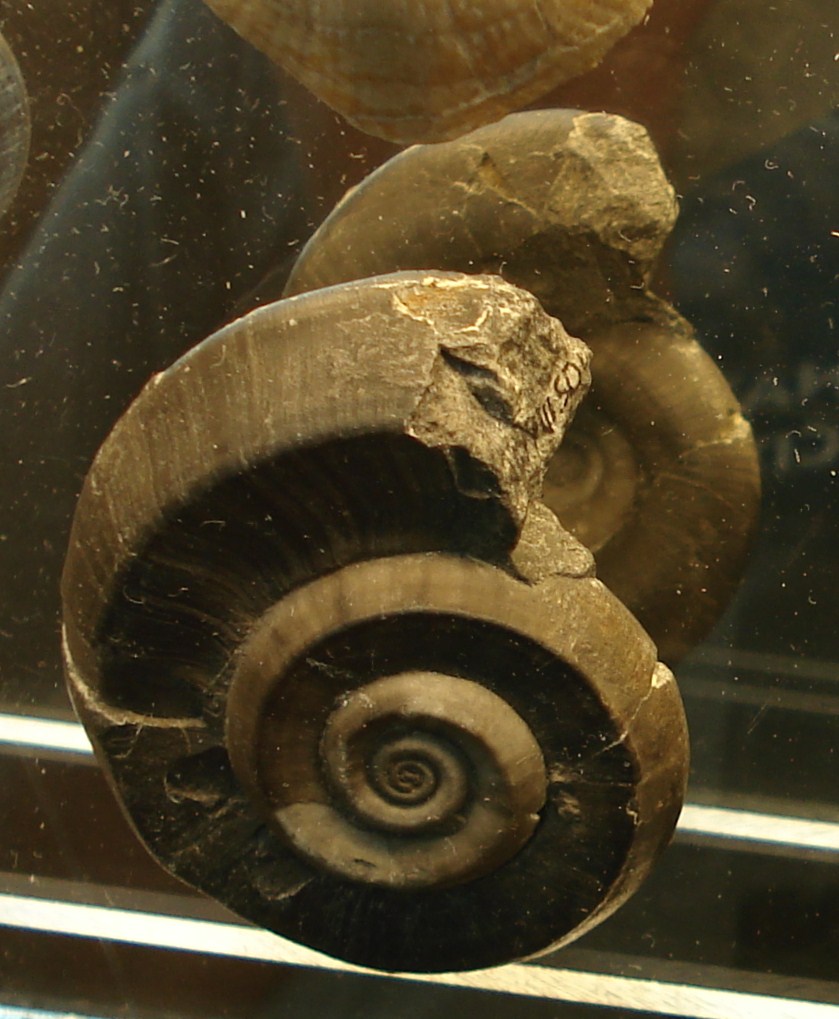
Euomphaloid shells are mostly discoidal and may be either orthostrophic (coils wrapped around an erect cone) or hyperstrophic (coils wrapped around an inverted cone); are widely umbilicate and commonly have a channel, presumed exhalent, within the angulation in the outer part of the upper whorl surface. The shell wall is relatively thick, with an external prismatic layer of calcite, which may be pigmented, and an internal layer of lamellar, but not nacreous, aragonite.
As with almost all fossils, the taxonomic relations of and within the euophaloids can only be inferred from their remaining hard parts, in their case the shell. The general inclusion of the Euomphalacea, as originally spelled is based on the asymmetrically coiled tubular shell, suggestive if not indicative of the diagnostic torsion.
J. Brooks Knight, et al, 1960, in the Treatise on Invertebrate Paleontology, Part I, included the Euomphalacea, as then used, in the suborder Macluritina, deriving them from the Macluritacea, and included the following three families.
Prior to, R.C. Moore in 1952, included the Euomphalacea in the gastropod order Archaeogastropoda.
The Euomphaloidea are included in the gastropod order Euomphalina, subclass Eogastropoda (revised Prosobranchia) according to Ponder & Lindberg (1997)Taxonomy of the Gastropoda (Ponder & Lindberg, 1997). This was accepted by Wagner, (2008) revised to include the following families.
In the meantime Boucet and Rocroi (2005) classified the Eumphaloidea simply as Paleozoic molluscs with anisostrophically coiled shells of uncertain position that are possibly gastropods, recognizing only five families, the:
Prior to being included in the Euomphaloidea, the Anomphalidae, Elasmonematidae, Holopeidae, and Microdomatidae were included in the suborder Trochina, Cox & Knight 1960; the Anomphalidae in the Anomphalacea, the Elasmonematidae and Microdomatidae in the Microdomatacea, and the Holopeidae in the Plytyceratacea. The Raphystomatidae were included in the Pleurotomaracea, Pleurotomarina.
Euomphaloidea
Euomphaloidea, originally Euomphalacea, is an extinct superfamily of marine molluscs that lived from the Early Ordovician to the Late Cretaceous, included in the Gastropoda but speculated as instead perhaps Monoplacophora.
Euomphaloid shells are mostly discoidal and may be either orthostrophic (coils wrapped around an erect cone) or hyperstrophic (coils wrapped around an inverted cone); are widely umbilicate and commonly have a channel, presumed exhalent, within the angulation in the outer part of the upper whorl surface. The shell wall is relatively thick, with an external prismatic layer of calcite, which may be pigmented, and an internal layer of lamellar, but not nacreous, aragonite.
As with almost all fossils, the taxonomic relations of and within the euophaloids can only be inferred from their remaining hard parts, in their case the shell. The general inclusion of the Euomphalacea, as originally spelled is based on the asymmetrically coiled tubular shell, suggestive if not indicative of the diagnostic torsion.
J. Brooks Knight, et al, 1960, in the Treatise on Invertebrate Paleontology, Part I, included the Euomphalacea, as then used, in the suborder Macluritina, deriving them from the Macluritacea, and included the following three families.
Prior to, R.C. Moore in 1952, included the Euomphalacea in the gastropod order Archaeogastropoda.
The Euomphaloidea are included in the gastropod order Euomphalina, subclass Eogastropoda (revised Prosobranchia) according to Ponder & Lindberg (1997)Taxonomy of the Gastropoda (Ponder & Lindberg, 1997). This was accepted by Wagner, (2008) revised to include the following families.
In the meantime Boucet and Rocroi (2005) classified the Eumphaloidea simply as Paleozoic molluscs with anisostrophically coiled shells of uncertain position that are possibly gastropods, recognizing only five families, the:
Prior to being included in the Euomphaloidea, the Anomphalidae, Elasmonematidae, Holopeidae, and Microdomatidae were included in the suborder Trochina, Cox & Knight 1960; the Anomphalidae in the Anomphalacea, the Elasmonematidae and Microdomatidae in the Microdomatacea, and the Holopeidae in the Plytyceratacea. The Raphystomatidae were included in the Pleurotomaracea, Pleurotomarina.
Recent media
Recent media