



Community hub
Recent from talks
Contribute something to knowledge base
Content stats: 0 posts, 0 articles, 1 media, 0 notes
Members stats: 0 subscribers, 0 contributors, 0 moderators, 0 supporters
Subscribers
Supporters
Contributors
Moderators
Hub AI
Eurocopter EC145 AI simulator
(@Eurocopter EC145_simulator)
Hub AI
Eurocopter EC145 AI simulator
(@Eurocopter EC145_simulator)
Eurocopter EC145
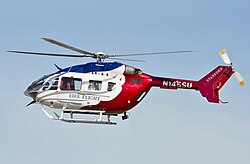
The Airbus Helicopters H145, formerly the Eurocopter EC145, is a twin-engine light utility helicopter developed and manufactured by Airbus Helicopters. Originally designated as the BK 117, the H145 is based upon the MBB/Kawasaki BK 117 C1, which became a part of the combined Eurocopter line-up in 1992 with the merger of Messerschmitt-Bölkow-Blohm's helicopter division of Daimler-Benz into Eurocopter. The helicopter was initially named EC145; an updated version, EC145 T2, was renamed H145 in 2015. The helicopter was significantly updated in the 2020s with first a fenestron replacing the traditional tail rotor, followed later by a 5-blade main rotor head.
The H145 is a twin-engine aircraft and can carry up to nine passengers along with two crew, depending on customer configuration. The helicopter is marketed for passenger transport, corporate transport, emergency medical services (EMS), search and rescue, parapublic and utility roles.
Military variants of the helicopter have also been produced under various designations, such as H145M or UH-72, and have been used for training, logistics, medical evacuation, reconnaissance, light attack, and troop-transport operations. Noted military users in terms of numbers include the United States which operates nearly 500 with National Guard, and Germany where it is used for SAR, Special Operations, and more.
The EC145 was a joint development between Messerschmitt-Bölkow-Blohm, subsequently Eurocopter and Kawasaki Heavy Industries on the basis of their successful prior jointly produced BK 117 C1. Rather than pursuing an entirely clean sheet design, the forward cockpit and modern avionics of Eurocopter's EC 135 were adopted in combination with the proven BK 117's rear section; Flight International described the new helicopter, originally designed as BK 117 C2, as being "90% a combination of these two aircraft [The EC135 and BK 117 C1]". However, there were significant areas of redesign, advantages held by the EC145 over its predecessor include possessing a greater range and payload capacity, a considerably increased and uninterrupted cabin area, reduced vibration and noise emissions, and measures to simplify maintenance and minimise operational costs. The noise signature of the EC145 is reportedly 60% lower than that of the BK 117 C1.
The new model was type-certificated as the BK 117 C2; in December 1997, it was selected by the French Defense and Civil Guard for air rescue mission, 31 EC145s were ordered to replace their fleet of ageing Aérospatiale Alouette III in a deal costing $170 million. The first EC145 completed its maiden flight at Donauwörth, Germany, on 12 June 1999; Eurocopter conducted a major publicity event for the emerging type at the US Helicopter Association International Show in February 2000. Safety certification of the EC145 was awarded by the German Luftfahrt-Bundesamt and Japanese Civil Aviation Bureau[citation needed] in December 2000; and by the United States Federal Aviation Administration (FAA) in January 2002.
Eurocopter and Kawasaki have an agreement to independently manufacture and market the rotorcraft, while working collaboratively on development and upgrades. Eurocopter has a 60% production workshare, which includes the main and tail rotors, intermediate and tail gearboxes, control systems, cockpit and tail structure, and landing gear; Kawasaki has a 40% workshare, comprising the fuselage structure, main transmission, electrical and fuel systems. Kawasaki uses the designation BK 117 C2 for the type and sells/produces the aircraft in the Asian market; Eurocopter sells the type globally under the EC145 designation. In November 2004, with the termination of production of Mitsubishi Heavy Industries' MH2000, the BK 117 C2 became the only civil helicopter in production in Japan. In August 2010, it was announced that the partnership between Eurocopter and Kawasaki on the development and production of the EC145 had been extended until at least 2025.
In 2011, Eurocopter launched an upgraded EC145 model, designated EC145 T2, unveiling the new type at Heli Expo 2011. The EC145 T2 is designed to significantly increase the aircraft's performance, featuring new Arriel 2E turboshaft engines, dual-digital Full Authority Digital Engine Controls (FADEC), Eurocopter's Fenestron shrouded tail rotor design, and upgraded tail and main rotor gear boxes. Considerable differences and improvements were introduced to the cockpit and aircraft subsystems, including the adoption of increasingly digital avionics and a fully modular approach to these systems; amongst the biggest changes is a sophisticated 4-axis autopilot. In April 2014, airworthiness certification from the European Aviation Safety Agency for the EC145 T2 was received, FAA certification followed in October 2014.
The primary manufacturing facility for the EC145 is located at Donauwörth in Germany, which is Eurocopter's second-largest site after Marignane in France. In 2014, Airbus Helicopters announced that 50 EC145 T2s would be manufactured in 2015; the production was expected to eventually rise to 70 helicopters per year.
Eurocopter EC145
The Airbus Helicopters H145, formerly the Eurocopter EC145, is a twin-engine light utility helicopter developed and manufactured by Airbus Helicopters. Originally designated as the BK 117, the H145 is based upon the MBB/Kawasaki BK 117 C1, which became a part of the combined Eurocopter line-up in 1992 with the merger of Messerschmitt-Bölkow-Blohm's helicopter division of Daimler-Benz into Eurocopter. The helicopter was initially named EC145; an updated version, EC145 T2, was renamed H145 in 2015. The helicopter was significantly updated in the 2020s with first a fenestron replacing the traditional tail rotor, followed later by a 5-blade main rotor head.
The H145 is a twin-engine aircraft and can carry up to nine passengers along with two crew, depending on customer configuration. The helicopter is marketed for passenger transport, corporate transport, emergency medical services (EMS), search and rescue, parapublic and utility roles.
Military variants of the helicopter have also been produced under various designations, such as H145M or UH-72, and have been used for training, logistics, medical evacuation, reconnaissance, light attack, and troop-transport operations. Noted military users in terms of numbers include the United States which operates nearly 500 with National Guard, and Germany where it is used for SAR, Special Operations, and more.
The EC145 was a joint development between Messerschmitt-Bölkow-Blohm, subsequently Eurocopter and Kawasaki Heavy Industries on the basis of their successful prior jointly produced BK 117 C1. Rather than pursuing an entirely clean sheet design, the forward cockpit and modern avionics of Eurocopter's EC 135 were adopted in combination with the proven BK 117's rear section; Flight International described the new helicopter, originally designed as BK 117 C2, as being "90% a combination of these two aircraft [The EC135 and BK 117 C1]". However, there were significant areas of redesign, advantages held by the EC145 over its predecessor include possessing a greater range and payload capacity, a considerably increased and uninterrupted cabin area, reduced vibration and noise emissions, and measures to simplify maintenance and minimise operational costs. The noise signature of the EC145 is reportedly 60% lower than that of the BK 117 C1.
The new model was type-certificated as the BK 117 C2; in December 1997, it was selected by the French Defense and Civil Guard for air rescue mission, 31 EC145s were ordered to replace their fleet of ageing Aérospatiale Alouette III in a deal costing $170 million. The first EC145 completed its maiden flight at Donauwörth, Germany, on 12 June 1999; Eurocopter conducted a major publicity event for the emerging type at the US Helicopter Association International Show in February 2000. Safety certification of the EC145 was awarded by the German Luftfahrt-Bundesamt and Japanese Civil Aviation Bureau[citation needed] in December 2000; and by the United States Federal Aviation Administration (FAA) in January 2002.
Eurocopter and Kawasaki have an agreement to independently manufacture and market the rotorcraft, while working collaboratively on development and upgrades. Eurocopter has a 60% production workshare, which includes the main and tail rotors, intermediate and tail gearboxes, control systems, cockpit and tail structure, and landing gear; Kawasaki has a 40% workshare, comprising the fuselage structure, main transmission, electrical and fuel systems. Kawasaki uses the designation BK 117 C2 for the type and sells/produces the aircraft in the Asian market; Eurocopter sells the type globally under the EC145 designation. In November 2004, with the termination of production of Mitsubishi Heavy Industries' MH2000, the BK 117 C2 became the only civil helicopter in production in Japan. In August 2010, it was announced that the partnership between Eurocopter and Kawasaki on the development and production of the EC145 had been extended until at least 2025.
In 2011, Eurocopter launched an upgraded EC145 model, designated EC145 T2, unveiling the new type at Heli Expo 2011. The EC145 T2 is designed to significantly increase the aircraft's performance, featuring new Arriel 2E turboshaft engines, dual-digital Full Authority Digital Engine Controls (FADEC), Eurocopter's Fenestron shrouded tail rotor design, and upgraded tail and main rotor gear boxes. Considerable differences and improvements were introduced to the cockpit and aircraft subsystems, including the adoption of increasingly digital avionics and a fully modular approach to these systems; amongst the biggest changes is a sophisticated 4-axis autopilot. In April 2014, airworthiness certification from the European Aviation Safety Agency for the EC145 T2 was received, FAA certification followed in October 2014.
The primary manufacturing facility for the EC145 is located at Donauwörth in Germany, which is Eurocopter's second-largest site after Marignane in France. In 2014, Airbus Helicopters announced that 50 EC145 T2s would be manufactured in 2015; the production was expected to eventually rise to 70 helicopters per year.
Recent media
Recent media