
Recent from talks
European land exploration of Australia
Knowledge base stats:
Talk channels stats:
Members stats:
European land exploration of Australia
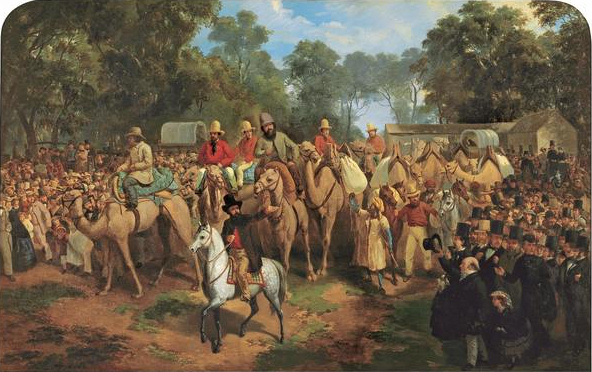
European land exploration of Australia deals with the opening up of the interior of Australia to European settlement which occurred gradually throughout the colonial period, 1788–1900. A number of these explorers are very well known, such as Burke and Wills who are well known for their failed attempt to cross the interior of Australia, as well as Hamilton Hume and Charles Sturt.
For many years, plans of westward expansion from Sydney were thwarted by the Great Dividing Range, a large range of mountains which shadows the east coast from the Queensland-New South Wales border to the south coast. The part of the range near Sydney is called the Blue Mountains. After numerous attempts William Paterson led an expedition northward along the coast to the Hunter Region in 1801 and up the Paterson River (later named in his honour by Governor King) and in 1804 Paterson led an expedition to Port Dalrymple, in what is now Tasmania, exploring the Tamar River and going up the North Esk River farther than any European had previously gone.
Despite King's pronouncement, some settlers continued to try crossing the mountains. Gregory Blaxland was the first to successfully lead an expedition to cross them in 1813, accompanied by William Lawson, William Wentworth and four servants. This trip paved the way for numerous small expeditions which were undertaken in the following few years.
On 13 November 1813 Governor Lachlan Macquarie sent Government Surveyor, George Evans, across the Blue Mountains to confirm the findings of Blaxland's exploration party. Evans generally followed Blaxland's route, reaching the end of their route on 26 November 1813 at a point Evans named Mount Blaxland. Evans's party then moved on and discovered the Fish River area and further west near the junction of the now named Fish and Campbell Rivers and described two plains in his view, the O'Connell Plains and the Macquarie Plains. On 9 December he reached the site of present-day Bathurst. After the explorations that took seven weeks Governor Macquarie awarded Evans £100 and 1000 acres of land near Richmond in Van Diemens Land (Tasmania). Evans departed for Tasmania in 1814.
In 1814, Governor Lachlan Macquarie approved an offer by William Cox to build a road crossing the Blue Mountains, from Emu Plains, the existing road terminus west of Sydney, to the Bathurst Plains. The first road to cross the Blue Mountains was 12 feet (3.7 m) wide by 101+1⁄2 miles (163.3 km) long, built between 18 July 1814 to 14 January 1815 using 5 freemen, 30 convict labourers and 8 soldiers as guards. Governor Macquarie surveyed the finished road in April 1815, and as a reward Cox was awarded 2,000 acres (810 ha) of land near what is now Bathurst.
On 7 May 1815, Governor Macquarie proclaimed the name of the future town of Bathurst, the first inland town in Australia and intended to be the administrative centre of the western plains of New South Wales.
Evans was back in New South Wales by 1815 to continue inland explorations. In 1815, Evans was the first colonial explorer to enter the Lachlan Valley, naming the area the Oxley Plains after his superior the Surveyor-General, John Oxley. He also discovered the Abercrombie and Belubula River Valleys. He was the first explorer through the areas that now include the towns of Boorowa and Cowra.
On 1 June 1815 in Eugowra, a town in the Central West region of New South Wales, George William Evans and his group marked a tree at the junction of Lachlan river and a creek which they named Byrnes Creek. This was the furthest west any Europeans had travelled into the country. On 1 June 1815 he was running short of provisions and returned to Bathurst where he arrived on 12 June. This journey opened the way for later explorations, mainly by John Oxley. Evans took part in some of Oxley's expeditions.
Hub AI
European land exploration of Australia AI simulator
(@European land exploration of Australia_simulator)
European land exploration of Australia
European land exploration of Australia deals with the opening up of the interior of Australia to European settlement which occurred gradually throughout the colonial period, 1788–1900. A number of these explorers are very well known, such as Burke and Wills who are well known for their failed attempt to cross the interior of Australia, as well as Hamilton Hume and Charles Sturt.
For many years, plans of westward expansion from Sydney were thwarted by the Great Dividing Range, a large range of mountains which shadows the east coast from the Queensland-New South Wales border to the south coast. The part of the range near Sydney is called the Blue Mountains. After numerous attempts William Paterson led an expedition northward along the coast to the Hunter Region in 1801 and up the Paterson River (later named in his honour by Governor King) and in 1804 Paterson led an expedition to Port Dalrymple, in what is now Tasmania, exploring the Tamar River and going up the North Esk River farther than any European had previously gone.
Despite King's pronouncement, some settlers continued to try crossing the mountains. Gregory Blaxland was the first to successfully lead an expedition to cross them in 1813, accompanied by William Lawson, William Wentworth and four servants. This trip paved the way for numerous small expeditions which were undertaken in the following few years.
On 13 November 1813 Governor Lachlan Macquarie sent Government Surveyor, George Evans, across the Blue Mountains to confirm the findings of Blaxland's exploration party. Evans generally followed Blaxland's route, reaching the end of their route on 26 November 1813 at a point Evans named Mount Blaxland. Evans's party then moved on and discovered the Fish River area and further west near the junction of the now named Fish and Campbell Rivers and described two plains in his view, the O'Connell Plains and the Macquarie Plains. On 9 December he reached the site of present-day Bathurst. After the explorations that took seven weeks Governor Macquarie awarded Evans £100 and 1000 acres of land near Richmond in Van Diemens Land (Tasmania). Evans departed for Tasmania in 1814.
In 1814, Governor Lachlan Macquarie approved an offer by William Cox to build a road crossing the Blue Mountains, from Emu Plains, the existing road terminus west of Sydney, to the Bathurst Plains. The first road to cross the Blue Mountains was 12 feet (3.7 m) wide by 101+1⁄2 miles (163.3 km) long, built between 18 July 1814 to 14 January 1815 using 5 freemen, 30 convict labourers and 8 soldiers as guards. Governor Macquarie surveyed the finished road in April 1815, and as a reward Cox was awarded 2,000 acres (810 ha) of land near what is now Bathurst.
On 7 May 1815, Governor Macquarie proclaimed the name of the future town of Bathurst, the first inland town in Australia and intended to be the administrative centre of the western plains of New South Wales.
Evans was back in New South Wales by 1815 to continue inland explorations. In 1815, Evans was the first colonial explorer to enter the Lachlan Valley, naming the area the Oxley Plains after his superior the Surveyor-General, John Oxley. He also discovered the Abercrombie and Belubula River Valleys. He was the first explorer through the areas that now include the towns of Boorowa and Cowra.
On 1 June 1815 in Eugowra, a town in the Central West region of New South Wales, George William Evans and his group marked a tree at the junction of Lachlan river and a creek which they named Byrnes Creek. This was the furthest west any Europeans had travelled into the country. On 1 June 1815 he was running short of provisions and returned to Bathurst where he arrived on 12 June. This journey opened the way for later explorations, mainly by John Oxley. Evans took part in some of Oxley's expeditions.
Recent media