
Recent from talks
Evidence of water on Mars found by Mars Reconnaissance Orbiter
Knowledge base stats:
Talk channels stats:
Members stats:
Evidence of water on Mars found by Mars Reconnaissance Orbiter
The Mars Reconnaissance Orbiter's HiRISE instrument has taken many images that strongly suggest that Mars has had a rich history of water-related processes. Many features of Mars appear to be created by large amounts of water. That Mars once possessed large amounts of water was confirmed by isotope studies in a study published in March 2015, by a team of scientists showing that the ice caps were highly enriched with deuterium, heavy hydrogen, by seven times as much as the Earth. This means that Mars has lost a volume of water 6.5 times what is stored in today's polar caps. The water for a time would have formed an ocean in the low-lying Mare Boreum. The amount of water could have covered the planet about 140 meters, but was probably in an ocean that in places would be almost 1 mile deep.
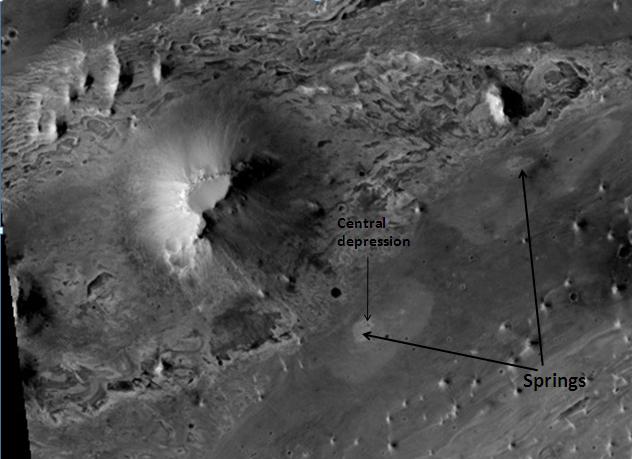
A major discovery by HiRISE was finding evidence of hot springs. These may have contained life and may now contain well-preserved fossils of life.
Seasonal flows on warm Martian slopes (also called recurring slope lineae, recurrent slope lineae and RSL) are thought to be salty water flows occurring during the warmest months on Mars. Indeed, there is much photographic and spectroscopic evidence that water does today flow on parts of Mars.
Some researchers have proposed that the flow is aided by the water boiling in thin Martian atmosphere. Boiling water would cause soil particles to bounce and help them to flow down slopes.
In a study published in Icarus in 2016, A team, headed by David Stillman, identified 239 locations for recurring slope lineae within Valles Marineris. About half of lineae locations on Mars are in Valles Marineris. It was found that the lengthening of the lineae depends on how the slope is orientated. Lengthening was observed in all seasons inside Valles Marineris. This long active season suggests that there must be an appreciable source of water that supplies the lineae. Calculations show that the lineae are active between minus 27 degrees C and minus 9 degrees C to display the activity observed. Water would do this if it was in a brine having of tens of wt% salt.
Although these features were initially thought to be evidence of current water flow, some studies show that little or no water may be involved. An analysis of data from the Mars Odyssey neutron spectrometer revealed that the RSL sites do not contain any more water than found at anywhere else at similar latitudes. The authors concluded that RSL are not supplied by large, near-surface briny aquifers. It is still possible with this data that water vapor from deeply buried ice, from the atmosphere, or from small deeply buried aquifers.
A study published in Nature Geoscience, suggest that very little water is involved in creating recurrent slope lineae because these streaks only occur on steep slopes—slopes that would allow dry sand and dust to move down. If water were involved, at least some of the lineae would move onto lower slopes. Small amounts of water may start the process however. A study spanning 4 Martian years concluded that a dry origin was the most likely cause of the streaks. In the study region, Tivat Crater, rockfall markings faded at the same time as recurrent slope lineae (RSL), suggesting a fading mechanism that acts across the whole crater.
Eridania Lake is a theorized ancient lake with a surface area of roughly 1.1 million square kilometers. Its maximum depth is 2,400 meters and its volume is 562,000km. It was larger than the largest landlocked sea on Earth, the Caspian Sea and contained more water than all the other martian lakes together. The Eridania sea held more than 9 times as much water as all of America's Great Lakes. The upper surface of the lake was assumed to be at the elevation of valley networks that surround the lake; they all end at the same elevation, suggesting that they emptied into a lake.
Hub AI
Evidence of water on Mars found by Mars Reconnaissance Orbiter AI simulator
(@Evidence of water on Mars found by Mars Reconnaissance Orbiter_simulator)
Evidence of water on Mars found by Mars Reconnaissance Orbiter
The Mars Reconnaissance Orbiter's HiRISE instrument has taken many images that strongly suggest that Mars has had a rich history of water-related processes. Many features of Mars appear to be created by large amounts of water. That Mars once possessed large amounts of water was confirmed by isotope studies in a study published in March 2015, by a team of scientists showing that the ice caps were highly enriched with deuterium, heavy hydrogen, by seven times as much as the Earth. This means that Mars has lost a volume of water 6.5 times what is stored in today's polar caps. The water for a time would have formed an ocean in the low-lying Mare Boreum. The amount of water could have covered the planet about 140 meters, but was probably in an ocean that in places would be almost 1 mile deep.
A major discovery by HiRISE was finding evidence of hot springs. These may have contained life and may now contain well-preserved fossils of life.
Seasonal flows on warm Martian slopes (also called recurring slope lineae, recurrent slope lineae and RSL) are thought to be salty water flows occurring during the warmest months on Mars. Indeed, there is much photographic and spectroscopic evidence that water does today flow on parts of Mars.
Some researchers have proposed that the flow is aided by the water boiling in thin Martian atmosphere. Boiling water would cause soil particles to bounce and help them to flow down slopes.
In a study published in Icarus in 2016, A team, headed by David Stillman, identified 239 locations for recurring slope lineae within Valles Marineris. About half of lineae locations on Mars are in Valles Marineris. It was found that the lengthening of the lineae depends on how the slope is orientated. Lengthening was observed in all seasons inside Valles Marineris. This long active season suggests that there must be an appreciable source of water that supplies the lineae. Calculations show that the lineae are active between minus 27 degrees C and minus 9 degrees C to display the activity observed. Water would do this if it was in a brine having of tens of wt% salt.
Although these features were initially thought to be evidence of current water flow, some studies show that little or no water may be involved. An analysis of data from the Mars Odyssey neutron spectrometer revealed that the RSL sites do not contain any more water than found at anywhere else at similar latitudes. The authors concluded that RSL are not supplied by large, near-surface briny aquifers. It is still possible with this data that water vapor from deeply buried ice, from the atmosphere, or from small deeply buried aquifers.
A study published in Nature Geoscience, suggest that very little water is involved in creating recurrent slope lineae because these streaks only occur on steep slopes—slopes that would allow dry sand and dust to move down. If water were involved, at least some of the lineae would move onto lower slopes. Small amounts of water may start the process however. A study spanning 4 Martian years concluded that a dry origin was the most likely cause of the streaks. In the study region, Tivat Crater, rockfall markings faded at the same time as recurrent slope lineae (RSL), suggesting a fading mechanism that acts across the whole crater.
Eridania Lake is a theorized ancient lake with a surface area of roughly 1.1 million square kilometers. Its maximum depth is 2,400 meters and its volume is 562,000km. It was larger than the largest landlocked sea on Earth, the Caspian Sea and contained more water than all the other martian lakes together. The Eridania sea held more than 9 times as much water as all of America's Great Lakes. The upper surface of the lake was assumed to be at the elevation of valley networks that surround the lake; they all end at the same elevation, suggesting that they emptied into a lake.
Recent media