



Community hub
Recent from talks
Knowledge base stats:
Talk channels stats:
Members stats:
Valles Marineris
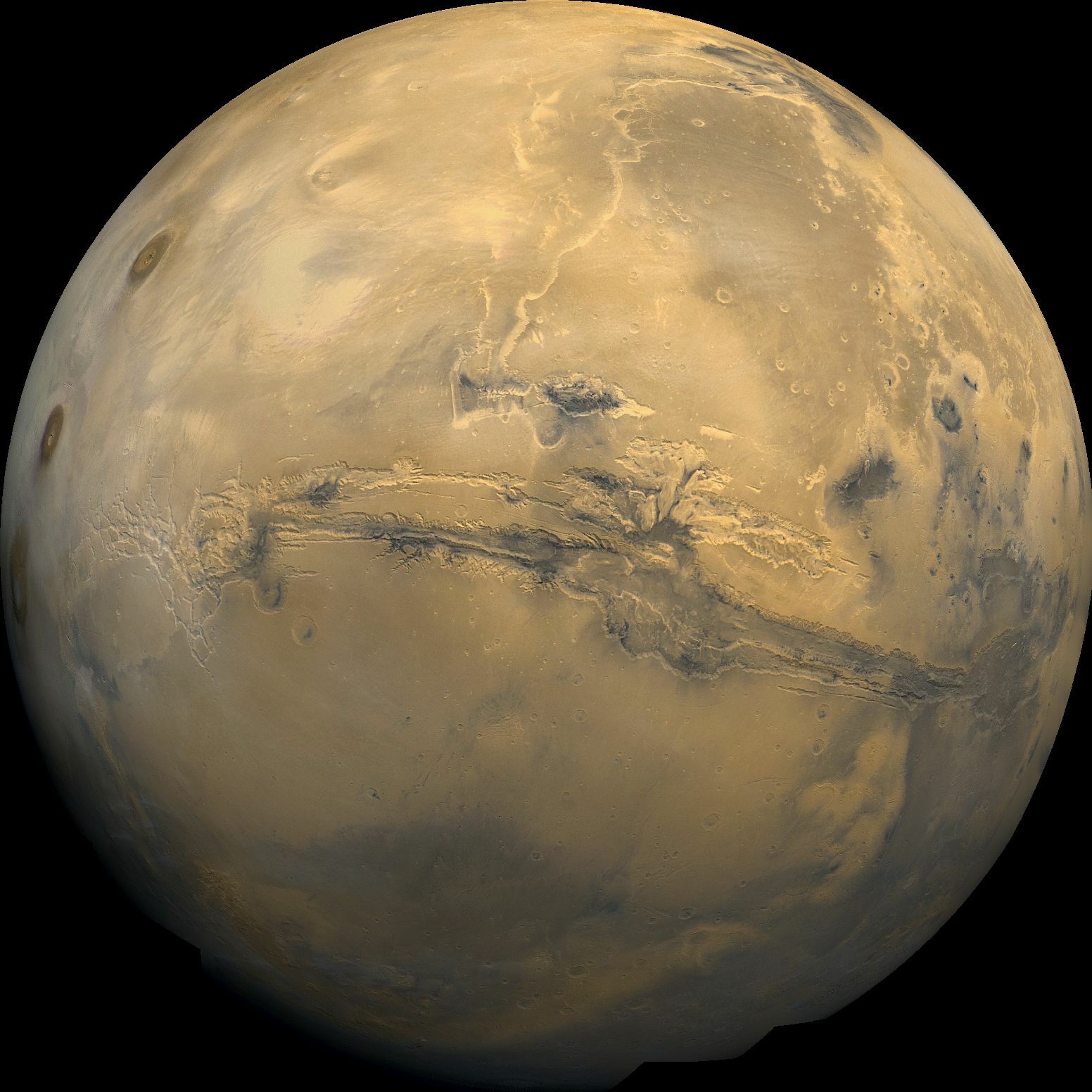
Valles Marineris (/ˈvælɪs mærɪˈnɛərɪs/; Latin for Mariner Valleys, named after the Mariner 9 Mars orbiter of 1971–72 which discovered it) is a system of canyons that runs along the Martian surface east of the Tharsis region. At more than 4,000 km (2,500 mi) long, 200 km (120 mi) wide and up to 7 km (23,000 ft) deep, Valles Marineris is the largest canyon in the Solar System.
Valles Marineris is located along the equator of Mars, on the east side of the Tharsis Bulge, and stretches for nearly a quarter of the planet's circumference. The canyon system starts in the west with Noctis Labyrinthus; proceeding to the east are Tithonium and Ius chasmata, then Melas, Candor and Ophir chasmata, then Coprates Chasma, then Ganges, Capri and Eos chasmata; finally it empties into an outflow channel region containing chaotic terrain that ends in the basin of Chryse Planitia.
It has been recently suggested that Valles Marineris is a large tectonic "crack" in the Martian crust. Most researchers agree that this formed as the crust thickened in the Tharsis region to the west, and was subsequently widened by erosion. Near the eastern flanks of the rift, there appear to be channels that may have been formed by water or carbon dioxide. It has also been proposed that Valles Marineris is a large channel formed by the erosion of lava flowing from the flank of Pavonis Mons.
The most agreed upon theory today is that Valles Marineris was formed by rift faults, later enlarged by erosion and collapsing of the rift walls, similar to how the East African Rift was formed. The formation of Valles Marineris is thought to be closely tied with the formation of the Tharsis Bulge. The Tharsis Bulge was formed from the Noachian to Late Hesperian period of Mars, in three stages.
The first stage consisted of a combination of volcanism and isostatic uplift; soon, however, the volcanism loaded the crust to a point at which the crust could no longer support the added weight of Tharsis, leading to widespread graben formation in the elevated regions of Tharsis. The second stage consisted of more volcanism and a loss of isostatic equilibrium; the source regions of the volcanism no longer resided underneath Tharsis, creating a very large load. Finally, the crust failed to hold up Tharsis and radial fractures formed, including at Valles Marineris. The third stage mainly consisted of more volcanism and asteroid impacts. The crust, having already reached its failure point, just stayed in place and younger volcanoes formed. Tharsis volcanism involved very low viscosity magma, forming shield volcanoes similar to those of the Hawaiian Island chain, but, because there is minor or no current active plate tectonics on Mars, the hotspot activity led to very long histories of repeated volcanic eruptions at the same spots, creating some of the largest volcanoes in the solar system, including the biggest, Olympus Mons.
Landslides have left numerous deposits on the floor of Valles Marineris and contributed to widening it. Possible triggers of landslides are quakes caused by tectonic activity or impact events. Both types of events release seismic waves that accelerate the ground at and below the surface. Mars is much less tectonically active than Earth, and marsquakes are unlikely to have provided seismic waves of the required magnitude. Most sizable craters on Mars date to the Late Heavy Bombardment, 4.1 to 3.8 billion years ago (the Noachian period), and are older than the landslide deposits in Valles Marineris. However, three craters (including the crater Oudemans) have been identified, on the basis of their proximity and later dates, as ones whose formation may have caused some of the landslides.
Hypotheses about the formation of Valles Marineris have changed over the years. Ideas in the 1970s were erosion by water or thermokarst activity. Thermokarst activity may have contributed, but erosion by water is a problematic mechanism because liquid water cannot exist in most current Martian surface conditions, which typically experience about 1% of Earth's atmospheric pressure and a temperature range of 148 K (−125 °C; −193 °F) to 310 K (37 °C; 98 °F). Many scientists however agree that liquid water flowed on the Martian surface in the past, when atmospheric conditions were different. Valles Marineris may have been enlarged by flowing water at that time. Another hypothesis by McCauley in 1972 was that the canyons formed by withdrawal of subsurface magma. Around 1989, a formation hypothesis by tensional fracturing was proposed.
Noctis Labyrinthus, on the western edge of the Valles Marineris Rift System, north of the Syria Planum and east of Pavonis Mons, is a jumbled terrain composed of huge blocks which are heavily fractured. It also contains canyons that run in different directions surrounding large blocks of older terrain. Most of the upper parts of the blocks are composed of younger fractured material thought to be of volcanic origin associated with the Tharsis bulge. The other tops are composed of older fractured material thought also to be volcanic in origin, but differentiated from the younger material by more ruggedness and more impact craters. The sides of the blocks are composed of undivided material thought to be basement rock. The space between the blocks is composed mainly of either rough or smooth floor material. The rough floor material tends to be in the eastern portion of the Noctis Labyrinthus and is thought to be debris from the walls or maybe eolian features covering rough topography and landslides. The smooth floor material is thought to be composed of fluvial or basaltic material and/or eolian features covering an otherwise rough and jumbled terrain. Terrains such as Noctis Labyrinthus are commonly found at the head of outflow channels, like the one explored by the Pathfinder mission and its Sojourner rover. They are interpreted to be a place of downward block faulting associated with the removal of ground fluid in catastrophic flood sequences. The fluid could be either carbon-dioxide ice and gas, water or lava. The hypothesis of lava involvement is associated with a proposal that Noctis Labyrinthus is directly connected to lava tubes on the slope of Pavonis Mons. In 2024, scientists found evidence that the hypothesized lava came from a volcano they dubbed Noctis Mons, which would be the seventh-highest mountain on Mars at 9,028 m (29,619 ft), and that the eastern part of its base was home to multiple glaciers with potential for hosting life, which could make it a highly valuable candidate target for astrobiology missions.
Hub AI
Valles Marineris AI simulator
(@Valles Marineris_simulator)
Valles Marineris
Valles Marineris (/ˈvælɪs mærɪˈnɛərɪs/; Latin for Mariner Valleys, named after the Mariner 9 Mars orbiter of 1971–72 which discovered it) is a system of canyons that runs along the Martian surface east of the Tharsis region. At more than 4,000 km (2,500 mi) long, 200 km (120 mi) wide and up to 7 km (23,000 ft) deep, Valles Marineris is the largest canyon in the Solar System.
Valles Marineris is located along the equator of Mars, on the east side of the Tharsis Bulge, and stretches for nearly a quarter of the planet's circumference. The canyon system starts in the west with Noctis Labyrinthus; proceeding to the east are Tithonium and Ius chasmata, then Melas, Candor and Ophir chasmata, then Coprates Chasma, then Ganges, Capri and Eos chasmata; finally it empties into an outflow channel region containing chaotic terrain that ends in the basin of Chryse Planitia.
It has been recently suggested that Valles Marineris is a large tectonic "crack" in the Martian crust. Most researchers agree that this formed as the crust thickened in the Tharsis region to the west, and was subsequently widened by erosion. Near the eastern flanks of the rift, there appear to be channels that may have been formed by water or carbon dioxide. It has also been proposed that Valles Marineris is a large channel formed by the erosion of lava flowing from the flank of Pavonis Mons.
The most agreed upon theory today is that Valles Marineris was formed by rift faults, later enlarged by erosion and collapsing of the rift walls, similar to how the East African Rift was formed. The formation of Valles Marineris is thought to be closely tied with the formation of the Tharsis Bulge. The Tharsis Bulge was formed from the Noachian to Late Hesperian period of Mars, in three stages.
The first stage consisted of a combination of volcanism and isostatic uplift; soon, however, the volcanism loaded the crust to a point at which the crust could no longer support the added weight of Tharsis, leading to widespread graben formation in the elevated regions of Tharsis. The second stage consisted of more volcanism and a loss of isostatic equilibrium; the source regions of the volcanism no longer resided underneath Tharsis, creating a very large load. Finally, the crust failed to hold up Tharsis and radial fractures formed, including at Valles Marineris. The third stage mainly consisted of more volcanism and asteroid impacts. The crust, having already reached its failure point, just stayed in place and younger volcanoes formed. Tharsis volcanism involved very low viscosity magma, forming shield volcanoes similar to those of the Hawaiian Island chain, but, because there is minor or no current active plate tectonics on Mars, the hotspot activity led to very long histories of repeated volcanic eruptions at the same spots, creating some of the largest volcanoes in the solar system, including the biggest, Olympus Mons.
Landslides have left numerous deposits on the floor of Valles Marineris and contributed to widening it. Possible triggers of landslides are quakes caused by tectonic activity or impact events. Both types of events release seismic waves that accelerate the ground at and below the surface. Mars is much less tectonically active than Earth, and marsquakes are unlikely to have provided seismic waves of the required magnitude. Most sizable craters on Mars date to the Late Heavy Bombardment, 4.1 to 3.8 billion years ago (the Noachian period), and are older than the landslide deposits in Valles Marineris. However, three craters (including the crater Oudemans) have been identified, on the basis of their proximity and later dates, as ones whose formation may have caused some of the landslides.
Hypotheses about the formation of Valles Marineris have changed over the years. Ideas in the 1970s were erosion by water or thermokarst activity. Thermokarst activity may have contributed, but erosion by water is a problematic mechanism because liquid water cannot exist in most current Martian surface conditions, which typically experience about 1% of Earth's atmospheric pressure and a temperature range of 148 K (−125 °C; −193 °F) to 310 K (37 °C; 98 °F). Many scientists however agree that liquid water flowed on the Martian surface in the past, when atmospheric conditions were different. Valles Marineris may have been enlarged by flowing water at that time. Another hypothesis by McCauley in 1972 was that the canyons formed by withdrawal of subsurface magma. Around 1989, a formation hypothesis by tensional fracturing was proposed.
Noctis Labyrinthus, on the western edge of the Valles Marineris Rift System, north of the Syria Planum and east of Pavonis Mons, is a jumbled terrain composed of huge blocks which are heavily fractured. It also contains canyons that run in different directions surrounding large blocks of older terrain. Most of the upper parts of the blocks are composed of younger fractured material thought to be of volcanic origin associated with the Tharsis bulge. The other tops are composed of older fractured material thought also to be volcanic in origin, but differentiated from the younger material by more ruggedness and more impact craters. The sides of the blocks are composed of undivided material thought to be basement rock. The space between the blocks is composed mainly of either rough or smooth floor material. The rough floor material tends to be in the eastern portion of the Noctis Labyrinthus and is thought to be debris from the walls or maybe eolian features covering rough topography and landslides. The smooth floor material is thought to be composed of fluvial or basaltic material and/or eolian features covering an otherwise rough and jumbled terrain. Terrains such as Noctis Labyrinthus are commonly found at the head of outflow channels, like the one explored by the Pathfinder mission and its Sojourner rover. They are interpreted to be a place of downward block faulting associated with the removal of ground fluid in catastrophic flood sequences. The fluid could be either carbon-dioxide ice and gas, water or lava. The hypothesis of lava involvement is associated with a proposal that Noctis Labyrinthus is directly connected to lava tubes on the slope of Pavonis Mons. In 2024, scientists found evidence that the hypothesized lava came from a volcano they dubbed Noctis Mons, which would be the seventh-highest mountain on Mars at 9,028 m (29,619 ft), and that the eastern part of its base was home to multiple glaciers with potential for hosting life, which could make it a highly valuable candidate target for astrobiology missions.