Exact functor
Exact functor
Main page

Exact functor

logo
Community Hub0 subscribers
Read side by side
from Wikipedia

In mathematics, particularly homological algebra, an exact functor is a functor that preserves short exact sequences. Exact functors are convenient for algebraic calculations because they can be directly applied to presentations of objects. Much of the work in homological algebra is designed to cope with functors that fail to be exact, but in ways that can still be controlled.

Definitions

[edit]

Let P and Q be abelian categories, and let F: PQ be a covariant additive functor (so that, in particular, F(0) = 0). We say that F is an exact functor if whenever

is a short exact sequence in P then

is a short exact sequence in Q. (The maps are often omitted and implied, and one says: "if 0→ABC→0 is exact, then 0→F(A)→F(B)→F(C)→0 is also exact".)

Further, we say that F is

  • left-exact if whenever 0→ABC→0 is exact then 0→F(A)→F(B)→F(C) is exact;
  • right-exact if whenever 0→ABC→0 is exact then F(A)→F(B)→F(C)→0 is exact;
  • half-exact if whenever 0→ABC→0 is exact then F(A)→F(B)→F(C) is exact. This is distinct from the notion of a topological half-exact functor.

If G is a contravariant additive functor from P to Q, we similarly define G to be

  • exact if whenever 0→ABC→0 is exact then 0→G(C)→G(B)→G(A)→0 is exact;
  • left-exact if whenever 0→ABC→0 is exact then 0→G(C)→G(B)→G(A) is exact;
  • right-exact if whenever 0→ABC→0 is exact then G(C)→G(B)→G(A)→0 is exact;
  • half-exact if whenever 0→ABC→0 is exact then G(C)→G(B)→G(A) is exact.

It is not always necessary to start with an entire short exact sequence 0→ABC→0 to have some exactness preserved. The following definitions are equivalent to the ones given above:

  • F is exact if and only if ABC exact implies F(A)→F(B)→F(C) exact;
  • F is left-exact if and only if 0→ABC exact implies 0→F(A)→F(B)→F(C) exact (i.e. if "F turns kernels into kernels");
  • F is right-exact if and only if ABC→0 exact implies F(A)→F(B)→F(C)→0 exact (i.e. if "F turns cokernels into cokernels");
  • G is left-exact if and only if ABC→0 exact implies 0→G(C)→G(B)→G(A) exact (i.e. if "G turns cokernels into kernels");
  • G is right-exact if and only if 0→ABC exact implies G(C)→G(B)→G(A)→0 exact (i.e. if "G turns kernels into cokernels").

Examples

[edit]

Every equivalence or duality of abelian categories is exact.

The most basic examples of left exact functors are the Hom functors: if A is an abelian category and A is an object of A, then FA(X) = HomA(A,X) defines a covariant left-exact functor from A to the category Ab of abelian groups.[1] The functor FA is exact if and only if A is projective.[2] The functor GA(X) = HomA(X,A) is a contravariant left-exact functor;[3] it is exact if and only if A is injective.[4]

If k is a field and V is a vector space over k, we write V * = Homk(V,k) (this is commonly known as the dual space). This yields a contravariant exact functor from the category of k-vector spaces to itself. (Exactness follows from the above: k is an injective k-module. Alternatively, one can argue that every short exact sequence of k-vector spaces splits, and any additive functor turns split sequences into split sequences.)

If X is a topological space, we can consider the abelian category of all sheaves of abelian groups on X. The covariant functor that associates to each sheaf F the group of global sections F(X) is left-exact.

If R is a ring and T is a right R-module, we can define a functor HT from the abelian category of all left R-modules to Ab by using the tensor product over R: HT(X) = TX. This is a covariant right exact functor; in other words, given an exact sequence ABC→0 of left R modules, the sequence of abelian groups TATBTC → 0 is exact.

The functor HT is exact if and only if T is flat. For example, is a flat -module. Therefore, tensoring with as a -module is an exact functor. Proof: It suffices to show that if i is an injective map of -modules , then the corresponding map between the tensor products is injective. One can show that if and only if is a torsion element or . The given tensor products only have pure tensors. Therefore, it suffices to show that if a pure tensor is in the kernel, then it is zero. Suppose that is an element of the kernel. Then, is torsion. Since is injective, is torsion. Therefore, . Therefore, is also injective.

In general, if T is not flat, then tensor product is not left exact. For example, consider the short exact sequence of -modules . Tensoring over with gives a sequence that is no longer exact, since is not torsion-free and thus not flat.


If A is an abelian category and C is an arbitrary small category, we can consider the functor category AC consisting of all functors from C to A; it is abelian. If X is a given object of C, then we get a functor EX from AC to A by evaluating functors at X. This functor EX is exact.

While tensoring may not be left exact, it can be shown that tensoring is a right exact functor:

Theorem: Let A,B,C and P be R-modules for a commutative ring R having multiplicative identity. Let be a short exact sequence of R-modules. Then
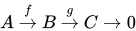

is also a short exact sequence of R-modules. (Since R is commutative, this sequence is a sequence of R-modules and not merely of abelian groups). Here, we define

.

This has a useful corollary: If I is an ideal of R and P is as above, then .

Proof: , where f is the inclusion and g is the projection, is an exact sequence of R-modules. By the above we get that : is also a short exact sequence of R-modules. By exactness, , since f is the inclusion. Now, consider the R-module homomorphism from given by R-linearly extending the map defined on pure tensors: implies that . So, the kernel of this map cannot contain any nonzero pure tensors. is composed only of pure tensors: For . So, this map is injective. It is clearly onto. So, . Similarly, . This proves the corollary.


As another application, we show that for, where and n is the highest power of 2 dividing m. We prove a special case: m=12.

Proof: Consider a pure tensor . Also, for . This shows that . Letting , A,B,C,P are R=Z modules by the usual multiplication action and satisfy the conditions of the main theorem. By the exactness implied by the theorem and by the above note we obtain that . The last congruence follows by a similar argument to one in the proof of the corollary showing that .


Properties and theorems

[edit]

A functor is exact if and only if it is both left exact and right exact.

A covariant (not necessarily additive) functor is left exact if and only if it turns finite limits into limits; a covariant functor is right exact if and only if it turns finite colimits into colimits; a contravariant functor is left exact iff it turns finite colimits into limits; a contravariant functor is right exact iff it turns finite limits into colimits.

The degree to which a left exact functor fails to be exact can be measured with its right derived functors; the degree to which a right exact functor fails to be exact can be measured with its left derived functors.

Left and right exact functors are ubiquitous mainly because of the following fact: if the functor F is left adjoint to G, then F is right exact and G is left exact.

Generalizations

[edit]

In SGA4, tome I, section 1, the notion of left (right) exact functors are defined for general categories, and not just abelian ones. The definition is as follows:

Let C be a category with finite projective (resp. inductive) limits. Then a functor from C to another category C′ is left (resp. right) exact if it commutes with finite projective (resp. inductive) limits.

Despite its abstraction, this general definition has useful consequences. For example, in section 1.8, Grothendieck proves that a functor is pro-representable if and only if it is left exact, under some mild conditions on the category C.

The exact functors between Quillen's exact categories generalize the exact functors between abelian categories discussed here.

The regular functors between regular categories are sometimes called exact functors and generalize the exact functors discussed here.

Notes

[edit]

References

[edit]
Revisions and contributorsEdit on WikipediaRead on Wikipedia
from Grokipedia
In homological algebra, an exact functor is an additive functor between abelian categories that preserves the exactness of short exact sequences, meaning that if 0ABC00 \to A \to B \to C \to 0 is exact in the source category, then 0F(A)F(B)F(C)00 \to F(A) \to F(B) \to F(C) \to 0 is exact in the target category.[1] This property implies that exact functors are both left exact (preserving kernels and finite limits) and right exact (preserving cokernels and finite colimits).[2] Exact functors play a central role in preserving homological structures, such as inducing natural transformations on derived functors like Ext and Tor groups, and they characterize important objects like flat, projective, and injective modules in module categories.[1] For contravariant functors, exactness similarly requires mapping exact sequences to exact sequences, with the arrows reversed, as seen in applications like the Hom functor, which is left exact but not generally exact unless the argument is projective.[3]

Background Concepts

Exact Sequences

In abelian categories, an exact sequence is a sequence of objects and morphisms where, at each object except possibly the ends, the image of the incoming morphism equals the kernel of the outgoing morphism.[4] More precisely, consider a sequence Ai1fi1AifiAi+1\cdots \to A_{i-1} \xrightarrow{f_{i-1}} A_i \xrightarrow{f_i} A_{i+1} \to \cdots; it is exact at AiA_i if im(fi1)=ker(fi)\operatorname{im}(f_{i-1}) = \ker(f_i).[4] This condition implies that the sequence forms a complex (consecutive compositions are zero) and captures a precise balance between subgroups or subobjects, central to homological algebra.[5] A short exact sequence is a finite exact sequence of the form 0AfBgC00 \to A \xrightarrow{f} B \xrightarrow{g} C \to 0, exact at AA, BB, and CC, meaning ff is injective, gg is surjective, and im(f)=ker(g)\operatorname{im}(f) = \ker(g).[4] Such sequences represent extensions of CC by AA, where BB is built from AA and CC in a way that AA embeds as a kernel and CC arises as a cokernel, playing a foundational role in homological algebra for studying derived functors and cohomology.[6] For instance, the sequence 0ZnZZ/nZ00 \to \mathbb{Z} \xrightarrow{\cdot n} \mathbb{Z} \to \mathbb{Z}/n\mathbb{Z} \to 0, where the first map is multiplication by n0n \neq 0 and the second is the canonical projection, is short exact, illustrating the structure of cyclic groups as quotients of the integers.[7] The zigzag lemma, also known as the snake lemma, provides a tool to connect kernels and cokernels across commutative diagrams of exact sequences. Specifically, for a commutative diagram
\xymatrix{ 0 \ar[r] & A' \ar[d]^f \ar[r] & B' \ar[d]^g \ar[r] & C' \ar[d]^h \ar[r] & 0 \\ 0 \ar[r] & A \ar[r] & B \ar[r] & C \ar[r] & 0 }
with exact rows, there exists an exact sequence ker(f)ker(g)ker(h)coker(f)coker(g)coker(h)\ker(f) \to \ker(g) \to \ker(h) \to \operatorname{coker}(f) \to \operatorname{coker}(g) \to \operatorname{coker}(h). This lemma implies that exactness propagates through diagrams, enabling the construction of long exact sequences from short ones and revealing relationships between homology groups in chain complexes.[8]

Abelian Categories

An abelian category is an additive category A\mathcal{A} equipped with a zero object, in which every morphism has a kernel and a cokernel, finite biproducts exist, every monomorphism is the kernel of its cokernel, and every epimorphism is the cokernel of its kernel.[9] In such categories, the Hom-sets form abelian groups under pointwise addition, and composition is bilinear, ensuring that the category behaves like the category of abelian groups in essential respects.[10] This structure guarantees that every morphism factors uniquely as the composition of an epimorphism followed by a monomorphism, providing a robust framework for algebraic manipulations.[9] Abelian categories serve as the foundational setting for homological algebra, where chain complexes and exact sequences can be defined and analyzed systematically to compute invariants like homology and cohomology groups.[10] In particular, they enable the construction of projective and injective resolutions, which are crucial for defining derived functors such as Tor and Ext; common examples, including the category of modules over a ring, possess enough projective objects to ensure the existence of such resolutions for every object.[11] Similarly, the category of abelian groups has enough injective objects, facilitating cohomology computations in dual settings.[11] Exact sequences within abelian categories thus provide a primary tool for studying exactness and exact functors.[9] Key properties of abelian categories include the five lemma, which states that in a commutative diagram of the form
ABCDEABCDE \begin{CD} A @>>> B @>>> C @>>> D @>>> E \\ @VVV @VVV @VVV @VVV @VVV \\ A' @>>> B' @>>> C' @>>> D' @>>> E' \end{CD}
where the rows are exact and the vertical maps on AA, BB, CC, DD, and EE are given, if the maps AAA \to A', BBB \to B', DDD \to D', and EEE \to E' are isomorphisms, then CCC \to C' is also an isomorphism.[9] The short five lemma, a variant for short exact sequences, asserts that if the rows
0ABC0 0 \to A \to B \to C \to 0
and
0ABC0 0 \to A' \to B' \to C' \to 0
are short exact with a commutative diagram where AAA \to A' and CCC \to C' are isomorphisms, then BBB \to B' is an isomorphism.[12] These lemmas underscore the rigidity of exactness in abelian categories without requiring detailed proofs here.[9]

Definition

Formal Definition

In homological algebra, an exact functor is defined between abelian categories as follows. Let A\mathcal{A} and B\mathcal{B} be abelian categories. A covariant functor F:ABF: \mathcal{A} \to \mathcal{B} is exact if it is additive and preserves exact sequences.[13] Additivity requires that FF preserves the abelian group structure on Hom-sets, meaning F(f+g)=F(f)+F(g)F(f + g) = F(f) + F(g) and F(nf)=nF(f)F(n \cdot f) = n \cdot F(f) for morphisms f,gf, g and integers nn, and that FF preserves finite direct sums (biproducts) and the zero object, so F(0)0F(0) \cong 0 and F(XY)F(X)F(Y)F(X \oplus Y) \cong F(X) \oplus F(Y).[14][15] Preservation of exact sequences means that if 0AAA00 \to A' \to A \to A'' \to 0 is a short exact sequence in A\mathcal{A}, then the induced sequence 0F(A)F(A)F(A)00 \to F(A') \to F(A) \to F(A'') \to 0 is short exact in B\mathcal{B}. More generally, FF maps arbitrary exact sequences in A\mathcal{A} to exact sequences in B\mathcal{B}. This property ensures that FF is both left exact (preserves kernels) and right exact (preserves cokernels).[13][14]

Equivalent Formulations

In abelian categories, an exact functor F:ABF: \mathcal{A} \to \mathcal{B} can be equivalently characterized as one that is both left exact and right exact.[13] A functor is left exact if it preserves finite limits, which is equivalent to being additive and preserving kernels.[16] Similarly, a functor is right exact if it preserves finite colimits, equivalent to being additive and preserving cokernels.[16] Thus, FF is exact if and only if it preserves both finite limits and finite colimits.[13] Alternatively, exactness holds if and only if FF is additive and preserves both kernels and cokernels.[17]

Properties

Preservation of Exactness

An exact functor $ F: \mathcal{A} \to \mathcal{B} $ between abelian categories preserves the exactness of short exact sequences, meaning that if $ 0 \to A \xrightarrow{f} B \xrightarrow{g} C \to 0 $ is exact in $ \mathcal{A} $, then $ 0 \to F(A) \xrightarrow{F(f)} F(B) \xrightarrow{F(g)} F(C) \to 0 $ is exact in $ \mathcal{B} $.[18] This property implies that exact functors preserve monomorphisms, as a monomorphism $ i: A \to B $ can be embedded in a short exact sequence $ 0 \to A \xrightarrow{i} B \to \operatorname{coker}(i) \to 0 $, and the image under $ F $ remains exact, ensuring $ F(i) $ is a monomorphism.[18] Similarly, epimorphisms are preserved, since an epimorphism $ p: B \to C $ fits into $ 0 \to \ker(p) \to B \xrightarrow{p} C \to 0 $, and exactness is maintained under $ F $.[18] Exact functors also preserve the zero object, as the trivial sequence $ 0 \to 0 \to 0 \to 0 $ maps to itself.[18] A key aspect of exact functors is their preservation of kernels and cokernels. Specifically, for any morphism $ f: A \to B $ in $ \mathcal{A} $, there is a natural isomorphism $ F(\ker f) \cong \ker(F f) $.[18] Dually, $ F(\operatorname{coker} f) \cong \operatorname{coker}(F f) $.[18] These isomorphisms follow from the preservation of short exact sequences defining kernels and cokernels, such as $ 0 \to \ker f \to A \xrightarrow{f} \operatorname{im} f \to 0 $ and $ 0 \to \operatorname{im} f \xrightarrow{f} B \to \operatorname{coker} f \to 0 $, both of which remain exact after applying $ F $.[18] Exact functors extend this behavior to longer exact sequences, preserving exactness at every term in arbitrary exact sequences in $ \mathcal{A} $, since local exactness at each morphism relies on matching kernels and images, which are preserved.[18] Regarding the snake lemma, which constructs connecting homomorphisms from short exact sequences of complexes to yield long exact sequences in homology, exact functors are compatible in the sense that applying $ F $ to the input data produces the snake lemma output in the image category, preserving the connecting maps up to natural isomorphism.[18] This compatibility ensures that homological constructions remain coherent under exact functors. Note that exact functors are precisely those that are both left exact and right exact.[18]

Detection of Exactness

To test exactness using resolutions, one applies FF to a projective resolution of an object in A\mathcal{A} and examines the resulting complex in B\mathcal{B}. For a left exact covariant functor FF, compute the left derived functors LiFL_i F via a projective resolution PAP_\bullet \to A; FF is exact if and only if LiF(A)=0L_i F(A) = 0 for all i>0i > 0 and all objects AA in A\mathcal{A}, meaning the homology of F(P)F(P_\bullet) vanishes in positive degrees. Dually, for a left exact contravariant functor, the derived functors can be computed using projective resolutions of the input, with exactness holding if the higher derived functors vanish for i>0i > 0. These methods leverage the universal properties of resolutions to detect obstructions to exactness without testing every possible sequence.[19] In the context of module categories, exactness can be detected via vanishing of derived functors such as Tor or Ext. For the tensor functor RM:RModAb-\otimes_R M: {}_R\mathrm{Mod} \to \mathrm{Ab}, which is right exact, it is exact (i.e., MM is flat) if and only if Tor1R(N,M)=0\operatorname{Tor}_1^R(N, M) = 0 for all modules NN, computed using a projective resolution of NN and tensoring with MM. Similarly, for the Hom functor HomR(M,):RModAb\operatorname{Hom}_R(M, -): {}_R\mathrm{Mod} \to \mathrm{Ab}, left exact by nature, exactness holds if ExtR1(M,N)=0\operatorname{Ext}^1_R(M, N) = 0 for all NN, verified via an injective resolution of NN. These vanishing conditions provide a practical algebraic test for exactness in specific cases, reducing the problem to homology computations.[19]

Examples

Modules over Rings

In the category of left modules over a ring RR, denoted ModR\mathrm{Mod}_R, the tensor product functor with a fixed right RR-module MM, defined by NNRMN \mapsto N \otimes_R M, maps to abelian groups and is right exact.[19] This functor preserves short exact sequences of the form 0ABC00 \to A \to B \to C \to 0 in their image as ARMBRMCRM0A \otimes_R M \to B \otimes_R M \to C \otimes_R M \to 0, but may fail to preserve the leftmost injection unless MM is flat.[19] A right RR-module MM is flat if and only if RM-\otimes_R M is exact, meaning it preserves all short exact sequences.[8] More generally, an additive right exact functor F:ModRAF: \mathrm{Mod}_R \to \mathcal{A} (where A\mathcal{A} is an abelian category, such as the category of abelian groups) preserves cokernels and direct sums.[20] Suppose a left RR-module VV admits a presentation given by the exact sequence
ReliiReiπV0, \mathrm{Rel} \xrightarrow{i} \bigoplus_i R e_i \xrightarrow{\pi} V \to 0,
where iRei\bigoplus_i R e_i is the free module generated by the eie_i and Rel\mathrm{Rel} is the submodule of relations. Applying FF yields the exact sequence
F(Rel)F(i)iF(Rei)F(π)F(V)0, F(\mathrm{Rel}) \xrightarrow{F(i)} \bigoplus_i F(R e_i) \xrightarrow{F(\pi)} F(V) \to 0,
since FF preserves direct sums (by additivity) and cokernels (by right exactness). Consequently,
F(V)iF(Rei)F(r)rRel, F(V) \cong \frac{\bigoplus_i F(R e_i)}{\langle F(r) \mid r \in \mathrm{Rel} \rangle},
where the denominator is the subobject generated by the images of the relations under FF. This construction illustrates how right exact functors allow explicit computation of images of presented modules, as occurs with the tensor product functor. Dually, the Hom functor with a fixed left RR-module NN, defined by PHomR(N,P)P \mapsto \mathrm{Hom}_R(N, P), is left exact.[19] For a short exact sequence 0ABC00 \to A \to B \to C \to 0 of left RR-modules, the induced sequence 0HomR(N,A)HomR(N,B)HomR(N,C)0 \to \mathrm{Hom}_R(N, A) \to \mathrm{Hom}_R(N, B) \to \mathrm{Hom}_R(N, C) remains exact, but the image need not be surjective onto HomR(N,C)\mathrm{Hom}_R(N, C) in general.[19] This functor is exact if and only if NN is projective, in which case it preserves all short exact sequences.[19] Change of rings functors arise from a ring homomorphism ϕ:RS\phi: R \to S. The restriction of scalars functor resϕ:ModSModR\mathrm{res}_\phi: \mathrm{Mod}_S \to \mathrm{Mod}_R, which forgets the SS-action on SS-modules, is always exact.[17] The extension of scalars (or induction) functor extϕ:ModRModS\mathrm{ext}_\phi: \mathrm{Mod}_R \to \mathrm{Mod}_S, given by MMRSM \mapsto M \otimes_R S, is exact precisely when SS is flat as an RR-module via ϕ\phi.[19] In particular, if SS is a separable RR-algebra, then SS is projective (hence flat) as an RR-module, ensuring that extϕ\mathrm{ext}_\phi is exact.

Sheaf Cohomology

In the category of sheaves of abelian groups on a topological space XX, denoted Sh(X)\mathrm{Sh}(X), the global sections functor Γ:Sh(X)Ab\Gamma: \mathrm{Sh}(X) \to \mathrm{Ab} assigns to each sheaf F\mathcal{F} its group of global sections Γ(X,F)\Gamma(X, \mathcal{F}). This functor is left exact, meaning that for any short exact sequence 0FFF00 \to \mathcal{F}' \to \mathcal{F} \to \mathcal{F}'' \to 0 in Sh(X)\mathrm{Sh}(X), the induced sequence $0 \to \Gamma(X, \mathcal{F}') \to \Gamma(X, \mathcal{F}) \to \Gamma(X, \mathcal{F}'') $ is exact.[21] The exactness of Γ\Gamma relates directly to the notion of acyclic sheaves, where a sheaf F\mathcal{F} is acyclic if the higher derived functors RiΓ(F)=0R^i \Gamma(\mathcal{F}) = 0 for i>0i > 0; such sheaves ensure that Γ\Gamma computes sheaf cohomology without higher obstructions in resolutions.[21] For a continuous map f:XYf: X \to Y between topological spaces, the pushforward (or direct image) functor f:Sh(X)Sh(Y)f_*: \mathrm{Sh}(X) \to \mathrm{Sh}(Y) and the pullback (or inverse image) functor f1:Sh(Y)Sh(X)f^{-1}: \mathrm{Sh}(Y) \to \mathrm{Sh}(X) play central roles in sheaf theory. The pullback functor f1f^{-1} is exact, preserving both kernels and cokernels in exact sequences: if 0GGG00 \to \mathcal{G}' \to \mathcal{G} \to \mathcal{G}'' \to 0 is exact in Sh(Y)\mathrm{Sh}(Y), then so is 0f1Gf1Gf1G00 \to f^{-1} \mathcal{G}' \to f^{-1} \mathcal{G} \to f^{-1} \mathcal{G}'' \to 0 in Sh(X)\mathrm{Sh}(X).[22] In contrast, the pushforward ff_* is left exact but not necessarily right exact: for the same short exact sequence in Sh(X)\mathrm{Sh}(X), the induced $0 \to f_* \mathcal{F}' \to f_* \mathcal{F} \to f_* \mathcal{F}'' $ is exact, though the map to the cokernel may fail to be surjective unless ff satisfies additional conditions, such as being a closed immersion.[22] These exactness properties facilitate the transfer of cohomological data between spaces. On a smooth manifold MM, the de Rham cohomology provides a concrete illustration of exact functors via resolution sequences. The de Rham complex ΩM\Omega_M^\bullet of differential forms forms a soft resolution of the constant sheaf RM\mathbb{R}_M, meaning the sequence $0 \to \mathbb{R}_M \to \Omega_M^0 \xrightarrow{d} \Omega_M^1 \xrightarrow{d} \cdots $ is exact, where each ΩMk\Omega_M^k is a soft sheaf. Since the global sections functor Γ\Gamma is exact on soft sheaves over paracompact manifolds, it preserves the exactness of this resolution, yielding Γ(M,ΩM)\Gamma(M, \Omega_M^\bullet) as an exact complex whose cohomology computes the de Rham cohomology groups HdR(M)H^\bullet_{\mathrm{dR}}(M).[23] This preservation ensures that exact sequences of such resolutions induce long exact sequences in de Rham cohomology, linking local exactness in the sheaf category to global topological invariants.[23]

Applications

Homological Algebra

In homological algebra, exact functors are essential for defining derived functors, as they commute with homology operations on resolutions. For an additive functor F:ABF: \mathcal{A} \to \mathcal{B} between abelian categories that is exact, applying FF to a projective resolution PAP_\bullet \to A yields a complex F(P)F(P_\bullet) whose homology satisfies Hn(F(P))F(Hn(P))H_n(F(P_\bullet)) \cong F(H_n(P_\bullet)) for all nn, because FF preserves the exactness of the resolution sequences.[8] This commutation property ensures that the higher left derived functors LiF=0L_i F = 0 for i>0i > 0 (and similarly for right derived functors RiF=0R^i F = 0), making FF itself the zeroth derived functor.[2] Consequently, exact functors preserve long exact sequences derived from short exact sequences of resolutions, such as the long exact sequences in Ext or Tor cohomology, facilitating the universal δ\delta-functor structure.[24] The Baer sum operation, which equips the set of equivalence classes of extensions (classified by Ext1\operatorname{Ext}^1) with an abelian group structure, is preserved under exact functors due to their compatibility with direct sums and pullback/pushout diagrams. Specifically, for two short exact sequences 0ABC00 \to A \to B \to C \to 0 and 0ABC00 \to A' \to B' \to C' \to 0, the Baer sum is the class of the direct sum sequence modulo congruences, and an exact functor FF maps this sum to the sum in Ext1(F(C),F(A))\operatorname{Ext}^1(F(C), F(A)), inducing a well-defined group homomorphism.[25] This preservation ensures that exact functors respect the algebraic structure of extension groups, maintaining naturality in homological computations.[8] Satellite functors, which provide a universal construction for higher derived functors via projective or injective approximations, exhibit compatibility with exactness when the base functor is exact. For an exact additive functor TT, the higher left and right satellite functors SnTS_n^- T and S+nTS^n_+ T vanish for n0n \neq 0, as the connected sequences they generate reduce to the exact functor itself, preserving short exact sequences without higher obstructions.[25] This vanishing mirrors the behavior in derived functor theory and ensures that satellite constructions remain exact in abelian categories with sufficient projectives or injectives.[8] Exact functors also preserve vanishing conditions for the Ext and Tor functors in specific setups, such as base change via faithful exact functors between module categories, where the higher derived functors of the base functor vanish, implying that ToriR(F(M),F(N))=0\operatorname{Tor}_i^R(F(M), F(N)) = 0 (or similarly for Ext) if the original Tor or Ext vanishes, thus maintaining properties like flatness or injectivity.[24] For example, in the category of modules over a ring, the left exact Hom functor preserves the vanishing of higher Ext groups for injective modules.[8]

Derived Functors

In the framework of derived categories, an exact functor between abelian categories lifts to a triangulated functor between their derived categories. Specifically, given abelian categories A\mathcal{A} and B\mathcal{B}, an exact functor F:ABF: \mathcal{A} \to \mathcal{B} induces an additive functor on the homotopy categories K(A)K(B)K(\mathcal{A}) \to K(\mathcal{B}) that preserves termwise split short exact sequences, and upon localization at quasi-isomorphisms, this extends to a triangulated functor F~:D(A)D(B)\tilde{F}: D(\mathcal{A}) \to D(\mathcal{B}) preserving distinguished triangles, which arise from short exact sequences via resolutions.[26] This lifting ensures that the homological structure encoded in exact sequences is maintained in the derived setting.[27] The total derived functors provide a precise way to extend FF to the derived category while accounting for resolutions. For an exact functor F:ABF: \mathcal{A} \to \mathcal{B}, the right derived functor RFRF is constructed using an injective resolution functor j:K+(A)K+(I(A))j: K^+(\mathcal{A}) \to K^+(I(\mathcal{A})), yielding RF(K)=F(j(K))RF(K^\bullet) = F(j(K^\bullet)) for complexes KK^\bullet in D+(A)D^+(\mathcal{A}).[28] Similarly, the left derived functor LFLF uses projective resolutions. Since FF is exact, it sends acyclic complexes to acyclic ones and preserves quasi-isomorphisms, implying that LFFRFLF \cong F \cong RF as functors on the derived categories D(A)D(\mathcal{A}) and D(B)D(\mathcal{B}).[29] This isomorphism highlights how exactness simplifies the derived functor construction, avoiding the need for non-trivial corrections.[30] A concrete illustration occurs in the bounded derived categories of modules over a ring RR. Here, an exact functor FF between module categories preserves quasi-isomorphisms because it maps acyclic complexes to acyclic ones, ensuring the induced F~:Db(ModR)Db(ModS)\tilde{F}: D^b(\text{Mod}_R) \to D^b(\text{Mod}_S) is triangulated and compatible with the standard model structure.[31] This property underpins applications in algebraic geometry and representation theory, where exact functors like tensor products preserve the derived structure without alteration.[26]

Generalizations

Triangulated Categories

In triangulated categories, the notion of an exact functor generalizes the preservation of exact sequences from abelian categories to the preservation of distinguished triangles. A triangulated functor, also known as an exact functor in this context, between two triangulated categories D\mathcal{D} and D\mathcal{D}' is an additive functor F:DDF: \mathcal{D} \to \mathcal{D}' equipped with natural isomorphisms ξX:F(X[1])F(X)[1]\xi_X: F(X[1]) \to F(X)[1] compatible with the shift functors, such that for any distinguished triangle XYZX[1]X \to Y \to Z \to X[1] in D\mathcal{D}, the induced triangle F(X)F(Y)F(Z)F(X)[1]F(X) \to F(Y) \to F(Z) \to F(X)[1] is distinguished in D\mathcal{D}'.[32] This ensures that FF respects the homotopical structure encoded by these triangles, which serve as analogs to short exact sequences.[33] The connection to exact functors on abelian categories arises through derived categories. Given abelian categories A\mathcal{A} and B\mathcal{B}, an exact functor F:ABF: \mathcal{A} \to \mathcal{B} induces an exact functor on the homotopy categories of complexes K(A)K(B)K(\mathcal{A}) \to K(\mathcal{B}), which preserves termwise split exact sequences and homotopies.[34] Composing with the localization quotients to the derived categories D(A)D(\mathcal{A}) and D(B)D(\mathcal{B}), this yields a triangulated functor D(A)D(B)D(\mathcal{A}) \to D(\mathcal{B}) that preserves distinguished triangles arising from short exact sequences in the underlying abelian categories.[26] Key properties of triangulated functors include the preservation of finite homotopy colimits, as distinguished triangles model homotopy pushouts, pullbacks, and fiber sequences; thus, FF maps such constructions to corresponding ones in the target category.[32] Regarding the octahedral axiom, which governs the composition of distinguished triangles in a triangulated category by ensuring that certain nine-term diagrams can be decomposed into two interlocking triangles, a triangulated functor respects these relations by mapping the composing triangles to distinguished ones, thereby preserving the axiom's implications for triangle manipulations.[35]

Stable Infinity-Categories

In stable ∞-categories, exact functors are defined as those that preserve finite colimits and fiber sequences, thereby generalizing the preservation of exact triangles in lower categorical settings.[36] This notion ensures that the functor respects the zero object and the suspension functor inherent to stable ∞-categories, maintaining the triangulated structure of the underlying homotopy category.[36] Specifically, a functor F:CDF: \mathcal{C} \to \mathcal{D} between stable ∞-categories C\mathcal{C} and D\mathcal{D} is exact if it is colimit-preserving and sends the zero object of C\mathcal{C} to the zero object of D\mathcal{D}, which is equivalent to preserving finite limits due to the stability condition.[36] Jacob Lurie's foundational work formalizes this in the context of colimit-preserving functors between stable ∞-categories, particularly emphasizing exactness when applied to the ∞-category of spectra or modules over structured ring spectra.[36] In the ∞-category of spectra, Sp\mathrm{Sp}, exact functors preserve the smash product and homotopy groups, ensuring compatibility with the monoidal structure.[36] For modules over an EE_\infty-ring spectrum RR, an exact functor between ModR\mathrm{Mod}_R and ModS\mathrm{Mod}_S (for another EE_\infty-ring SS) induces a ring spectrum map RSR \to S and preserves derived tensor products, crucial for derived algebraic geometry. Post-2010 developments have extended these ideas to frameworks like condensed mathematics, where the ∞-category of condensed modules over a condensed ring forms a stable ∞-category, and exact functors preserve solid and liquid structures to maintain exact sequences in p-adic settings.[37] Similarly, in motivic homotopy theory, exact functors between stable ∞-categories of motivic spectra ensure preservation of the A1\mathbb{A}^1-homotopy structure and norm maps, facilitating computations in étale and motivic cohomology via six-functor formalisms. These connections highlight how exactness in stable ∞-categories underpins spectrum preservation in analytic and arithmetic geometry.[38]

References

User Avatar
No comments yet.










