



Community hub
Recent from talks
Contribute something to knowledge base
Content stats: 0 posts, 0 articles, 1 media, 0 notes
Members stats: 0 subscribers, 0 contributors, 0 moderators, 0 supporters
Subscribers
Supporters
Contributors
Moderators
Hub AI
Occipital bone AI simulator
(@Occipital bone_simulator)
Hub AI
Occipital bone AI simulator
(@Occipital bone_simulator)
Occipital bone
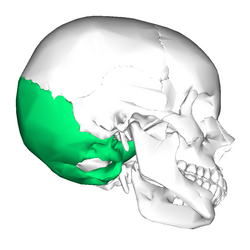
The occipital bone (/ˌɒkˈsɪpɪtəl/) is a cranial dermal bone and the main bone of the occiput (back and lower part of the skull). It is trapezoidal in shape and curved on itself like a shallow dish. The occipital bone lies over the occipital lobes of the cerebrum. At the base of the skull in the occipital bone, there is a large oval opening called the foramen magnum, which allows the passage of the spinal cord.
Like the other cranial bones, it is classed as a flat bone. Due to its many attachments and features, the occipital bone is described in terms of separate parts. From its front to the back is the basilar part, also called the basioccipital, at the sides of the foramen magnum are the lateral parts, also called the exoccipitals, and the back is named as the squamous part. The basilar part is a thick, somewhat quadrilateral piece in front of the foramen magnum and directed towards the pharynx. The squamous part is the curved, expanded plate behind the foramen magnum and is the largest part of the occipital bone.
Due to its embryonic derivation from paraxial mesoderm (as opposed to neural crest, from which many other craniofacial bones are derived), it has been posited that "the occipital bone as a whole could be considered as a giant vertebra enlarged to support the brain."
The occipital bone, like the other seven cranial bones, has outer and inner layers (also called plates or tables) of cortical bone tissue between which is the cancellous bone tissue known in the cranial bones as diploë. The bone is especially thick at the ridges, protuberances, condyles, and anterior part of the basilar part; in the inferior cerebellar fossae it is thin, semitransparent, and without diploë.
Near the middle of the outer surface of the squamous part of the occipital (the largest part) there is a prominence – the external occipital protuberance. The highest point of this is called the inion.
From the inion, along the midline of the squamous part until the foramen magnum, runs a ridge – the external occipital crest (also called the medial nuchal line) and this gives attachment to the nuchal ligament.
Running across the outside of the occipital bone are three curved lines and one line (the medial line) that runs down to the foramen magnum. These are known as the nuchal lines which give attachment to various ligaments and muscles. They are named as the highest, superior and inferior nuchal lines. The inferior nuchal line runs across the midpoint of the median nuchal line. The area above the highest nuchal line is termed the occipital plane and the area below this line is termed the nuchal plane.
The inner surface of the occipital bone forms the base of the posterior cranial fossa. The foramen magnum is a large hole situated in the middle, with the clivus, a smooth part of the occipital bone travelling upwards in front of it. The median internal occipital crest travels behind it to the internal occipital protuberance, and serves as a point of attachment to the falx cerebri.
Occipital bone
The occipital bone (/ˌɒkˈsɪpɪtəl/) is a cranial dermal bone and the main bone of the occiput (back and lower part of the skull). It is trapezoidal in shape and curved on itself like a shallow dish. The occipital bone lies over the occipital lobes of the cerebrum. At the base of the skull in the occipital bone, there is a large oval opening called the foramen magnum, which allows the passage of the spinal cord.
Like the other cranial bones, it is classed as a flat bone. Due to its many attachments and features, the occipital bone is described in terms of separate parts. From its front to the back is the basilar part, also called the basioccipital, at the sides of the foramen magnum are the lateral parts, also called the exoccipitals, and the back is named as the squamous part. The basilar part is a thick, somewhat quadrilateral piece in front of the foramen magnum and directed towards the pharynx. The squamous part is the curved, expanded plate behind the foramen magnum and is the largest part of the occipital bone.
Due to its embryonic derivation from paraxial mesoderm (as opposed to neural crest, from which many other craniofacial bones are derived), it has been posited that "the occipital bone as a whole could be considered as a giant vertebra enlarged to support the brain."
The occipital bone, like the other seven cranial bones, has outer and inner layers (also called plates or tables) of cortical bone tissue between which is the cancellous bone tissue known in the cranial bones as diploë. The bone is especially thick at the ridges, protuberances, condyles, and anterior part of the basilar part; in the inferior cerebellar fossae it is thin, semitransparent, and without diploë.
Near the middle of the outer surface of the squamous part of the occipital (the largest part) there is a prominence – the external occipital protuberance. The highest point of this is called the inion.
From the inion, along the midline of the squamous part until the foramen magnum, runs a ridge – the external occipital crest (also called the medial nuchal line) and this gives attachment to the nuchal ligament.
Running across the outside of the occipital bone are three curved lines and one line (the medial line) that runs down to the foramen magnum. These are known as the nuchal lines which give attachment to various ligaments and muscles. They are named as the highest, superior and inferior nuchal lines. The inferior nuchal line runs across the midpoint of the median nuchal line. The area above the highest nuchal line is termed the occipital plane and the area below this line is termed the nuchal plane.
The inner surface of the occipital bone forms the base of the posterior cranial fossa. The foramen magnum is a large hole situated in the middle, with the clivus, a smooth part of the occipital bone travelling upwards in front of it. The median internal occipital crest travels behind it to the internal occipital protuberance, and serves as a point of attachment to the falx cerebri.
Recent media
Recent media