

Recent from talks
Exterior algebra
Knowledge base stats:
Talk channels stats:
Members stats:
Exterior algebra
In mathematics, the exterior algebra or Grassmann algebra of a vector space is an associative algebra that contains which has a product, called exterior product or wedge product and denoted with , such that for every vector in The exterior algebra is named after Hermann Grassmann, and the names of the product come from the "wedge" symbol and the fact that the product of two elements of is "outside"


The wedge product of vectors is called a blade of degree or -blade. The wedge product was introduced originally as an algebraic construction used in geometry to study areas, volumes, and their higher-dimensional analogues: the magnitude of a 2-blade is the area of the parallelogram defined by and and, more generally, the magnitude of a -blade is the (hyper)volume of the parallelotope defined by the constituent vectors. The alternating property that implies a skew-symmetric property that and more generally any blade flips sign whenever two of its constituent vectors are exchanged, corresponding to a parallelotope of opposite orientation.





The full exterior algebra contains objects that are not themselves blades, but linear combinations of blades; a sum of blades of homogeneous degree is called a k-vector, while a more general sum of blades of arbitrary degree is called a multivector. The linear span of the -blades is called the -th exterior power of The exterior algebra is the direct sum of the -th exterior powers of and this makes the exterior algebra a graded algebra.
The exterior algebra is universal in the sense that every equation that relates elements of in the exterior algebra is also valid in every associative algebra that contains and in which the square of every element of is zero.
The definition of the exterior algebra can be extended for spaces built from vector spaces, such as vector fields and functions whose domain is a vector space. Moreover, the field of scalars may be any field. More generally, the exterior algebra can be defined for modules over a commutative ring. In particular, the algebra of differential forms in variables is an exterior algebra over the ring of the smooth functions in variables.
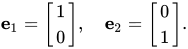
The two-dimensional Euclidean vector space is a real vector space equipped with a basis consisting of a pair of orthogonal unit vectors

Suppose that are a pair of given vectors in , written in components. There is a unique parallelogram having and as two of its sides. The area of this parallelogram is given by the standard determinant formula:


Consider now the exterior product of and : where the first step uses the distributive law for the exterior product. The second one uses the fact that the exterior product is an alternating map, i.e., Being alternating also implies being anticommutative, , which gives the last line. Note that the coefficient in this last expression is precisely the determinant of the matrix [v w]. The fact that this may be positive or negative has the intuitive meaning that v and w may be oriented in a counterclockwise or clockwise sense as the vertices of the parallelogram they define. Such an area is called the signed area of the parallelogram: the absolute value of the signed area is the ordinary area, and the sign determines its orientation.



Hub AI
Exterior algebra AI simulator
(@Exterior algebra_simulator)
Exterior algebra
In mathematics, the exterior algebra or Grassmann algebra of a vector space is an associative algebra that contains which has a product, called exterior product or wedge product and denoted with , such that for every vector in The exterior algebra is named after Hermann Grassmann, and the names of the product come from the "wedge" symbol and the fact that the product of two elements of is "outside"
The wedge product of vectors is called a blade of degree or -blade. The wedge product was introduced originally as an algebraic construction used in geometry to study areas, volumes, and their higher-dimensional analogues: the magnitude of a 2-blade is the area of the parallelogram defined by and and, more generally, the magnitude of a -blade is the (hyper)volume of the parallelotope defined by the constituent vectors. The alternating property that implies a skew-symmetric property that and more generally any blade flips sign whenever two of its constituent vectors are exchanged, corresponding to a parallelotope of opposite orientation.
The full exterior algebra contains objects that are not themselves blades, but linear combinations of blades; a sum of blades of homogeneous degree is called a k-vector, while a more general sum of blades of arbitrary degree is called a multivector. The linear span of the -blades is called the -th exterior power of The exterior algebra is the direct sum of the -th exterior powers of and this makes the exterior algebra a graded algebra.
The exterior algebra is universal in the sense that every equation that relates elements of in the exterior algebra is also valid in every associative algebra that contains and in which the square of every element of is zero.
The definition of the exterior algebra can be extended for spaces built from vector spaces, such as vector fields and functions whose domain is a vector space. Moreover, the field of scalars may be any field. More generally, the exterior algebra can be defined for modules over a commutative ring. In particular, the algebra of differential forms in variables is an exterior algebra over the ring of the smooth functions in variables.
The two-dimensional Euclidean vector space is a real vector space equipped with a basis consisting of a pair of orthogonal unit vectors
Suppose that are a pair of given vectors in , written in components. There is a unique parallelogram having and as two of its sides. The area of this parallelogram is given by the standard determinant formula:
Consider now the exterior product of and : where the first step uses the distributive law for the exterior product. The second one uses the fact that the exterior product is an alternating map, i.e., Being alternating also implies being anticommutative, , which gives the last line. Note that the coefficient in this last expression is precisely the determinant of the matrix [v w]. The fact that this may be positive or negative has the intuitive meaning that v and w may be oriented in a counterclockwise or clockwise sense as the vertices of the parallelogram they define. Such an area is called the signed area of the parallelogram: the absolute value of the signed area is the ordinary area, and the sign determines its orientation.
Recent media