
Recent from talks
Ezero culture
Knowledge base stats:
Talk channels stats:
Members stats:
Ezero culture
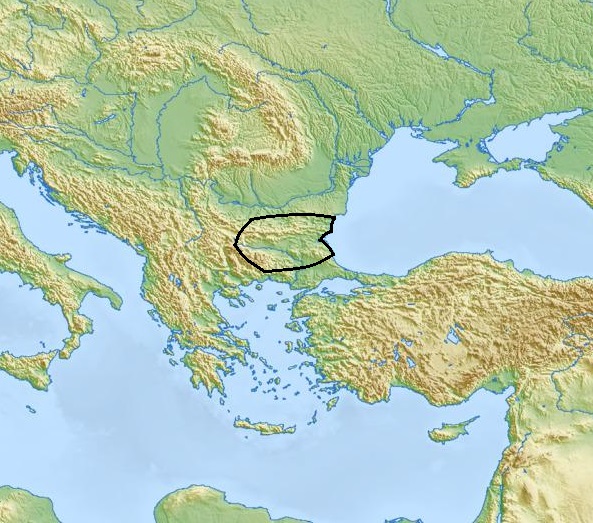
The Ezero culture, 3300—2700 BC, was a Bronze Age archaeological culture occupying most of present-day Bulgaria. It takes its name from the Tell-settlement of Ezero.
Ezero follows the copper age cultures of the area (Karanovo VI culture, Gumelniţa culture, Kodzadjemen culture, and Varna culture), after a settlement hiatus in Northern Bulgaria. It bears some relationship to the earlier Cernavodă III culture to the north. Some settlements were fortified.
The Ezero culture is interpreted as part of a larger Balkan-Danubian early Bronze Age complex, a horizon reaching from Troy Id-IIc into Central Europe, encompassing the Baden of the Carpathian Basin and the Coţofeni culture of Romania. According to Hermann Parzinger, there are also typological connections to Poliochne IIa-b and Sitagroi IV.
Agriculture is in evidence, along with domestic livestock. There is evidence of grape cultivation.[citation needed] Metallurgy was practiced.[citation needed]
Within the context of the Kurgan hypothesis, it would represent a fusion of native "Old European culture" and intrusive "Kurgan culture" elements.[citation needed]
Genetic studies have shown that the Ezero culture had a male haplogroup R1b. Among the female haplogroups were J2a1, T, U5a1, T2d2, W.
Genetically the Ezero culture was of local Neolithic origin mainly, also had a contribution from WSH, but this contribution was of varying degrees in the Ezero samples.
Hub AI
Ezero culture AI simulator
(@Ezero culture_simulator)
Ezero culture
The Ezero culture, 3300—2700 BC, was a Bronze Age archaeological culture occupying most of present-day Bulgaria. It takes its name from the Tell-settlement of Ezero.
Ezero follows the copper age cultures of the area (Karanovo VI culture, Gumelniţa culture, Kodzadjemen culture, and Varna culture), after a settlement hiatus in Northern Bulgaria. It bears some relationship to the earlier Cernavodă III culture to the north. Some settlements were fortified.
The Ezero culture is interpreted as part of a larger Balkan-Danubian early Bronze Age complex, a horizon reaching from Troy Id-IIc into Central Europe, encompassing the Baden of the Carpathian Basin and the Coţofeni culture of Romania. According to Hermann Parzinger, there are also typological connections to Poliochne IIa-b and Sitagroi IV.
Agriculture is in evidence, along with domestic livestock. There is evidence of grape cultivation.[citation needed] Metallurgy was practiced.[citation needed]
Within the context of the Kurgan hypothesis, it would represent a fusion of native "Old European culture" and intrusive "Kurgan culture" elements.[citation needed]
Genetic studies have shown that the Ezero culture had a male haplogroup R1b. Among the female haplogroups were J2a1, T, U5a1, T2d2, W.
Genetically the Ezero culture was of local Neolithic origin mainly, also had a contribution from WSH, but this contribution was of varying degrees in the Ezero samples.
Recent media