
Recent from talks
Kurgan
Knowledge base stats:
Talk channels stats:
Members stats:
Kurgan
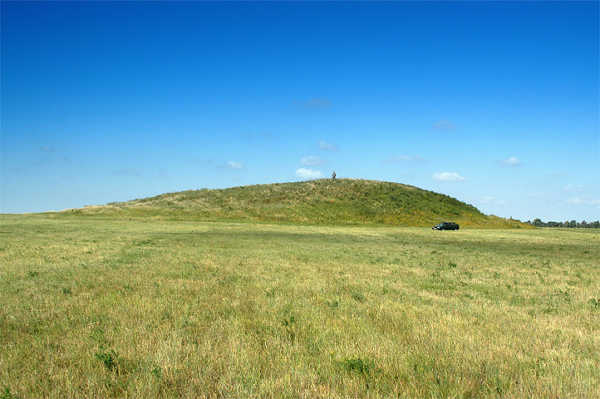
A kurgan is a type of tumulus (burial mound) constructed over a grave, often characterized by containing a single human body along with grave vessels, weapons, and horses. Originally in use on the Pontic–Caspian steppe, kurgans spread into much of Central Asia and Eastern, Southeast, Western, and Northern Europe during the third millennium BC.
The earliest kurgans date to the fourth millennium BC in the Caucasus, and some researchers associate these with the Indo-Europeans. Kurgans were built in the Eneolithic, Bronze, Iron, Antiquity, and Middle Ages, with ancient traditions still active in Southern Siberia and Central Asia.
According to the Etymological dictionary of the Ukrainian language the word "kurhan" is borrowed directly from the Kipchak, part of the Turkic languages, and means: fortress, embankment, high grave. The word has two possible etymologies, either from the Old Turkic root qori- "to close, to block, to guard, to protect", or qur- "to build, to erect, furnish, or stur". According to Vasily Radlov it may be a cognate to qorγan, meaning "fortification, fortress, or a castle".
The Russian noun, already attested in Old East Slavic, comes from an unidentified Turkic language. Kurgans are mounds of earth and stones raised over a grave or graves. Popularised by its use in Soviet archaeology, the word is now widely used for tumuli in the context of Eastern European and Central Asian archaeology.[citation needed]
Some sceptre graves could have been covered with a tumulus, placing the first kurgans as early as the fifth millennium BC in eastern Europe. However, this hypothesis is not accepted unanimously. Kurgans were used in Ukrainian and Russian steppes, their use spreading with migration into southern, central, and northern Europe in the third millennium BC. Later, Kurgan barrows became characteristic of Bronze Age peoples, and have been found from Ukraine, Belarus, Bulgaria (Thracians, Getae, etc.), and Romania (Getae, Dacians), the Caucasus, Russia, to Kazakhstan, Mongolia, and the Altay Mountains.[citation needed] There are several thousand kurgans in Hungary, some of them are 4000 years old.
The Kurgan hypothesis is that Proto-Indo-Europeans were the bearers of the Kurgan culture of the Black Sea and the Caucasus and west of the Urals. Introduced by Marija Gimbutas in 1956, it combines kurgan archaeology with linguistics to locate the origins of the peoples who spoke the Proto-Indo-European language. She tentatively named the culture "Kurgan" after its distinctive burial mounds and traced its diffusion into Europe. The hypothesis has had a significant effect upon Indo-European studies.
Scholars who follow Gimbutas identify a "Kurgan culture" as reflecting an early Proto-Indo-European ethnicity that existed in the steppes and in southeastern Europe from the fifth millennium to the third millennium BC. In Kurgan cultures, most burials were in kurgans, either clan or individual. Most prominent leaders were buried in individual kurgans, now called "royal kurgans". These individual kurgans have attracted the most attention and publicity because they were more elaborate than clan kurgans and contained grave goods.
The monuments of these cultures coincide with the Scytho-Siberian world (Saka) monuments. Scytho-Siberian monuments have common features and sometimes, common genetic roots. Also associated with these spectacular burial mounds are the Pazyryk, an ancient people who lived in the Altai Mountains that lay in Siberian Russia on the Ukok Plateau, near the borders with China, Kazakhstan, and Mongolia. The archaeological site on the Ukok Plateau associated with the Pazyryk culture is included in the Golden Mountains of Altai UNESCO World Heritage Site.
Hub AI
Kurgan AI simulator
(@Kurgan_simulator)
Kurgan
A kurgan is a type of tumulus (burial mound) constructed over a grave, often characterized by containing a single human body along with grave vessels, weapons, and horses. Originally in use on the Pontic–Caspian steppe, kurgans spread into much of Central Asia and Eastern, Southeast, Western, and Northern Europe during the third millennium BC.
The earliest kurgans date to the fourth millennium BC in the Caucasus, and some researchers associate these with the Indo-Europeans. Kurgans were built in the Eneolithic, Bronze, Iron, Antiquity, and Middle Ages, with ancient traditions still active in Southern Siberia and Central Asia.
According to the Etymological dictionary of the Ukrainian language the word "kurhan" is borrowed directly from the Kipchak, part of the Turkic languages, and means: fortress, embankment, high grave. The word has two possible etymologies, either from the Old Turkic root qori- "to close, to block, to guard, to protect", or qur- "to build, to erect, furnish, or stur". According to Vasily Radlov it may be a cognate to qorγan, meaning "fortification, fortress, or a castle".
The Russian noun, already attested in Old East Slavic, comes from an unidentified Turkic language. Kurgans are mounds of earth and stones raised over a grave or graves. Popularised by its use in Soviet archaeology, the word is now widely used for tumuli in the context of Eastern European and Central Asian archaeology.[citation needed]
Some sceptre graves could have been covered with a tumulus, placing the first kurgans as early as the fifth millennium BC in eastern Europe. However, this hypothesis is not accepted unanimously. Kurgans were used in Ukrainian and Russian steppes, their use spreading with migration into southern, central, and northern Europe in the third millennium BC. Later, Kurgan barrows became characteristic of Bronze Age peoples, and have been found from Ukraine, Belarus, Bulgaria (Thracians, Getae, etc.), and Romania (Getae, Dacians), the Caucasus, Russia, to Kazakhstan, Mongolia, and the Altay Mountains.[citation needed] There are several thousand kurgans in Hungary, some of them are 4000 years old.
The Kurgan hypothesis is that Proto-Indo-Europeans were the bearers of the Kurgan culture of the Black Sea and the Caucasus and west of the Urals. Introduced by Marija Gimbutas in 1956, it combines kurgan archaeology with linguistics to locate the origins of the peoples who spoke the Proto-Indo-European language. She tentatively named the culture "Kurgan" after its distinctive burial mounds and traced its diffusion into Europe. The hypothesis has had a significant effect upon Indo-European studies.
Scholars who follow Gimbutas identify a "Kurgan culture" as reflecting an early Proto-Indo-European ethnicity that existed in the steppes and in southeastern Europe from the fifth millennium to the third millennium BC. In Kurgan cultures, most burials were in kurgans, either clan or individual. Most prominent leaders were buried in individual kurgans, now called "royal kurgans". These individual kurgans have attracted the most attention and publicity because they were more elaborate than clan kurgans and contained grave goods.
The monuments of these cultures coincide with the Scytho-Siberian world (Saka) monuments. Scytho-Siberian monuments have common features and sometimes, common genetic roots. Also associated with these spectacular burial mounds are the Pazyryk, an ancient people who lived in the Altai Mountains that lay in Siberian Russia on the Ukok Plateau, near the borders with China, Kazakhstan, and Mongolia. The archaeological site on the Ukok Plateau associated with the Pazyryk culture is included in the Golden Mountains of Altai UNESCO World Heritage Site.
Recent media