
Recent from talks
General Dynamics F-111 Aardvark
Knowledge base stats:
Talk channels stats:
Members stats:
General Dynamics F-111 Aardvark
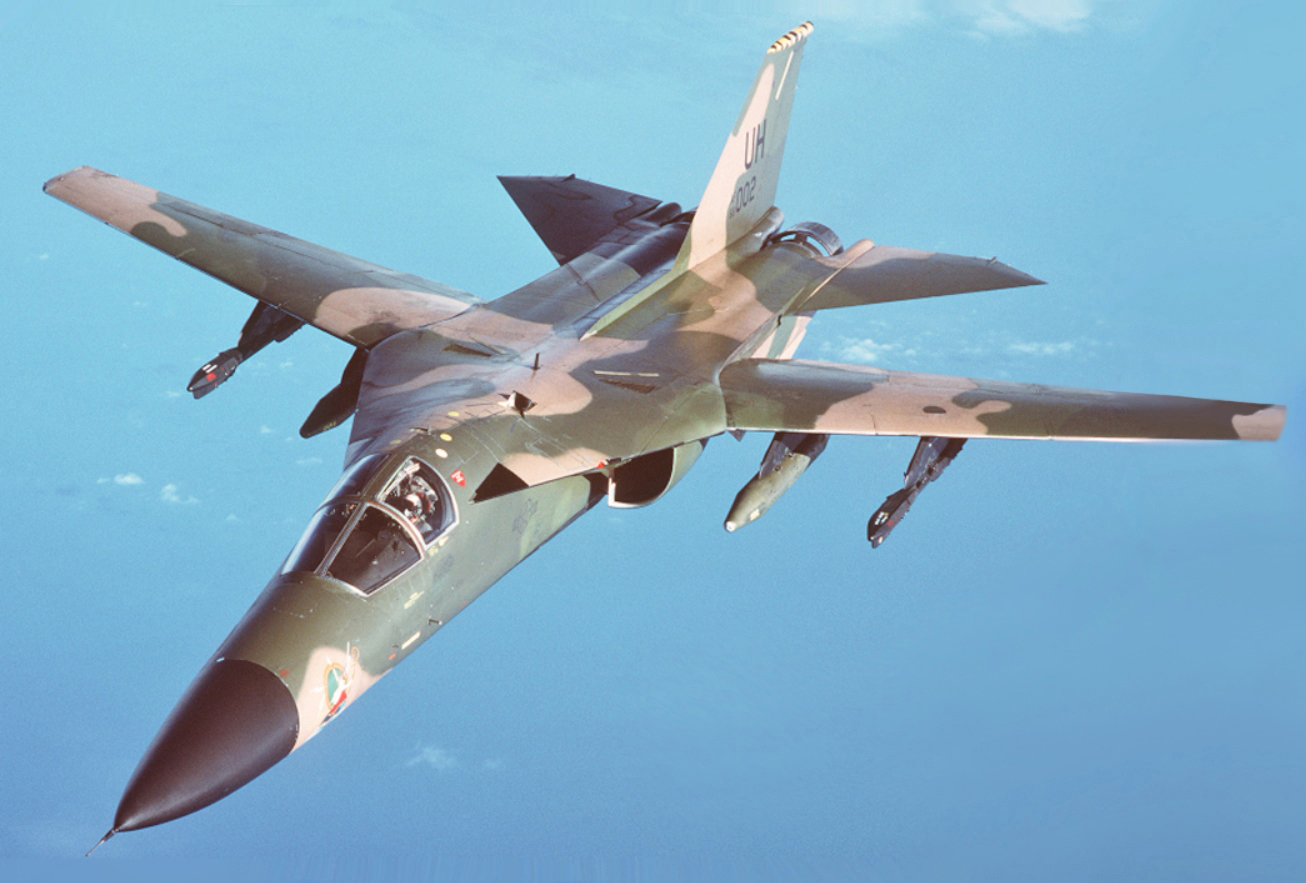
The General Dynamics F-111 Aardvark is a retired supersonic, medium-range, fighter-bomber. Production models of the F-111 had roles that included attack (e.g. interdiction), strategic bombing (including nuclear-weapons capabilities), reconnaissance, and electronic warfare. Its name "Aardvark" comes from a long-nosed, insect-eating African animal.
Developed in the 1960s by General Dynamics under Robert McNamara's TFX Program, the F-111 pioneered variable-sweep wings, afterburning turbofan engines, and automated terrain-following radar for low-level, high-speed flight. Its design influenced later variable-sweep wing aircraft, and some of its advanced features have become commonplace. The F-111 suffered problems during initial development, largely related to the engines. A multirole carrier-based fighter/long-range interception variant intended for the United States Navy, the F-111B, was canceled before production. Several specialized models, such as the FB-111A strategic bomber and the EF-111A electronic warfare aircraft, were also developed.
The F-111 entered service in 1967 with the United States Air Force (USAF). In the meantime, the Australian government had ordered the F-111C, to replace the English Electric Canberra then used by the Royal Australian Air Force (RAAF). The F-111C entered service with the RAAF in 1973.
As early as March 1968, the USAF was deploying F-111s into active combat situations; the type saw heavy use during the latter half of the Vietnam War to conduct low-level ground-attack missions, flying in excess of 4,000 combat missions while incurring only six combat losses in the theatre. The F-111s also participated in the Gulf War (Operation Desert Storm) in 1991; the F-111Fs completed 3.2 successful strike missions for every unsuccessful one, better than any other US strike aircraft used in the operation. RAAF F-111s never saw offensive action, but were deployed periodically as a deterrent, such as for the Australian-led International Force East Timor.
Being relatively expensive to maintain amid post-Cold War budget cuts, the USAF elected to retire its F-111 fleet during the 1990s; the last F-111Fs were withdrawn in 1996, while the remaining EF-111s also departed in 1998. The F-111 was replaced in USAF service by the F-15E Strike Eagle for medium-range precision strike missions, while the supersonic bomber role has been assumed by the B-1B Lancer. The RAAF continued to operate the type until December 2010, when the last F-111C was retired; its role was transitioned to the Boeing F/A-18E/F Super Hornet as an interim measure until the Lockheed Martin F-35 Lightning II became available.
The May 1960 U-2 incident, in which an American CIA U-2 reconnaissance plane was shot down over the USSR, stunned the United States government. Besides greatly damaging US–Soviet relations, the incident showed that the Soviet Union had developed a surface-to-air missile that could reach aircraft above 60,000 ft (18,000 m). Consequently, the United States Air Force Strategic Air Command (SAC) and the RAF Bomber Command's plans to send subsonic, high-altitude Boeing B-47 Stratojet and V bomber formations into the USSR were realized to be much less viable.
By 1960, SAC had begun moving to low-level penetration, which greatly reduced radar detection distances. At the time, SAMs were ineffective against low-flying aircraft while interceptor aircraft had less of a speed advantage at low altitudes. The USAF's Tactical Air Command (TAC) was largely concerned with the fighter-bomber and deep strike/interdiction roles. TAC was in the process of receiving its latest design, the Republic F-105 Thunderchief, which was designed to deliver nuclear weapons fast and far, but required long runways. A simpler variable-geometry wing configuration with the pivot points farther out from the aircraft's centerline was reported by NASA in 1958, which made swing-wings viable. This led USAF leaders to encourage its use.
In June 1960, the USAF issued specification SOR 183 for a long-range, interdiction/strike aircraft able to penetrate Soviet air defenses at very low altitudes and high speeds. Specifically, it was to be capable of at least 800 mi (1,300 km) of low-level flight, half of which was to be at a speed of no less than Mach 1.2. Furthermore, the specification also called for the aircraft to possess short takeoff and landing (STOL) capabilities to permit operations from short, unprepared airstrips that had a length of no more than 3,000 ft (900 m). An internal payload of 1,000 lb (450 kg) was to be carried in the primary mission role. A variant suitable for aerial reconnaissance flights was also included in the specification.
Hub AI
General Dynamics F-111 Aardvark AI simulator
(@General Dynamics F-111 Aardvark_simulator)
General Dynamics F-111 Aardvark
The General Dynamics F-111 Aardvark is a retired supersonic, medium-range, fighter-bomber. Production models of the F-111 had roles that included attack (e.g. interdiction), strategic bombing (including nuclear-weapons capabilities), reconnaissance, and electronic warfare. Its name "Aardvark" comes from a long-nosed, insect-eating African animal.
Developed in the 1960s by General Dynamics under Robert McNamara's TFX Program, the F-111 pioneered variable-sweep wings, afterburning turbofan engines, and automated terrain-following radar for low-level, high-speed flight. Its design influenced later variable-sweep wing aircraft, and some of its advanced features have become commonplace. The F-111 suffered problems during initial development, largely related to the engines. A multirole carrier-based fighter/long-range interception variant intended for the United States Navy, the F-111B, was canceled before production. Several specialized models, such as the FB-111A strategic bomber and the EF-111A electronic warfare aircraft, were also developed.
The F-111 entered service in 1967 with the United States Air Force (USAF). In the meantime, the Australian government had ordered the F-111C, to replace the English Electric Canberra then used by the Royal Australian Air Force (RAAF). The F-111C entered service with the RAAF in 1973.
As early as March 1968, the USAF was deploying F-111s into active combat situations; the type saw heavy use during the latter half of the Vietnam War to conduct low-level ground-attack missions, flying in excess of 4,000 combat missions while incurring only six combat losses in the theatre. The F-111s also participated in the Gulf War (Operation Desert Storm) in 1991; the F-111Fs completed 3.2 successful strike missions for every unsuccessful one, better than any other US strike aircraft used in the operation. RAAF F-111s never saw offensive action, but were deployed periodically as a deterrent, such as for the Australian-led International Force East Timor.
Being relatively expensive to maintain amid post-Cold War budget cuts, the USAF elected to retire its F-111 fleet during the 1990s; the last F-111Fs were withdrawn in 1996, while the remaining EF-111s also departed in 1998. The F-111 was replaced in USAF service by the F-15E Strike Eagle for medium-range precision strike missions, while the supersonic bomber role has been assumed by the B-1B Lancer. The RAAF continued to operate the type until December 2010, when the last F-111C was retired; its role was transitioned to the Boeing F/A-18E/F Super Hornet as an interim measure until the Lockheed Martin F-35 Lightning II became available.
The May 1960 U-2 incident, in which an American CIA U-2 reconnaissance plane was shot down over the USSR, stunned the United States government. Besides greatly damaging US–Soviet relations, the incident showed that the Soviet Union had developed a surface-to-air missile that could reach aircraft above 60,000 ft (18,000 m). Consequently, the United States Air Force Strategic Air Command (SAC) and the RAF Bomber Command's plans to send subsonic, high-altitude Boeing B-47 Stratojet and V bomber formations into the USSR were realized to be much less viable.
By 1960, SAC had begun moving to low-level penetration, which greatly reduced radar detection distances. At the time, SAMs were ineffective against low-flying aircraft while interceptor aircraft had less of a speed advantage at low altitudes. The USAF's Tactical Air Command (TAC) was largely concerned with the fighter-bomber and deep strike/interdiction roles. TAC was in the process of receiving its latest design, the Republic F-105 Thunderchief, which was designed to deliver nuclear weapons fast and far, but required long runways. A simpler variable-geometry wing configuration with the pivot points farther out from the aircraft's centerline was reported by NASA in 1958, which made swing-wings viable. This led USAF leaders to encourage its use.
In June 1960, the USAF issued specification SOR 183 for a long-range, interdiction/strike aircraft able to penetrate Soviet air defenses at very low altitudes and high speeds. Specifically, it was to be capable of at least 800 mi (1,300 km) of low-level flight, half of which was to be at a speed of no less than Mach 1.2. Furthermore, the specification also called for the aircraft to possess short takeoff and landing (STOL) capabilities to permit operations from short, unprepared airstrips that had a length of no more than 3,000 ft (900 m). An internal payload of 1,000 lb (450 kg) was to be carried in the primary mission role. A variant suitable for aerial reconnaissance flights was also included in the specification.
Recent media