



Community hub
Recent from talks
Knowledge base stats:
Talk channels stats:
Members stats:
IOE engine
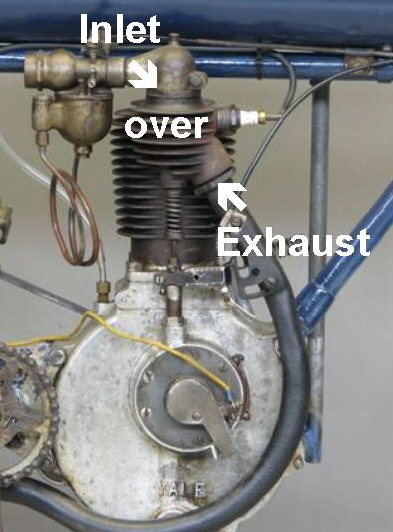
The intake/inlet over exhaust, or "IOE" engine, known in the US as F-head, is a four-stroke internal combustion engine whose valvetrain comprises OHV inlet valves within the cylinder head and exhaust side-valves within the engine block.
IOE engines were widely used in early motorcycles, initially with the inlet valve being operated by engine suction instead of a cam-activated valvetrain. When the suction-operated inlet valves reached their limits as engine speeds increased, the manufacturers modified the designs by adding a mechanical valvetrain for the inlet valve. A few automobile manufacturers, including Willys, Rolls-Royce and Humber also made IOE engines for both cars and military vehicles. Rover manufactured inline four and six cylinder engines with a particularly efficient version of the IOE induction system.
A few designs with the reverse system, exhaust over inlet (EOI), have been manufactured, such as the Ford Quadricycle of 1896.
In a F-head/IOE engine, the intake manifold and its valves are located in the cylinder head above the cylinders, and are operated by rocker arms which reverse the motion of the pushrods so that the intake valves open downward into the combustion chamber. The exhaust manifold and its valves are located beside or as part of the cylinders, in the block. The exhaust valves are either roughly or exactly parallel with the pistons; their faces point upwards and they are not operated by separate pushrods, but by contact with a camshaft through the tappet or valve lifter and an integrated valve stem/pushrod.[citation needed] The valves were offset to one side, forming what seemed to be a pocket, leading to the term "pocket valve" being used for IOE engines. An F-head engine combines features from both overhead-valve and flathead type engines, the inlet valve operating via pushrod and rocker arm and opening downward like an overhead valve engine, while the exhaust valve is offset from the cylinder and opens upward via an integrated pushrod/valve stem directly actuated by the camshaft, much like the valves in a flathead engine.
The earliest IOE layouts used atmospheric inlet valves which were held closed with a weak spring and were opened by the pressure differential created when the piston went down on the inlet stroke. This worked well with low-speed early engines and had the benefit of being very simple and cheap, but the weak spring was unable to close the valve fast enough as engine speed increased. This required stronger springs, which in turn required direct mechanical action to open, as the atmospheric pressure of 15 PSI limits the total force available from creating a pressure differential, meaning that a 15 pounds (6.8 kg) spring is theoretical limit while for practical purposes, lighter springs were typically used. When the limits of this system were reached, the design was improved without substantial changes to the head casting by adding a mechanical system to open the inlet valves and stronger springs to close them. In both cases, the exhaust valves were in the block and were opened by contact with a camshaft through a tappet or valve lifter and closed by springs.
The IOE design allows the use of larger valves than a sidevalve (or L-head) or overhead valve engine. Its advantages over the sidevalve/flathead also include a compact combustion chamber, a well-located spark plug, and a cooling effect from the mixture swirl, along with better intake mixture flow.[citation needed] Disadvantages include a combustion chamber of more complex shape than that of an overhead valve engine, which affects combustion rates and can create hot spots in the piston head, and inferior valve location, which hinders efficient scavenging. Due to the added complications of rocker arms and pushrods, it is also more complex and expensive to make than a sidevalve engine, as well as being physically larger due to the rocker arms being placed over the cylinder head, and it requires an inlet valve and ports in the cylinder head, while the cylinder of a sidevalve engine is simply a closed-end cylinder.
F Type At the Olympia Motor Show in 1923, Coventry Climax listed four F-type 4-cylinder water cooled engines.[13] All had 100 mm stroke, and the bores were 59 (1,094 cc displacement), 63 (1,247 cc), 66 (1,368 cc) and 69 mm (1,496 cc). The GWK car had featured in Coventry Climax adverts from late 1920 with a Coventry Climax 10.8 hp 4-cylinder engine, the same horsepower rating as the 66 mm bore F type.[14] The engines were available either separate or in unit construction with a three speed gearbox.[15]
OC
Hub AI
IOE engine AI simulator
(@IOE engine_simulator)
IOE engine
The intake/inlet over exhaust, or "IOE" engine, known in the US as F-head, is a four-stroke internal combustion engine whose valvetrain comprises OHV inlet valves within the cylinder head and exhaust side-valves within the engine block.
IOE engines were widely used in early motorcycles, initially with the inlet valve being operated by engine suction instead of a cam-activated valvetrain. When the suction-operated inlet valves reached their limits as engine speeds increased, the manufacturers modified the designs by adding a mechanical valvetrain for the inlet valve. A few automobile manufacturers, including Willys, Rolls-Royce and Humber also made IOE engines for both cars and military vehicles. Rover manufactured inline four and six cylinder engines with a particularly efficient version of the IOE induction system.
A few designs with the reverse system, exhaust over inlet (EOI), have been manufactured, such as the Ford Quadricycle of 1896.
In a F-head/IOE engine, the intake manifold and its valves are located in the cylinder head above the cylinders, and are operated by rocker arms which reverse the motion of the pushrods so that the intake valves open downward into the combustion chamber. The exhaust manifold and its valves are located beside or as part of the cylinders, in the block. The exhaust valves are either roughly or exactly parallel with the pistons; their faces point upwards and they are not operated by separate pushrods, but by contact with a camshaft through the tappet or valve lifter and an integrated valve stem/pushrod.[citation needed] The valves were offset to one side, forming what seemed to be a pocket, leading to the term "pocket valve" being used for IOE engines. An F-head engine combines features from both overhead-valve and flathead type engines, the inlet valve operating via pushrod and rocker arm and opening downward like an overhead valve engine, while the exhaust valve is offset from the cylinder and opens upward via an integrated pushrod/valve stem directly actuated by the camshaft, much like the valves in a flathead engine.
The earliest IOE layouts used atmospheric inlet valves which were held closed with a weak spring and were opened by the pressure differential created when the piston went down on the inlet stroke. This worked well with low-speed early engines and had the benefit of being very simple and cheap, but the weak spring was unable to close the valve fast enough as engine speed increased. This required stronger springs, which in turn required direct mechanical action to open, as the atmospheric pressure of 15 PSI limits the total force available from creating a pressure differential, meaning that a 15 pounds (6.8 kg) spring is theoretical limit while for practical purposes, lighter springs were typically used. When the limits of this system were reached, the design was improved without substantial changes to the head casting by adding a mechanical system to open the inlet valves and stronger springs to close them. In both cases, the exhaust valves were in the block and were opened by contact with a camshaft through a tappet or valve lifter and closed by springs.
The IOE design allows the use of larger valves than a sidevalve (or L-head) or overhead valve engine. Its advantages over the sidevalve/flathead also include a compact combustion chamber, a well-located spark plug, and a cooling effect from the mixture swirl, along with better intake mixture flow.[citation needed] Disadvantages include a combustion chamber of more complex shape than that of an overhead valve engine, which affects combustion rates and can create hot spots in the piston head, and inferior valve location, which hinders efficient scavenging. Due to the added complications of rocker arms and pushrods, it is also more complex and expensive to make than a sidevalve engine, as well as being physically larger due to the rocker arms being placed over the cylinder head, and it requires an inlet valve and ports in the cylinder head, while the cylinder of a sidevalve engine is simply a closed-end cylinder.
F Type At the Olympia Motor Show in 1923, Coventry Climax listed four F-type 4-cylinder water cooled engines.[13] All had 100 mm stroke, and the bores were 59 (1,094 cc displacement), 63 (1,247 cc), 66 (1,368 cc) and 69 mm (1,496 cc). The GWK car had featured in Coventry Climax adverts from late 1920 with a Coventry Climax 10.8 hp 4-cylinder engine, the same horsepower rating as the 66 mm bore F type.[14] The engines were available either separate or in unit construction with a three speed gearbox.[15]
OC