Hubbry Logo
ValvetrainValvetrainMain
Open search
Valvetrain
Community hub
Valvetrain
logo
8 pages, 0 posts
0 subscribers
Be the first to start a discussion here.
Valvetrain
Valvetrain
from Wikipedia

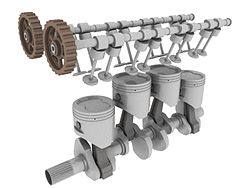
Cutaway of a dual overhead camshaft engine
1969 AMC V8 overhead valve engine. The rocker cover has been removed, so elements of the pushrods, rocker arms, valve springs, and valves are visible.

A valvetrain is a mechanical system that controls the operation of the intake and exhaust valves in an internal combustion engine.[1] The intake valves control the flow of air/fuel mixture (or air alone for direct-injected engines) into the combustion chamber, while the exhaust valves control the flow of spent exhaust gases out of the combustion chamber once combustion is completed.[2]

Layout

[edit]

The valvetrain layout is largely dependent on the location of the camshaft. The common valvetrain configurations for piston engines, in order from oldest to newest, are:

Components

[edit]

The valvetrain consists of all the components responsible for transferring the rotational movement of the camshaft into the opening and closing of the intake and exhaust valves. Typical components are listed below in order from the crankshaft to the valves.

Camshaft

[edit]

The timing and lift profile of the valve opening events are controlled by the camshafts, through use of a carefully shaped lobe on a rotating shaft. The camshaft is driven by the crankshaft and, in the case of a four-stroke engine, rotates at half the speed of the crankshaft.

Motion is transferred from the crankshaft to the camshaft most commonly by a rubber timing belt, a metallic timing chain or a set of gears.

Pushrod

[edit]

Pushrods are long, slender metal rods that are used in overhead valve engines to transfer motion from the camshaft (located in the engine block) to the valves (located in the cylinder head). The bottom end of a pushrod is mated to a lifter, upon which the camshaft makes contact. The camshaft lobe moves the lifter upwards, which moves the pushrod. The top end of the pushrod pushes on the rocker arm, which opens the valve.

Rocker arm / Finger / Bucket tappet

[edit]

Depending on the design used, the valves are actuated by a rocker arm, finger, or bucket tappet. Overhead valve engines use rocker arms, which are actuated from below indirectly (through the pushrods) by the cam lobes. Overhead camshaft engines use fingers or bucket tappets, which are actuated from above directly by the cam lobes.[3]

Valves

[edit]

Most modern engines use poppet valves, although sleeve valves, slide valves and rotary valves have also been used at times. Poppet valves are typically opened by the camshaft lobe or rocker arm, and closed by a coiled spring called a valve spring.

Valve float occurs when the valve spring is unable to control the inertia of the valvetrain at high engine speeds (RPM).[4][5]

Valve guide

[edit]

Valve guides ensure that engine valves are properly aligned, support the intake/exhaust valve stem, stabilize valve angle, and allow heat to escape to the cylinder head.

See also

[edit]

References

[edit]
Revisions and contributorsEdit on WikipediaRead on Wikipedia
from Grokipedia
The valvetrain, also known as the valve train, is a mechanical in internal engines that precisely controls the opening and closing of the and exhaust valves to regulate the flow of air-fuel mixture into the and the expulsion of exhaust gases. This assembly ensures the engine adheres to the four-stroke cycle—intake, compression, power, and exhaust—while maintaining chamber sealing during to optimize and power output. Key components of the valvetrain include the , a rotating shaft with eccentric lobes that dictate and lift; lifters (or tappets), which transfer the camshaft's motion to other elements; pushrods (in overhead valve designs), long rods that transmit force from the camshaft to the rocker arms; rocker arms, pivoting levers that convert the into valve actuation; valves, poppet-style components made from heat-resistant alloys like austenitic to handle high temperatures; and valve springs, which provide the force to close the rapidly after opening. Additional elements such as valve guides, which align the to reduce wear; valve seats, which form a gas-tight seal; and valve stem seals, which prevent oil leakage into the , further enhance durability and performance under extreme pressures and heat. Valvetrain configurations vary by engine design, with overhead valve (OHV) systems placing the camshaft in the block below the for simplicity and cost-effectiveness, though they require pushrods and can limit high-speed performance; overhead camshaft (OHC) setups positioning the directly in the head to reduce components and improve timing precision; and dual overhead camshaft (DOHC) arrangements using separate s for intake and exhaust valves to enable advanced for better efficiency and power. The synchronization of these components with the via a timing belt, chain, or gears is essential to prevent valve-piston interference and ensure reliable operation. The valvetrain's design profoundly impacts characteristics, including , fuel economy, emissions control, and noise levels, as it influences airflow dynamics and efficiency. Modern advancements, such as (VVT) and electrohydraulic actuation, allow dynamic adjustment of events to adapt to varying loads and speeds, reducing fuel consumption and meeting stringent environmental regulations. materials and springs are engineered for fatigue resistance, with features like rotators promoting even heat distribution to extend component life in high-performance applications.

Fundamentals

Definition and Purpose

The valvetrain is a mechanical system in reciprocating internal combustion engines responsible for actuating the and exhaust valves to regulate the flow of the air-fuel mixture into the and the expulsion of exhaust gases. This system ensures that valves open and close at precise intervals, allowing fresh charge to enter during the stroke and spent gases to exit during the exhaust , thereby supporting the engine's cyclic operation. The primary purpose of the valvetrain is to synchronize valve events with the piston's position, optimizing the timing for efficient in the four-stroke cycle while minimizing losses such as or incomplete scavenging. By controlling lift, duration, and phasing, it contributes to , fuel economy, and emissions control without interfering with the piston's motion. As an integral part of the 's broader , the valvetrain interfaces with the —typically through a driven by timing belts, chains, or gears—to maintain rotational , usually at half the crankshaft speed in four-stroke engines. This connection ensures that valve actuation aligns precisely with travel, enabling coordinated operation across the engine's cycles. In piston engines, valvetrains are conventionally designed around poppet , which dominate due to their reliability and sealing efficiency, distinct from alternative mechanisms like rotary or sleeve that are not addressed here.

Basic Principles of Operation

The valvetrain operates through a mechanical sequence where the , driven by the engine's , rotates to actuate the intake and exhaust . As the turns, its eccentric lobe profiles contact intermediaries such as lifters or followers, which transmit the motion to lift the from their seats, allowing the controlled flow of air-fuel mixture into the cylinder and exhaust gases out. Upon completion of the lobe's action, valve springs exert force to return the to their closed positions, ensuring a gas-tight seal during compression and power strokes. In four-stroke internal combustion engines, valvetrain synchronization is achieved by linking the to the at half the crankshaft's rotational speed, as each complete engine cycle requires two crankshaft revolutions. This timing relationship, typically maintained via belts, chains, or , ensures that valve events align precisely with positions. For instance, the completes one full rotation for every two turns of the , coordinating the opening and closing of s during the appropriate strokes. Key operational events include the valve opening near the end of the exhaust to admit the fresh charge, remaining open through the intake , and closing after bottom dead center; conversely, the opens near the end of the power and stays open through the exhaust , closing after top dead center. A brief period of valve overlap occurs when both valves are slightly open simultaneously around top dead center, facilitating scavenging by using exhaust gas momentum to draw out residual gases and promote fresh charge . Kinematically, the valvetrain's performance is defined by valve lift—the maximum distance the valve travels from its seat, determined by the cam lobe's height—duration, which measures the crankshaft degrees the valve remains off its seat, and timing phases that specify opening and closing points relative to piston positions. The lift curve profile, shaped by the cam lobe's contour, ensures smooth acceleration and deceleration of the valve to minimize wear and noise, with ramps providing gradual initial and final motion followed by a peak lift over the lobe nose.

Historical Development

Early Innovations

The origins of valvetrain technology trace back to the , where initial designs emerged in steam engines to control steam flow efficiently. One of the earliest significant advancements was the , patented in 1849 by George Henry Corliss, which featured a sophisticated four-valve system with separate inlet and exhaust valves operated by trip mechanisms for improved timing and reduced steam waste. These mechanical valve controls, often using slide or poppet valves linked to cams or eccentrics, addressed basic needs for precise admission and release of in high-pressure environments. By the mid-1800s, designs like the , developed around 1841 by William Howe and William Williams, employees at , became widespread in locomotives, employing linkage systems to vary for reversible operation and power modulation. As internal (IC) engines developed in the late , valvetrain concepts were adapted from steam technology to manage and exhaust in gaseous fuel cycles. Nikolaus Otto's landmark 1876 incorporated side-valve (or slide-valve) mechanisms, where valves were positioned in the block adjacent to the , allowing compressed air-fuel mixture entry and exhaust expulsion through primitive cam-driven actuation. This side-valve configuration, known as the flathead or L-head design, became a staple in early IC engines due to its simplicity and compatibility with cast-iron construction. Early challenges included achieving reliable sealing against combustion pressures and maintaining durability in high-heat conditions, as primitive coil springs often fatigued under cycling, and basic metallic cams wore rapidly, leading to timing inaccuracies and leakage. Engineers mitigated these issues through iterative material improvements, such as for valve seats and basic lubrication channels, though primitive designs limited engine speeds to below 1,000 rpm. Key milestones in early automotive valvetrains highlighted the push toward better performance. The , introduced in 1908, popularized the with its inline-four configuration, using side-mounted valves actuated by a in the block via tappets and short pushrods, enabling mass production and reliability for everyday use. Shortly before, in 1904, achieved a breakthrough with the first production overhead valve (OHV) pushrod system, patented under US Patent #771,095 by engineer Eugene , which relocated valves to the for improved breathing and power output of approximately 22 horsepower in the Model B. This design used longer pushrods and rocker arms to transmit motion from the block to the head, addressing flathead limitations in airflow while retaining a compact layout. Influential figures like further refined in the 1920s, particularly for aviation engines, where his research on single-sleeve valves—oscillating cylindrical sleeves replacing traditional poppets—enhanced sealing and reduced friction in high-revving radial aircraft powerplants, influencing designs like the . These innovations laid the groundwork for more robust valvetrains, prioritizing mechanical simplicity amid evolving engine demands.

Evolution to Modern Systems

Following , the valvetrain landscape shifted toward overhead valve (OHV) designs in American , prioritizing and manufacturability in V8 configurations. The Chevrolet small-block V8, introduced in 1955 as an OHV engine producing 162 horsepower, exemplified this trend and became a cornerstone of U.S. and truck applications due to its compact size and high output relative to displacement. In parallel, European and Japanese manufacturers increasingly adopted overhead camshaft (OHC) systems to enhance and breathing in smaller-displacement engines, addressing fuel economy and performance needs in compact vehicles. Honda's early embrace of OHC technology, seen in the DOHC inline-four of the 1963 , marked a pivotal step in Japan's automotive rise, enabling superior high-revving capabilities compared to traditional side-valve or pushrod setups. By the 1980s and 1990s, dual overhead camshaft (DOHC) configurations proliferated, particularly with multi-valve cylinder heads featuring four valves per cylinder to further optimize airflow and combustion efficiency. This evolution was driven by the need for higher power outputs in performance-oriented engines, as demonstrated by Ford's 2.0-liter DOHC inline-four introduced in 1989, which supported 16-valve heads for improved torque across a broader RPM range. Concurrently, integration with electronic (EFI) systems allowed for precise valve timing synchronization with fuel delivery, enhancing throttle response and reducing emissions; 's 1989 VTEC DOHC engine, for instance, combined with EFI to achieve better low-end torque and fuel economy in mainstream applications. These advancements marked a departure from single-cam OHV dominance, enabling engines to meet evolving regulatory demands while boosting overall efficiency. Into the 2020s, valvetrain designs have emphasized lightweight materials and friction-minimizing components to support high-performance and electrified powertrains. valves, which reduce valvetrain mass by up to 40% compared to equivalents, have gained traction in premium and engines for their ability to withstand extreme temperatures and enable higher RPM limits without excessive spring loads. Roller finger followers have similarly become standard, cutting interface by up to 80% over traditional slider pad designs, thereby improving in both conventional and hybrid systems. In hybrid engine adaptations, modular valvetrains facilitate deactivation and variable lift profiles to optimize operation during electric-assisted modes, extending battery range and reducing overall mechanical losses. These innovations are largely propelled by stringent emissions regulations, such as the EU's 6 and U.S. EPA Tier 3 standards, which incentivize compact, efficient layouts to minimize and CO2 outputs while maintaining drivability.

Valvetrain Configurations

Overhead Valve (OHV)

The overhead valve (OHV) valvetrain, also known as the pushrod valvetrain, features a mounted in the below the , with motion transmitted to the overhead s via long pushrods and rocker arms. This arrangement positions the intake and exhaust s in the above the , allowing for a more compact head design compared to side-valve engines while utilizing intermediary linkages to actuate valve opening and closing. The , driven by the through gears, chains, or belts, lobes push against lifters that drive the pushrods upward, which in turn pivot the rocker arms to press against the valve stems, enabling precise timing controlled by the cam profile. This configuration offers several advantages, particularly in cost-sensitive applications. The block-mounted camshaft simplifies cylinder head manufacturing by eliminating the need for complex overhead cam provisions, resulting in lower production costs and a more compact head that facilitates higher compression ratios and improved through reduced heat losses from a smaller chamber surface area. Additionally, the supports robust low- to mid-range output, making it well-suited for V8 engines where pushrod flexibility is managed to prioritize durability over extreme speeds. The overall simplicity reduces assembly complexity and enhances reliability in demanding environments. However, the OHV layout has notable trade-offs. The extended linkages introduce valvetrain flex and higher inertia, limiting high-RPM performance due to slower valve response and potential for valve float, which constrains maximum engine speeds compared to direct-actuation systems. This also elevates the center of gravity slightly due to the deeper block housing the , and the additional increase frictional losses and maintenance needs, potentially raising and wear over time. Despite these limitations, the design remains viable where cost and take precedence over revving capability. OHV valvetrains are commonly applied in trucks and performance-oriented vehicles requiring strong low-end , such as Chrysler's Hemi V8 series, which employs a pushrod OHV setup in models like the Ram heavy-duty trucks for towing demands and in muscle cars like the Charger and Challenger for acceleration-focused driving. These engines leverage the layout's efficiency in V8 configurations to deliver high at moderate RPMs, as seen in the 5.7-liter Hemi Magnum producing 345 horsepower in Ram applications.

Overhead Camshaft (OHC and DOHC)

In overhead (OHC) configurations, the is mounted within the directly above the valves, enabling more direct mechanical actuation and shorter paths for valve operation compared to block-mounted designs. This placement reduces the number of intermediary components, allowing for precise timing control and efficient valve lift profiles. OHC systems are driven by the via a timing belt, chain, or gears at a 2:1 ratio to synchronize with the four-stroke cycle. The single overhead (SOHC) layout features one camshaft per bank, which actuates both and exhaust valves, often through rocker arms that transmit motion to the valves while valve springs provide closure. This design supports 3 or 4 valves per by arranging cam lobes to operate multiple valves via rockers or direct contact, making it suitable for balancing simplicity with breathing. SOHC engines are commonly used in inline 4- and 6- configurations, where a single cam per head handles all valves, or in V-type engines with one cam per . The approach minimizes valvetrain weight and inertia, facilitating reliable operation at moderate to high engine speeds. In contrast, the double overhead camshaft (DOHC) layout employs two parallel s per cylinder bank—one dedicated to valves and the other to exhaust valves—allowing independent timing and lift optimization for each set. Valves are typically actuated using bucket tappets or finger followers that sit directly on the cam lobes, providing precise control without the need for complex rocker linkages in many implementations. This separation enables higher rev limits, often exceeding 7,000 rpm, due to lower reciprocating masses and reduced dynamic stresses in the valvetrain. DOHC systems are prevalent in engines requiring 4 or more valves per cylinder, such as inline-6 or V-6 layouts, where the dual cams accommodate the additional lobes needed for operation. OHC designs, both SOHC and DOHC, offer key advantages including reduced valvetrain for faster response and higher speeds, as well as improved through wider angles and setups that enhance . These benefits contribute to better high-rpm power output and overall efficiency in performance-oriented applications. However, OHC systems introduce disadvantages such as increased complexity from additional camshafts, timing drives, and head components, leading to higher and costs compared to simpler layouts. SOHC variants are generally less expensive and easier to produce, while DOHC adds further intricacy but delivers superior precision for demanding conditions. DOHC valvetrains dominate modern sedans and sports cars, exemplified by BMW's inline-6 DOHC engines like the B58, which feature dual overhead cams with 4 valves per cylinder for enhanced power and torque delivery in vehicles such as the 3 Series and 5 Series. These configurations are widely adopted for their ability to support advanced features like while maintaining compact head designs.

Alternative Designs

The flathead, or side-valve, valvetrain configuration positions both and exhaust valves within the adjacent to the cylinders, rather than in the . This design simplifies construction by allowing a flat without provisions for valve mechanisms, reducing manufacturing complexity and costs, which made it suitable for early mass-produced automotive engines. However, the layout results in suboptimal airflow due to the circuitous paths required for the charge to reach the and for exhaust gases to exit, leading to restricted breathing, lower , and reduced power output compared to overhead valve systems. By the mid-20th century, these limitations rendered the flathead obsolete in favor of designs offering better performance and efficiency. Desmodromic valvetrains employ a positive-closure mechanism that uses dedicated closing cams and to mechanically drive shut, eliminating the need for return springs. Developed for high-performance applications, this system features conjugate cams on dual overhead camshafts, with each connected to opening and closing via adjusters, enabling precise control without reliance on spring tension. In engines, such as the four-cylinder 'L' configuration with four per cylinder used in MotoGP racing, the desmodromic setup allows for significantly higher valve accelerations—up to levels unattainable in spring-based systems—while preventing follower jump-off and valve bounce at elevated engine speeds exceeding 15,000 RPM. This advantage stems from the absence of spring resonance issues, permitting sustained high-RPM operation with reduced risk of valvetrain failure, though it introduces greater mechanical complexity and maintenance requirements. Sleeve valve systems utilize a sliding cylindrical within the liner to control and exhaust openings, replacing traditional valves with a reciprocating or oscillating driven by an eccentric or linkage from the . Historically prominent in , Bristol Aeroplane Company's radial engines, such as the and series produced from the 1930s to the 1950s, employed single- designs that achieved higher detonation-limited indicated (IMEP) values—17% greater at rich mixtures and 30% at lean mixtures—compared to -valve equivalents, due to induced swirl and larger areas facilitating better . Advantages include lower consumption (approximately 0.008 lb/HP-hr versus 0.015 lb/HP-hr for valves) and comparable losses, but disadvantages encompass increased weight (e.g., 28% heavier than comparable -valve designs like the ) and challenges in achieving perfect sealing, which contributed to their decline post-World War II in favor of lighter systems. Rotary valve configurations feature a rotating or disk element that aligns ports with the to manage gas flow, offering an alternative to reciprocating mechanisms with potentially fewer . Experimental designs, such as those tested in small-scale prototypes for high-speed applications, have demonstrated effective sealing through dynamic interfaces that minimize loss across a wide RPM range (up to 13,000 RPM), addressing historical challenges like leakage and uneven heat distribution that plagued earlier iterations. These systems enable high (around 40 kW/L) and operation without valve float, with reduced noise and vibration due to smoother , though persistent issues with material wear and precise machining limit widespread adoption. Pneumatic and electromagnetic valvetrains represent prototype efforts to achieve fully variable actuation without cams, using or solenoids/motors to directly control motion. Electromagnetic prototypes, such as the normal-force electromechanical drive (NFEMVD) patented in 1984 and later refined at MIT with a motor-slotted disk cam system, allow independent phasing and lift adjustment, yielding up to 10% economy gains through optimized timing and soft landings at seating velocities of 15-27 cm/s, while consuming minimal power (e.g., 2.56 kW at 6000 RPM). Pneumatic variants, including Freevalve's camless systems demonstrated in vehicles like the 2008 Saab 9-5 and 2016 Qoros 3, employ air actuators for lift modulation and techniques like late closing, improving by 30% (184 Nm versus 141 Nm at low RPM) and enabling throttle-free operation with 14% better efficiency. These prototypes highlight potential for multi- compatibility and reduced emissions but face hurdles in reliability and energy demands for full production. Alternative valvetrains find niche applications where limitations, such as float or sealing constraints, are prohibitive. Desmodromic systems excel in , powering Ducati's MotoGP engines to sustain extreme RPMs without spring-related failures. valves saw extensive use in , with Bristol's radials equipping like the during for their superior power-to-weight in high-altitude operations. Rotary and electromagnetic prototypes appear in specialized racing or experimental contexts, such as small unmanned aerial vehicles, where compact, high-RPM designs without traditional valvetrain provide efficiency gains in constrained environments.

Essential Components

Camshaft and Drive Mechanisms

The serves as the primary timing element in a valvetrain, consisting of a cylindrical shaft with eccentric lobes that precisely control valve opening and closing events in synchronization with the . These lobes are machined with specific profiles to dictate the valve lift—the maximum distance a valve travels from its —and duration—the angular period during which the valve remains open relative to crankshaft rotation. Lobe profiles are typically asymmetrical, with and exhaust lobes optimized for airflow efficiency, often featuring ramp sections for gradual acceleration to minimize valvetrain stress. Camshafts are commonly manufactured from or to balance durability, machinability, and wear resistance under high-speed operation. Chilled , such as with alloying elements like and , provides a hardened surface for lobe while maintaining a ductile core. camshafts, often produced from or tubular stock and induction-hardened, offer superior strength for high-performance applications but at higher cost. Drive mechanisms connect the to the , ensuring precise 2:1 rotational synchronization for four-stroke engines. Timing belts, typically reinforced rubber with fiberglass cords, provide quiet operation and are easily replaceable, making them suitable for non-interference engines where belt poses less risk. Timing chains, constructed from links and rollers, deliver greater and , often lasting the engine's , though they generate more noise and require . Gear drives, using precision-machined spur or helical gears, offer the highest accuracy and resistance to stretch but are bulkier, more expensive, and primarily used in specialized or engines. In interference engines, where and paths overlap, drive can cause catastrophic contact, necessitating frequent belt inspections; non-interference designs provide clearance to avoid such damage. Camshaft location varies by configuration: in overhead valve (OHV) systems, it resides in the engine block below the cylinders for compactness, while in overhead camshaft (OHC) setups, it mounts directly in the cylinder head for reduced mechanical complexity. Basic variable phasing mechanisms, such as hydraulic cam phasers, allow limited angular adjustment of the relative to the drive system using engine oil pressure, optimizing timing across operating conditions without altering lobe profiles. Common failure modes include material stretch in chains or belts from fatigue and elongation, leading to gradual timing slip and potential valvetrain misalignment. Lobe wear, accelerated by inadequate lubrication or debris, erodes profiles and causes inconsistent lift, ultimately resulting in reduced engine performance or seizure.

Valves and Springs

Valves in the valvetrain are primarily poppet designs, featuring a disc-shaped head attached to a slender stem, with the head's sealing margin designed to contact the for airtight closure of the or exhaust port. The stem extends through the to interface with the spring retainer and actuation mechanism, while the interface ensures precise alignment and . valves typically have larger heads than exhaust valves to accommodate higher volumes, as the differential aids in closing the valve more forcefully. Intake valves are commonly constructed from high-strength steel alloys for durability under moderate temperatures, whereas exhaust valves utilize heat-resistant materials such as , silicon-chromium, or cobalt-chromium alloys to withstand temperatures exceeding 800°C. In high-performance or turbocharged applications, exhaust valves often incorporate sodium-filled hollow stems, where molten sodium sloshes within the stem to enhance convective cooling, transferring up to 40% of the head's via the stem compared to 25% in solid designs. This reduces the risk of valve overheating, , and failure. Valve specifications vary by and design, but representative automotive examples include diameters of 30-40 mm and exhaust diameters of 25-35 mm, optimizing flow without compromising structural integrity. lift, the peak opening distance from the , typically ranges from 8-15 mm to maximize while limiting inertial stresses on the valvetrain. is a critical consideration, as valves elongate under operating temperatures up to 600°C for exhaust components; initial cold clearances ( lash) of 0.15-0.40 mm are set to achieve near-zero hot clearance, preventing binding or excessive wear. Valve springs, usually helical coil types, exert a closing force of 50-150 N at seat and up to 300-500 N at maximum lift to ensure rapid reseating against combustion pressures. High-performance engines employ dual or beehive springs to boost overall rate and damping, reducing mass and enabling higher RPM operation. The springs' natural frequency, calculated as approximately f=12πkmf = \frac{1}{2\pi} \sqrt{\frac{k}{m}}
Add your contribution
Related Hubs
User Avatar
No comments yet.