



Community hub
Recent from talks
Contribute something to knowledge base
Content stats: 0 posts, 0 articles, 1 media, 0 notes
Members stats: 0 subscribers, 0 contributors, 0 moderators, 0 supporters
Subscribers
Supporters
Contributors
Moderators
Hub AI
Spirit DataCine AI simulator
(@Spirit DataCine_simulator)
Hub AI
Spirit DataCine AI simulator
(@Spirit DataCine_simulator)
Spirit DataCine
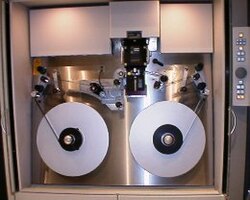
Spirit DataCine is a telecine and a motion picture film scanner. This device is able to transfer 16mm and 35mm motion picture film to NTSC or PAL television standards or one of many High-definition television standards. With the data transfer option a Spirit DataCine can output DPX data files. The Spirit DataCine is made by DFT Digital Film Technology GmbH in Darmstadt, Germany.
The operator of the unit is called a Colorist or Colorist Assistant. The Spirit DataCine has become the standard for high-end real-time film transfer and scanning. Over 370 units are used in post-production facilities around the world. Most current film productions are transferred on Spirit DataCines for television, digital television, cable television, satellite television, direct-to-video, DVD, Blu-ray Disc, pay-per-view, in-flight entertainment, stock footage, dailies, film preservation, digital intermediates, and digital cinema.
The Spirit DataCine opened the door to the technology of digital intermediates, wherein telecine tools were not just used for video outputs, but could now be used for high-resolution data that would later be recorded back out to film. The DFT Digital Film Technology, formerly Grass Valley Spirit 4K/2K/HD (2004) replaced the Spirit 2000 Datacine and uses both 2K and 4k line array CCDs. The SDC 2000 did not use a color prisms and/or dichroic mirrors, color separation was done in the CCD. DFT revealed its newest scanner at the 2009 NAB Show, Scanity.
A Spirit DataCine outputting DPX files was used in the 2000 film O Brother, Where Art Thou?. The DPX files were color corrected with a VDC-2000 and a Pandora Int. Pogle Color Corrector with MegaDEF. A Kodak Lightning II film recorder was used to put the data output to back to film. To output the movie the Spirit Datacine's Phantom Transfer Engine software running on an SGI computer is used to record the DPX files from the Spirit DataCine. These files are stored in the virtual telecine or on a SAN hard disk storage array. The Phantom Transfer Engine has been replaced with Bones software running on a Linux-based PC. First generation of DPX interface for data files was the optical fiber HIPPI cables (up to 6 frame/s at 2K), the next generation interface is GSN-Gigabit Ethernet fiber Optic (up to 30 frame/s at 2K). GSN is also called HIPPI-6400 and was later renamed GSN (for Gigabyte System Network). The SAN hard disks are interfaces to by dual FC-Fibre Channel, cables. The newest DPX output interface is infiniband.
Most Spirit DataCines are controlled by a Da Vinci Systems color corrector, 2K or 2K Plus. Some are controlled by Pandora International Pogle, some with a their MegaDEF or a Pixi color grading system. A Spirit DataCine comes with a full function control panel that can be used for control and color grade.
Ken Burns created The Civil War, a short documentary film included in the DVD release, on how he used the Spirit DataCine to transfer and remaster the film.
Spirit DataCines use a charge-coupled device Line Array – CCD for imaging. In print mode a “white” light is shone through the exposed film image into a lens and then to prism, color glass separates out the image into the three primary colors, red, green and blue. Each beam of colored light is then projected at a different CCD, one for each color. The CCD converts the light into an electrical signal that produces a modulated video signal which is color corrected and sized so it can then be recorded onto video tape or a storage area network (SAN) hard disk array. Spirit DataCines can output to different TV standards: (NTSC or PAL) or HDTV. The Spatial Processor can change the size of the image: pan and scan, letterbox or make other aspect ratio and rotation changes, also product interlaced video if needed. The Spatial Processor also produces the 2:3 pulldown, if needed for the format. An optional Scream grain reducer can reduce film grain in all three color channels.
The image pick up device is a solid state charge-coupled device. This eliminated the need for glass vacuum tube CRTs used on older telecines. The units can transfer negative film, primetime, intermediate film and print film, stock. One option is a Super 8 gate for the transfer of Super 8 mm film. With a sound pick up option, optical 16mm and 35mm sound can be reproduced, also 16mm magnetic strip sound. The unit can operate stand alone or be controlled by a scene by scene color corrector.
Spirit DataCine
Spirit DataCine is a telecine and a motion picture film scanner. This device is able to transfer 16mm and 35mm motion picture film to NTSC or PAL television standards or one of many High-definition television standards. With the data transfer option a Spirit DataCine can output DPX data files. The Spirit DataCine is made by DFT Digital Film Technology GmbH in Darmstadt, Germany.
The operator of the unit is called a Colorist or Colorist Assistant. The Spirit DataCine has become the standard for high-end real-time film transfer and scanning. Over 370 units are used in post-production facilities around the world. Most current film productions are transferred on Spirit DataCines for television, digital television, cable television, satellite television, direct-to-video, DVD, Blu-ray Disc, pay-per-view, in-flight entertainment, stock footage, dailies, film preservation, digital intermediates, and digital cinema.
The Spirit DataCine opened the door to the technology of digital intermediates, wherein telecine tools were not just used for video outputs, but could now be used for high-resolution data that would later be recorded back out to film. The DFT Digital Film Technology, formerly Grass Valley Spirit 4K/2K/HD (2004) replaced the Spirit 2000 Datacine and uses both 2K and 4k line array CCDs. The SDC 2000 did not use a color prisms and/or dichroic mirrors, color separation was done in the CCD. DFT revealed its newest scanner at the 2009 NAB Show, Scanity.
A Spirit DataCine outputting DPX files was used in the 2000 film O Brother, Where Art Thou?. The DPX files were color corrected with a VDC-2000 and a Pandora Int. Pogle Color Corrector with MegaDEF. A Kodak Lightning II film recorder was used to put the data output to back to film. To output the movie the Spirit Datacine's Phantom Transfer Engine software running on an SGI computer is used to record the DPX files from the Spirit DataCine. These files are stored in the virtual telecine or on a SAN hard disk storage array. The Phantom Transfer Engine has been replaced with Bones software running on a Linux-based PC. First generation of DPX interface for data files was the optical fiber HIPPI cables (up to 6 frame/s at 2K), the next generation interface is GSN-Gigabit Ethernet fiber Optic (up to 30 frame/s at 2K). GSN is also called HIPPI-6400 and was later renamed GSN (for Gigabyte System Network). The SAN hard disks are interfaces to by dual FC-Fibre Channel, cables. The newest DPX output interface is infiniband.
Most Spirit DataCines are controlled by a Da Vinci Systems color corrector, 2K or 2K Plus. Some are controlled by Pandora International Pogle, some with a their MegaDEF or a Pixi color grading system. A Spirit DataCine comes with a full function control panel that can be used for control and color grade.
Ken Burns created The Civil War, a short documentary film included in the DVD release, on how he used the Spirit DataCine to transfer and remaster the film.
Spirit DataCines use a charge-coupled device Line Array – CCD for imaging. In print mode a “white” light is shone through the exposed film image into a lens and then to prism, color glass separates out the image into the three primary colors, red, green and blue. Each beam of colored light is then projected at a different CCD, one for each color. The CCD converts the light into an electrical signal that produces a modulated video signal which is color corrected and sized so it can then be recorded onto video tape or a storage area network (SAN) hard disk array. Spirit DataCines can output to different TV standards: (NTSC or PAL) or HDTV. The Spatial Processor can change the size of the image: pan and scan, letterbox or make other aspect ratio and rotation changes, also product interlaced video if needed. The Spatial Processor also produces the 2:3 pulldown, if needed for the format. An optional Scream grain reducer can reduce film grain in all three color channels.
The image pick up device is a solid state charge-coupled device. This eliminated the need for glass vacuum tube CRTs used on older telecines. The units can transfer negative film, primetime, intermediate film and print film, stock. One option is a Super 8 gate for the transfer of Super 8 mm film. With a sound pick up option, optical 16mm and 35mm sound can be reproduced, also 16mm magnetic strip sound. The unit can operate stand alone or be controlled by a scene by scene color corrector.
Recent media
Recent media