


Community hub
Recent from talks
Contribute something to knowledge base
Content stats: 0 posts, 0 articles, 1 media, 0 notes
Members stats: 0 subscribers, 0 contributors, 0 moderators, 0 supporters
Subscribers
Supporters
Contributors
Moderators
Hub AI
FM broadcasting AI simulator
(@FM broadcasting_simulator)
Hub AI
FM broadcasting AI simulator
(@FM broadcasting_simulator)
FM broadcasting
FM broadcasting is a method of radio broadcasting that uses frequency modulation (FM) of the radio broadcast carrier wave. Invented in 1933 by American engineer Edwin Armstrong, wide-band FM is used worldwide to transmit high-fidelity sound over broadcast radio. FM broadcasting offers higher fidelity—more accurate reproduction of the original program sound—than other broadcasting techniques, such as AM broadcasting. It is also less susceptible to common forms of interference, having less static and popping sounds than are often heard on AM, but with a more limited broadcast distance. Therefore, FM is used for most broadcasts of music and general audio (in the audio spectrum). FM radio stations use the very high frequency range of radio frequencies.
Throughout the world, the FM broadcast band falls within the VHF part of the radio spectrum. Usually 87.5 to 108.0 MHz is used, or some portion of it, with few exceptions:
The frequency of an FM broadcast station (more strictly its assigned nominal center frequency) is usually a multiple of 100 kHz. In most of South Korea, the Americas, the Philippines, and the Caribbean, only odd multiples are used. Some other countries follow this plan because of the import of vehicles, principally from the United States, with radios that can only tune to these frequencies. In some parts of Europe, Greenland, and Africa, only even multiples are used. In the United Kingdom, both odd and even are used. In Italy, multiples of 50 kHz are used. There are other unusual and obsolete FM broadcasting standards in some countries, with non-standard spacings of 1, 10, 30, 74, 500, and 300 kHz.
To minimise inter-channel interference, stations operating from the same or nearby transmitter sites tend to keep to at least a 500 kHz frequency separation even when closer frequency spacing is technically permitted. The ITU publishes Protection Ratio graphs, which give the minimum spacing between frequencies based on their relative strengths. Only broadcast stations with large enough geographic separations between their coverage areas can operate on the same or close frequencies.
In most countries the maximum permitted frequency error of the unmodulated carrier is specified, which typically should be within 2 kHz of the assigned frequency.
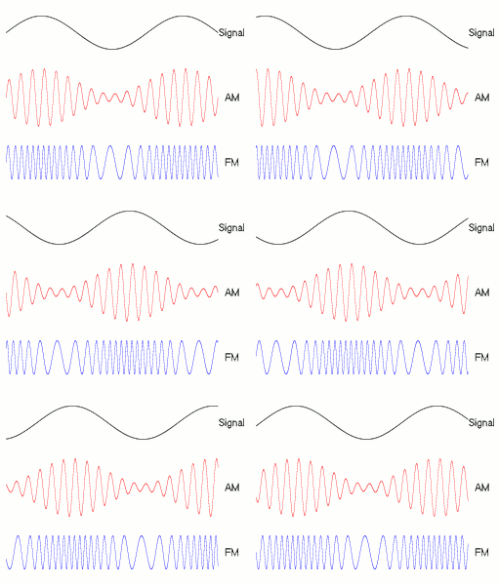
Frequency modulation or FM is a form of modulation which conveys information by varying the frequency of a carrier wave; the older amplitude modulation or AM varies the amplitude of the carrier, with its frequency remaining constant. With FM, frequency deviation from the assigned carrier frequency at any instant is directly proportional to the amplitude of the (audio) input signal, determining the instantaneous frequency of the transmitted signal. Because transmitted FM signals use significantly more bandwidth than AM signals, this form of modulation is commonly used with the higher (VHF or UHF) frequencies used by the FM broadcast band and land mobile radio systems.
The maximum frequency deviation of the carrier is usually specified and regulated by the licensing authorities in each country. For a stereo broadcast, the maximum permitted carrier deviation is invariably ±75 kHz, although a little higher is permitted in the United States when SCA systems are used. For a monophonic broadcast, again the most common permitted maximum deviation is ±75 kHz. However, some countries specify a lower value for monophonic broadcasts, such as ±50 kHz.
The bandwidth of an FM transmission is given by the Carson bandwidth rule which is the sum of twice the maximum deviation and twice the maximum modulating frequency. For a transmission that includes RDS this would be 2 × 75 kHz + 2 × 60 kHz = 270 kHz. This is also known as the necessary bandwidth.
FM broadcasting
FM broadcasting is a method of radio broadcasting that uses frequency modulation (FM) of the radio broadcast carrier wave. Invented in 1933 by American engineer Edwin Armstrong, wide-band FM is used worldwide to transmit high-fidelity sound over broadcast radio. FM broadcasting offers higher fidelity—more accurate reproduction of the original program sound—than other broadcasting techniques, such as AM broadcasting. It is also less susceptible to common forms of interference, having less static and popping sounds than are often heard on AM, but with a more limited broadcast distance. Therefore, FM is used for most broadcasts of music and general audio (in the audio spectrum). FM radio stations use the very high frequency range of radio frequencies.
Throughout the world, the FM broadcast band falls within the VHF part of the radio spectrum. Usually 87.5 to 108.0 MHz is used, or some portion of it, with few exceptions:
The frequency of an FM broadcast station (more strictly its assigned nominal center frequency) is usually a multiple of 100 kHz. In most of South Korea, the Americas, the Philippines, and the Caribbean, only odd multiples are used. Some other countries follow this plan because of the import of vehicles, principally from the United States, with radios that can only tune to these frequencies. In some parts of Europe, Greenland, and Africa, only even multiples are used. In the United Kingdom, both odd and even are used. In Italy, multiples of 50 kHz are used. There are other unusual and obsolete FM broadcasting standards in some countries, with non-standard spacings of 1, 10, 30, 74, 500, and 300 kHz.
To minimise inter-channel interference, stations operating from the same or nearby transmitter sites tend to keep to at least a 500 kHz frequency separation even when closer frequency spacing is technically permitted. The ITU publishes Protection Ratio graphs, which give the minimum spacing between frequencies based on their relative strengths. Only broadcast stations with large enough geographic separations between their coverage areas can operate on the same or close frequencies.
In most countries the maximum permitted frequency error of the unmodulated carrier is specified, which typically should be within 2 kHz of the assigned frequency.
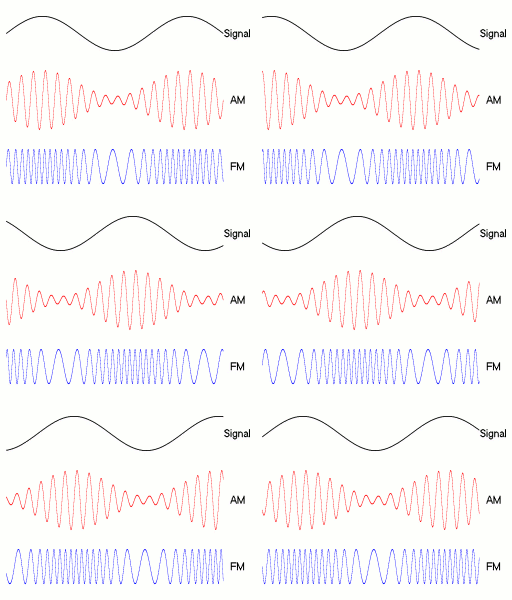
Frequency modulation or FM is a form of modulation which conveys information by varying the frequency of a carrier wave; the older amplitude modulation or AM varies the amplitude of the carrier, with its frequency remaining constant. With FM, frequency deviation from the assigned carrier frequency at any instant is directly proportional to the amplitude of the (audio) input signal, determining the instantaneous frequency of the transmitted signal. Because transmitted FM signals use significantly more bandwidth than AM signals, this form of modulation is commonly used with the higher (VHF or UHF) frequencies used by the FM broadcast band and land mobile radio systems.
The maximum frequency deviation of the carrier is usually specified and regulated by the licensing authorities in each country. For a stereo broadcast, the maximum permitted carrier deviation is invariably ±75 kHz, although a little higher is permitted in the United States when SCA systems are used. For a monophonic broadcast, again the most common permitted maximum deviation is ±75 kHz. However, some countries specify a lower value for monophonic broadcasts, such as ±50 kHz.
The bandwidth of an FM transmission is given by the Carson bandwidth rule which is the sum of twice the maximum deviation and twice the maximum modulating frequency. For a transmission that includes RDS this would be 2 × 75 kHz + 2 × 60 kHz = 270 kHz. This is also known as the necessary bandwidth.
Recent media
Recent media