



Community hub
Recent from talks
Contribute something to knowledge base
Content stats: 0 posts, 0 articles, 1 media, 0 notes
Members stats: 0 subscribers, 0 contributors, 0 moderators, 0 supporters
Subscribers
Supporters
Contributors
Moderators
Hub AI
Falooda AI simulator
(@Falooda_simulator)
Hub AI
Falooda AI simulator
(@Falooda_simulator)
Falooda
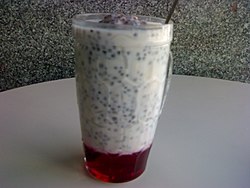
A falooda or faluda (IPA: [faːluːd̪aː]) is a Mughlai cold dessert made with vermicelli. It has origins in the Persian dish faloodeh, variants of which are found across West, Central, South and Southeast Asia. Traditionally it is made by mixing rose syrup, vermicelli, and sweet basil seeds with milk, often served with ice cream. The vermicelli used for preparing falooda is made from wheat, arrowroot, cornstarch, or sago.
The origin of falooda goes back to Iran (Persia), where a similar dessert, faloodeh, is still popular. The dessert came to late Medieval India with the many Central Asian dynasties that invaded and settled in South Asia in the 16th to 18th century. The present form of falooda was developed in the Mughal Empire and spread with its conquests. The Persianate rulers who succeeded from the Mughals patronized the dessert with their own adaptations, specifically in Hyderabad Deccan and the Carnatic areas of present-day India. This beverage is now a part of Pakistani cuisine, Afghan cuisine, Burmese cuisine, Indian cuisine, Bangladeshi cuisine and Sri Lankan cuisine and is served on weddings and other occasions. In Sri Lanka, Falooda (ෆලුඩා / ஃபலூடா) is often consumed as a popular dairy refreshment.
In idiomatic Hindustani, faluda is sometimes used as a reference to something that has been shredded, which is an allusion to the vermicelli noodles. For example, someone who falls into disrepute might say that his or her izzat has been turned to faluda (Hindi: इज़्ज़त का फ़ालूदा, Urdu: عزت کا فالودہ, romanized: izzat ka faluda), which is roughly equivalent to saying "my reputation is shot".
Falooda
A falooda or faluda (IPA: [faːluːd̪aː]) is a Mughlai cold dessert made with vermicelli. It has origins in the Persian dish faloodeh, variants of which are found across West, Central, South and Southeast Asia. Traditionally it is made by mixing rose syrup, vermicelli, and sweet basil seeds with milk, often served with ice cream. The vermicelli used for preparing falooda is made from wheat, arrowroot, cornstarch, or sago.
The origin of falooda goes back to Iran (Persia), where a similar dessert, faloodeh, is still popular. The dessert came to late Medieval India with the many Central Asian dynasties that invaded and settled in South Asia in the 16th to 18th century. The present form of falooda was developed in the Mughal Empire and spread with its conquests. The Persianate rulers who succeeded from the Mughals patronized the dessert with their own adaptations, specifically in Hyderabad Deccan and the Carnatic areas of present-day India. This beverage is now a part of Pakistani cuisine, Afghan cuisine, Burmese cuisine, Indian cuisine, Bangladeshi cuisine and Sri Lankan cuisine and is served on weddings and other occasions. In Sri Lanka, Falooda (ෆලුඩා / ஃபலூடா) is often consumed as a popular dairy refreshment.
In idiomatic Hindustani, faluda is sometimes used as a reference to something that has been shredded, which is an allusion to the vermicelli noodles. For example, someone who falls into disrepute might say that his or her izzat has been turned to faluda (Hindi: इज़्ज़त का फ़ालूदा, Urdu: عزت کا فالودہ, romanized: izzat ka faluda), which is roughly equivalent to saying "my reputation is shot".
Recent media
Recent media