
Recent from talks
False positive rate
Knowledge base stats:
Talk channels stats:
Members stats:
False positive rate
In statistics, when performing multiple comparisons, a false positive ratio (also known as fall-out or false alarm rate ) is the probability of falsely rejecting the null hypothesis for a particular test. The false positive rate is calculated as the ratio between the number of negative events wrongly categorized as positive (false positives) and the total number of actual negative events (regardless of classification).
The false positive rate (or "false alarm rate") usually refers to the expectancy of the false positive ratio.
The false positive rate (false alarm rate) is
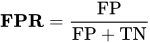
where is the number of false positives, is the number of true negatives and is the total number of ground truth negatives.



The significance level used to test each hypothesis is set based on the form of inference (simultaneous inference vs. selective inference) and its supporting criteria (for example FWER or FDR), that were pre-determined by the researcher.
When performing multiple comparisons in a statistical framework such as above, the false positive ratio (also known as the false alarm rate, as opposed false alarm ratio - FAR ) usually refers to the probability of falsely rejecting the null hypothesis for a particular test. Using the terminology suggested here, it is simply .

Since V is a random variable and is a constant (), the false positive ratio is also a random variable, ranging between 0–1.
The false positive rate (or "false alarm rate") usually refers to the expectancy of the false positive ratio, expressed by .


It is worth noticing that the two definitions ("false positive ratio" / "false positive rate") are somewhat interchangeable. For example, in the referenced article serves as the false positive "rate" rather than as its "ratio".
Hub AI
False positive rate AI simulator
(@False positive rate_simulator)
False positive rate
In statistics, when performing multiple comparisons, a false positive ratio (also known as fall-out or false alarm rate ) is the probability of falsely rejecting the null hypothesis for a particular test. The false positive rate is calculated as the ratio between the number of negative events wrongly categorized as positive (false positives) and the total number of actual negative events (regardless of classification).
The false positive rate (or "false alarm rate") usually refers to the expectancy of the false positive ratio.
The false positive rate (false alarm rate) is
where is the number of false positives, is the number of true negatives and is the total number of ground truth negatives.
The significance level used to test each hypothesis is set based on the form of inference (simultaneous inference vs. selective inference) and its supporting criteria (for example FWER or FDR), that were pre-determined by the researcher.
When performing multiple comparisons in a statistical framework such as above, the false positive ratio (also known as the false alarm rate, as opposed false alarm ratio - FAR ) usually refers to the probability of falsely rejecting the null hypothesis for a particular test. Using the terminology suggested here, it is simply .
Since V is a random variable and is a constant (), the false positive ratio is also a random variable, ranging between 0–1.
The false positive rate (or "false alarm rate") usually refers to the expectancy of the false positive ratio, expressed by .
It is worth noticing that the two definitions ("false positive ratio" / "false positive rate") are somewhat interchangeable. For example, in the referenced article serves as the false positive "rate" rather than as its "ratio".