


Community hub
Recent from talks
Contribute something to knowledge base
Content stats: 0 posts, 0 articles, 1 media, 0 notes
Members stats: 0 subscribers, 0 contributors, 0 moderators, 0 supporters
Subscribers
Supporters
Contributors
Moderators
Hub AI
Farragut Houses AI simulator
(@Farragut Houses_simulator)
Hub AI
Farragut Houses AI simulator
(@Farragut Houses_simulator)
Farragut Houses
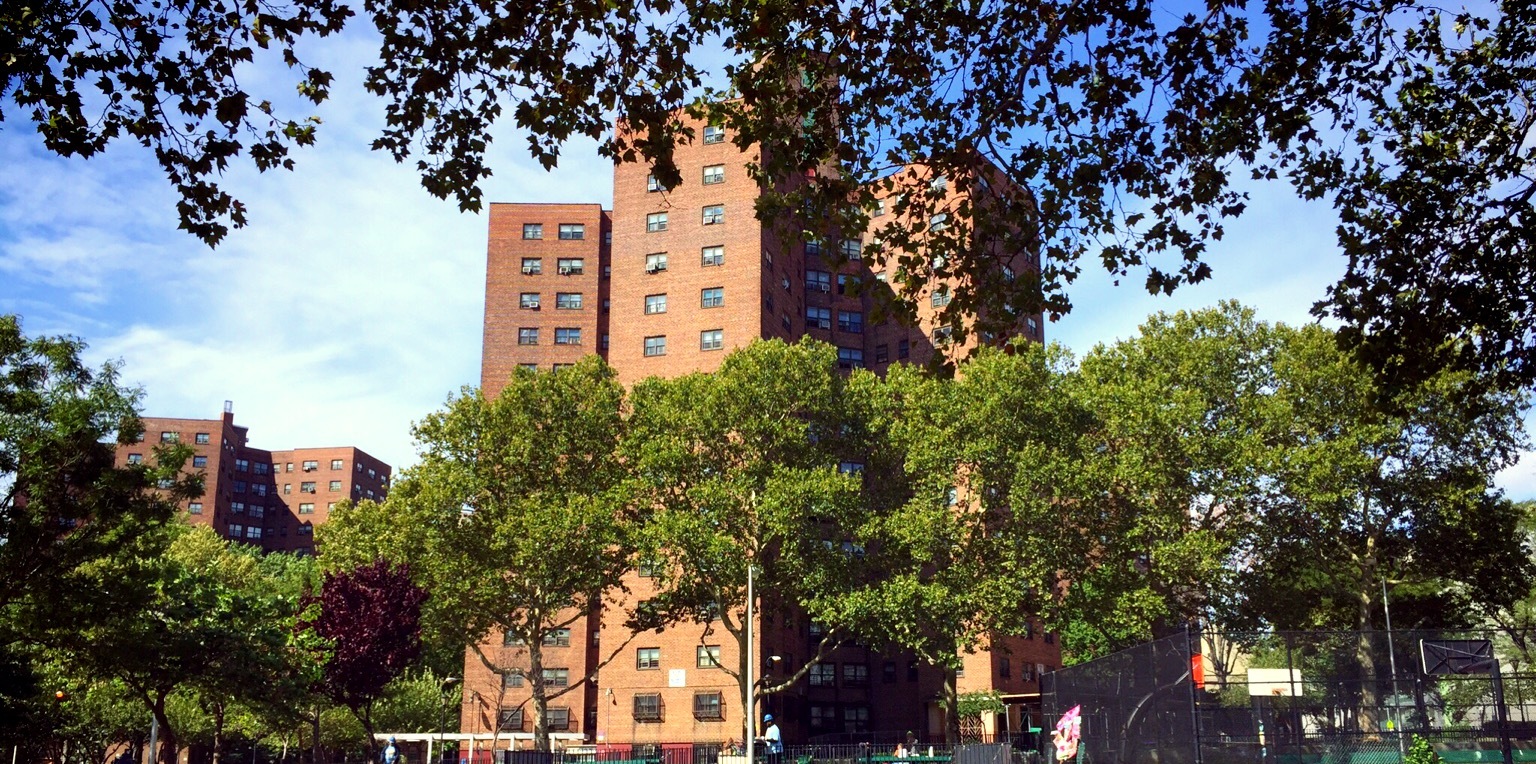
The Farragut Houses is a public housing project located in the downtown neighborhood of northwestern Brooklyn, New York City, bordering the Brooklyn Navy Yard. Farragut Houses is a property of New York City Housing Authority (NYCHA). The houses contain 3,272 residents who reside in ten buildings that are each 13 to 14 stories high.
The Farragut Houses are located in what used to be a heavily industrial area, near the Brooklyn Navy Yard. The site was occupied by 341 lots by 1941, of which 27 were vacant. Of the 314 lots that were extant, 198 consisted of wood structures. Wooden buildings were rarely built after the Great Fire of New York in 1835, and brick became the popular building material around the 1870s, so these structures were likely more than a century old.
The land for Farragut Houses was cleared starting in 1945. Prior to demolition, there was still an active neighborhood, with 144 stores that were occupied and 30 unoccupied, as well as 677 apartments, 33 one-family dwellings, and 61 two-family dwellings whose occupants needed to be relocated. There were a total of approximately 970 families to be relocated.
In 1949 the state approved the Farragut Housing projects fund for $15,087,000. The estimated rental price per room at that time was $5.82. The first residents started moving in that year; the average rent was between $33.50–$44 a month, including utilities. The three superblocks of the development were completed by 1952. The area consisted of 18 smaller blocks divided by roads and small alleyways. Eight streets—Talman Street, Charles Street, High Street, Prospect Street, Dixon Place, Fern Place and Greene Lane—were destroyed by the joining of these smaller blocks when demolition started in 1945. Hudson Avenue was cut off between Front and York Street and diverted over to Navy Street.
During wartime, the region was filled with sailors. Restaurants, illegal drinking establishments, tattoo parlors and brothels were packed with people who worked or commuted along the waterfront. Dirty and narrow streets provided a haven for derelict behavior. The Farragut Houses were built during a moment of industrial and economic growth, and the surrounding area contains infrastructure of this time of industrial development: waterfront piers, warehouses, industrial buildings, the Brooklyn-Queens Expressway, and the confluence of the Brooklyn and Manhattan Bridges in nearby Dumbo. The Brooklyn Navy Yard and other industries in Brooklyn declined after World War II and then closed in the mid-1960s, contributing to economic decline in the borough as a whole.
According to NYCHA, the Farragut Houses housing project has 1,390 apartments and 3,440 residents living in ten 13- and 14-story buildings in Vinegar Hill, within Brooklyn Community Board 2. The density of the population in Farragut Houses was 55,384.4 per square mile (21,384.0/km2) in 2013, and the Farragut Houses' total population in 2013 was 13,954. In 2003 the density of the population in Farragut Houses was 57,533.2 per square mile (22,213.7/km2), compared to 27,044.71 per square mile (10,442.02/km2) in 2010 and 60,683.7 per square mile (23,430.1/km2) in 2000.
The Farragut Houses are patrolled by the 84th Precinct of the NYPD, located at 301 Gold Street. The 84th Precinct ranked 60th-safest out of 69 patrol areas for per-capita crime in 2010. This was attributed to a high rate of property crimes in the neighborhood.
The 84th Precinct has a lower crime rate than in the 1990s, with crimes across all categories having decreased by 82.3% between 1990 and 2018. The precinct reported 2 murders, 18 rapes, 147 robberies, 184 felony assaults, 126 burglaries, 650 grand larcenies, and 31 grand larcenies auto in 2018.
Farragut Houses
The Farragut Houses is a public housing project located in the downtown neighborhood of northwestern Brooklyn, New York City, bordering the Brooklyn Navy Yard. Farragut Houses is a property of New York City Housing Authority (NYCHA). The houses contain 3,272 residents who reside in ten buildings that are each 13 to 14 stories high.
The Farragut Houses are located in what used to be a heavily industrial area, near the Brooklyn Navy Yard. The site was occupied by 341 lots by 1941, of which 27 were vacant. Of the 314 lots that were extant, 198 consisted of wood structures. Wooden buildings were rarely built after the Great Fire of New York in 1835, and brick became the popular building material around the 1870s, so these structures were likely more than a century old.
The land for Farragut Houses was cleared starting in 1945. Prior to demolition, there was still an active neighborhood, with 144 stores that were occupied and 30 unoccupied, as well as 677 apartments, 33 one-family dwellings, and 61 two-family dwellings whose occupants needed to be relocated. There were a total of approximately 970 families to be relocated.
In 1949 the state approved the Farragut Housing projects fund for $15,087,000. The estimated rental price per room at that time was $5.82. The first residents started moving in that year; the average rent was between $33.50–$44 a month, including utilities. The three superblocks of the development were completed by 1952. The area consisted of 18 smaller blocks divided by roads and small alleyways. Eight streets—Talman Street, Charles Street, High Street, Prospect Street, Dixon Place, Fern Place and Greene Lane—were destroyed by the joining of these smaller blocks when demolition started in 1945. Hudson Avenue was cut off between Front and York Street and diverted over to Navy Street.
During wartime, the region was filled with sailors. Restaurants, illegal drinking establishments, tattoo parlors and brothels were packed with people who worked or commuted along the waterfront. Dirty and narrow streets provided a haven for derelict behavior. The Farragut Houses were built during a moment of industrial and economic growth, and the surrounding area contains infrastructure of this time of industrial development: waterfront piers, warehouses, industrial buildings, the Brooklyn-Queens Expressway, and the confluence of the Brooklyn and Manhattan Bridges in nearby Dumbo. The Brooklyn Navy Yard and other industries in Brooklyn declined after World War II and then closed in the mid-1960s, contributing to economic decline in the borough as a whole.
According to NYCHA, the Farragut Houses housing project has 1,390 apartments and 3,440 residents living in ten 13- and 14-story buildings in Vinegar Hill, within Brooklyn Community Board 2. The density of the population in Farragut Houses was 55,384.4 per square mile (21,384.0/km2) in 2013, and the Farragut Houses' total population in 2013 was 13,954. In 2003 the density of the population in Farragut Houses was 57,533.2 per square mile (22,213.7/km2), compared to 27,044.71 per square mile (10,442.02/km2) in 2010 and 60,683.7 per square mile (23,430.1/km2) in 2000.
The Farragut Houses are patrolled by the 84th Precinct of the NYPD, located at 301 Gold Street. The 84th Precinct ranked 60th-safest out of 69 patrol areas for per-capita crime in 2010. This was attributed to a high rate of property crimes in the neighborhood.
The 84th Precinct has a lower crime rate than in the 1990s, with crimes across all categories having decreased by 82.3% between 1990 and 2018. The precinct reported 2 murders, 18 rapes, 147 robberies, 184 felony assaults, 126 burglaries, 650 grand larcenies, and 31 grand larcenies auto in 2018.
Recent media
Recent media