Hubbry Logo
Fatimid CaliphateFatimid CaliphateMain
Open search
Fatimid Caliphate
Community hub
Fatimid Caliphate
logo
8 pages, 0 posts
0 subscribers
Be the first to start a discussion here.
Contribute something
Fatimid Caliphate
Fatimid Caliphate
from Wikipedia

Key Information

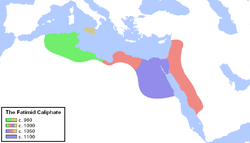
The Fatimid Caliphate (/ˈfætɪmɪd/; Arabic: الخلافة الفاطمیّة, romanizedal-Khilāfa al-Fāṭimiyya), also known as the Fatimid Empire, was a caliphate extant from the tenth to the twelfth centuries CE under the rule of the Fatimids, an Isma'ili Shi'a dynasty. Spanning a large area of North Africa and West Asia, it ranged from the western Mediterranean in the west to the Red Sea in the east. The Fatimids traced their ancestry to the Islamic prophet Muhammad's daughter Fatima and her husband Ali, the first Shi'a imam. The Fatimids were acknowledged as the rightful imams by different Isma'ili communities as well as by denominations in many other Muslim lands and adjacent regions.[4][5] Originating during the Abbasid Caliphate, the Fatimids initially conquered Ifriqiya (roughly present-day Tunisia and north-eastern Algeria). They extended their rule across the Mediterranean coast and ultimately made Egypt the center of the caliphate. At its height, the caliphate included—in addition to Egypt—varying areas of the Maghreb, Sicily, the Levant, and the Hejaz.

Between 902 and 909, the foundation of the Fatimid state was realized under the leadership of da'i (missionary) Abu Abdallah, whose conquest of Aghlabid Ifriqiya with the help of Kutama forces paved the way for the establishment of the Caliphate.[6][7][8] After the conquest, Abdallah al-Mahdi Billah was retrieved from Sijilmasa and then accepted as the Imam of the movement, becoming the first Caliph and founder of the dynasty in 909.[9][10] In 921, the city of al-Mahdiyya was established as the capital. In 948, they shifted their capital to al-Mansuriyya, near Kairouan. In 969, during the reign of al-Mu'izz, they conquered Egypt, and in 973, the caliphate was moved to the newly founded Fatimid capital of Cairo. Egypt became the political, cultural, and religious centre of the empire and it developed a new and "indigenous Arabic culture".[11] After its initial conquests, the caliphate often allowed a degree of religious tolerance towards non-Shi'a sects of Islam, as well as to Jews and Christians.[12] However, its leaders made little headway in persuading the Egyptian population to adopt its religious beliefs.[13]

After the reigns of al-'Aziz and al-Hakim, the long reign of al-Mustansir entrenched a regime in which the caliph remained aloof from state affairs and viziers took on greater importance.[14] Political and ethnic factionalism within the army led to a civil war in the 1060s, which threatened the empire's survival.[15] After a period of revival during the tenure of the vizier Badr al-Jamali, the Fatimid caliphate declined rapidly during the late eleventh and twelfth centuries.[16] In addition to internal difficulties, the caliphate was weakened by the encroachment of the Seljuk Turks into Syria in the 1070s and the arrival of the Crusaders in the Levant in 1097.[15] In 1171, Saladin abolished the dynasty's rule and founded the Ayyubid dynasty, which incorporated Egypt back into the nominal sphere of authority of the Abbasid Caliphate.[17][18]

Name

[edit]

The Fatimid dynasty claimed descent from Fatimah, the daughter of the Islamic prophet Muhammad. The dynasty legitimized its claim through descent from Muhammad by way of his daughter and her husband Ali, the first Shi'a imam, hence the dynasty's name, faṭimiyy (Arabic: فَاطِمِيّ), the Arabic relative adjective for Fāṭima.[19][20][7][8]

Emphasizing its Alid descent, the dynasty named itself simply the 'Alid dynasty' (al-dawla al-alawiyya),[21] but many hostile Sunni sources only refer to them as the Ubaydids (Banu Ubayd), after the diminutive form Ubayd Allah for the name of the first Fatimid caliph.[21]

History

[edit]

Origins

[edit]

The Fatimid dynasty came to power as the leaders of Isma'ilism, a revolutionary Shi'a movement "which was at the same time political and religious, philosophical and social," and which originally proclaimed nothing less than the arrival of an Islamic messiah.[22] The origins of that movement, and of the dynasty itself, are obscure prior to the late ninth century.[22]

The Fatimid rulers were Arab in origin, starting with its founder, the Isma'ili Shi'a caliph Abdallah al-Mahdi Billah.[19] The caliphate's establishment was accomplished by Kutama Berbers from Little Kabylia, who converted to the Fatimid cause early and made up its original military forces.[7][8][9][10]

Early Shi'ism and the roots of Isma'ilism

[edit]

The Shi'a opposed the Umayyad and Abbasid caliphates, whom they considered usurpers. Instead, they believed in the exclusive right of the descendants of Ali through Muhammad's daughter Fatima, to lead the Muslim community. This manifested itself in a line of imams, descendants of Ali via al-Husayn, whom their followers considered as the true representatives of God on earth.[23] At the same time, there was a widespread messianic tradition in Islam concerning the appearance of a mahdi ("the Rightly Guided One") or qa'im ("He Who Arises"), who would restore true Islamic government and justice and usher in the end times. This figure was widely expected – not just among the Shi'a – to be a descendant of Ali.[24] Among Shi'a, however, this belief became a core tenet of their faith, and was applied to several Shi'a leaders who were killed or died; their followers believed that they had gone into "occultation" (ghayba) and would return (or be resurrected) at the appointed time.[25]

These traditions manifested themselves in the succession of the sixth imam, Ja'far al-Sadiq. Al-Sadiq had appointed his son Isma'il ibn Ja'far as his successor, but Isma'il died before his father, and when al-Sadiq himself died in 765, the succession was left open. Most of his followers followed al-Sadiq's son Musa al-Kazim down to a twelfth and final imam who supposedly went into occultation in 874 and would one day return as the mahdī. This branch is hence known as the "Twelvers".[26][27] Others followed other sons, or even refused to believe that al-Sadiq had died, and expected his return as the mahdī.[28] Another branch believed that Ja'far was followed by a seventh imam, who had gone into occultation and would one day return; hence this party is known as the "Seveners". The exact identity of that seventh imam was disputed, but by the late ninth century had commonly been identified with Muhammad, son of Isma'il and grandson of al-Sadiq. From Muhammad's father, Isma'il, the sect, which gave rise to the Fatimids, receives its name of "Isma'ili".[26][29][30] Due to the harsh Abbasid persecution of the Alids, the Ismaili Imams went into hiding and neither Isma'il's nor Muhammad's lives are well known, and after Muhammad's death during the reign of Harun al-Rashid (r. 786–809), the history of the early Isma'ili movement becomes obscure.[31]

The secret network

[edit]

While the awaited mahdi Muhammad ibn Isma'il remained hidden, however, he would need to be represented by agents, who would gather the faithful, spread the word (da'wa, "invitation, calling"), and prepare his return. The head of this secret network was the living proof of the imam's existence, or "seal" (hujja).[32] It is in this role that the ancestors of the Fatimids are first documented. The first known hujja was a certain Abdallah al-Akbar ("Abdallah the Elder"), a wealthy merchant from Khuzestan, who established himself at the small town of Salamiya on the western edge of the Syrian Desert.[33] Salamiya became the centre of the Isma'ili da'wa, with Abdallah al-Akbar being succeeded by his son and grandson as the secret "grand masters" of the movement.[34][35]

In the last third of the ninth century, the Isma'ili da'wa spread widely, profiting from the collapse of Abbasid power in the Anarchy at Samarra and the subsequent Zanj Revolt, as well as from dissatisfaction among Twelver adherents with the political quietism of their leadership and the recent disappearance of the twelfth imam.[36] Missionaries (da'is) such as Hamdan Qarmat and Ibn Hawshab spread the network of agents to the area round Kufa in the late 870s, and from there to Yemen (882) and thence India (884), Bahrayn (899), Persia, and the Maghreb (893).[37][38][39]

The Qarmatian schism and its aftermath

[edit]

In 899, Abdallah al-Akbar's great-grandson, Abdallah,[a] became the new head of the movement, and introduced a radical change in the doctrine: no longer was he and his forebears merely the stewards for Muhammad ibn Isma'il, but they were declared to be the rightful imams, and Abdallah himself was the awaited mahdi.[40] Various genealogies were later put forth by the Fatimids to justify this claim by proving their descent from Isma'il ibn Ja'far, but even in pro-Isma'ili sources, the succession and names of imams differ, while Sunni and Twelver sources of course reject any Fatimid descent from the Alids altogether and consider them impostors.[41][42] Abdallah's claim caused a rift in the Isma'ili movement, as Hamdan Qarmat and other leaders denounced this change and held onto the original doctrine, becoming known as the "Qarmatians", while other communities remained loyal to Salamiya.[37][15] Shortly after, in 902–903, pro-Fatimid loyalists began a great uprising in Syria. The large-scale Abbasid reaction it precipitated and the attention it brought on him, forced Abdallah to abandon Salamiya for Palestine, Egypt, and finally for the Maghreb, where the da'i Abu Abdallah al-Shi'i had made great headway in converting the Kutama Berbers to the Isma'ili cause. Unable to join his da'i directly, Abdallah instead settled at Sijilmasa sometime between 904 and 905.[21][43][44]

Rise to power

[edit]

Establishment of the Isma'ili State

[edit]

Prior to the Fatimid rise to power, a large part of the Maghreb including Ifriqiya was under the control of the Aghlabids, an Arab dynasty who ruled nominally on behalf the Abbasids but were de facto independent.[45] In 893 the dā'ī Abu Abdallah al-Shi'i first settled among the Banu Saktan tribe (part of the larger Kutama tribe) in Ikjan, near the city of Mila (in northeastern Algeria today).[46] However, due to hostility from the local Aghlabid authorities and other Kutuma tribes, he was forced to leave Ikjan and sought the protection of another Kutama tribe, the Banu Ghashman, in Tazrut (two miles southwest of Mila). From there, he began to build support for a new movement.[47][48] Shortly after, the hostile Kutama tribes and the Arab lords of the nearby cities (Mila, Setif, and Bilizma) allied together to march against him, but he was able to move quickly and muster enough support from friendly Kutama to defeat them one by one before they were able to unite. This first victory brought Abu Abdallah and his Kutama troops valuable loot and attracted more support to the dā'ī's cause. Over the next two years Abu Abdallah was able to win over most of the Kutama tribes in the region through either persuasion or coercion.[47] This left much of the countryside under his control, while the major cities remained under Aghlabid control. He established an Isma'ili theocratic state based in Tazrut, operating in a way similar to previous Isma'ili missionary networks in Mesopotamia but adapted to local Kutama tribal structures. He adopted the role of a traditional Islamic ruler at the head of this organization while remaining in frequent contact with Abdallah. He continued to preach to his followers, known as the Awliya' Allah ('Friends of God'), and to initiate them into Isma'ili doctrine.[49][48]

Conquest of Aghlabid Ifriqiya

[edit]
Map of Abu Abdallah's campaigns and battles during the overthrow of the Aghlabids

In 902, while the Aghlabid emir Ibrahim II was away on campaign in Sicily, Abu Abdallah struck the first significant blow against Aghlabid authority in North Africa by attacking and capturing the city of Mila for the first time.[50] This news triggered a serious response from the Aghlabids, who sent a punitive expedition of 12,000 men from Tunis in October of the same year. Abu Abdallah's forces were unable to resist this counterattack and after two defeats they evacuated Tazrut (which was largely unfortified) and fled to Ikjan, leaving Mila to be retaken. Ikjan became the new center of the Fatimid movement and the dā'ī reestablished his network of missionaries and spies.[51]

Ibrahim II died in October 902 while in southern Italy and was succeeded by Abdallah II. In early 903 Abdallah II set out on another expedition to destroy Ikjan and the Kutama rebels, but he ended the expedition prematurely due to troubles at home arising from disputes over his succession. On 27 July 903, he was assassinated and his son Ziyadat Allah III took power in Tunis.[52] These internal Aghlabid troubles gave Abu Abdallah the opportunity to recapture Mila and then go on to capture Setif, another fortified city, by October or November 904.[53][48] In 905 the Aghlabids sent a third expedition to try and subdue the Kutama. They based themselves in Constantine and in the fall of 905, after receiving further reinforcements, set out to march against Abu Abdallah. However, they were surprised by Kutama forces on the first day of their march, which caused a panic and scattered their army. The Aghlabid general fled and the Kutama captured a large booty.[44] Another Aghlabid military expedition organized the next year (906) failed when the soldiers mutinied. Around the same time or soon after, Abu Abdallah's forces besieged and captured the fortified cities of Tubna and Bilizma. The capture of Tubna was significant as it was the first major commercial center to come under Abu Abdallah's control.[54]

Fatimid ewer, 10th century CE[55]

Meanwhile, Ziyadat Allah III moved his court from Tunis to Raqqada, the palace-city near Kairouan, in response to the growing threat. He fortified Raqqada in 907.[56] In early 907 another Aghlabid army marched westwards again against Abu Abdallah, accompanied by Berber reinforcements from the Aurès Mountains. They were again scattered by Kutama cavalry and retreated to Baghaya, the most fortified town on the old southern Roman road between Ifriqiya and the central Maghreb. The fortress, however, fell to the Kutama without a siege when local notables arranged to have the gates opened to them in May or June 907.[57] This opened a hole in the wider defensive system of Ifriqiya and created panic in Raqqada. Ziyadat Allah III stepped up anti-Fatimid propaganda, recruited volunteers, and took measures to defend the weakly fortified city of Kairouan.[58] He spent the winter of 907–908 with his army in al-Aribus (Roman-era Laribus, between present-day El Kef and Maktar), expecting an attack from the north. However, Abu Abdallah's forces had been unable to capture the northerly city of Constantine and therefore they instead attacked along the southern road from Baghaya in early 908 and captured Maydara (present-day Haïdra). An indecisive battle subsequently occurred between the Aghalabid and Kutama armies near Dar Madyan (probably a site between Sbeitla and Kasserine), with neither side gaining the upper hand.[59] During the winter of 908–909 Abu Abdallah campaigned in the region around Chott el-Jerid, capturing the towns of Tuzur (Tozeur), Nafta, and Qafsa (Gafsa) and taking control of the region. The Aghlabids responded by besieging Baghaya soon afterward in the same winter, but they were quickly repelled.[60]

On 25 February 909, Abu Abdallah set out from Ikjan with an army of 200,000 men for a final invasion of Kairouan.[61] The remaining Aghlabid army, led by an Aghlabid prince named Ibrahim Ibn Abi al-Aghlab, met them near al-Aribus on 18 March. The battle lasted until the afternoon, when a contingent of Kutama horsemen managed to outflank the Aghlabid army and finally caused a rout.[61] When news of the defeat reached Raqqada, Ziyadat Allah III packed his valuable treasures and fled towards Egypt. The population of Kairouan looted the abandoned palaces of Raqqada and resisted Ibn Abi al-Aghlab's calls to organise a last-ditch resistance.[62] Upon hearing of the looting, Abu Abdallah sent an advance force of Kutama horsemen who secured Raqqada on 24 March. On 25 March 909 (Saturday, 1 Rajab 296), Abu Abdallah himself entered Raqqada and took up residence here.[63][15]

Establishment of the Caliphate

[edit]

Upon assuming power in Raqqada, Abu Abdallah inherited much of the Aghlabid state's apparatus and allowed its former officials to continue working for the new regime.[64] He established a new, Isma'ili Shi'a regime on behalf of his absent, and for the moment unnamed, master. He then led his army west to Sijilmasa, whence he led Abdallah in triumph to Raqqada, which he entered on 15 January 910. There Abdallah publicly proclaimed himself as caliph with the regnal name of al-Mahdī, and presented his son and heir, with the regnal name of al-Qa'im.[21][15] Al-Mahdi quickly fell out with Abu Abdallah: not only was the dā'ī over-powerful, but he demanded proof that the new caliph was the true mahdī. The elimination of Abu Abdallah al-Shi'i and his brother led to an uprising among the Kutama, led by a child-mahdī, which was suppressed. At the same time, al-Mahdi repudiated the millenarian hopes of his followers and curtailed their antinomian tendencies.[21][15]

The new regime regarded its presence in Ifriqiya as only temporary: the real target was Baghdad, the capital of the Fatimids' Abbasid rivals.[21] The ambition to carry the revolution eastward had to be postponed after the failure of two successive invasions of Egypt, led by al-Qa'im, in 914–915 and 919–921.[15] In addition, the Fatimid regime was as yet unstable. The local population were mostly adherents of Maliki Sunnism and various Kharijite sects such as Ibadism,[21] so that the real power base of Fatimids in Ifriqiya was quite narrow, resting on the Kutama soldiery, later extended by the Sanhaja Berber tribes as well. The historian Heinz Halm describes the early Fatimid state as being, in essence, "a hegemony of the Kutama and Sanhaja Berbers over the eastern and central Maghrib".[15]

Fragments of mosaic pavement from the palace of al-Qa'im in al-Mahdiyya (Mahdia), on display at the Mahdia Museum

In 912, al-Mahdi began looking for the site of a new capital along the Mediterranean shore.[65] Construction of the new fortified palace city, al-Mahdiyya, began in 916.[15] The new city was officially inaugurated on 20 February 921, though construction continued after this.[65] The new capital was removed from the Sunni stronghold of Kairouan, allowing for the establishment of a secure base for the Caliph and his Kutama forces without raising further tensions with the local population.[21][65]

The Fatimids also inherited the Aghlabid province of Sicily, which the Aghlabids had gradually conquered from the Byzantine Empire starting in 827. The conquest was generally completed when the last Christian stronghold, Taormina, was conquered by Ibrahim II in 902.[66][51] However, some Christian or Byzantine resistance continued in some spots in the northeast of Sicily until 967, and the Byzantines still held territories in southern Italy, where the Aghlabids had also campaigned.[67][68][51][66] This ongoing confrontation with the traditional foe of the Islamic world provided the Fatimids with a prime opportunity for propaganda, in a setting where geography gave them the advantage.[69] Sicily itself proved troublesome, and only after a rebellion under Ibn Qurhub was subdued, was Fatimid authority on the island consolidated.[70]

Consolidation and western rivalry

[edit]

For a large part of the tenth century the Fatimids also engaged in a rivalry with the Umayyads of Cordoba, who ruled Al-Andalus and were hostile to the Fatimids' pretensions in an effort to establish domination over the western Maghreb.[21] In 911, Tahert, which had been briefly captured by Abu Abdallah al-Shi'i in 909, had to be retaken by the Fatimid general Masala ibn Habus of the Miknasa tribe.[71] The first Fatimid expeditions to what is now northern Morocco occurred in 917 and 921 and were primarily aimed at the Principality of Nakur, which they subjugated on both occasions. Fez and Sijilmasa were also captured in 921. These two expeditions were led by Masala ibn Habus, who had been made governor of Tahert.[72][71] Thereafter, the weakened Idrisids and various local Zenata and Sanhaja leaders acted as proxies whose formal allegiances oscillated between the Umayyads or the Fatimids depending on the circumstances.[73][74] As a result of the political instability in the western Maghreb, effective Fatimid control did not extend much beyond the former territory of the Aghlabids.[75] Masala's successor, Musa ibn Abi'l-Afiya, captured Fez from the Idrisids again, but in 932 defected to the Umayyads, taking the western Maghreb with him.[70] The Umayyads gained the upper hand again in northern Morocco during the 950s, until the Fatimid general Jawhar, on behalf of Caliph Al-Mu'izz li-Din Allah, led another major expedition to Morocco in 958 and spent two years subjugating most of northern Morocco.[75] He was accompanied by Ziri ibn Manad, the leader of the Zirids. Jawhar took Sijilmasa in September or October 958 and then, with the help of Ziri, his forces took Fez in November 959. He was unable, however, to dislodge the Umayyad garrisons in Sala, Sebta (present-day Ceuta) and Tangier, and this marked the only time that the Fatimid army was present at the Strait of Gibraltar.[76] Jawhar and Ziri returned to al-Mansuriyya in 960. The subjugated parts of Morocco, including Fez and Sijilmasa, were left under the control of local vassals while most of the central Maghreb (Algeria), including Tahert, was given to Ziri ibn Manad to govern on the caliph's behalf.[77]

All this warfare in the Maghreb and Sicily necessitated the maintenance of a strong army, and a capable fleet as well.[21] Nevertheless, by the time of al-Mahdi's death in 934, the Fatimid Caliphate "had become a great power in the Mediterranean".[15] The reign of the second Fatimid imam-caliph, al-Qa'im, was dominated by the Kharijite rebellion of Abu Yazid. Starting in 943/4 among the Zenata Berbers, the uprising spread through Ifriqiya, taking Kairouan and blockading al-Qa'im at al-Mahdiyya, which was besieged in January–September 945. Al-Qa'im died during the siege, but this was kept secret by his son and successor, Isma'il, until he had defeated Abu Yazid; he then announced his father's death and proclaimed himself imam and caliph as al-Mansur.[21][15] While al-Mansur was campaigning to suppress the last remnants of the revolt, a new palace city was being constructed for him south of Kairouan. Construction began around 946 and it was only fully completed under al-Mansur's son and successor, al-Mu'izz.[78] It was named al-Mansuriyya (also known as Sabra al-Mansuriyya) and became the new seat of the caliphate.[15][78]

Apogee

[edit]

Conquest of Egypt and transfer of the Caliphate to Cairo

[edit]
Al-Azhar Mosque in Cairo, built by the Fatimids between 970 and 972[79]

In 969, Jawhar launched a carefully prepared and successful invasion of Egypt, which had been under the control of the Ikhshidids, another regional dynasty whose formal allegiance was to the Abbasids.[80][81] Al-Mu'izz had given Jawhar specific instructions to carry out after the conquest, and one of his first actions was to found a new capital named al-Qahira (Cairo) in 969.[82][83] The name al-Qahira, meaning "the Vanquisher" or "the Conqueror", referenced the planet Mars, "The Subduer",[84] rising in the sky at the time when the construction of the city started.[82] The city was located several miles northeast of Fustat, the older regional capital founded by the Arab conquerors in the seventh century.[85]

Control of Egypt was secured with relative ease and soon afterward, in 970, Jawhar sent a force to invade Syria and remove the remaining Ikhshidids who had fled there from Egypt. This Fatimid force was led by a Kutama general named Ja'far ibn Falah. This invasion was successful at first and many cities, including Damascus, were occupied that same year.[86] Ja'far's next step was to attack the Byzantines, who had captured Antioch and subjugated Aleppo in 969 (around the same time as Jawhar was arriving in Egypt), but he was forced to call off the advance in order to face a new threat from the east. The Qarmatis of Bahrayn, responding to the appeal of the recently defeated leaders of Damascus, had organized a large coalition of Arab tribesmen to attack him. Ja'far chose to confront them in the desert in August 971, but his army was surrounded and defeated and Ja'far himself was killed.[87] A month later the Qarmati imam Hasan al-A'ṣam led the army, with new reinforcements from Transjordan, into Egypt, seemingly without opposition. The Qarmatis spent time occupying the Nile Delta region, which gave Jawhar time to organize a defense of Fustat and Cairo. The Qarmati advance was halted just north of the city and eventually routed. A Kalbid relief force arriving by sea secured the expulsion of the Qarmatis from Egypt. Ramla, the capital of Palestine, was retaken by the Fatimids in May 972, but otherwise the progress in Syria had been lost.[88]

Architectural fragment from a bathhouse in al-Fustat, 11th century CE (pre-1168 CE). Museum of Islamic Art, Cairo, 12880.[89][90]

Once Egypt was sufficiently pacified and the new capital was ready, Jawhar sent for al-Mu'izz in Ifriqiya. The caliph, his court, and his treasury, departed from al-Mansuriyya in fall 972, traveling by land but shadowed by the Fatimid navy sailing along the coast. After making triumphant stops in major cities along the way, the caliph arrived in Cairo on 10 June 973.[91][92] Like other royal capitals before it, Cairo was constructed as an administrative and palatine city, housing the palaces of the caliph and the official state mosque, Al-Azhar Mosque. In 988, the mosque also became an academic institution that was central in the dissemination of Isma'ili teachings.[93] Until the last years of the Fatimid Caliphate, the economic centre of Egypt remained Fustat, where most of the general population lived and traded.[94]

Under the Fatimids, Egypt became the centre of an empire that included at its peak parts of North Africa, Sicily, the Levant (including Transjordan), the Red Sea coast of Africa, Tihamah, Hejaz, Yemen, with its most remote territorial reach being Multan (in modern-day Pakistan).[95][96][97] Egypt flourished, and the Fatimids developed an extensive trade network both in the Mediterranean and in the Indian Ocean. Their trade and diplomatic ties, extending all the way to China under the Song Dynasty (r. 960–1279), eventually determined the economic course of Egypt during the High Middle Ages. The Fatimid focus on agriculture further increased their riches and allowed the dynasty and the Egyptians to flourish. The use of cash crops and the propagation of the flax trade allowed Fatimids to import other items from various parts of the world.[98] The Fatimids built upon some of the bureaucratic foundations laid by the Ikhshidids and the old Abbasid imperial order. The office of the wazir (vizier), which existed under the Ikhshidids, was soon revived under the Fatimids. The first to be appointed to this position was the Jewish convert Ya'qub ibn Killis, who was elevated to this office in 979 by al-Mu'izz's successor al-Aziz. The office of the vizier became progressively more important over the years, as the vizier became the intermediary between the caliph and the large bureaucratic state that he ruled.[99][100]

Campaigns in Syria

[edit]
Image of two standing soldiers. 11th century, Fatimid period, from Fustat near Cairo. Museum of Islamic Art, Cairo, inv. no. 13703.[101][102] Attribution to the Fatimid period is sometimes questioned.[103]

In 975, the Byzantine emperor John Tzimisces retook most of Palestine and Syria, leaving only Tripoli in Fatimid control. He aimed to capture Jerusalem, but he died in 976 on his way back to Constantinople, thus staving off the Byzantine threat to the Fatimids.[104] Meanwhile, the Turkish ghulam (plural: ghilman, meaning soldiers recruited as slaves) Aftakin, a Buyid refugee who had fled an unsuccessful rebellion in Baghdad with his own contingent of Turkish soldiers, became the protector of Damascus. He allied with the Qarmatis and with Arab Bedouin tribes in Syria and invaded Palestine in the spring of 977.[104] Jawhar, once again called into action, repelled their invasion and besieged Damascus. However, he suffered a rout during the winter and was forced to hold out in Ascalon against Aftakin. When his Kutama soldiers mutinied in April 978, Caliph al-Aziz himself led an army to relieve him. Instead of returning to Damascus, Aftakin and his Turkish ghilman joined the Fatimid army and became a useful instrument in the Syrian effort.[105]

After Ibn Killis became vizier in 979, the Fatimids changed tactics. Ibn Killis was able to subjugate most of Palestine and southern Syria (the former Ikhshidid territories) by paying off the Qarmatis with an annual tribute and making alliances with local tribes and dynasties, such as the Jarrahids and the Banu Kilab.[106] Following another failed attempt by a Kutama general, Salman, to take Damascus, the Turkish ghulam Bultakin finally succeeded in occupying the city for the Fatimids in 983, demonstrating the value of this new force.[107] Another ghulam, Bajkur, was appointed governor of Damascus at this time. That same year he tried and failed to take Aleppo, but he was soon able to conquer Raqqa and Rahba in the Euphrates valley (present-day northeast Syria).[108] Cairo eventually judged him to be a little too popular as governor of Damascus and he was forced to move to Raqqa while Munir, a eunuch in the caliph's household (like Jawhar before him), took direct control in Damascus on behalf of the caliph.[107] Further north, Aleppo remained out of reach and under Hamdanid control.[107]

The incorporation of the Turkish troops into the Fatimid army had long-term consequences. On the one hand, they were a necessary addition to the military in order for the Fatimids to compete militarily with other powers in the region.[106] The Fatimids began to recruit ghilman much as the Abbasids had done before them. They were soon joined by recruited Daylamis (footmen from the Buyid homeland in Iran). Black Africans from the Sudan (upper Nile valley) were also recruited afterward.[106] In the short term the Kutama warriors remained the most important troops of the Caliph, but resentment and rivalry eventually grew between the different ethnic components of the army.[106]

Bajkur, based in Raqqa, made another unsuccessful attempt against Aleppo in 991 which resulted in his capture and execution.[109] That same year, Ibn Killis died and Munir was accused of conducting treasonous correspondence with Baghdad. These difficulties triggered a strong response in Cairo. A major military campaign was prepared to impose Fatimid control over all of Syria. Along the way, Munir was arrested in Damascus and sent back to Cairo.[110] Circumstances were favourable to the Fatimids as the Byzantine emperor Basil II was campaigning far away in the Balkans and the Hamdanid ruler Sa'd al-Dawla died in late 991.[111] Manjutakin, the Turkish Fatimid commander, advanced methodically north along the Orontes valley. He took Homs and Hama in 992 and defeated a combined force from Hamdanid Aleppo and Byzantine-held Antioch. In 993 he took Shayzar and in 994 he began the siege of Aleppo.[111] In May 995, however, Basil II unexpectedly arrived in the region after a forced march with his army through Anatolia, forcing Manjutakin to lift the siege and return to Damascus. Before another Fatimid expedition could be sent, Basil II negotiated a one-year truce with the caliph, which the Fatimids used to recruit and build new ships for their fleet.[112] In 996 many of the ships were destroyed by a fire at al-Maqs, the port on the Nile near Fustat, further delaying the expedition. Finally, in August 996 al-Aziz died and the objective of Aleppo became secondary to other concerns.[113]

The Zirids in the Maghreb

[edit]

Before leaving for Egypt, al-Mu'izz had installed Buluggin ibn Ziri, the son of Ziri bn Manad (who died in 971), as his viceroy in the Maghreb. This established a dynasty of viceroys, with the title of "amir", who ruled the region on behalf of the Fatimids.[114][115] Their authority remained disputed in the western Maghreb, where the rivalry with the Umayyads and with local Zenata leaders continued. After Jawhar's successful western expedition, the Umayyads returned to northern Morocco in 973 to reassert their authority. Buluggin launched one last expedition in 979–980 that reestablished his authority in the region temporarily, until a final decisive Umayyad intervention in 984–985 put an end to further efforts.[73][114] In 978 the caliph also gave Tripolitania to Buluggin to govern, though Zirid authority there was later replaced by the local Banu Khazrun dynasty in 1001.[116]

In 988, Buluggin's son and successor al-Mansur moved the Zirid dynasty's base from Ashir (central Algeria) to the former Fatimid capital al-Mansuriyya, cementing the status of the Zirids as more or less de facto independent rulers of Ifriqiya, while still officially maintaining their allegiance to the Fatimid caliphs. Caliph al-Aziz accepted this situation for pragmatic reasons to maintain his own formal status as universal ruler. Both dynasties exchanged gifts and the succession of new Zirid rulers to the throne was officially sanctioned by the caliph in Cairo.[117]

The reign of al-Hakim

[edit]

After al-Aziz's unexpected death, his young son al-Mansur, 11 years old, was installed on the throne as al-Hakim. Hasan ibn Ammar, the leader of the Kalbid clan in Egypt, a military veteran, and one of the last remaining members of al-Mu'izz's old guard, initially became regent, but he was soon forced to flee by Barjawan, the eunuch and tutor of the young al-Hakim, who took power in his stead.[118] Barjawan stabilized the internal affairs of the empire but refrained from pursuing al-Aziz's policy of expansion towards Aleppo.[119] In the year 1000, Barjawan was assassinated by al-Hakim, who now took direct and autocratic control of the state.[120][15] His reign, which lasted until his mysterious disappearance in 1021, is the most controversial in Fatimid history. Traditional narratives have described him as either eccentric or outright insane, but more recent studies have tried to provide more measured explanations based on the political and social circumstances of the time.[121]

Among other things, al-Hakim was known for executing his officials when unsatisfied with them, seemingly without warning, rather than dismissing them from their posts as had been traditional practice. Many of the executions were members of the financial administration, which may mean that this was al-Hakim's way of trying to impose discipline in an institution rife with corruption.[122] He also opened the Dar al-'Ilm ("House of Knowledge"), a library for the study of the sciences, which was in line with al-Aziz's previous policy of cultivating this knowledge.[123] For the general population, he was noted for being more accessible and willing to receive petitions in person, as well as for riding out in person among the people in the streets of Fustat. On the other hand, he was also known for his capricious decrees aimed at curbing what he saw as public improprieties.[124][125] He also unsettled the plurality of Egyptian society by imposing new restrictions on Christians and Jews, particularly on the way they dressed or behaved in public. He ordered or sanctioned the destruction of a number of churches and monasteries (mostly Coptic or Melkite), which was unprecedented, and in 1009, for reasons that remain unclear, he ordered the demolition of the Church of the Holy Sephulchre in Jerusalem.[15][126]

Al-Hakim greatly expanded the recruitment of Black Africans into the army, who subsequently became another powerful faction to balance against the Kutama, Turks, and Daylamis.[127] In 1005, during his early reign, a dangerous uprising led by Abu Rakwa was successfully put down but had come within striking distance of Cairo.[128] In 1012 the leaders of the Arab Tayyi tribe occupied Ramla and proclaimed the sharif of Mecca, al-Hasan ibn Ja'far, as the Sunni anti-caliph, but the latter's death in 1013 led to their surrender.[15] Despite his policies against Christians and his demolition of the church in Jerusalem, al-Hakim maintained a ten-year truce with the Byzantines that began in 1001.[129] For most of his reign, Aleppo remained a buffer state that paid tribute to Constantinople. This lasted until 1017, when the Fatimid Armenian general Fatāk finally occupied Aleppo at the invitation of a local commander who had expelled the Hamdanid ghulam ruler Mansur ibn Lu'lu'.[15] After a year or two, however, Fatak made himself effectively independent in Aleppo.[130]

The Al-Hakim Mosque in Cairo, commissioned by al-Aziz in 990 and completed by al-Hakim in 1013 (later renovated in the 1980s by the Dawoodi Bohra)[131]

Al-Hakim also alarmed his Isma'ili followers in several ways. In 1013 he announced the designation of two great-great-grandsons of al-Mahdi as two separate heirs: one, Abd al-Rahim ibn Ilyas, would inherit the title of caliphate as the role of political ruler, and the other, Abbas ibn Shu'ayb, would inherit the imamate or religious leadership.[15] This was a serious departure from a central purpose of the Fatimid Imam-Caliphs, which was to combine these two functions in one person.[132] In 1015 he also suddenly halted the Isma'ili doctrinal lectures of the majalis al-hikma ("sessions of wisdom") which had taken place regularly inside the palace.[15] In 1021, while wandering the desert outside Cairo on one of his nightly excursions, he disappeared. He was purportedly murdered, but his body was never found.[133][15]

Decline

[edit]

Losses, successes, and civil war

[edit]

After al-Hakim's death his two designated heirs were killed, putting an end to his succession scheme, and his sister Sitt al-Mulk arranged to have his 15-year-old son Ali installed on the throne as al-Zahir. She served as his regent until her death in 1023, at which point an alliance of courtiers and officials ruled, with al-Jarjara'i, a former finance official, at their head.[134][15] Fatimid control in Syria was threatened during the 1020s. In Aleppo, Fatak, who had declared his independence, was killed and replaced in 1022, but this opened the way for a coalition of Bedouin chiefs from the Banu Kilab, Jarrahids, and Banu Kalb led by Salih ibn Mirdas to take the city in 1024 or 1025 and to begin imposing their control on the rest of Syria. Al-Jarjara'i sent Anushtakin al-Dizbari, a Turkish commander, with a force that defeated them in 1029 at the Battle of Uqhuwana near Lake Tiberias.[135][15] In 1030 the new Byzantine emperor Romanos III broke a truce to invade northern Syria and forced Aleppo to recognize his suzerainty. His death in 1034 changed the situation again and in 1036 peace was restored. In 1038 Aleppo was directly annexed by the Fatimids state for the first time.[136]

Fatimid gold dinar minted during the reign of al-Mustansir Billah (1036–1094)

Al-Zahir died in 1036 and was succeeded by his son, al-Mustansir, who had the longest reign in Fatimid history, serving as caliph from 1036 to 1094. However, he remained largely uninvolved in politics and left the government in the hands of others.[15] He was seven years old at his accession and thus al-Jarjara'i continued to serve as vizier and his guardian. When al-Jarjara'i died in 1045 a series of court figures ran the government until al-Yazuri, a jurist of Palestinian origin, took and kept the office of vizier from 1050 to 1058.[15]

In the 1040s (possibly in 1041 or 1044), the Zirids declared their independence from the Fatimids and recognized the Sunni Abbasid caliphs of Baghdad, which led the Fatimids to launch the devastating Banu Hilal invasions of North Africa.[137][115] Fatimid suzerainty over Sicily also faded as the Muslim polity there fragmented and external attacks increased. By 1060, when the Italo-Norman Roger I began his conquest of the island (completed in 1091), the Kalbid dynasty, along with any Fatimid authority, were already gone.[15][138]

There was more success in the east, however. In 1047, the Fatimid da'i Ali Muhammad al-Sulayhi in Yemen built a fortress and recruited tribes with which he was able to capture San'a in 1048. In 1060, he began a campaign to conquer all of Yemen, capturing Aden and Zabid. In 1062 he marched on Mecca, where Shukr ibn Abi al-Futuh's death in 1061 provided an excuse. Along the way he forced the Zaydi Imam in Sa'da into submission. Upon arriving in Mecca, he installed Abu Hashim Muhammad ibn Ja'far as the new sharif and custodian of the holy sites under the suzerainty of the Fatimids. He returned to San'a where he established his family as rulers on behalf of the Fatimid caliphs. His brother founded the city of Ta'izz, while the city of Aden became an important hub of trade between Egypt and India, which brought Egypt further wealth.[139][15] His rise to power established the Sulayhid dynasty which continued to rule Yemen as nominal vassals of the Fatimids after this.[140]

Events degenerated in Egypt and Syria, however. Starting in 1060, various local leaders began to break away or challenge Fatimid dominion in Syria.[141] While the ethnic-based army was generally successful on the battlefield, it had begun to have negative effects on Fatimid internal politics. Traditionally, the Kutama element of the army had the strongest sway over political affairs, but as the Turkish element grew more powerful it began to challenge this. In 1062, the tentative balance between the different ethnic groups within the Fatimid army collapsed and they quarreled constantly or fought each other in the streets. At the same time, Egypt suffered a seven-year period of drought and famine known as the Mustansirite Hardship.[15] Viziers came and went in a flurry, the bureaucracy broke down, and the caliph was unable or unwilling to assume responsibilities in their absence.[142] Declining resources accelerated the problems among the different ethnic factions and outright civil war began, primarily between the Turks under Nasir al-Dawla ibn Hamdan, a scion of the Hamdanids of Aleppo, and Black African troops, while the Berbers shifted alliance between the two sides.[143][144] The Turkish faction under Nasir al-Dawla seized partial control of Cairo but their leader was not given any official title. In 1067–1068, they plundered the state treasury and then looted any treasures they could find in the palaces.[15][145] The Turks turned against Nasir al-Dawla in 1069 but he managed to rally Bedouin tribes to his side, took over most of the Nile Delta region, and blocked supplies and food from reaching the capital from this region. Things degenerated further for the general population, especially in the capital, which relied on the countryside for food. Historical sources of this period report extreme hunger and hardship in the city, even to the point of cannibalism.[146] The depredations in the Nile Delta may have also been a turning point that accelerated the long-term decline of the Coptic community in Egypt.[147]

Badr al-Jamali and the Fatimid revival

[edit]
Al-Juyushi Mosque, Cairo, overlooking the city from the Muqattam Hills
Bab al-Futuh, one of the gates of Cairo dating from Badr al-Jamali's reconstruction of the city walls (1987)

By 1072, in a desperate attempt to save Egypt, al-Mustansir recalled general Badr al-Jamali, who was at the time the governor of Acre. Badr led his troops into Egypt, entered Cairo in January 1074, and successfully suppressed the different groups of the rebelling armies.[15] As a result, Badr was made vizier, becoming one of the first military viziers (amir al-juyush 'commander of the armies') who would dominate late Fatimid politics.[15] In 1078 al-Mustansir formally abdicated responsibility for all state affairs to him.[16] His de facto rule initiated a temporary and limited revival of the Fatimid state, although it was now faced with serious challenges.[148][149] Badr reestablished Fatimid authority in the Hejaz (Mecca and Medina) and the Sulayhids were able to hold on in Yemen.[144] Syria, however, saw the advance of the Sunni-aligned Seljuk Turks, who had conquered much of the Middle East and had become the guardians of the Abbasid Caliphs, as well as independent Turkmen groups. Atsiz ibn Uwaq, a Turkmen of the Nawaki tribe,[150] conquered Jerusalem in 1073 and Damascus in 1076 before attempting to invade even Egypt itself.[151][15] After defeating him at a battle close to Cairo,[152] Badr was able to start a counter-offensive to secure coastal cities, such as Gaza and Ascalon, and later Tyre, Sidon, and Byblos further north in 1089.[15]

Badr made major reforms to the state, updating and simplifying the administration of Egypt.[15] As he was of Armenian background, his term also saw a large influx of Armenian immigrants, both Christian and Muslim, into Egypt. The Armenian church, patronised by Badr, established itself in the country along with a clerical hierarchy.[15] He commanded a large contingent of Armenian troops, many (if not all) of whom were also Christian.[147] Badr also used his relations and influence with the Coptic Church for political advantage. In particular, he enlisted Cyril II (Coptic Pope from 1078 to 1092[153]) to secure the allegiance of the Christian kingdoms of Nubia (specifically Makuria) and Ethiopia (specifically the Zagwe dynasty) as vassals to the Fatimid state.[154]

The Juyushi Mosque ('the Mosque of the Armies'), was commissioned by Badr and completed in 1085 under the patronage of the caliph.[155] The mosque, identified as a mashhad, was also a victory monument commemorating vizier Badr's restoration of order for al-Mustansir.[156] Between 1087 and 1092, the vizier also replaced the mudbrick walls of Cairo with new stone walls and slightly expanded the city. Three of its monumental gates still survive today: Bab Zuweila, Bab al-Futuh, and Bab al-Nasr.[157]

Final decline

[edit]

As the military viziers effectively became heads of state, the Caliph himself was reduced to the role of a figurehead. The reliance on the iqta system also ate into Fatimid central authority, as more and more the military officers at the further ends of the empire became semi-independent.[citation needed]

Badr al-Jamali died in 1094, along with Caliph al-Mustansir that same year, and his son Al-Afdal Shahanshah succeeded him in power as vizier.[158][15] After al-Mustansir, the Caliphate passed on to al-Musta'li; after his death in 1101, it passed to the 5-year-old al-Amir. Another of al-Mustansir's sons, Nizar, attempted to take the throne after his father's death and organized a rebellion in 1095, but he was defeated and executed that same year.[159] This resulted in a schism with Isma'ili missionaries in Iran, led by the da'i Hasan-i Sabbah, who founded the Nizari sect and went on to form the Order of Assassins.[15][160] Al-Afdal arranged for his sister to marry al-Musta'li and later for his daughter to marry al-Amir, hoping in this way to merge his family with that of the caliphs. He also attempted to secure the succession of his son to the vizierate as well, but this ultimately failed.[15]

During al-Afdal's tenure (1094–1121), the Fatimids faced a new external threat: the First Crusade. Although initially both sides intended to reach an agreement and an alliance against the Seljuk Turks, these negotiations would eventually break down. First contact seems to have been established by the crusaders who sent in May or June 1097, on suggestion of Byzantine Emperor Alexios Komnenos, an embassy to al-Afdal.[161][162] In return the Fatimids dispatched an embassy to the crusading forces which arrived in February 1098 during their siege of Antioch, witnessing and congratulating the crusaders on their victory against the Seljuk emirs Ridwan of Aleppo and Sökmen of Jerusalem as well as stressing their friendly attitude towards Christians.[161] The Fatimid embassy stayed for a month with the crusading forces before returning via the harbour of Latakia with gifts as well as Frankish ambassadors. It is uncertain whether an agreement was reached but it seems that the parties expected to reach a conclusion in Cairo.[163] Al-Afdal took then advantage of the crusader victory at Antioch to reconquer Jerusalem in August 1098, possibly to be in a better position in the negotiations with the crusaders.[164] The next time both parties met was at Arqah in April 1099 where an impasse was reached in regard to the question of ownership over Jerusalem. Following this, the crusaders crossed into Fatimid territory and captured Jerusalem in July 1099 while al-Afdal was leading a relief army trying to reach the city. The two forces finally clashed in the Battle of Ascalon in which al-Afdal was defeated.[165] Nevertheless, the initial negotiations were held against the Fatimids and Ibn al-Athir wrote that it was said that the Fatimids had invited the crusaders to invade Syria.[166]

This defeat established the Kingdom of Jerusalem as a new regional rival and although many crusaders returned to Europe, having fulfilled their vows, the remaining forces, often aided by the Italian maritime republics, overran much of the coastal Levant, with Tripoli, Beirut, and Sidon falling to them between 1109 and 1110. The Fatimids retained Tyre, Ascalon, and Gaza with the help of their fleet.[15][167] After 1107, a new rising star rose through the ranks of the regime in the form of Muhammad Ali bin Fatik, better known as al-Ma'mun al-Bata'ihi. He managed to carry out various administrative reforms and infrastructural projects in the later years of al-Afdal's term, including the construction of an astronomical observatory in 1119.[15] Al-Afdal was assassinated in 1121, an act blamed on the Nizaris or Assassins, though the truth of this is unconfirmed.[168]

Al-Aqmar Mosque built in 1125-6, under the Caliph al-Amir

Al-Bata'ihi took al-Afdal's place as vizier, but unlike his predecessors he had less support in the army and was ultimately reliant on the caliph for power.[169] In 1124, he lost Tyre to the Crusaders.[15] He was also responsible for constructing a small but notable mosque in Cairo, the Al-Aqmar Mosque, which was completed in 1125 and has largely survived to the present day.[170][171] That same year, however, Caliph al-Amir had him arrested, probably due to his failure to resist the Crusaders or due to the caliph's resentment of his wealth and power. Three years later he was executed.[15][169] Al-Amir then ruled the Caliphate personally, briefly interrupting the long period of de facto rule by the caliph's viziers. Al-Amir himself was assassinated in 1130, probably by the Nizari Assassins.[172][15][171][173]

Al-Amir did not leave an adult heir but apparently had a son born shortly before his death, known as al-Ṭayyib. One of Al-Amir's cousins (a grandson of al-Mustansir), Abd al-Majid, had himself appointed regent. Under pressure from the army, one of al-Afdal's sons, Abu Ali Ahmad (known as Kutayfat), was appointed vizier with titles similar to al-Afdal and Badr al-Jamali.[174][15] Kutayfat attempted to depose the Fatimid dynasty by imprisoning Abd al-Majid and by declaring himself to be the representative of Muhammad al-Muntazar, the "hidden" Imam awaited by Twelver Shi'as.[175] The coup did not last long, as Kutayfat was assassinated in 1131 by al-Amir's followers in the Fatimid establishment.[176][15] Abd al-Majid was released and resumed his role as regent. In 1132, however, he declared himself to be the new Imam-Caliph, taking the title of al-Hafiz, sidelining the infant al-Ṭayyib and breaking with the tradition of the succession passing directly from father to son. Most of the Fatimid lands acknowledged his succession, but the Sulayhids in Yemen did not and broke away from the Caliphate in Cairo, recognizing al-Ṭayyib as the true Imam. This caused another schism between the Hafizi and Tayyibi branches of the Musta'li Isma'ilis.[177][15]

In 1135, al-Hafiz was pressured by the Fatimid Armenian troops into appointing Bahram, a Christian Armenian, to the office of vizier. Opposition from Muslim troops forced him to leave in 1137, when Ridwan, a Sunni Muslim, was appointed vizier.[15] When Ridwan began to plot the deposition of al-Hafiz, he was expelled from Cairo and later defeated in battle. He accepted a pardon from the caliph and remained at the palace. Al-Hafiz chose not to appoint another vizier, and instead took direct control of the state until his death in 1149.[178][15] During this time, the fervor of the Isma'ili religious cause in Egypt had significantly faded, and political challenges to the caliph became more common. Sunni Muslims were also increasingly appointed to high posts. The Fatimid dynasty largely continued to survive due to the established common interests that many factions and elites had in maintaining the current system of government.[179]

Al-Salih Tala'i Mosque in Cairo, built by Tala'i ibn Ruzzik in 1160 and originally intended to house the head of Husayn (the head ended up being interred instead at the present-day al-Hussein Mosque)[180]

Al-Hafiz was the last Fatimid caliph to rule directly and the last one to ascend to the throne as an adult. The last three caliphs, al-Zafir (r. 1149–1154), al-Fa'iz (r. 1154–1160), and al-Adid (r. 1160–1171), were all children when they came to the throne.[15] Under al-Zafir, an elderly Berber named Ibn Masal was initially vizier, per the instructions left by Al-Hafiz. The army, however, supported a Sunni named Ibn Sallar instead, whose supporters managed to defeat and kill Ibn Masal in battle. After negotiating with the women of the palace, Ibn Sallar was installed as vizier in 1150.[181] In January 1153, the Crusader king Baldwin III of Jerusalem besieged Ascalon, the last remaining Fatimid foothold in the Levant. In April, Ibn Sallar was murdered in a plot organized by Abbas, his stepson, and Abbas's son, Nasr. As no relieving force arrived, Ascalon surrendered in August, on the condition that the inhabitants could leave safely for Egypt. It was on this occasion that the head of Husayn was allegedly brought from Ascalon to Cairo, where it was housed in what is now the al-Hussein Mosque.[182] The next year (1154), Nasr murdered al-Zafir, and Abbas, now vizier, declared his 5-year-old son Isa (al-Fa'iz) the new caliph.[182] The women of the palace intervened, calling on Tala'i ibn Ruzzik, a Muslim Armenian governor in Upper Egypt, to help. Tala'i drove out Abbas and Nasr from Cairo and became vizier that same year. Afterwards he also conducted renewed operations against the Crusaders, but he could do little more than harass them by sea.[15] Al-Fa'iz died in 1160 and Tala'i was assassinated in 1161 by Sitt al-Qusur, a sister of al-Zafir. Tala'i's son, Ruzzik ibn Tala'i, held the office of vizier until 1163, when he was overthrown and killed by Shawar, the governor of Qus.[15]

As vizier, Shawar came into conflict with his rival, the Arab general Dirgham. The internal disorder of the Caliphate attracted the attention and meddling of the Sunni Zengid ruler Nur ad-Din, who was now in control of Damascus and a large part of Syria, and of the King of Jerusalem, Amalric I. The Crusaders had already forced Tala'i ibn Ruzzik to pay them a tribute in 1161 and had made an attempt to invade Egypt in 1162.[15] When Shawar was driven out of Cairo by Dirgham in 1163, he sought refuge and help with Nur al-Din. Nur al-Din sent his general, Asad al-Din Shirkuh, to seize Egypt and reinstall Shawar as vizier. He accomplished this task in the summer of 1164, when Dirgham was defeated and killed.[15]

Shawar's remaining years continued in chaos as he made shifting alliances with either the King of Jerusalem or with Nur al-Din, depending on circumstances. In 1167, the Crusaders pursued Shirkuh's forces into Upper Egypt.[15] In 1168, Shawar, worried about the possible Crusader capture of Cairo, infamously set fire to Fustat in an attempt to deny the Crusaders a base from which to besiege the capital.[183] After forcing the Crusaders to leave Egypt again, Shirkuh finally had Shawar murdered in 1169, with the agreement of Caliph al-Adid. Shirkuh himself was appointed as al-Adid's vizier, but he died unexpectedly two months later.[15] The position passed to his nephew, Salah ad-Din Yusuf ibn Ayyub (known in the West as Saladin). Salah ad-Din was openly pro-Sunni and suppressed the Shi'a call to prayer, ended the Isma'ili doctrinal lectures (the majalis al-hikma), and installed Sunni judges.[15] He finally and officially deposed al-Adid, the last Fatimid caliph, in September 1171. This ended the Fatimid dynasty and began the Ayyubid Sultanate of Egypt and Syria.[15][184]

Dynasty

[edit]

White was the dynastic colour of the Fatimids, in opposition to Abbasid black, while red and yellow banners were associated with the Fatimid caliph's person.[185] Green is also cited as their dynastic colour, based on a tradition that the Islamic prophet Muhammad wore a green cloak.[186]

Caliphs

[edit]
  1. Abu Muhammad Abdallah al-Mahdi bi'llah (909–934), founder of the Fatimid dynasty[184]
  2. Abu'l-Qasim Muhammad al-Qa'im bi-Amr Allah (934–946)[184]
  3. Abu Tahir Isma'il al-Mansur bi-Nasr Allah (946–953)[184]
  4. Abu Tamim Ma'add al-Mu'izz li-Din Allah (953–975). Egypt is conquered during his reign.[184]
  5. Abu Mansur Nizar al-'Aziz bi-llah (975–996)[184]
  6. Abu Ali al-Mansur al-Hakim bi-Amr Allah (996–1021). The Druze religion is founded during his lifetime.[184]
  7. Abu'l-Hasan Ali al-Zahir li-I'zaz Din Allah (1021–1036)[184]
  8. Abu Tamim Ma'add al-Mustansir bi-llah (1036–1094).[184] Quarrels over his succession led to the Nizari split.
  9. Abu'l-Qasim Ahmad al-Musta'li bi-llah (1094–1101)[184]
  10. Abu Ali Mansur al-Amir bi-Ahkam Allah (1101–1130).[184] The Fatimid rulers of Egypt after him are not recognized as Imams by Mustaali/Taiyabi Ismailis.
  11. Abu'l-Maymun Abd al-Majid al-Hafiz li-Din Allah (1130–1149).[184] The Hafizi sect is founded with Al-Hafiz as Imam.
  12. Abu Mansur Isma'il al-Zafir bi-Amr Allah (1149–1154)[184]
  13. Abu'l-Qasim Isa al-Fa'iz bi-Nasr Allah (1154–1160)[184]
  14. Abu Muhammad Abdallah al-'Adid li-Din Allah (1160–1171)[187][184]

Consorts

[edit]
  1. Rasad, wife of the seventh caliph Ali al-Zahir and mother of the eighth caliph al-Mustansir bi-llah.[188]

Burial place

[edit]

The Fatimid caliphs were buried in a mausoleum known as Turbat az-Za'faraan ("the Saffron Tomb"), located at the southern end of the eastern Fatimid palace in Cairo on the site now occupied by the Khan el-Khalili market.[189][190][191] The remains of the early Fatimid caliphs in Ifriqiya were also transferred here when al-Mu'izz moved his capital to Cairo.[192] However, the mausoleum was completely demolished by the Mamluk amir Jaharkas al-Khalili in 1385 to make way for the construction of a new merchant building (which gave its name to the present-day market).[193][194] During the demolition, Jaharkas reportedly desecrated the bones of the Fatimid royal family by having them dumped into the rubbish hills east of the city.[189]

Society

[edit]

Religious communities

[edit]

Fatimid society was highly pluralistic. Isma'ili Shi'ism was the religion of the state and the caliph's court, but most of the population followed different religions or denominations. Most of the Muslim population remained Sunni, and a large part of the population remained Christian.[195][15] Jews were a smaller minority.[196] As in other Islamic societies of the time, non-Muslims were classified as dhimmis, a term which implied both certain restrictions and certain liberties, though the practical circumstances of this status varied from context to context. As elsewhere in the historic Muslim world, they were required to pay the jizya tax.[195]: 194–95  Scholars generally agree that, on the whole, Fatimid rule was highly tolerant and inclusive towards different religious communities.[197][198][195]: 195 

Unlike western European governments of the era, advancement in Fatimid state offices was more meritocratic than hereditary.[citation needed] Members of other branches of Islam, like the Sunnis, were just as likely to be appointed to government posts as Shiites. Tolerance was extended to non-Muslims, such as Christians and Jews,[84] who occupied high levels in government based on ability, and this policy of tolerance ensured the flow of money from non-Muslims in order to finance the Caliphs' large army of Mamluks brought in from Circassia by Genoese merchants.[citation needed]

There were exceptions to this general attitude of tolerance, however, most notably by al-Hakim, though this has been highly debated, with Al-Hakim's reputation among medieval Muslim historians conflated with his role in the Druze faith.[84] Christians in general and Copts in particular were persecuted by Al-Hakim;[199][200][201] the persecution of the Christians included closing and demolishing churches and forced conversion to Islam.[202][203][204] With the succession of Caliph al-Zahir, the Druze faced a mass persecution,[205] which included large massacres against the Druze in Antioch, Aleppo, and other cities.[206]

Isma'ilis

[edit]
The original Fatimid-period mihrab inside the al-Azhar Mosque[207]

It's unclear what number or percentage of the population inside the caliphate were actually Isma'ilis, but they always remained a minority.[208] Historical chronicles report large numbers of enthusiastic converts in Egypt during the reign of al-'Aziz, but this trend dropped significantly around the middle of al-Hakim's reign.[208] The Fatimid state promoted Isma'ili doctrine (the da'wa) through a hierarchical organization. The Imam-Caliph, as successor to the Prophet Muhammad, was both the political and religious leader. Below the Imam-Caliph, the top of this hierarchy was headed by the da'i l-du'at or "supreme missionary".[15] Newcomers to the doctrine were initiated by attending the majalis al-hikma ("Sessions of Wisdom"), lectures and lessons that were delivered in a special hall inside the palaces of Cairo. The doctrine was kept secret from those who were not initiated.[15] Additionally, Isma'ili doctrines were disseminated through the lectures hosted at Al-Azhar Mosque in Cairo, which became an intellectual center hosting teachers and students.[93] Beyond the borders of the Fatimid Caliphate, recruitment to the da'wa continued to be performed in secret as it had been before the caliphate's establishment, though the many missionaries maintained contact with the leadership in Ifriqiya or Egypt.[15][209] Some of the da'is (missionaries) abroad sometimes came to Cairo and became important figures in the state, as with the example of al-Kirmani during al-Hakim's reign.[210]

Isma'ili unity was weakened over time by several schisms after the establishment of the caliphate (in addition to the Qarmatian schism before its establishment). The Druze, who believed in the divinity of Caliph al-Hakim, were suppressed in Egypt and elsewhere, but eventually found a home in the region of Mount Lebanon.[210] After the death of Caliph al-Mustansir, a succession crisis resulted in the breakaway of the Nizaris, who supported the claim of his oldest son Nizar, as opposed to the Musta'lis who supported the successful enthronement of al-Musta'li. The Nizaris were also suppressed inside the Caliphate's borders, but continued to be active outside it, mostly in Iran, Iraq, and parts of Syria.[211] After the death of Caliph al-Amir, al-Hafiz, his cousin, successfully claimed the title of Imam-Caliph at the expense of al-Amir's infant son, al-Tayyib. Those who recognized al-Hafiz in Cairo were known as the al-Hafizi branch, but those who opposed this unusual succession and supported the succession of al-Tayyib were known as the al-Tayyibi branch. This particular schism resulted in the loss of Fatimid support in Yemen.[211]

Other Muslims

[edit]

In Ifriqiya, the Sunni Muslims of the cities largely followed the Maliki school or madhhab. The Maliki school had become predominant here during the eighth century at the expense of the Hanafi school, which had generally been favoured by the Aghlabids.[212] In Egypt, the majority of Muslims were Sunni and remained so throughout the Fatimid period. Cognizant of this, the Fatimid authorities introduced Shi'a changes to religious rituals only gradually after Jawhar's conquest.[213] It was also in this era that the followers of the Hanafi, Shafi'i, Hanbali, and Maliki schools were beginning to think of themselves collectively, to one extent or another, as Sunni, which undermined the universalism that the Shi'a Isma'ilis promoted.[212] Some Shi'as, including some Hasanid and Husaynid families, were also present in Egypt and welcomed the Fatimids as fellow Shi'as or as blood relatives, but without necessarily converting to Isma'ilism.[213] Many non-Isma'ili Muslims also accepted the Fatimid caliphs as having legitimate rights to lead the Muslim community but did not accept the more absolute Shi'a beliefs in the concept of the Imamate.[213]

Christians

[edit]
Side chapel in the Hanging Church in Old Cairo, including frescoes (partly visible behind the screen here) dating from the late 12th or 13th century, before the church's later renovation[214]

Christians may have still constituted a majority of the population in Egypt during the Fatimid period, although scholarly estimates on this issue are tentative and vary between authors.[215][195]: 194  The proportion of Christians would have likely been greater in the rural population than in the main cities.[195] Among Christians, the largest community were Copts, followed by Melkite Christians.[195] A large number of Armenian immigrants also arrived in Egypt during the late 11th and early 12th centuries when Armenian viziers like Badr al-Jamali dominated the state, which led to the Armenian church establishing a foothold in the country as well.[195][15] In addition to churches in towns and cities, Christian monasteries also dotted the countryside. Some regions, like Wadi al-Natrun, were ancient centres of Coptic monasticism.[195] Italian traders, led by Amalfitans, were also present in Fustat and Alexandria, moving goods between Egypt and the rest of the Mediterranean world.[216]

Within the Christian communities, and especially among Copts, there emerged a relatively affluent class of notables who served as scribes or administrators in the Fatimid regime. These laymen used their wealth to patronize, and in turn influence, their churches.[195]: 198  The state also had influence on the church, as demonstrated by the transfer of the Coptic Patriarchate from Alexandria to Fustat (specifically what is now Old Cairo) during the patriarchate of Cyril II (1078–1092), due to the demands of Badr al-Jamali, who wished for the Coptic pope to stay close to the capital.[153][195]: 202  The Church of the Virgin, now known as the Hanging Church, became the new seat of the Patriarchate, along with an alternative church compound built on the upper floor of the St. Mercurius Church. Until the 14th century (when the seat was moved to the Church of the Virgin Mary in Harat Zuwayla), both churches were residences of the Coptic pope and served as venues for the consecrations of new popes and other important religious events.[195]: 202 [214]

Jews

[edit]
Cover page of the Leningrad Codex, a manuscript of the Hebrew Bible copied in Cairo/Fustat in the early 11th century[196]

Jewish communities existed across the territories under Fatimid control and also enjoyed a degree of self-governance.[217] Although a smaller minority compared to Christians and Muslims, their history is relatively well documented thanks to the Genizah documents.[196] The community was divided between Rabbanites and Karaites.[196] Traditionally, up until the late 11th century, the most powerful head of the Jewish community was the ga'on or leader of the yeshiva of Jerusalem, who appointed judges and other Jewish community officials across the region. The Fatimids formally charged the ga'on of Jerusalem with responsibilities as representative of the community.[218][217] By 1100, however, a new position was established by Egyptian Jews in Fustat, known as the "Head of the Jews" or as the nagid. This official in the Egyptian capital became recognized afterward as the head and representative of the Jewish community in its dealings with the Fatimid state. This shift was likely due to the Jerusalem ga'on's own loss of influence and to the Jewish community's engagement with the centralizing politics that Badr al-Jamali pursued around this time (which had already resulted in the transfer of the Coptic Patriarchate to Fustat).[218][217]

Language

[edit]

Religious diversity notwithstanding, the spread of Arabic as the main language of the population had already progressed rapidly before the Fatimid period. In parts of Egypt, Copts and possibly also some Muslim communities were still speaking Coptic when the Fatimids arrived on the scene. It is during the Fatimid period, however, that Coptic religious culture began to be translated into Arabic. By the end of the Fatimid period (12th century), many Coptic Christians could no longer understand the Coptic language, and eventually its usage was reduced to a liturgical language.[195]: 194 

Military system

[edit]
Men hunting, on ivory panel, 11th century

The Fatimid military was based largely on the Kutama Berber tribesmen brought along on the march to Egypt, and they remained an important part of the military even after Ifriqiya began to break away.[219]

A fundamental change occurred when the Fatimid Caliphate attempted to push into Syria in the latter half of the tenth century. The Fatimids were faced with the now Turkish-dominated forces of the Abbasid Caliphate and began to realize the limits of their current military. Thus during the reign of al-Aziz Billah and al-Hakim bi-Amr Allah, the Caliph began incorporating armies of Turks and, later, black Africans (even later, other groups such as Armenians were also used).[143] The army units were generally separated along ethnic lines: the Berbers were usually the light cavalry and foot skirmishers, while the Turks were the horse archers or heavy cavalry (known as Mamluks). The black Africans, Syrians, and Arabs generally acted as the heavy infantry and foot archers. This ethnic-based army system, along with the partial slave status of many of the imported ethnic fighters, would remain fundamentally unchanged in Egypt for many centuries after the fall of the Fatimid Caliphate.[citation needed]

The Fatimids focused their military on the defence of the empire as threats presented, which they were able to repel. In the mid-10th century, the Byzantine Empire was ruled by Nikephoros II Phokas, who had destroyed the Muslim Emirate of Crete in 961 and conquered Tartus, al-Masaisah, Ain Zarbah, among other areas, gaining complete control of Iraq and the Syrian borders, and earning the sobriquet "The Pale Death of the Saracens". With the Fatimids, however, he proved less successful. After renouncing his payments of tribute to the Fatimid caliphs, he sent an expedition to Sicily, but was forced by defeats on land and sea to evacuate the island completely. In 967, he made peace with the Fatimids and turned to defend himself against their common enemy, Otto I, who had proclaimed himself Roman Emperor and had attacked Byzantine possessions in Italy.[citation needed]

Capital cities

[edit]
Entrance portal of the Great Mosque of Mahdia (10th century)

Al-Mahdiyya

[edit]

Al-Mahdiyya, the first capital of the Fatimid dynasty, was established by its first caliph, Abdullah al-Mahdi (297–322 AH/909–934 CE) in 300 AH/912–913 CE. The caliph had been residing in nearby Raqqada but chose this new and more strategic location in which to establish his dynasty. The city of al-Mahdiyya is located on a narrow peninsula along the coast of the Mediterranean Sea, east of Kairouan and just south of the Gulf of Hammamet, in modern-day Tunisia. The primary concern in the city's construction and locale was defense. With its peninsular topography and the construction of a wall 8.3 m thick, the city became impenetrable by land. This strategic location, together with a navy that the Fatimids had inherited from the conquered Aghlabids, made the city of al-Mahdiyya a strong military base where Abdullah al-Mahdi consolidated power and planted the seeds of the Fatimid caliphate for two generations. The city included two royal palaces—one for the caliph and one for his son and successor al-Qa'im—as well as a mosque, many administrative buildings, and an arsenal.[220]

Al-Mansuriyya

[edit]

Al-Mansuriyya (also known as Ṣabra al-Mansuriyya[78]) was established between 334 and 336 AH (945 and 948 CE) by the third Fatimid caliph al-Mansur (334–41 AH/946–53 CE) in a settlement known as Ṣabra, located on the outskirts of Kairouan in modern-day Tunisia. The new capital was established in commemoration of the victory of al-Mansur over the Kharijite rebel Aba Yazid at Ṣabra.[221] Construction of the city was not quite finished when al-Mansur died in 953, but his son and successor, al-Mu'izz, finished it and completed the city's mosque that same year.[78] Like Baghdad, the plan of the city of Al-Mansuriyya is round, with the caliphal palace at its center. Due to a plentiful water source, the city grew and expanded a great deal under al-Mansur. Archaeological evidence suggests that there were more than 300 hammams built during this period in the city as well as numerous palaces.[221] When al-Mansur's successor, al-Mu'izz, moved the caliphate to Cairo he left his deputy, Buluggin ibn Ziri, as regent of Ifriqiya, marking the beginning of the city's Zirid period. In 1014–15 the Zirid ruler Badis ibn al-Mansur ordered merchants and artisans of Kairouan to be transferred to al-Mansuriyya, which may have helped provoke a revolt in 1016 which damaged the city. In 1057, under pressure from the Banu Hilal invasions, the Zirids abandoned al-Mansuriyya for Mahdiyya and the city was devastated. Unlike Kairouan, it remained in ruins afterwards and was never revived. The site was pillaged over time. Modern archeological excavations here began in 1921.[221]

Cairo

[edit]

Cairo was established by the fourth Fatimid caliph, al-Mu'izz, in 359 AH/970 CE and remained the capital of the Fatimid caliphate for the duration of the dynasty. The city was officially named al-Qahirah al-Mu'izziyya, which can be translated as the "Victorious City of al-Mu'izz", known afterward simply as al-Qahira and giving us the modern English name "Cairo".[222][223] Cairo can thus be considered the capital of Fatimid cultural production. Though the original Fatimid palace complex, including administrative buildings and royal residents, no longer exists, modern scholars can glean a good idea of the original structure based on the Mamluk-era account of al-Maqrizi. Perhaps the most important of Fatimid monuments outside the palace complex is the mosque of al-Azhar (359–61 AH/970–72 CE) which still stands today, though the building was significantly expanded and modified in later periods. Likewise, the important Fatimid mosque of al-Hakim, built from 380 to 403 AH/990–1012 CE under two Fatimid caliphs, was significantly rebuilt and renovated in the 1980s. Cairo remained the capital for, including al-Mu'izz, eleven generations of caliphs, after which the Fatimid Caliphate finally fell to Ayyubid forces in 567 AH/1171 CE.[224][225]

Art and architecture

[edit]
Lustreware Plate with Bird Motif, 11th century. Archaeological digs have found many kilns and ceramic fragments in al-Fustat, and it was likely an important production location for Islamic ceramics during the Fatimid period.[226]

The Fatimids were known for their exquisite arts. The Fatimid period is important in the history of Islamic art and architecture as it is one of the earliest Islamic dynasties for which enough materials survive for a detailed study of their evolution.[227] The stylistic diversity of Fatimid art was also a reflection of the wider cultural environment of the Mediterranean world at this time.[227] The most notable characteristics of their decorative arts are the use of lively figurative motifs and the use of an angular, floriated Kufic script for Arabic inscriptions.[227] Among the best-known art forms that flourished are a type of ceramic lustreware and the crafting of objects carved in solid rock crystal. The dynasty also sponsored the production of linen textiles and a tiraz workshop. A vast collection of different luxury objects once existed within the caliph's palaces, but few examples of them have survived to the present day.[227]

Many traces of Fatimid architecture exist in both Egypt and present-day Tunisia, particularly in the former capitals of Mahdia (al-Mahdiyya) and Cairo (al-Qahira). At Mahdia, the most important surviving monument is Great Mosque.[65] In Cairo, prominent examples include the Al-Azhar Mosque and the Al-Hakim Mosque, as well as the smaller monuments of al-Aqmar Mosque, the Mashhad of Sayyida Ruqayya, and the Mosque of al-Salih Tala'i.[228][225] Al-Azhar Mosque, which was also a center of learning and teaching known today as al-Azhar University, was named in honour of Fatimah (the daughter of Muhammad from whom the Fatimids claimed descent), who was called Az-Zahra (the brilliant).[229] There were two main Fatimid palaces in Cairo, covering a huge area around Bayn al-Qasrayn, near Khan el-Khalili.[230] Parts of the city walls constructed by Badr al-Jamali—most notably three of its gates—also survive.

Important figures

[edit]

List of important figures:

Legacy

[edit]

After Al-Mustansir Billah, his sons Nizar and Al-Musta'li both claimed the right to rule, leading to a split into the Nizari and Musta'li factions respectively. Nizar's successors eventually came to be known as the Aga Khan, while Musta'li's followers eventually came to be called the Dawoodi bohra.

The Fatimid dynasty continued and flourished under Al-Musta'li until Al-Amir bi-Ahkami'l-Lah's death in 1130. Leadership was then contested between At-Tayyib Abu'l-Qasim, Al-Amir's two-year-old son, and Al-Hafiz, Al-Amir's cousin whose supporters (Hafizi) claimed Al-Amir died without an heir. The supporters of At-Tayyib became the Tayyibi Isma'ilis. At-Tayyib's claim to the imamate was endorsed by Arwa al-Sulayhi, Queen of Yemen. In 1084, Al-Mustansir had Arwa designated a hujjah (a holy, pious lady), the highest rank in the Yemeni Da'wah. Under Arwa, the Da'i al-Balagh (the imam's local representative) Lamak ibn Malik and then Yahya ibn Lamak worked for the cause of the Fatimids. After At-Tayyib's disappearance, Arwa named Dhu'ayb bin Musa the first Da'i al-Mutlaq with full authority over Tayyibi religious matters. Tayyibi Isma'ili missionaries (in about 1067 AD (460 AH)) spread their religion to India,[231][232] leading to the development of various Isma'ili communities, most notably the Alavi, Dawoodi, and Sulaymani Bohras. Syedi Nuruddin went to Dongaon to look after southern India and Syedi Fakhruddin went to East Rajasthan.[233][234]

See also

[edit]

Notes

[edit]

References

[edit]

Sources

[edit]
[edit]
Revisions and contributorsEdit on WikipediaRead on Wikipedia
from Grokipedia
The Fatimid Caliphate was an Ismaili Shia caliphate that ruled from 909 to 1171 CE, originating in North Africa where it overthrew the Sunni Aghlabid emirate and proclaimed a counter-caliphate challenging the Abbasid authority in Baghdad. Founded by ʿUbayd Allāh al-Mahdi Billah, who claimed descent from the Prophet Muhammad through his daughter Fatimah and son-in-law ʿAlī, the dynasty expanded under subsequent rulers like al-Muʿizz li-Dīn Allāh, who conquered Egypt in 969 CE and established Cairo as the new capital, fostering a period of economic prosperity through Red Sea trade networks linking the Mediterranean and Indian Ocean. The Fatimids promoted Ismaili doctrine via a sophisticated missionary organization (daʿwa), sponsoring institutions like in 970 CE, which became a center for learning in , sciences, and philosophy, while maintaining relative toward Sunnis, , and to sustain administrative and economic functions. Their military relied on Berber tribes initially, later incorporating Turkish and Black African slave soldiers, enabling conquests in , the Levant, and the Hijaz, alongside a formidable that secured trade routes. Despite peaks under caliphs like al-ʿAzīz Billāh (975–996), the caliphate declined after the erratic rule of al-Ḥākim bi-Amr Allāh (996–1021), exacerbated by succession crises post-1094, factional strife among viziers such as the Armenian Badr al-Jamāli, and external pressures from Seljuk Turks and Crusaders. The dynasty ended in 1171 CE when the last caliph, al-ʿĀḍid, died amid palace intrigues, allowing vizier to abolish the Fatimid line and restore Sunni Abbasid nominal suzerainty over .

Name and Ideological Foundations

Etymology and Dynastic Claims

The name Fatimid (al-Fāṭimiyyūn in Arabic) derives from Fāṭimah, the daughter of the Prophet Muḥammad, underscoring the dynasty's asserted direct descent from her and her husband ʿAlī ibn Abī Ṭālib, the first Shiʿite . This nomenclature emphasized their Alid heritage, with the dynasty initially styling itself as the al-dawla al-ʿalawiyya (Alid dynasty) to highlight legitimacy through the Prophet's family line. The Fatimids positioned themselves as the continuation of the through the Ismāʿīlī branch of Shiʿism, tracing an unbroken chain from ʿAlī and Fāṭimah via their son al-Ḥusayn, subsequent , and the line of Ismāʿīl ibn Jaʿfar al-Ṣādiq (d. c. 762 CE). After a period of "hidden" amid persecution, ʿUbayd Allāh (r. 909–934 CE), known as al-Mahdī bi'l-Lāh, emerged in 909 CE to proclaim himself the awaited and 11th , founding the in Ifriqiyya after defeating the Aghlabids. This claim justified their rivalry with the Sunni ʿAbbāsid , portraying the Fatimids as divinely ordained rulers over . Contemporary opponents, particularly ʿAbbāsid authorities, vehemently contested this genealogy through polemical tracts; for instance, Caliph al-Qādir issued a in 402/1011 CE denouncing the Fatimid lineage as fabricated to usurp caliphal authority. While later historians like Ibn Khaldūn (d. 1406 CE) deemed the Alid descent authentic based on available records, the obscurity of the pre-Fatimid Imams—spanning generations with scant independent documentation—has fueled ongoing scholarly debate over the chain's historical veracity, with some attributing it to strategic daʿwa (missionary) fabrication amid 8th–9th century Shiʿite fragmentation. No conclusive archaeological or non-sectarian textual evidence confirms the intermediate links, rendering the claims pivotal for Fatimid ideology yet empirically contested.

Isma'ili Shi'ism and Esoteric Doctrine

Isma'ili Shi'ism originated as a branch of from a succession dispute following the death of Imam Ja'far al-Sadiq in 765 CE, when a faction of his followers rejected in favor of as the designated heir, viewing the as continuing exclusively through Isma'il's lineage despite his predeceasing his father. The positioned itself as the culmination of this lineage, with founder (r. 909–934 CE) proclaimed as the rightful in 909 CE, thereby claiming spiritual authority over all Muslims as descendants of ibn Abi Talib and , Muhammad's daughter. This doctrinal foundation underpinned the Fatimids' challenge to Abbasid Sunni legitimacy, emphasizing the imam-caliph's infallible guidance in both exoteric law and hidden truths. Central to Isma'ili doctrine was the distinction between the zahir (exoteric, literal aspects of scripture and law) and the batin (esoteric, inner meanings), with the latter accessible only through the imam's interpretive authority. The method of ta'wil, meaning "to return to the origin" or allegorical exegesis, served to uncover these concealed realities by penetrating beyond surface-level readings of the Quran, hadith, and natural phenomena, often integrating philosophical and scientific inquiry. In Fatimid texts, ta'wil applied to ambiguous Quranic verses, legal prescriptions, and even cosmology, revealing eternal truths (haqa'iq) that complemented rather than contradicted the zahir, thereby elevating the imam's role as the sole possessor and disseminator of salvific knowledge. Fatimid Isma'ilism framed religious history in cyclical terms, positing seven prophetic cycles, each led by a natiq (speaking prophet, such as , , Abraham, , , and culminating in ) accompanied by a wasi (legatee or foundational interpreter, like , , , , Simon Peter, and ). The seventh cycle's imams, post-, progressively unveiled esoteric doctrines, with Muhammad ibn Isma'il anticipated as a qutb (pole) or figure heralding resurrection and full disclosure. Early doctrines drew on gnostic cosmologies involving intellectual substances and dualistic elements, evolving under Fatimid patronage (909–1171 CE) toward Neoplatonic , where divine intellects emanated hierarchically from , mirroring the imam's spiritual hierarchy. This esoteric framework justified the Fatimids' establishment of institutions like the majalis al-hikma (sessions of wisdom) in from 1005 CE, where da'is (missionaries) instructed initiates in graded levels of , fostering loyalty through and salvific enlightenment.

Historical Origins and Rise

Pre-Fatimid Da'wa and Secret Network

The Isma'ili da'wa, or missionary propagation, originated in the mid-9th century as a clandestine network following the death of Imam in 765 CE, when a arose over succession, with Isma'ilis upholding the line through his son as rightful imams. This movement operated in secrecy during periods of satr (concealment), particularly from 878 to 899 CE, to evade Abbasid persecution, organizing adherents into a hierarchical of initiates progressing through ten ranks, from basic by da'is (missionaries) to esoteric reserved for hujjas (proofs) and the himself. The central was established in Salamiyya, , by the mid-870s, where the imam-designate Ubayd Allah (later , r. 909–934 CE) directed operations, dispatching da'is to regions including , Persia, Sind, and while maintaining (dissimulation) to mask revolutionary aims of establishing an challenging Abbasid Sunni authority. In , the da'wa's pivotal expansion began around 893 CE when da'i (d. 911 CE), dispatched from Salamiyya alongside Husayn ibn Ahmad al-Hamdani, entered the territory of the in the Kabylie mountains of modern , initially facing resistance but gradually converting tribes through persuasive preaching that equated Isma'ili cosmology with local animist beliefs and promises of egalitarian rule. By 901 CE, Abu Abdallah had unified approximately 300,000 followers into a disciplined force, leveraging their marginalization under Aghlabid Sunni rule to frame the mission as liberation, while secretly coordinating with the hidden via couriers and avoiding direct of Fatimid descent to prevent . This network's success stemmed from its cellular organization—local cells led by da'is who recruited via oaths of secrecy and gradual doctrinal unveiling—enabling rapid mobilization without centralized exposure, contrasting with overt Shi'i uprisings that Abbasid forces routinely crushed. Abu Abdallah's campaigns escalated from 902 CE, capturing strategic forts like Timimad and advancing on Ifriqiya's urban centers, culminating in the 909 CE siege and fall of Raqqada, the Aghlabid capital near Qayrawan, after which he proclaimed Ubayd Allah as caliph al-Mahdi, ending the pre-Fatimid phase. The da'wa's secrecy preserved doctrinal purity amid Abbasid espionage, with da'is trained in disputation to counter Sunni scholars, though internal tensions arose from Abu Abdallah's growing autonomy, leading to his execution by al-Mahdi in 911 CE upon the imam's arrival. This underground infrastructure not only facilitated the caliphate's founding but exemplified Isma'ili adaptation of Shi'i esotericism into a proto-revolutionary apparatus, prioritizing causal recruitment over mass appeal.

Establishment in Ifriqiya (909–969)

The Fatimid Caliphate was founded in 909 CE in Ifriqiya when Ubayd Allah, known as Abd Allah al-Mahdi Billah, was proclaimed caliph following the overthrow of the Sunni Aghlabid dynasty by Ismaili forces led by the da'i Abu Abdallah al-Shi'i. Al-Mahdi, who had claimed the Ismaili imamate in 899 CE and endured captivity in Sijilmasa under the Midrarid ruler al-Yasa', was rescued by Abu Abdallah's Kutama Berber army after their decisive victory over Aghlabid emir Ziyadat Allah III near Ar-Raqqada on 4 March 909. The Kutama, converted to Ismailism since Abu Abdallah's arrival in their mountains around 893 CE, provided the core military force that exploited Aghlabid internal weaknesses, including fiscal strains and Sunni-Kharijite unrest, to capture Qayrawan and Raqqada, establishing Fatimid control over central Ifriqiya. Al-Mahdi initially governed from , executing Abu Abdallah in 911 CE amid suspicions of disloyalty, and focused on suppressing Sunni and Kharijite opposition while organizing a centralized administration blending Ismaili da'wa structures with Abbasid-inspired . To bolster defense and commerce, he founded al-Mahdiyya in 916–921 CE as a fortified coastal capital east of Qayrawan, featuring double walls, a , arsenal, and harbor to project naval power across the Mediterranean and secure trade routes. Under al-Mahdi's rule until his death in 934 CE, the caliphate expanded westward into the central Maghrib, though efforts to subdue Umayyad and eastern Zirid tribes faced logistical limits imposed by Berber tribalism and terrain. Al-Qa'im bi-Amr Allah (r. 934–946 CE) inherited a precarious realm, confronting the devastating Kharijite revolt led by al-Nukkari, a Zanata Berber, who in 943 CE captured Qayrawan, defeated Fatimid armies, and besieged al-Mahdiyya, nearly collapsing the dynasty before its suppression after al-Qa'im's death. His son (r. 946–953 CE) decisively crushed the rebellion by 947 CE, leveraging loyal forces and slave troops, then founded al-Mansuriyya in 946 CE near Qayrawan as an administrative hub with palaces and mosques, shifting emphasis from al-Mahdiyya's naval focus to inland stability. Under (r. 953–975 CE), the Fatimids solidified as a launchpad for expansion, reforming the military by integrating Sudanese and Turkish mercenaries to offset Kutama decline, quelling residual Zanata unrest, and fostering economic revival through agricultural reclamation and Mediterranean trade in grain, textiles, and ceramics. By 969 CE, general Jawhar's conquest of Ikhshidid marked the caliphate's pivot eastward, but remained the foundational territory, governed via appointed viceroys until the full capital transfer to in 973 CE, with al-Mu'izz ensuring doctrinal propagation and fiscal reforms to sustain the Ismaili state's ideological and material base.

Conquest of Egypt and Capital Transfer (969–973)

In 969 CE, the Fatimid Caliph dispatched his general al-Siqilli to conquer , exploiting the Ikhshidid dynasty's political instability after the death of its de facto ruler, the Kafur al-Ikhshidi, in 968 CE, which left a child ruler and factional strife among the Black African troops and Turkish mercenaries. 's expeditionary force, departing from in earlier that year, first secured the Libyan provinces of Tripoli and Barqa before advancing into , where local governors submitted with minimal combat due to the Ikhshidid regime's fiscal exhaustion from tribute payments to the Abbasids and internal disarray. Jawhar's army reached in the spring of 969 CE; the city surrendered after a brief on 21 , allowing the Fatimids to control the Mediterranean coast. Advancing southward along the , Jawhar negotiated the capitulation of , the existing capital, on 7 August 969 CE, as the Ikhshidid Abu al-Fawaris al-Yahya al-Tujibi pledged allegiance to avoid destruction, enabling Jawhar to enter without significant bloodshed. To consolidate control, Jawhar proclaimed a general (aman) in late 969 CE, assuring Egyptian elites, merchants, and religious communities of their property rights and religious freedoms, while suppressing pockets of Abbasid loyalists and Qarmatian sympathizers. He then initiated the construction of al-Qahira ("the Victorious"), a walled enclosure north of , as a secure base for Fatimid administration, military barracks, and palaces, laying its foundations in August 969 CE to symbolize the dynasty's permanence in . The conquest integrated Egypt's fertile Nile economy and trade routes into Fatimid domains, providing resources to sustain the caliphate's ambitions against the Abbasids. governed as viceroy from 969 to 973 CE, implementing tax reforms to restore agricultural productivity after years of and mismanagement under the Ikhshidids, while founding in 970 CE as a center for Isma'ili propagation. In June 973 CE (Ramadan 362 AH), al-Mu'izz formally transferred the Fatimid capital from in to al-Qahira, arriving with his court, treasury, and the remains of predecessor imams on 10 June, which he interred in a purpose-built , thereby abandoning North African bases vulnerable to Berber revolts and reorienting the caliphate eastward toward and the Abbasid heartlands. This relocation, motivated by Egypt's superior wealth and strategic depth, elevated al-Qahira—renamed —to the political, religious, and economic hub of the Fatimid realm, fostering urban expansion and institutional centralization under direct caliphal oversight.

Government, Administration, and Military

Caliphal Authority and Vizieral System

The Fatimid caliphs embodied the dual role of and temporal ruler, deriving their authority from Isma'ili Shi'i , which posited the as the infallible interpreter of divine revelation and the legitimate successor to the Prophet Muhammad through the line of and . This theoretical supremacy encompassed both spiritual guidance via esoteric teachings (ta'wil) and political sovereignty over the realm, with the caliph serving as the ultimate arbiter of justice, law, and da'wa (missionary propagation). In practice, however, caliphal involvement in administration diminished after the conquest of in 969 CE, as rulers increasingly delegated secular affairs to subordinates amid expanding territorial demands and internal challenges, retaining oversight primarily through religious legitimacy and occasional direct interventions, such as al-Mu'izz's (r. 953–975 CE) strategic conquests and al-'Aziz's (r. 975–996 CE) fiscal reforms. The vizieral system emerged as the cornerstone of Fatimid administration following the establishment of as capital in 973 CE, formalizing a (wazir) responsible for coordinating fiscal, military, and judicial bureaucracies under caliphal direction. Unlike the informal advisory roles in Ifriqiyya (909–969 CE), where loyal slaves like Jawhar al-Siqilli (d. 992 CE) handled conquests without the vizier title, the Egyptian phase adopted the Abbasid-inspired wazirate, beginning with Ya'qub ibn Killis's appointment in 978 CE by al-'Aziz, who tasked him with reorganizing the diwans (administrative departments) inherited from the Ikhshidids. Viziers wielded executive power over provincial governors, tax collection, and army logistics, often drawing from diverse ethnic and religious backgrounds—including Jews like Ibn Killis (a former slave) and Christians like 'Isa ibn Nestorius—to leverage expertise in a multi-confessional empire. Power dynamics between caliph and fluctuated, with the acting as an intermediary (wisata) in early decades but evolving into a near-autonomous office by the , particularly under military s who commanded the multi-ethnic army of , Turks, and Sudanese. , appointed in 1075 CE, exemplified this shift by quelling rebellions and centralizing control, effectively exercising sultan-like authority while the young al-Mustansir (r. 1036–1094 CE) focused on doctrinal matters; his son al-Afdal Shahanshah ( 1094–1121 CE) further consolidated familial vizieral dominance, even influencing caliphal succession. Such delegations preserved caliphal religious prestige but eroded temporal control during periods of weak rulers, contributing to factionalism and the dynasty's fragmentation by 1171 CE, when s like ultimately supplanted the caliphate.

Provincial Administration and Fiscal Policies

The Fatimid Empire's provincial administration relied on appointed governors, known as wālīs or amīrs, who oversaw regions such as , , , and the Hijaz, reporting to the central vizierate in Cairo after the capital's transfer in 973 CE. These officials maintained local order, enforced caliphal decrees, and coordinated military defenses, often drawing from in early phases or diverse ethnic groups like Turks and later. In , for instance, governors like Anushtakin al-Dizbari unified administration under Fatimid by 1076 CE, suppressing local rivals and channeling revenues centrally. Judicial functions fell to qāḍīs appointed by the center, ensuring Isma'ili doctrinal influence alongside , though enforcement varied by province due to ethnic and sectarian diversity. Fiscal policies emphasized centralized control to fund the caliphate's expansive ambitions, with Caliph al-Mu'izz reorganizing Egypt's administration upon arrival in 973 CE under vizier Ya'qub ibn Killis, who established key diwāns for revenue oversight. The diwān al-kharāj managed land taxes (kharāj), assessed proportionally to agricultural yield—typically one-fifth to one-half of produce in cash or kind—while ushr (tithe) applied to Muslim-owned lands and jizya to non-Muslims. Ibn Killis introduced duplicative offices for audits, curbing corruption by cross-verifying collections, which provincial governors remitted after local deductions for administration and garrisons. Tax farming occurred selectively in remote areas like al-Ashmunayn, where officials bid for revenue rights, but central diwans prioritized direct oversight to maximize inflows, enabling military campaigns and architectural projects. Under al-Aziz (r. 975–996 CE), fiscal reforms sustained prosperity, with strict enforcement yielding surpluses from Egypt's Nile-based agriculture, though over-taxation in provinces like sparked revolts by 993 CE. Later caliphs, facing ethnic military tensions, devolved some fiscal authority via iqṭāʿ grants—temporary land assignments to troops for maintenance—reducing direct state revenue but stabilizing frontiers. This system, while efficient initially, eroded under al-Mustansir (r. 1036–1094 CE) amid factional strife, contributing to administrative fragmentation. Overall, Fatimid fiscal realism prioritized empirical revenue maximization over ideological uniformity, leveraging Egypt's productivity to subsidize peripheral provinces.

Military Organization and Ethnic Divisions

The Fatimid army originated as a tribal force dominated by the , who provided the primary manpower for the caliphate's establishment in in 909 CE and subsequent expansions, including the conquest of in 969 CE under general al-Siqilli. These , loyal adherents of Isma'ili Shi'ism, formed cohesive units emphasizing and skirmishers, enabling early victories against Aghlabid and Ikhshidid forces. By the late , however, the army transitioned to a professional standing force reliant on purchased slave soldiers, or mamluks and 'abid, to supplement and eventually supplant the Berber core as their numbers dwindled due to losses and desertions. Military organization emphasized ethnic segregation, dividing troops into contingents such as al-Maghriba (Westerners, primarily and ), al-Mashariqa (Easterners, including Turks, , and later ), and al-Sudan (black African troops from and ). handled reconnaissance and mobile warfare, Turks specialized in heavy cavalry charges, and Sudanese units, often numbering over 30,000 by the mid-11th century, served as spearmen, foot archers, and shock infantry in major campaigns like the Syrian expeditions. Total regular forces hovered around 15,000–20,000, with expeditionary armies reaching 20,000–40,000; pre-civil war estimates included 20,000 Kutama cavalry, 10,000 Turks and Persians, and 30,000 purchased black slaves. Command structures featured ethnic officers leading homogeneous units under a central amir al-umara or , with pay administered through dedicated diwans to maintain loyalty amid fiscal strains. Ethnic divisions, exacerbated by competition for stipends, promotions, and resources, undermined cohesion and precipitated recurrent crises. Rivalries between Sudanese infantry and Turkish cavalry erupted in clashes like the 1062 CE confrontation in , escalating into the Great Crisis (1065–1073 CE), a civil war marked by factional strife, famine, and incursions that halved the army's effectiveness. , an Armenian commander summoned in 1073 CE, quelled the unrest with 2,000–7,000 of his own troops, purging unreliable elements and integrating as a counterbalance, thereby restoring order but entrenching further divisions. Subsequent imbalances persisted; al-Afdal Shahanshah's favoritism toward Turks alienated Sudanese ranks, culminating in the (1169 CE), where approximately 50,000 African soldiers rebelled against Syrian forces under vizier and , devastating before their suppression. These conflicts, rooted in the caliphs' failure to enforce unified discipline over disparate ethnic loyalties, accelerated the Fatimid state's decline by prioritizing short-term suppression over structural reform.

Economy and Trade

Agricultural Systems and Taxation

The agricultural economy of the Fatimid Caliphate centered on the Valley, where annual inundations deposited nutrient-rich silt, enabling intensive cultivation through basin irrigation systems involving earthen dikes, s, and basins to retain and distribute waters. This method supported two main harvests per year: a flood-season of winter grains like and , followed by a summer of pulses, , and irrigated via persistent s (sadl). The Fatimids, upon conquering in 969 CE, prioritized agricultural stability by maintaining inherited hydraulic infrastructure and occasionally investing in repairs to mitigate variability, though low levels in periods such as 1065–1072 CE triggered famines and reduced yields, exacerbating economic strain. Land tenure remained largely state-controlled, with peasants (fallahin) holding rights under conditional contracts tied to timely payments, a system formalized by the early and continued under Fatimid rule. Taxation on agricultural land primarily consisted of , a productivity-based levy assessed at rates up to double the (one-tenth) for non-Muslim-held lands, determined via annual spring surveys (rawk) and recorded in fiscal registers (daftar) for individual liability rather than communal quotas. Collection was outsourced to contractors (multaqin or mutaqaabilun) who bid fixed sums to the state diwan al-kharaj, retaining surpluses from peasant rents paid in cash, kind, or labor; this tax-farming incentivized efficient oversight but risked over-extraction during poor harvests. Military iqta' grants—temporary assignments of land revenue rights in lieu of salaries—emerged more prominently in the late Fatimid period around 1169 CE, allocating tax yields from cultivated estates to troops without alienating ownership, though earlier ad hoc grants existed for Berber and Turkish units. These policies sustained fiscal revenues averaging 3–4 million dinars annually from Egyptian by the , funding caliphal expenditures, but vulnerability to fluctuations often led to debt cycles among peasants and state interventions like .

Maritime Commerce and Economic Prosperity

The Fatimids established a robust maritime orientation early in their rule over , founding the port of in the early 910s as the first major Islamic maritime base, which served as both a naval arsenal and commercial gateway to the Mediterranean. This development enabled the importation of timber from regions like and , critical for to sustain a professional composed of mercenaries and enslaved personnel, which protected trade routes and conducted operations against Byzantine naval threats. Mahdia's shipyards, operational from the early tenth century, laid the groundwork for Fatimid naval expansion, facilitating control over central Mediterranean commerce. Following the conquest of Egypt in 969, the Fatimids integrated the Nile-linked ports of , , , and Tinnis into their network, while enhancing Red Sea facilities at Aydhab and to connect Mediterranean trade with routes. emerged as the premier hub, attracting 66 documented Italian merchant voyages between 1154 and 1164 from cities like , , and . Key exports included Egyptian flax linen in 22 varieties, with one recorded shipment of 54 tons to valued at 44,860 dinars, alongside grain and ; imports encompassed timber, iron, spices such as pepper and , and luxury goods rerouted via the , which supplanted Persian Gulf paths for trade with . The caliphate's policies of tolerance toward dhimmis, particularly Jewish and Christian merchants who managed much of the , promoted economic through shared ventures, systems, and religious , except during brief restrictive periods like that under Caliph al-Hakim. This framework, bolstered by naval defenses using signal systems like horns and torches along coasts from Gaza to , ensured secure passage and generated revenues via customs duties and state monopolies on high-value goods. Maritime prosperity underpinned Egypt's fiscal strength, enabling resistance to external pressures such as Crusader incursions by sustaining resource flows, though naval decline in the twelfth century eroded these advantages.

Religious Policies and Societal Structure

Propagation of Isma'ilism and Doctrinal Enforcement

The Fatimid Caliphate's propagation of centered on the da'wa, a hierarchical apparatus that predated the dynasty's establishment and continued as a core institution for doctrinal dissemination. Originating in the clandestine phase before 909, the da'wa organized da'is (summoners) into ranked levels, from initiates to high-ranking hujjas (proofs), tasked with converting elites and masses through esoteric teachings on the imam's infallible guidance and cyclical prophetic revelations. This structure enabled targeted outreach, achieving successes like the conversion of Buyid ruler Abu Kalijar and his Daylamite troops around 1055 under Fatimid influence. In conquered territories, particularly Egypt after 969, the Fatimids repurposed mosques as propagation hubs, leveraging their role in communal life to instill Isma'ili tenets. The , constructed in 970 by general al-Siqilli and expanded into a teaching center by 988 under Caliph al-Aziz, hosted mandatory sessions for officials and public lectures on ta'wil (allegorical interpretation of scripture) and doctrine, aiming to supplant Sunni orthodoxy. Similarly, the Dar al-Hikma () in facilitated advanced esoteric studies, drawing scholars to reinforce loyalty to the caliph-imam. These efforts extended beyond Egypt, with da'is active in , , and Persia, peaking under Caliph al-Mustansir (r. 1036–1094). Doctrinal enforcement balanced persuasion with coercion, prioritizing internal unity over mass persecution of Sunnis, who formed the majority. Caliphs like al-Mu'izz (r. 953–975) implemented reforms to standardize teachings, curbing divergent interpretations such as those of the . Under al-Hakim (r. 996–1021), enforcement intensified: edicts mandated public adherence to Shi'i rituals, suppressed anti-Fatimid propaganda, and occasionally targeted Sunni customs, though systematic forced conversions remained rare, with tolerance generally extended to non-. Dissent within , like Nizari schisms post-1094, prompted purges to maintain the da'wa's , underscoring the caliphate's reliance on ideological cohesion for legitimacy against Abbasid rivals.

Treatment of Sunnis and Internal Schisms

The Fatimid Caliphate, as an Isma'ili Shia dynasty ruling over predominantly Sunni populations, adopted policies of pragmatic tolerance toward Sunnis to administrative stability and avoid widespread revolt, particularly after the conquest of in 969 CE. Sunnis were permitted to maintain their religious practices, mosques, and scholarly institutions without systematic , reflecting the dynasty's minority status in a Sunni-majority realm. High-ranking positions such as , military command, and emirates were largely reserved for Isma'ilis or loyal non-Sunnis, with Sunnis confined to lower administrative roles, though no formal edicts barred their participation in public ceremonies or festivals. Under Caliph al-Mu'izz (r. 953–975 CE) and al-'Aziz (r. 975–996 CE), initial policies emphasized cautious accommodation, leveraging Sunni bureaucratic expertise for governance while promoting Isma'ili da'wa (missionary propagation) through state institutions like the (). This era saw minimal violent suppression of Sunnis, though efforts highlighted Fatimid legitimacy over Abbasid rivals. Tensions arose sporadically, such as Sunni clerical opposition to Fatimid permissions for non-Muslim church repairs, but no large-scale uprisings occurred, unlike in the where earlier Fatimid rule faced Sunni tribal revolts led by figures like Abu Yazid al-Khariji (d. 947 CE). Caliph (r. 996–1021 CE) introduced greater inconsistency, with early measures including public cursing of the first three Sunni caliphs (, , ) inscribed in mosques, signaling doctrinal antagonism, though these were later moderated. His reign featured erratic enforcement, including pressure on Sunni amid broader campaigns against perceived disloyalty, but outright remained limited compared to actions against non-Muslims. Subsequent caliphs, facing fiscal and military strains, relied on Sunni or non-Isma'ili viziers like (d. 1094 CE), who suppressed aggressive Isma'ili da'wa to placate Sunni elites and stabilize rule, effectively prioritizing Sunni acquiescence over doctrinal expansion. Internal schisms within exacerbated Fatimid vulnerabilities, stemming from succession disputes and theological divergences that fragmented the da'wa apparatus. A pivotal split occurred after the death of Caliph al-Mustansir (r. 1036–1094 CE) in 1094 CE, when Vizier installed (r. 1094–1101 CE) as successor, bypassing al-Mustansir's designated heir, Nizar (d. 1095 CE). This Nizari-Musta'li schism divided : Nizaris, centered in Persia and under leaders like (d. 1124 CE), rejected Fatimid authority post-Nizar's execution, establishing autonomous strongholds like ; Musta'lis remained aligned with the Cairo caliphate but saw weakened cohesion. Earlier fissures included the Druze secession during al-Hakim's reign, where (d. ca. 1021 CE) proclaimed al-Hakim's divinity, diverging from orthodox and prompting Fatimid repudiation, leading to Druze autonomy in and . These divisions undermined unified propagation efforts, as competing da'is and regional factions eroded central authority, contributing to the caliphate's reliance on viziers over religious by the . The schisms' long-term impact persisted, with Nizari independence accelerating Fatimid territorial losses to Seljuqs and Crusaders.

Policies Toward Christians, Jews, and Other Minorities

The Fatimid Caliphate upheld the conventional Islamic framework for and , affording them protected status (dhimma) in return for the poll tax, loyalty to the state, and compliance with restrictions such as wearing distinctive garments (e.g., the zunnar belt for ) and refraining from public proselytization or loud worship. In practice, however, enforcement of humiliations like the Pact of Umar's provisions—prohibiting church bells, new places of worship, or riding horses—was often lax, enabling relative economic prosperity and , particularly for urban merchants and administrators. Non-Muslims frequently occupied high administrative roles, reflecting pragmatic reliance on their bureaucratic expertise amid the Fatimids' Shia minority status in Sunni-majority territories. Under Caliph al-Mu'izz (r. 953–975), the Jewish physician Paltiel (Mūsā b. ) of Oria served as court physician with significant influence. Al-Azīz (r. 975–996) appointed the Coptic Christian ʿĪsā ibn Nestūrūs as from 995 to 996, despite his dismissal and reinstatement after a 300,000-dinar fine, and elevated Jewish figures like Manasseh b. Ibrāhīm al-Qazzāz to head Syrian administration around 994. Such appointments extended to later caliphs, including Copts like Majlā ibn Nestūrūs in the Dīwān al-ʿAbbās under al-Ẓāhir (r. 1021–1036) and as nagīds (heads of Jewish communities) appointed directly by the caliphs, such as Judah b. Saʿadyah (1065–1079). Evidence of intercommunal coexistence includes joint Muslim-Coptic celebrations, such as New Year's festivities in 998 and Epiphany in 1025. Caliph al-Ḥākim bi-Amr Allāh (r. 996–1021) markedly deviated from this tolerance starting around 1009, initiating persecutions against dhimmīs amid a shift toward stricter Islamicization, possibly to appeal to Sunni subjects and consolidate authority. He ordered the destruction of churches across the realm, including the in on 28 September 1009, and imposed bans on riding horses or employing Muslim servants; many and converted under duress or fled, while others faced forced wearing of badges and escalated taxes. endured church closures and demolitions, with later executions for reverting to , such as the beheading of Abū Zakariyyā in 1025. Al-Ḥākim inconsistently restored some churches later in his reign, but the policies fueled urban unrest and contributed to broader sectarian tensions. Successor al-Ẓāhir (r. 1021–1036) reversed many measures, restoring tolerance and allowing church repairs, though sporadic violence persisted, including the 1047 murder of prominent Jewish merchants Abū Saʿd and Abū Naṣr b. Sahl at court. Mid-11th-century unrest saw further strains, such as church closures and jizya hikes in 1055–1056, and the killing of 63 monks near al-Ashmūnayn in 1066–1067 amid civil strife. Persecutions intensified again under al-ʿĀdid (r. 1160–1171), coinciding with internal collapse, but overall, the Fatimids' policies toward dhimmīs—balancing protection with subordination—facilitated administrative efficiency while occasionally yielding to populist or ideological pressures. Other minorities, such as or residual pagans, remained marginal and subject to similar dhimmi-like oversight where present, though historical records focus predominantly on , Melkites, and Rabbanite Karaite .

Cultural and Intellectual Achievements

Art, Architecture, and Urban Development

The Fatimids established al-Qahira () as their new capital in 969 CE following the conquest of , selecting a site north of the existing city of to create an enclosed royal enclosure distinct from the general population. The city's layout featured a aligned parallel to the of the , with a primary north-south thoroughfare bisecting the area and monumental gates providing controlled access. This planned emphasized security and exclusivity, housing the caliphal palaces and administrative structures within fortified walls, while infrastructure developments like water systems supported its growth into a major center. Fatimid architecture blended influences from Abbasid, Umayyad, and North African traditions, evident in mosques such as al-Azhar, founded in 970 CE as both a and a center for Ismaili learning, featuring a hypostyle hall with reused pre-Islamic marble columns bearing Corinthian capitals and round arches supported by a flat roof. Other key structures included the (completed 1013 CE) with its square minarets and the al-Aqmar Mosque (1125 CE), which introduced innovative facades oriented to urban streets rather than the . Palaces, such as the Great Eastern Palace (969–972 CE) and Western Palace, comprised vast enclosures with multiple halls arranged around garden courtyards, accessed via ornate gates like Bab al-Zuwayla, reflecting a focus on ceremonial space and hydraulic features including shadirwan water channels. Fatimid flourished in luxury media, particularly rock crystal carvings produced in during the 10th–11th centuries, where artisans fashioned ewers and vessels from single blocks of the hard mineral, incising floral motifs, lions, birds, and palmettes in , often exporting these high-value items to courts across and the Islamic world. paralleled this, with boxes and panels depicting similar figural and vegetal themes, while broader encompassed lusterware ceramics, metalwork, and textiles featuring human and animal figures, diverging from stricter in contemporary Sunni contexts to serve both secular elite patronage and subtle Ismaili symbolic purposes. These works, prized for technical mastery, circulated widely, influencing Norman Sicilian art and Byzantine collections.

Scientific Advancements and Learning Institutions

The Fatimids promoted intellectual pursuits through key institutions in , beginning with the establishment of the in 970 CE by general al-Siqilli under Caliph , completed in 972 CE. Primarily designed to disseminate Isma'ili Shi'i doctrine, it functioned as an early offering instruction in Qur'anic , Islamic , , , and logic, with ancillary subjects such as astronomy occasionally incorporated into the curriculum. A more dedicated center for scientific inquiry emerged with the Dar al-'Ilm (House of Knowledge), founded on March 24, 1005 CE by Caliph in as a publicly accessible independent of partisan religious agendas. This institution facilitated advanced studies and research in , astronomy, , , , , , and logic, attracting scholars to conduct empirical investigations and compile treatises that built upon Hellenistic and Persian traditions. Prominent figures under Fatimid patronage advanced optics and astronomy. (c. 965–1040 CE), residing in from circa 1011 CE during al-Hakim's reign, produced the seminal Kitab al-Manazir () between 1011 and 1021 CE while under , introducing controlled experimentation, disproving emission theories of vision, elucidating refraction laws, and employing the —foundational to the modern . Post-release, he taught near Al-Azhar and copied scientific texts. Similarly, astronomer (c. 950–1009 CE) developed the al-Zij al-Hakimi al-Kabir, refining Ptolemaic models through meticulous observations in , yielding precise tables for planetary positions and timekeeping that influenced subsequent Islamic and European astronomy. In medicine, Fatimid rulers endowed bimaristans (hospitals) in and invited physicians from eastern and western regions, fostering advancements in clinical practice, , and through the integration of Greek, Indian, and Syriac knowledge; these facilities provided free treatment, maintained patient records, and served as training sites, exemplifying institutionalized healthcare. Such efforts, while rooted in caliphal rather than decentralized scholarly guilds, sustained a synthesis of empirical observation and theoretical reasoning amid the dynasty's theological priorities.

Expansion, Conflicts, and Decline

Campaigns in the Maghreb, Syria, and Beyond

Following the establishment of the Fatimid Caliphate in in 909 CE through the defeat of the Aghlabid dynasty, the Fatimids conducted campaigns to consolidate control over the . In 920–921 CE, forces under Caliph al-Qa'im captured Fez and in present-day , though these gains proved difficult to maintain against local resistance. A major challenge arose during the led by al-Nukkari in 944–947 CE, which briefly threatened the caliphal capital at before being suppressed by Berber troops loyal to the Fatimids. Further western expeditions occurred in 958–960 CE, when General and Ziri ibn Manad led campaigns against the of Cordoba and the Banu Midrar in , aiming to extend Fatimid influence into the central and western . These efforts temporarily secured allegiance from some tribes but ultimately faltered due to overextension and revolts, leading to the loss of to emerging local dynasties like the Idrisids and Banu Hammadi. By the time of the transfer to Egypt in 973 CE, Fatimid authority in the western had waned, with viceroys like the Zirids tasked with nominal oversight from . After conquering Egypt in 969 CE under , Fatimid armies pushed into and to challenge Abbasid and Byzantine influence. In 970–971 CE, initial advances captured and , but a Qarmatian invasion supported by Buyids and Hamdanids defeated Fatimid forces near Damascus in 971 CE, temporarily seizing the city and advancing toward Egypt. Under Caliph (r. 975–996 CE), reconquest efforts succeeded in retaking Damascus in 978 CE and extending control over much of Palestine, including and by 979 CE, though Byzantine Emperor reoccupied northern and parts of Palestine in 975 CE, leaving only coastal Tripoli under Fatimid hold. Military engagements continued into the , with clashes against Byzantines at the Battles of the Orontes in 994 CE, where Fatimid general Manjutakin inflicted defeats on imperial forces but failed to halt Byzantine raids. Expansion beyond included nominal suzerainty over the Hijaz, secured through diplomacy and subsidies to Sharifian rulers of and rather than direct conquest, as evidenced by Fatimid control of pilgrimage routes and coinage privileges from the 970s onward. The most ambitious foray eastward occurred in 1057–1059 CE under Caliph , when the general Arslan al-Basasiri, backed by Fatimid resources, overran , proclaimed the Fatimid caliph in , and suppressed Abbasid authority for a year. However, Seljuk Turkish forces under Tughril Beg decisively defeated Basasiri in 1059 CE near , ending the incursion and confining Fatimid ambitions to defensive campaigns in against Seljuk advances. These eastern efforts highlighted the limits of Fatimid military projection, reliant on Berber and Turkish slave troops but undermined by internal factionalism and logistical strains.

Internal Strife, Civil Wars, and Assassinations

The reign of (r. 996–1021) was marked by persistent internal conflicts, including rivalries between Berber and Turkish factions within the Fatimid armies that fueled unrest across the empire. These ethnic tensions exacerbated uprisings, such as Sunni-led massacres of Isma'ili communities in orchestrated by Maliki jurists, and ongoing hostilities with the in . Power struggles at court intensified after al-Hakim dismissed the influential regent Barjawan in 1000 and cycled through over 15 viziers in two decades, reflecting his efforts to centralize authority amid factional intrigue. Al-Hakim's disappearance on 13 February 1021 during an outing near the Muqattam hills—leaving only his bloodstained clothes and donkey—remains unresolved, with contemporary accounts suggesting possible murder by disaffected elites or family members opposed to his erratic policies. Under al-Mustansir Billah (r. 1036–1094), the Mustansirite Hardship (ca. 1065–1072) triggered a devastating civil war driven by prolonged drought, famine, and ethnic factionalism in the army between Sudanese, Turkish, and Berber units. Turkish forces seized Cairo, sacking the city and holding the caliph ransom while Berber and Sudanese troops contested control, resulting in widespread devastation and an estimated 40,000 deaths from starvation. To resolve the chaos, al-Mustansir invited the Armenian military commander Badr al-Jamali in 1073, who suppressed the factions but entrenched vizierial dominance, sidelining the caliph from governance. The death of al-Mustansir on 29 December 1094 precipitated a major succession dispute, as vizier bypassed the designated heir Nizar in favor of the younger , sparking a revolt by Nizar in in 1095. Nizar's forces briefly held the city but were defeated after a , leading to his capture and execution later that year, which fractured the Isma'ili da'wa into Nizari and Musta'li branches. In the mid-12th century, power struggles escalated into routine assassinations, exemplified by the murder of (r. 1149–1154) in 1154 by his Abbas ibn Abi al-Futuh amid palace intrigues. Tala'i ibn Ruzzik, who seized the vizierate in 1154 after al-Zafir's death, ruled until his assassination in 1161 by rivals, highlighting the Armenian viziers' precarious hold on power during the caliphate's fragmentation. These events, compounded by Turkic officers' involvement in caliphal murders, underscored the caliphs' weakening authority and reliance on mercenary elites, paving the way for external interventions.

Fall to Saladin and End of the Dynasty (1160s–1171)

By the 1160s, the Fatimid Caliphate faced severe internal instability, with effective power held by competing s rather than the young caliph (r. 1160–1171), who served as a figurehead amid factional strife and economic strain. In 1163, overthrew his predecessor Dirgham and initially allied with Crusader king Amalric I of against threats from , but later sought aid from Zengid ruler Nur ad-Din to counter Frankish influence, inviting expeditions that exposed Egypt's vulnerabilities. Nur ad-Din dispatched his general , accompanied by his nephew Salah ad-Din Yusuf (), on multiple campaigns: in 1164, Shirkuh briefly reinstalled before being expelled by a joint Fatimid-Crusader force; he returned in 1167 with around 2,000 cavalry, defeating the Crusaders at al-Babayn in March with minimal losses under 100; and in 1169, after another Frankish-Byzantine assault on failed, Shirkuh secured the vizierate. , fearing Shirkuh's dominance, plotted against him and was executed, but Shirkuh died of illness shortly thereafter in March 1169, leaving , a Sunni Kurd, as vizier under . As vizier, Saladin methodically consolidated military control by integrating Kurdish and Turkish troops, suppressing Fatimid loyalist revolts in and , and capturing the Eilat fortress in December 1170 to safeguard routes. He gradually undermined Isma'ili institutions without overt confrontation, awaiting caliphal weakness; on September 10, 1171, following Abbasid endorsement, Saladin proclaimed the end of Fatimid rule and the restoration of Sunni Abbasid via Friday prayers in . Al-Adid, aged 20 and already ill, died on September 13, 1171, amid reports of natural causes or possibly exacerbated illness, with no successor proclaimed, effectively terminating the dynasty after 262 years; Saladin attended the funeral respectfully but assumed full governance, founding the Ayyubid regime.

Legacy and Critical Assessment

Geopolitical and Religious Impacts

The Fatimid Caliphate exerted lasting geopolitical influence by challenging the Abbasid Caliphate's monopoly on Islamic leadership, establishing a Shi'i countercaliphate that fragmented political authority across the Muslim world from 909 to 1171. Originating in , the dynasty's conquest of in 969 redirected the center of gravity for Arab-Islamic power from to the Valley, founding as a strategic capital that integrated Mediterranean commerce with Red Sea routes to the . This reconfiguration boosted Egypt's economic dominance, enabling control over key trade nodes in the , , and briefly , while military expeditions secured suzerainty over and , symbols of universal caliphal legitimacy. The dynasty's naval prowess and alliances further shaped Mediterranean balances, countering Byzantine and Seljuk advances until internal decay and Crusader incursions eroded its frontiers in the . The collapse in 1171, orchestrated by Saladin's forces, ended Fatimid rule but perpetuated Cairo's preeminence as an economic and administrative hub under subsequent Sunni regimes, underscoring the dynasty's role in elevating Egypt's enduring geopolitical centrality. By sustaining a rival for over two centuries, the Fatimids deepened divisions that weakened centralized Abbasid control, indirectly facilitating the rise of Turkic powers like the Seljuks and paving the way for Ayyubid consolidation. Religiously, the Fatimids institutionalized Ismaili Shiism as a state doctrine, sponsoring da'wa missions and scholarly centers that disseminated esoteric interpretations of , thereby diversifying theological currents beyond Sunni orthodoxy. , established in 970, initially functioned as an Ismaili hub for imamic propagation, influencing doctrinal developments in branches like the Nizaris, whose later imams invoked Fatimid precedents to assert spiritual authority amid . While pragmatic governance over Sunni majorities preserved relative stability, episodes of zealotry—such as Caliph al-Hakim's edicts against non-Ismailis from 1009—exacerbated sectarian tensions, modeling future intra-Islamic conflicts. The dynasty's fall restored Sunni Abbasid nominal oversight, yet its propagation efforts embedded Ismaili networks that survived underground, contributing to Shi'i resilience and the pluralistic fragmentation of Islamic authority persisting into later eras.

Economic and Cultural Contributions vs. Instabilities

The Fatimid Caliphate's economy thrived on 's agricultural bounty and following the of 969 CE, which provided access to the Nile's fertile delta for cultivating , , , , , and fruits via sophisticated networks. developed into a pivotal nexus, channeling Mediterranean maritime and trans-Saharan caravans in commodities such as spices, silk, ivory, and gold, bolstered by stable taxation and coinage. This prosperity funded infrastructure like canals and ports, enhancing revenue from tolls and agrarian surpluses. Culturally, Fatimid rulers patronized a cosmopolitan milieu blending Ismaili with broader Islamic scholarship, exemplified by the founding of Al-Azhar in 970 CE as a mosque-university that drew scholars in , astronomy, and , while court artisans produced rock crystal vessels and illuminated manuscripts reflecting Persian and Byzantine influences. Architectural innovations, including ribbed domes and carved , adorned Cairo's mosques and palaces, fostering an indigenous Arabic-Islamic aesthetic amid relative intellectual tolerance. Yet these gains were undermined by recurrent instabilities, including Nile flood failures triggering famines—such as those in the 1060s–1070s CE—that devastated harvests, prompted peasant flight to cities, and inflated grain prices, eroding fiscal stability. Internal divisions, fueled by ethnic rivalries in the Berber-Slav-Turkic army and Sunni-Ismaili sectarian friction, ignited revolts like the 1065–1073 CE civil war, which sacked Cairo and halted trade. Prolonged military campaigns against Byzantines, Seljuks, and Bedouins strained treasuries through high expenditures on mercenaries, exacerbating economic decline by the 1100s CE amid territorial losses and succession disputes that fragmented authority. While early reigns balanced expansion with cultural efflorescence, later vizieral overreach and palace intrigues amplified these vulnerabilities, contrasting the caliphate's peak innovations with its eventual enfeeblement.

Historiographical Debates and Modern Re-evaluations

Traditional Sunni historiography, drawing from chroniclers like al-Musabbihi and Ibn al-Qalanisi, depicted the Fatimids as heretical innovators who undermined orthodox Islam through aggressive da'wa and suppression of Sunni institutions, such as closing over 1,000 mosques in during al-Hakim's reign (996–1021) to enforce Ismaili doctrine. This perspective, shaped by Abbasid and Ayyubid rivals, emphasized their illegitimacy and cultural erasure, including claims of systematic library destruction by in 1171. Modern scholarship, informed by documents and recovered Ismaili manuscripts, has re-evaluated these narratives, highlighting Fatimid administrative sophistication and economic patronage while acknowledging Sunni source biases rooted in sectarian rivalry. Historians like argue for pragmatic tolerance toward non-Muslims, evidenced by Jewish and Christian viziers under caliphs like al-Mu'izz (r. 953–975), contrasting with occasional repression, but note this served recruitment and control rather than ideological pluralism. Debates persist on the extent of elevation, with some scholars viewing it as favoritism at Sunni expense, fostering resentment that accelerated decline. A key controversy surrounds al-Hakim's policies, traditionally framed as tyrannical madness in Sunni accounts but re-assessed in recent studies as potentially strategic enforcement of Ismaili exclusivity amid threats, including forced conversions and church destructions from 1004–1014. On library fates, medieval sources like Abu Shama detail book sales and dispersal rather than wholesale burning, with Fatimid texts surviving in Ayyubid-era chronicles like Ibn al-Furat's, challenging myths of total cultural obliteration. Re-evaluations of decline attribute it less to external Crusader pressures and more to internal causal factors: doctrinal secrecy alienating subjects, vizier overreach eclipsing caliphal authority by the , and ethnic military fractures between and Turks, culminating in civil wars from 1065–1073 that halved Cairo's population. Genealogical claims of descent from , propagated in al-Mahdi's 10th-century letters, face scrutiny in contemporary analyses for lacking verifiable pre-Fatimid evidence, underscoring propagandistic foundations over empirical lineage. Overall, while affirming Fatimid innovations in and , scholars emphasize inherent instabilities of theocratic rule, rejecting romanticized views of tolerance in favor of realist assessments of power dynamics.

References

Add your contribution
Related Hubs
Contribute something
User Avatar
No comments yet.